


Indonesia Cash-for-photos Scheme Turns Animal Hunters Into Protectors

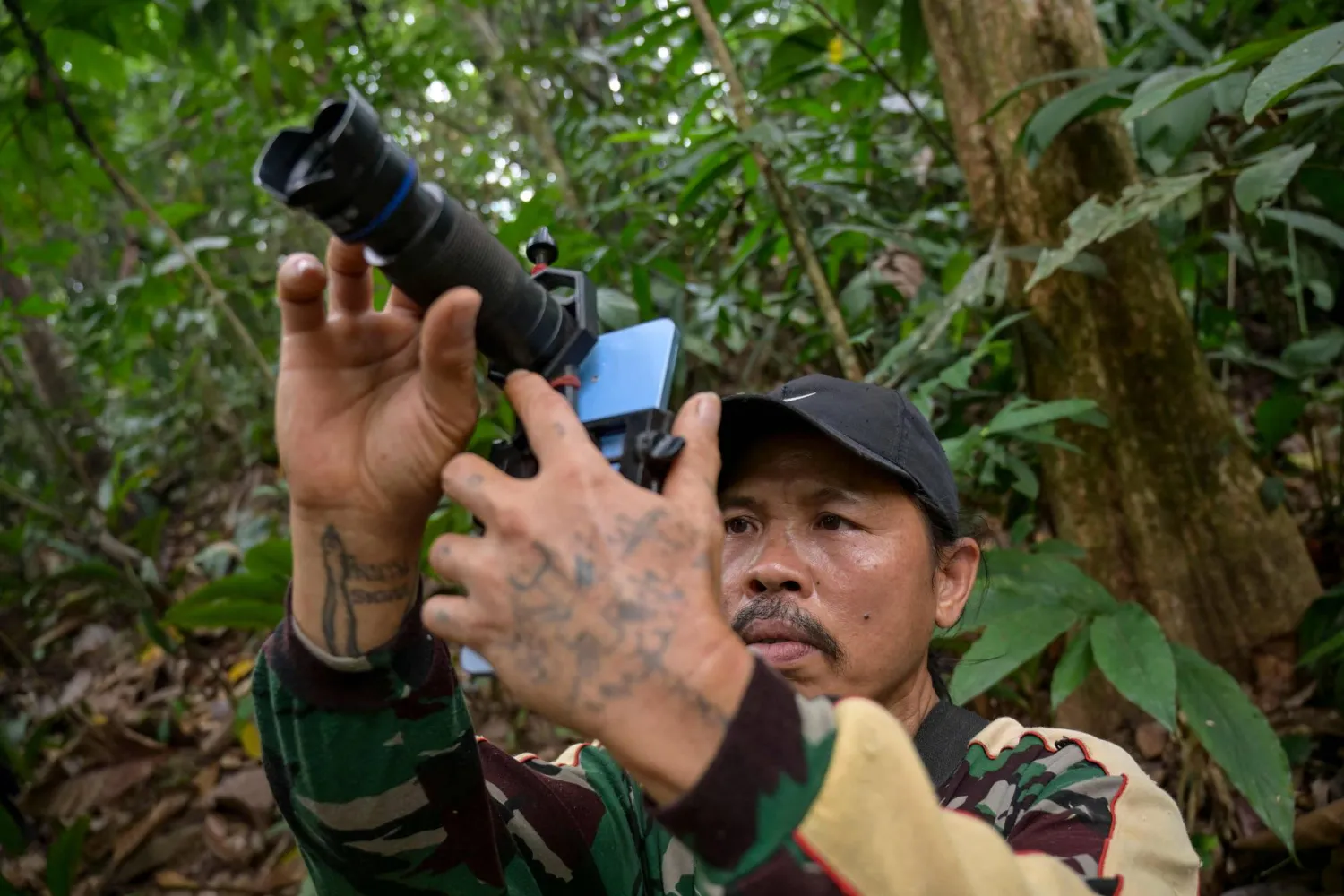
This picture taken on September 2, 2026 shows wildlife observer and former poacher Octavius using a mobile phone equipped with a telephoto lens to take pictures of wildlife in a forest near Labian village in Kapuas Hulu, West Kalimantan. (Photo by BAY ISMOYO / AFP)
TT

Indonesia Cash-for-photos Scheme Turns Animal Hunters Into Protectors

This picture taken on September 2, 2026 shows wildlife observer and former poacher Octavius using a mobile phone equipped with a telephoto lens to take pictures of wildlife in a forest near Labian village in Kapuas Hulu, West Kalimantan. (Photo by BAY ISMOYO / AFP)

Indonesian villager Octavius wades through the forest in rubber boots and tattered joggers, ears pricked, eyes peeled, a telephoto lens on his phone primed to capture orangutans, monkeys or birds.

The daily photo hunt earns Octavius and hundreds of others in Borneo cash as part of a conservation program seeking to make animals worth more alive than dead.

Locals on the island have long made money from hunting wild songbirds and selling them, mainly to domestic customers.

The KehatiKu project aims to break that cycle by paying individuals in nine participating villages in West Kalimantan province for photos or recordings of animals instead.

Payments range from 5,000 rupiah (about $0.30) for observing a common bird, to 130,000 rupiah for an endangered orangutan -- the top prize.

The most successful observers earn up to 10 million rupiah a month -- equivalent to about $570, several times an average farmworker's income.

The extra cash "really helps, especially to pay for my children's college", said 50-year-old Octavius, who like many Indonesians uses a single name.

The program, run by environmental consultancy Borneo Futures, began two years ago and produces data on wildlife distribution and population changes.

Most participants are small-scale farmers of rice, cacao, durian and the stimulant kratom.
Early signs suggest the scheme is working.

"People have started to realize that where previously they caught one bird and it was worth 50,000 rupiah, now they just need to take a photo, send it to us, and they can receive a payment of 5,000 to 10,000 rupiah," Borneo Futures Indonesia director Nardiyono told AFP.

"If they take just five photos, they (may) earn 50,000 rupiah, and the bird is still in their environment, still observable, and still able to reproduce, so the potential income from observing birds is far greater than from hunting birds."

That shifting logic has prompted two participating villages to voluntarily introduce hunting bans since the project started, added Nardiyono.

The program is funded by philanthropic foundations and has received about $300,000 to date, according to Borneo Futures.

Half has gone towards development, including a mobile app for uploading animal sightings and an AI system that helps humans verify observations.

So far, users have submitted over 350,000 observations, about half of which have been validated and paid for.

Invalid entries might include multiple observations of the same animal, or a species that is not on the program's list.

In September, Octavius and dozens of others gathered at the tiny office in Labian village -- population 683 -- for their monthly payments.

His share was four million rupiah, or nearly $230.

"This is a side-job; it doesn't interfere" with farming, he told AFP as he showed off a patch where he grows kratom and cacao.

"Sometimes when we're working, when everyone is gathered to collect kratom leaves, we hear birds calling, so we go over, observe them -- if we can take a photo, we take a photo; if not, we just make a sound recording."

The program's model is "likely better for both environmental and social impacts than an unincentivized, top-down conservation project design," said researcher Paul Ferraro of the US-based Johns Hopkins University.

The main challenge will be maintaining funding, he added.

"People may revert to their prior behavioral patterns because the incentive payments are insufficient when the enthusiasm has waned," said Ferraro, an expert in human behavior and public policy.

For now, Borneo Futures has funding secured through 2028, and two more villages will join next month.

It pays for observations of 73 species, including birds, monkeys, wild cats and deer.

Antonia Uneng says she never has to venture too far from her home in Sungai Ajung, a village of fewer than 400 people, for observations.

She bought her first fridge with her earnings, as well as a karaoke machine, complete with flashing lights and two microphones, that occupies pride of place in her living room.

The project has given women in the village a sense of independence, said the 36-year-old part-time nursing assistant, whose husband works abroad.

"I have my own income... so I am not dependent on my husband."

Imelda, a farmer in Labian, goes into the forest daily with friends to record bird sounds and, if they are lucky, orangutans.

"It makes us healthier, walking in the forest," said the 72-year-old.

In the past, some in the community considered wild boar and deer pests for damaging their gardens and crops, she said.

But now, "we really, really want to protect them".


Lula, the President Without a Cellphone, Turns to Selfies to Woo Voters

Brazilian President Luiz Inacio Lula da Silva, the Workers' Party (PT) candidate for presidential re-election attends the closing ceremony of a joint meeting of the Workers' Party (PT) caucuses in Congress, ahead of the runoff election, in Brasilia, Brazil, October 7, 2026. (Reuters)
TT

Lula, the President Without a Cellphone, Turns to Selfies to Woo Voters

Brazilian President Luiz Inacio Lula da Silva, the Workers' Party (PT) candidate for presidential re-election attends the closing ceremony of a joint meeting of the Workers' Party (PT) caucuses in Congress, ahead of the runoff election, in Brasilia, Brazil, October 7, 2026. (Reuters)

Brazil's President Luiz Inacio Lula da Silva does not own a cellphone and has long mocked the "finger-tapping generation."

However, facing a fierce battle for re-election, the 80-year-old on Wednesday recorded and shared his first selfie video on social media as part of a shake-up of his campaign to win over voters.

Lula was caught off-guard by his second-place finish behind right-wing senator Flavio Bolsonaro on Sunday, putting him on the backfoot heading into the October 25 runoff election.

"People are always bugging me. Janja gets up every day saying, 'Come on, take a selfie.' I don't like it. But today, I decided to do it," he said, referring to his wife, during a meeting with young influencers.

Lula's campaign is focusing heavily on social media ahead of the runoff, a domain typically dominated by the right in Brazil.

"Come on, folks, let's hit the streets; let's talk to people," Lula said in the video posted on Instagram and TikTok.

His rival Flavio Bolsonaro has been doing spontaneous selfie videos directly addressing his followers for months on social media.

Lula on Wednesday convened leftist influencers who won legislative seats on Sunday to advise his campaign, such as Ana Elisa Santos Silva, who, at 21, was elected the country's youngest federal deputy.

"Today, our most important campaign leaflet is the mobile phone," the influencer told reporters.

She said she had worked late into the night with the president's communications team to bring him onto social media "in a way that makes him feel comfortable."

"The far right dominates the narrative on social media," said Ana Elisa, who has nearly three million followers.

It is a tricky challenge for Lula.

"I don't use a cellphone because I need my hands to do other things," Lula insisted on Wednesday. "And I like to say only what is essential."


Nobel Prize in Chemistry Awarded to Kagan, Soai for Untangling Mirror Images in Molecules

(Bottom L-R) Heiner Linke, Chair of the Nobel Committee for Chemistry; Ellen Moons, Secretary General of the Royal Swedish Academy of Sciences; and Peter Somfai, Member of the Nobel Committee for Vhemistry, react in front of a screen displaying this year's laureates Henri Kagan of France and Kenso Soai from Japan during the announcement of the winners of the 2026 Nobel Prize in Chemistry at the Royal Swedish Academy of Sciences in Stockholm, Sweden, on October 7, 2026.  (Photo by Jonathan Nackstrand / AFP)
(Bottom L-R) Heiner Linke, Chair of the Nobel Committee for Chemistry; Ellen Moons, Secretary General of the Royal Swedish Academy of Sciences; and Peter Somfai, Member of the Nobel Committee for Vhemistry, react in front of a screen displaying this year's laureates Henri Kagan of France and Kenso Soai from Japan during the announcement of the winners of the 2026 Nobel Prize in Chemistry at the Royal Swedish Academy of Sciences in Stockholm, Sweden, on October 7, 2026. (Photo by Jonathan Nackstrand / AFP)
TT

Nobel Prize in Chemistry Awarded to Kagan, Soai for Untangling Mirror Images in Molecules

(Bottom L-R) Heiner Linke, Chair of the Nobel Committee for Chemistry; Ellen Moons, Secretary General of the Royal Swedish Academy of Sciences; and Peter Somfai, Member of the Nobel Committee for Vhemistry, react in front of a screen displaying this year's laureates Henri Kagan of France and Kenso Soai from Japan during the announcement of the winners of the 2026 Nobel Prize in Chemistry at the Royal Swedish Academy of Sciences in Stockholm, Sweden, on October 7, 2026.  (Photo by Jonathan Nackstrand / AFP)
(Bottom L-R) Heiner Linke, Chair of the Nobel Committee for Chemistry; Ellen Moons, Secretary General of the Royal Swedish Academy of Sciences; and Peter Somfai, Member of the Nobel Committee for Vhemistry, react in front of a screen displaying this year's laureates Henri Kagan of France and Kenso Soai from Japan during the announcement of the winners of the 2026 Nobel Prize in Chemistry at the Royal Swedish Academy of Sciences in Stockholm, Sweden, on October 7, 2026. (Photo by Jonathan Nackstrand / AFP)

Scientists Henri B. Kagan and Kenso Soai won the Nobel Prize in chemistry Wednesday for untangling mysterious mirror images in molecules, a discovery that has been used to develop countless drugs and transformed modern medicine.

Many molecules come in versions that look alike but are not exactly identical, like right and left hands. One mirror image of the chemical carvone smells like mint, for example, while the other has a whiff of caraway, a spice often used in rye bread.

Even life itself prefers one mirror image over the other. DNA twists to the right, and the proteins in human bodies are made of mostly left-handed building blocks, The AP news reported.

Versions of the same molecule can behave differently when interacting with other chemicals. When designing drugs to treat diseases, scientists want to be choosy about which mirror image they get. They want the version of a molecule to treat a cold, not one that will make the sniffles worse.

Kagan, who is from France, and Soai, from Japan, found ways to make chemistry pick a side, designing and manipulating reactions to produce the desired mirror image.

“This is probably the coolest experiment in organic chemistry,” said Peter Somfai, a member of the Nobel Committee for Chemistry. “Taken together, the groundbreaking discoveries by Henri Kagan and Kenso Soai have reshaped our understanding of molecular chirality,” a term that comes from the Greek word for “hand.”

The discovery enabled most modern medicines Scientists paid tribute to Kagan and Soai's work, which the Nobel committee described as a feat never previously achieved by anyone “other than life itself.”

“It might be difficult to say that this drug, or that drug, was developed using this,” Somfai said. “I would say all of them, because we use this as a tool, we use this as an understanding, how to develop catalysts, how they function.”

In the 1980s, Kagan’s work showed there might be a way to design reactions to produce one form of a molecule over the other. Years later, Soai perfected the process. He created the first-ever chemical reaction to efficiently produce only one of a molecule’s mirror images, in what’s now known as the Soai reaction.

“The medicines we have today would not be possible without this chemistry,” said Rigoberto Hernandez, president of the American Chemical Society.

Kagan, 95, is affiliated with the Université Paris-Sud in Orsay, France. Soai, 76, is affiliated with the Tokyo University of Science.

The French Academy of Sciences, of which Kagan is a member, congratulated the two scientists and expressed its pride in the prize.

Neither the Université Paris-Sud nor the Tokyo University of Science immediately responded to requests for comment from The Associated Press.

“I’m very excited to receive the very nice news,” Soai told the committee and journalists by phone. “Of course this is one of the most exciting days in my life.”

He said he was shopping near his home when he was reached by the Nobel committee.

More Nobel prizes will be awarded over the next week The Royal Swedish Academy of Sciences announced the winner in Stockholm.

Last year, three scientists won the chemistry Nobel for their development of new molecular structures that can trap vast quantities of gas inside, laying the groundwork to potentially suck greenhouse gases out of the atmosphere or harvest moisture from desert environments.

This year's prizes began with the Nobel for medicine, awarded Monday to three scientists whose work led to a tool that uses light to help unravel how the brain works. The physics award Tuesday recognized a scientist's efforts to demystify a rare group of neutrinos.

The literature prize is set to be awarded Thursday. After Friday’s peace prize is awarded, the Nobel Memorial Prize in Economic Sciences will be announced Monday.

The prize money this year is 12 million Swedish kronor (about $1.2 million), whether for an individual, a small group of laureates or an organization.


WHO Says No Obesity Drugs, Surgery for Under-10s

FILED - 06 June 2025, Saxony, Leipzig: File Photo - The weight (134.7 kilograms) of a morbidly obese woman is measured as part of the Obesity Therapy Program at Leipzig University Hospital. Photo: Jan Woitas/dpa
TT

WHO Says No Obesity Drugs, Surgery for Under-10s

FILED - 06 June 2025, Saxony, Leipzig: File Photo - The weight (134.7 kilograms) of a morbidly obese woman is measured as part of the Obesity Therapy Program at Leipzig University Hospital. Photo: Jan Woitas/dpa

Medicine and surgery are not the answer for overweight children, the World Health Organization said Wednesday.

Releasing its first guidelines addressing the sharp rise in obesity among children and adolescents, the WHO instead strongly recommended structured diets, physical activity and behavior changes.

"WHO does not recommend pharmacological treatment, bariatric surgery (surgery that changes the stomach or digestive tract) or weight-loss devices for children aged 0-9 years," AFP quoted it as saying.

"For adolescents aged 10-19 years, treatment with approved medicines may be considered only when a supervised multimodal lifestyle program has not achieved the desired results.

"Bariatric surgery may be considered under strict conditions for adolescents with severe obesity."

The recommendations for those aged 19 and under contrast with the UN health agency's guidelines for adult obesity issued in December 2025, following the surge in popularity of a new generation of appetite-suppressing drugs called GLP-1 agonists -- which includes blockbuster brands Ozempic and Mounjaro.

The WHO said the range of weight-loss and diabetes drugs could be used for tackling obesity -- in adults.

In 2024, some 70 million children aged five to nine were obese, as were 100 million adolescents aged 10 to 19 worldwide, according to the WHO.

Among 5- to 19-year-olds, the prevalence of obesity has surged globally, rising from two percent in 1990 to eight percent in 2024.

"The rise of obesity is observed everywhere in all regions," said Luz Maria De Regil, director of the WHO's nutrition and food safety department.

"It's growing in low- and middle-income countries," while some high-income countries are starting to stop the rise of obesity, without yet making reductions.

"The foundation of obesity care for children and adolescents is not medicine or surgery, but access to comprehensive support that enables healthy eating, physical activity and sustainable behavior change," she said.

The recommendations also stressed the importance of addressing mental health alongside obesity.

Anxiety, depression and low self-esteem can contribute to unhealthy eating, physical inactivity and social withdrawal, the WHO said.

Children and adolescents living with obesity may experience stigma and bullying, the UN health agency added.

Maria Nieves Garcia Casal, a scientist in the WHO's nutrition and food safety department, told reporters that bariatric surgery may be considered during adolescence for cases of severe obesity accompanied by complications such as type 2 diabetes or hypertension -- if diet and lifestyle changes have failed.
