South Korea Investigates Online Leak of President's Passport Details

South Korean President Lee Jae Myung delivers a budget speech for 2027 at the National Assembly in Seoul on November 2, 2026. Lee Jin-man / POOL/AFP
TT

South Korea Investigates Online Leak of President's Passport Details

South Korean President Lee Jae Myung delivers a budget speech for 2027 at the National Assembly in Seoul on November 2, 2026. Lee Jin-man / POOL/AFP

South Korea is investigating an online leak of passport details belonging to President Lee Jae Myung and more than 160 other officials, a government minister said on Tuesday.

Local media reported on Monday that a computer file containing personal details, including the passport numbers and dates of birth of the first couple and senior officials accompanying Lee on an overseas trip, had been uploaded to a website in June, AFP said.

The file was reportedly uploaded to VirusTotal, a malware-scanning platform, ahead of Lee's visit to Europe, and remained accessible for nearly five months.

It remains unclear who uploaded it and why.

The foreign ministry has since renewed the passports of all those affected, including Lee, and had the exposed information removed from the website, ministry spokesman Park Doo-soon said at a news briefing on Tuesday.

"The foreign ministry is now working with the National Police Agency and other agencies to determine how the information was leaked," he said.

Park said the ministry was treating the incident as a data leak rather than a hacking attack, and was examining computers and email accounts used to prepare the presidential trip.

The leak was a "serious matter that must not be taken lightly", Presidential Chief of Staff Lim Kwang-hyun told an emergency meeting on the breach, according to Lee's office.

The incident has raised "need for a thorough investigation into how the leak occurred, the extent of the information exposed and whether any actual harm had resulted", he said.


South Korea Investigates Online Leak of President's Passport Details

South Korean President Lee Jae Myung delivers a budget speech for 2027 at the National Assembly in Seoul on November 2, 2026. Lee Jin-man / POOL/AFP
TT

South Korea Investigates Online Leak of President's Passport Details

South Korean President Lee Jae Myung delivers a budget speech for 2027 at the National Assembly in Seoul on November 2, 2026. Lee Jin-man / POOL/AFP

South Korea is investigating an online leak of passport details belonging to President Lee Jae Myung and more than 160 other officials, a government minister said on Tuesday.

Local media reported on Monday that a computer file containing personal details, including the passport numbers and dates of birth of the first couple and senior officials accompanying Lee on an overseas trip, had been uploaded to a website in June, AFP said.

The file was reportedly uploaded to VirusTotal, a malware-scanning platform, ahead of Lee's visit to Europe, and remained accessible for nearly five months.

It remains unclear who uploaded it and why.

The foreign ministry has since renewed the passports of all those affected, including Lee, and had the exposed information removed from the website, ministry spokesman Park Doo-soon said at a news briefing on Tuesday.

"The foreign ministry is now working with the National Police Agency and other agencies to determine how the information was leaked," he said.

Park said the ministry was treating the incident as a data leak rather than a hacking attack, and was examining computers and email accounts used to prepare the presidential trip.

The leak was a "serious matter that must not be taken lightly", Presidential Chief of Staff Lim Kwang-hyun told an emergency meeting on the breach, according to Lee's office.

The incident has raised "need for a thorough investigation into how the leak occurred, the extent of the information exposed and whether any actual harm had resulted", he said.


UN Reports Warn of Large-Scale Damage to Earth’s Ice from Climate Change

Melting of glaciers and sea ice, the thawing of permafrost and the accelerating rise in sea levels, will have widespread repercussions, from flooding to water shortages. (AFP)
TT

UN Reports Warn of Large-Scale Damage to Earth’s Ice from Climate Change

Melting of glaciers and sea ice, the thawing of permafrost and the accelerating rise in sea levels, will have widespread repercussions, from flooding to water shortages. (AFP)

Exceeding 1.5C of global warming will have "irreversible" consequences for glaciers, sea ice and the Earth's frozen regions, two UN reports warned on Monday, calling for urgent action.

The landmark 2015 Paris Agreement commits the world to limiting warming to well below 2C and pursuing efforts to hold it at 1.5C to try to avoid the worst effects of climate change.

One of the reports said overshooting the 1.5C target "will bring large-scale and in many cases irreversible impacts" for the cryosphere -- Earth's ice in all its forms.

Melting of glaciers and sea ice, the thawing of permafrost and the accelerating rise in sea levels, will have widespread repercussions, from flooding to water shortages.

Some of the effects of the rise in temperature are already visible, such as the 20-percent loss in glacial mass in Switzerland.

But even if the 1.5C target remains relevant, it is already too high for the cryosphere, as current levels of warming were "already unsafe" for the Arctic, Antarctic, mountain glaciers and polar oceans, the UN warned.

"Although returning to 1.5 C will slow ice loss, a truly 'safe' temperature for Earth's ice is now thought to be closer to 1C or even below over the coming centuries," it added.

Global warming has already reached 1.37C above pre-industrial levels and according to the European Copernicus network, the 1.5C threshold could be exceeded around 2030.

"There are no good outcomes in exceeding 1.5C," said glaciologist James Kirkham, lead author of one of the reports, entitled "Overshoot and the Cryosphere", which was written with 80 scientists.

"To contain the global fallout and damage from ice loss in the world's polar and mountain regions, overshoot needs to be kept to the absolute minimum," he said.

"Every extra fraction of a degree and every year spent in overshoot means more devastating impacts."

- Urgency -

Scientists warn in particular about the risks of crossing certain tipping points and say that, even if temperatures were to return to below the 1.5C threshold, recovery would be very slow.

Reducing warming to under 1.5C and even 1C could see some glaciers partially regenerate, while there could also be benefits for sea ice.

But Matthew England, an oceanographer and climatologist at the University of New South Wales in Australia, said recovery could take "decades to centuries".

The second report -- "State of the Cryosphere 2026. The Cost of Overshoot" -- shows that exceeding 2.8C into the next century would have significant consequences.

Sea levels could rise by up to five centimeters a year by 2150, compared to the current 0.45 centimeters while the thawing of permafrost could release as much carbon dioxide each year as the United States, the world's second-largest polluter.

A worst-case but not-so-improbable scenario is that the world is heading towards warming of 2.6C by 2100 even if countries meet their climate commitments.

"Temporarily exceeding 1.5C does not mean that the goals of the Paris Agreement are irrelevant but instead makes them more urgent," argued Kirkham.

"Returning to 1.5C or below by 2100 remains possible with sufficient political ambition and urgency, specifically by speeding the transition away from fossil fuel use to reach net zero by mid-century," he said.

"Such urgent action can prevent and even reverse some cryosphere loss."

Gunjan Silwal, a Nepali glacier researcher, said decisions made in the next few years "will lock in the scale of the damage", warning that August's mountain and glacier collapse that killed more than 1,400 and left over 5,000 missing, was "only a foretaste".


Challenging Scientific Assumptions: Blood Remnants Found in 115-Million-Year-Old Dinosaur Bones

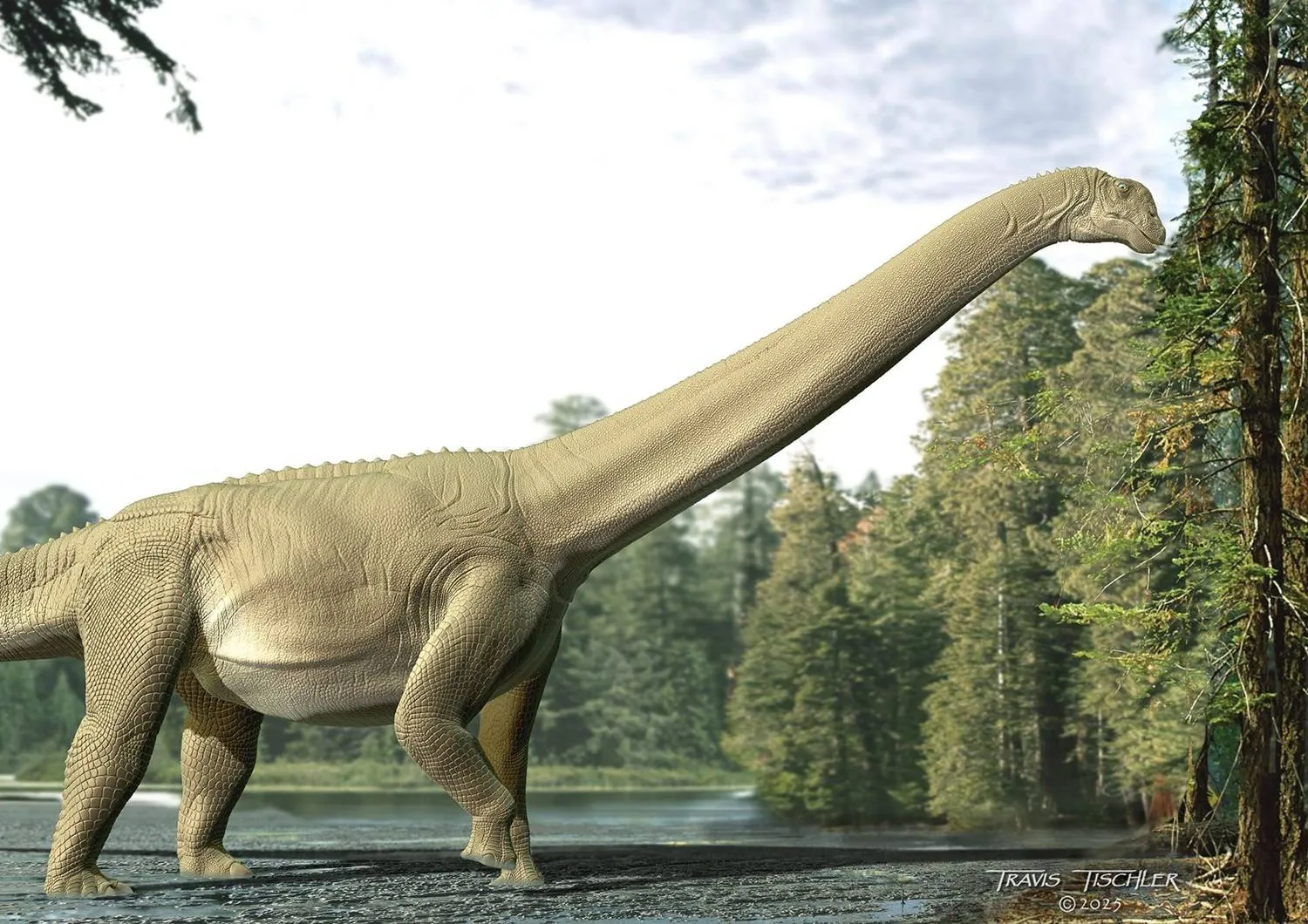
An artist's impression of a giant dinosaur (Curtin University, Australia)
TT

Challenging Scientific Assumptions: Blood Remnants Found in 115-Million-Year-Old Dinosaur Bones

An artist's impression of a giant dinosaur (Curtin University, Australia)

An international research team has discovered fossilized red blood cells, hemoglobin-derived biomolecules and amino acids from collagen protein inside the bones of a dinosaur that lived approximately 115 million years ago in Brazil. The unprecedented discovery opens new avenues for studying ancient life and challenges existing assumptions about how long fossils can preserve their biological components.

The researchers, led by Australia's Curtin University, said the remains were discovered inside the limb bones of a theropod dinosaur known as Aratasaurus museunacionali, whose fossils were found in northwestern Brazil. The findings were published Monday in the journal Proceedings of the National Academy of Sciences (PNAS).

Analyses revealed large numbers of preserved red blood cells within the bones' vascular canals. For the first time, researchers were able to establish the presence of hemoglobin-derived chemical compounds inside these cells by detecting heme, the component of hemoglobin responsible for binding and transporting oxygen.

The finding provides confirmed chemical evidence of fossilized blood remnants, unlike previous studies that identified structures resembling red blood cells in fossils but could not conclusively establish their chemical nature.

The discovery surprised researchers because the preservation of delicate biological components, such as red blood cells and hemoglobin molecules, over 115 million years challenges scientific assumptions about how long these materials can survive degradation.

The researchers described the identification of heme-derived molecules within red blood cells of such extraordinary age as a remarkable discovery and a significant milestone in paleontology.

They added that the findings not only expand the fossil record of blood remnants but also provide a direct molecular window into the physiological characteristics of extinct animals, helping scientists better understand their biology and the environments in which they lived.

The study explained that the red blood cells had been mineralized by hausmannite, a mineral that acted as a natural time capsule, helping stabilize cellular structures and biological components, including amino acids associated with collagen protein, and protecting them from degradation over millions of years.

Researchers believe this exceptional preservation resulted from the dinosaur's carcass being rapidly buried after death in a low-oxygen environment rich in microorganisms. These conditions may have helped preserve the biological components within the bones.

The researchers said the findings challenge long-standing scientific assumptions that biomolecules such as hemoglobin could not survive over extended geological timescales.

They also open new avenues for investigating the evolution of blood and metabolic processes, potentially offering insights into the activity levels of ancient animals.

According to the team, the study redefines the limits of molecular preservation across vast periods of time, even under harsh environmental conditions.

The findings may also have implications for astrobiology, potentially helping scientists develop methods to search for evidence of ancient life beyond Earth.