


US Defense Chief Tells China Talks Essential to Avoid Crisis

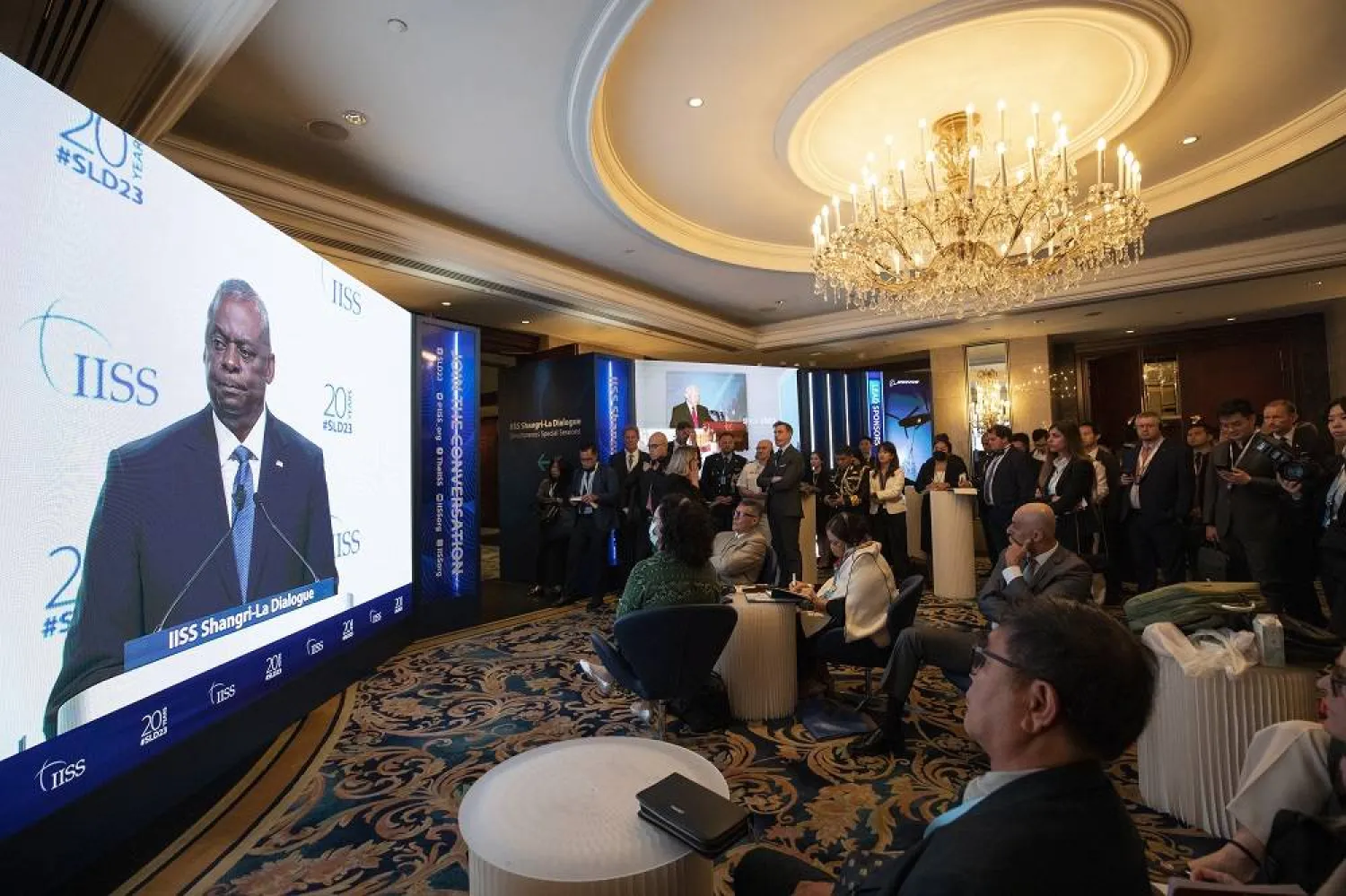
Attendees watch a livestream of US Secretary of Defense Lloyd Austin speaking during a plenary session on a screen outside the main hall during the International Institute for Strategic Studies (IISS) Shangri-La Dialogue at the Shangri-La hotel in Singapore, 03 June 2023. (EPA)
TT

US Defense Chief Tells China Talks Essential to Avoid Crisis

Attendees watch a livestream of US Secretary of Defense Lloyd Austin speaking during a plenary session on a screen outside the main hall during the International Institute for Strategic Studies (IISS) Shangri-La Dialogue at the Shangri-La hotel in Singapore, 03 June 2023. (EPA)

United States Secretary of Defense Lloyd Austin said on Saturday he was deeply concerned by China's unwillingness to engage on military crisis management, warning that talks are key to avoiding conflict.

The relationship between the United States and China is at its lowest point in decades, as they remain deeply divided over everything from the sovereignty of Taiwan to espionage and territorial disputes in the South China Sea.

Speaking at the Shangri-La Dialogue, Asia's top security summit, Austin said that open lines of communication between US and Chinese defense and military leaders were essential to avoid conflict and bolster stability in the Asia-Pacific.

"I am deeply concerned that the PRC (People's Republic of China) has been unwilling to engage more seriously on better mechanisms for crisis management between our two militaries," Austin told the meeting in Singapore.

"The more that we talk, the more that we can avoid the misunderstandings and miscalculations that could lead to crisis or conflict."

China's Minister of National Defence Li Shangfu had this week declined an invitation to meet Austin at the security summit. Li, a general who has been sanctioned by the US, delivers his own speech on Sunday.

On Friday, the two shook hands on the sidelines of the conference but did not hold detailed talks, the Pentagon said.

"A cordial handshake over dinner is no substitute for a substantive engagement," Austin said.

Dialogue between the two countries has stalled since

US Secretary of State Antony Blinken cancelled a visit to China

in February after a suspected Chinese spy balloon was tracked flying across the United States.

Liu Pengyu, spokesperson at the Chinese embassy in Washington, said on Friday in an emailed statement that communication between China and the US was conducive to a greater mutual understanding.

"However, now the US says it wants to speak to the Chinese side while seeking to suppress China through all possible means and continue imposing sanctions on Chinese officials, institutions and companies," the statement said.

China will have bilateral talks with defense chiefs from a dozen countries at the summit, Lieutenant General He Lei, former vice president of the Academy of Military Sciences, said in comments published by state-backed Chinese newspaper the Global Times on Saturday.

Taiwan tensions

One of the thorniest security issues between the two superpowers is over the future of Taiwan, a democratically governed territory which Beijing wants to bring under its rule.

There are increasing concerns that China could invade Taiwan with the US drawn into any conflict.

Austin pointed to Russia's invasion of Ukraine as an example of "how dangerous our world would become if big countries could just invade their peaceful neighbors with impunity".

He said the US was "deeply committed" to preserving the status quo in Taiwan and opposes unilateral changes from either side.

"Conflict is neither imminent nor inevitable. Deterrence is strong today and it’s our job to keep it that way," Austin said.

Chinese Senior Colonel Zhao Xiaozhuo told reporters on the sidelines of the meeting that Austin's comments risk creating confrontation in the Asia-Pacific region, including over Taiwan.

"It (US) wants instability in Taiwan so that it can bring its soldiers to Taiwan, and earn money from selling military weapons to Taiwan," said Zhao, a researcher at China's Academy of Military Sciences.

US military officials have previously said that Chinese President Xi Jinping has called on his armed forces to develop the capabilities for a possible invasion of Taiwan by 2027.

"It doesn't mean that he's made a decision to do that," Austin said in response to a question about Xi's plans.

Under President Joe Biden, the US has been strengthening its ties with allies in Asia, including Australia, Japan, India, the Philippines and Taiwan.

Beijing has criticized a deal announced by Australia in March to buy US nuclear-powered submarines.

Australia is set to spend A$368 billion ($250 billion) over three decades on the submarine program, part of a broader security pact with the US and Britain known as AUKUS.

"(AUKUS) promotes greater stability and security," Austin said.


Trump Hints at Land Strike as Venezuela Pressure Mounts

A US Air Force C-130J Super Hercules aircraft approaches for landing at Rafael Hernandez Airport, amid tensions between US President Donald Trump's administration and the government of Venezuelan President Nicolas Maduro, in Aguadilla, Puerto Rico, December 28, 2025. (Reuters)
TT

Trump Hints at Land Strike as Venezuela Pressure Mounts

A US Air Force C-130J Super Hercules aircraft approaches for landing at Rafael Hernandez Airport, amid tensions between US President Donald Trump's administration and the government of Venezuelan President Nicolas Maduro, in Aguadilla, Puerto Rico, December 28, 2025. (Reuters)

A throwaway remark last week by President Donald Trump has raised questions about whether US forces may have carried their first land strike against drug cartels in Venezuela.

Trump said the US knocked out a "big facility" for producing trafficking boats, as he was discussing his pressure campaign against Venezuelan President Nicolas Maduro in an interview broadcast Friday.

"They have a big plant or a big facility where they send, you know, where the ships come from," Trump said in an interview with billionaire supporter John Catsimatidis on the WABC radio station in New York.

"Two nights ago we knocked that out. So we hit them very hard."

Trump did not say where the facility was located or give any other details. US forces have carried out numerous strikes in both the Caribbean Sea and eastern Pacific Ocean since September, killing more than 100 people.

The Pentagon referred questions about Trump's remarks to the White House. The White House did not respond to requests for comment from AFP.

There has been no official comment from the Venezuelan government.

Trump has been saying for weeks that the United States will "soon" start carrying out land strikes targeting drug cartels in Latin America, but there have been no confirmed attacks to date.

The Trump administration has been ramping up pressure on Maduro, accusing the Venezuelan leader of running a drug cartel himself and imposing an oil tanker blockade.

Maduro has accused Washington of attempting regime change.


UN Chief Says ‘Get Serious’ in Grim New Year Message

 UN Secretary-General Antonio Guterres. (AFP)
UN Secretary-General Antonio Guterres. (AFP)
TT

UN Chief Says ‘Get Serious’ in Grim New Year Message

 UN Secretary-General Antonio Guterres. (AFP)
UN Secretary-General Antonio Guterres. (AFP)

The United Nations urged global leaders Monday to focus on people and the planet in a New Year's message depicting the world in chaos.

"As we enter the new year, the world stands at a crossroads. Chaos and uncertainty surround us. Division. Violence. Climate breakdown. And systemic violations of international law," UN Secretary-General Antonio Guterres said in a video message.

In 2026, as war rages in Ukraine and elsewhere, world leaders must work to ease human suffering and fight climate change, he added.

"I call on leaders everywhere: Get serious. Choose people and planet over pain," said Guterres, criticizing the global imbalance between military spending and financing for the poorest countries.

Military spending is up nearly 10 percent this year to $2.7 trillion, which is 13 times total world spending on development aid and equivalent to the entire gross domestic product of Africa, he said.

Wars are raging at levels unseen since World War II, he added.

"In this New Year, let's resolve to get our priorities straight. A safer world begins by investing more in fighting poverty and less in fighting wars. Peace must prevail," said Guterres, who will be serving his last year as secretary general.


Türkiye and Armenia Agree to Simplify Visa Procedures to Normalize Ties

Türkiye’s President Recep Tayyip Erdogan, right, and Armenia's Prime Minister Nikol Pashinyan shake hands before a meeting at Prague Castle in Prague, Czech Republic, Thursday, Oct. 6, 2022. (Turkish Presidency via AP, File)
TT

Türkiye and Armenia Agree to Simplify Visa Procedures to Normalize Ties

Türkiye’s President Recep Tayyip Erdogan, right, and Armenia's Prime Minister Nikol Pashinyan shake hands before a meeting at Prague Castle in Prague, Czech Republic, Thursday, Oct. 6, 2022. (Turkish Presidency via AP, File)

Türkiye and Armenia have agreed to simplify visa procedures as part of efforts to normalize ties, Türkiye’s Foreign Ministry announced Monday, making it easier for their citizens to travel between the two countries.

Relations between Türkiye and Armenia have long been strained by historic grievances and Türkiye’s alliance with Azerbaijan. The two neighboring countries have no formal diplomatic ties and their joint border has remained closed since the 1990s.

The two countries, however, agreed to work toward normalization in 2021, appointing special envoys to explore steps toward reconciliation and reopening the frontier. Those talks have progressed in parallel with efforts to ease tensions between Armenia and Azerbaijan.

Türkiye supported Azerbaijan during its 2020 conflict with Armenia for control of the Karabakh region, known internationally as Nagorno-Karabakh, a territorial dispute that had lasted nearly four decades.

The Turkish Foreign Ministry said in a statement posted on social platform X that Ankara and Yerevan agreed that holders of diplomatic, special and service passports from both countries would be able to obtain electronic visas free of charge as of Jan. 1.

“On this occasion, Türkiye and Armenia reaffirm once again their commitment to continue the normalization process between the two countries with the goal of achieving full normalization without any preconditions,” the ministry said.

Türkiye and Armenia also have a more than century-old dispute over the deaths of an estimated 1.5 million Armenians in massacres, deportations and forced marches that began in 1915 in Ottoman Türkiye. Historians widely view the event as genocide.

Türkiye denies the deaths constituted genocide, saying the toll has been inflated and those killed were victims of civil war and unrest. It has lobbied to prevent countries from officially recognizing the massacres as genocide.
