South Korean Lawmakers Berate IAEA Chief over Japanese Plans to Release Treated Fukushima Wastewater

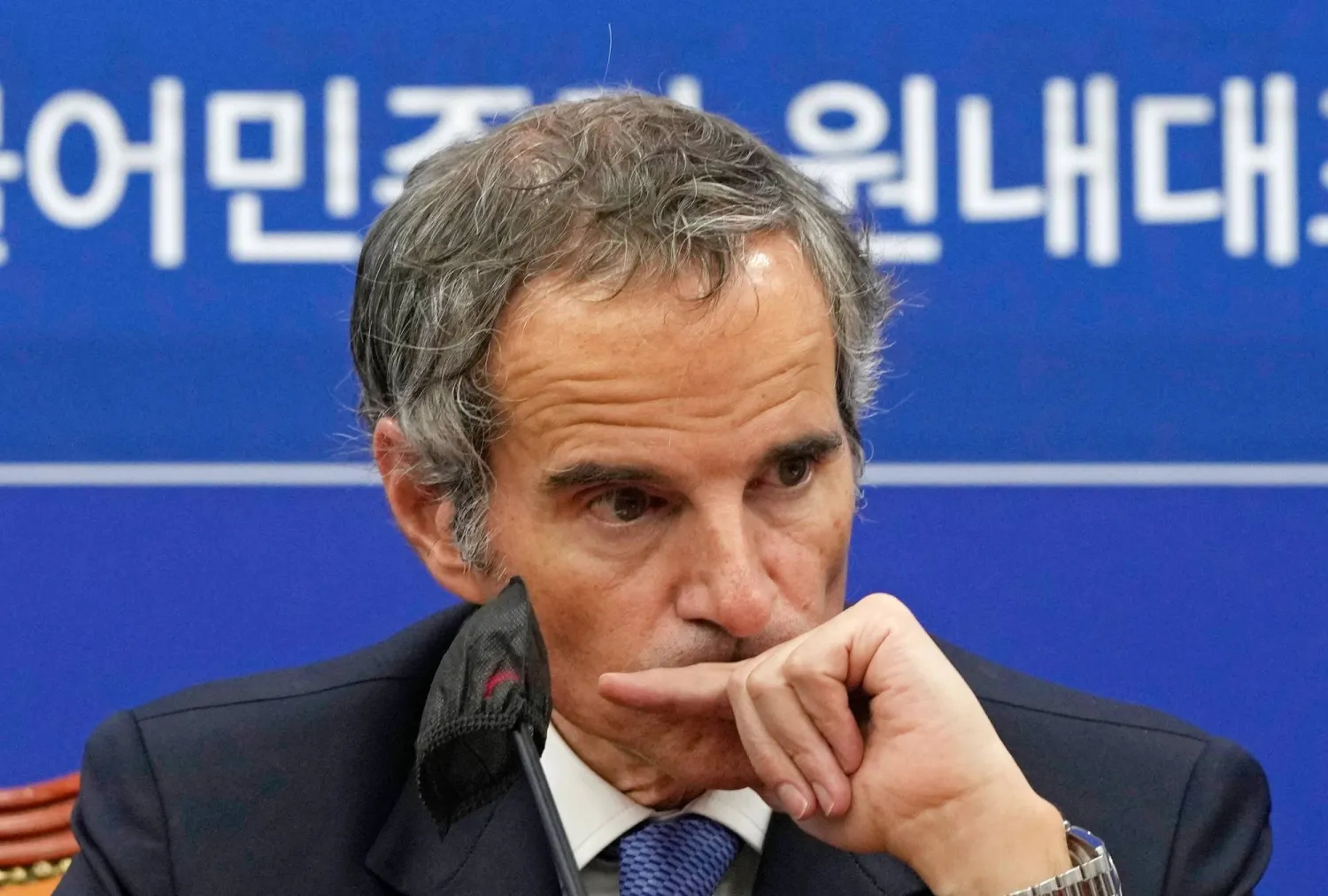
Rafael Mariano Grossi, Director General of the International Atomic Energy Agency reacts during a meeting with lawmakers from the opposition Democratic Party at the National Assembly in Seoul, South Korea, Sunday, July 9, 2023. (AP Photo/Ahn Young-joon)
TT

South Korean Lawmakers Berate IAEA Chief over Japanese Plans to Release Treated Fukushima Wastewater

Rafael Mariano Grossi, Director General of the International Atomic Energy Agency reacts during a meeting with lawmakers from the opposition Democratic Party at the National Assembly in Seoul, South Korea, Sunday, July 9, 2023. (AP Photo/Ahn Young-joon)

South Korean opposition lawmakers sharply criticized the head of the United Nations' nuclear watchdog for its approval of Japanese plans to release treated wastewater from the damaged Fukushima nuclear power plant during a tense meeting in Seoul on Sunday, with protesters screaming outside the door.
Rafael Mariano Grossi, the International Atomic Energy Agency’s director general, arrived in South Korea over the weekend to engage with government officials and critics and help reduce public concerns about food safety. The planned release of the Fukushima plant's treated wastewater emerged as a major political issue in South Korea after the IAEA last week approved the Japanese discharge plans, saying the process would meet international safety standards and pose negligible environmental and health impacts.
South Korea’s government has also endorsed the safety of the Japanese plans, saying that the contamination levels of water pumped out from the plant would be within acceptable standards and wouldn’t meaningfully affect South Korean seas as long as the plant’s treatment systems work as designed, The Associated Press said.
In his meeting with visiting members of the liberal Democratic Party, which controls a majority in South Korea's parliament, Grossi said the IAEA’s review of the Japanese plans was based on “transparent” and ”scientific" research. He acknowledged concerns over how the Japanese plans would play out in actuality and said the IAEA would establish a permanent office in Fukushima to closely monitor how the discharge process is implemented over the next three decades.
The lawmakers responded by harshly criticizing IAEA’s review, which they say neglected long-term environmental and health impacts of the wastewater release and threatens to set a bad precedent that may encourage other countries to dispose nuclear waste into sea. They called for Japan to scrap the discharge plans and work with neighboring countries to find safer ways to handle the wastewater, including a possible pursuit of long-term storage on land.
The party has also criticized the government of South Korean President Yoon Suk Yeol for putting people's health at risk while trying to improve relations with Japan.
“If you think (the treated wastewater) is safe, I wonder whether you would be willing to suggest the Japanese government use that water for drinking or for industrial and agricultural purposes, rather than dumping it in the sea,” Woo Won-shik, a Democratic Party lawmaker who attended the meeting, told Grossi. The party said Woo has been on a hunger strike for the past 14 days to protest the Japanese discharge plans.
Further details from the meeting weren’t immediately available after reporters were asked to leave following opening statements. Dozens of protesters shouted in a nearby hall while holding signs denouncing the IAEA and Japan, and they were closely watched by parliamentary security staff.
Hundreds of demonstrators had also marched in downtown Seoul on Saturday demanding that Japan scrap its discharge plans. Those protests provided a tense backdrop to a meeting between Grossi and South Korean Foreign Minister Park Jin, who called for IAEA’s “active cooperation” in reassuring the South Korean public.
The safety of Fukushima’s wastewater has been a sensitive issue for years between the US allies. South Korea and Japan have been working in recent months to repair relations long strained over wartime historical grievances to address shared concerns such as the North Korean nuclear threat and China’s assertive foreign policy.
South Korea’s assessment about the safety of the discharge plan was partially based on observations by a team of government scientists who were allowed to tour the Fukushima plant in May. Japanese Prime Minister Fumio Kishida had agreed to that visit during a May 7 summit with Yoon in Seoul, in a show of his desire for improved ties.
In a statement released by state media on Sunday, North Korea also criticized the Japanese discharge plans, warning against “fatal adverse impact on the human lives and security and ecological environment” resulting from the discharge of “nuclear-polluted water.” The statement, which was attributed to an unidentified official in North Korea’s Ministry of Land and Environment Protection, also criticized Washington and Seoul for backing the Japanese plans.
“What matters is the unreasonable behavior of IAEA actively patronizing and facilitating Japan’s projected discharge of nuclear-polluted water, which is unimaginable,” it said. “Worse still, the US and (South) Korea openly express unseemly ‘welcome’ to Japan’s discharge plan that deserves condemnation and rejection, provoking strong anger of the public.”
A massive earthquake and tsunami in 2011 destroyed the Fukushima plant’s cooling systems, causing three reactors to melt and release large amounts of radiation.
Tokyo Electric Power Company Holdings, which operates the facility, has been storing the treated water in hundreds of tanks that now cover most of the plant and are nearly full. Japanese officials say the tanks must be removed to make room to build facilities for the plant’s decommissioning and to minimize the risk of leaks in case of another major disaster. The tanks are expected to reach their capacity of 1.37 million tons in early 2024.
Japan first announced plans to discharge the treated water into the sea in 2018, saying the water will be further diluted by seawater before being released in a carefully controlled process that will take decades to complete.



Freed Gaza Flotilla Activists Allege Israeli Abuse Including Rape

 Italian members of the Global Sumud Flotilla arrive at the Fiumicino Airport in Rome on Thursday, May 21, 2026, after they were released and deported by the Israeli government after attempting to reach Gaza. (Cecilia Fabiano/LaPresse via AP)
Italian members of the Global Sumud Flotilla arrive at the Fiumicino Airport in Rome on Thursday, May 21, 2026, after they were released and deported by the Israeli government after attempting to reach Gaza. (Cecilia Fabiano/LaPresse via AP)
TT

Freed Gaza Flotilla Activists Allege Israeli Abuse Including Rape

 Italian members of the Global Sumud Flotilla arrive at the Fiumicino Airport in Rome on Thursday, May 21, 2026, after they were released and deported by the Israeli government after attempting to reach Gaza. (Cecilia Fabiano/LaPresse via AP)
Italian members of the Global Sumud Flotilla arrive at the Fiumicino Airport in Rome on Thursday, May 21, 2026, after they were released and deported by the Israeli government after attempting to reach Gaza. (Cecilia Fabiano/LaPresse via AP)

Activists released from Israeli custody after being detained on a flotilla trying to bring aid to Gaza were subjected to abuse, organizers said on Friday, with several hospitalized with injuries and at least 15 reporting sexual assaults, including rape.

Israel's prison service denied the allegations, and Reuters was not able to verify them independently.

Germany said some of its nationals had been injured and that some accusations were "serious", without giving further details. A legal source in Italy said prosecutors there were investigating possible crimes including kidnapping and sexual assault.

"The allegations raised are false and entirely without factual basis," an Israeli prison service spokesperson said in a statement.

"All prisoners and detainees are held in accordance with the law, with full regard for their basic rights and under the supervision of professional and trained prison staff," it said. "Medical care is provided according to professional medical judgment and in accordance with Ministry of Health guidelines."

The Israeli military referred queries to the foreign ministry, which referred them to the prison service.

Israeli forces arrested 430 people on board 50 ships in international waters on Tuesday to halt a flotilla of ‌volunteers trying to bring ‌aid supplies to the Gaza Strip.

The allegations of abuse will add to pressure on Israeli authorities to ‌explain the ⁠treatment of the ⁠detainees, after video of an Israeli cabinet minister in a prison mocking some of the activists sparked an international outcry. Italy said EU members were discussing imposing sanctions on the minister, Itamar Ben-Gvir.

ALLEGATIONS OF SEXUAL ABUSE

Global Sumud Flotilla, the organizers of the aid shipment, said the group had documented at least 15 cases of sexual abuse, with the worst occurring on one Israeli landing craft which had been converted into a makeshift prison with barbed wire and shipping containers.

Detainees were thrown into the containers and beaten over the head and ribs, the group said in a statement.

They suffered multiple cases of sexual abuse, including "humiliating strip searches, sexual taunting, groping and pulling of genitals, and multiple accounts of rape."

"At least 12 sexual assaults have been documented on that vessel alone, including anal rape and forcible penetration ⁠by a handgun," it added.

The statement was released after the Israeli prison service's blanket denial of mistreatment, rape and ‌sexual assault allegations. Reuters sent the additional specific allegations to the prison service but did not receive ‌a reply after hours on Friday, a holiday in Israel.

Ilaria Mancosu, an Italian activist, said the flotilla members were removed from their boats to two so-called prison ships. ‌Those put on one of the ships suffered more violence than the other. They were locked in a container and beaten by five soldiers, ‌suffering fractures to the ribs and arms. Some had serious injuries to their eyes and ears caused by tasers.

She said they spent two days on the prison ships with no running water and used cardboard and plastic to keep warm at night, since they had no blankets and were stripped of most of their clothes.

Once on land they were made to kneel for several hours and kicked and shoved if they moved or spoke. They were then taken to a prison where they were ‌moved from room to room periodically to keep them from sleeping, she said.

ROME PROSECUTORS INVESTIGATING POSSIBLE CRIMES

Rome prosecutors are investigating the possible crimes of kidnapping, torture and sexual assault and will hear testimony from activists ⁠who have returned to Italy over ⁠the coming days, the Italian legal source said.

A German Foreign Ministry spokesperson said consular officials who met German activists on their arrival in Istanbul reported that a number had injuries and were undergoing medical checks.

Humane treatment of German nationals was an "absolute priority," the spokesperson said, and "we naturally expect a full explanation, as some of the allegations that have been made are serious".

Sabrina Charik, who helped organize the return of 37 French citizens from the flotilla, told Reuters five French participants had been hospitalized in Türkiye, some with broken ribs or fractured vertebrae. Some had made detailed accusations of sexual violence, including of rape, she said.

In an Instagram post by an activist group verified by Reuters, French national Adrien Jouen showed bruises across his back and on his forearms.

Activists said some of the alleged abuse took place at sea after their interception by Israeli naval forces, and some following their arrest and imprisonment in Israel.

Spain's Foreign Minister Jose Manuel Albares told reporters that 44 Spanish flotilla members were expected to arrive on Friday on flights from Istanbul to Madrid and Barcelona. Four of them had received medical treatment for injuries, he added.

Western governments on Thursday had expressed their anger after Ben-Gvir posted a video of himself mocking activists being pinned to the ground in a prison.

Italian Foreign Minister Antonio Tajani said on the sidelines of the NATO meeting in Sweden that he was in touch with all his EU counterparts "so that there may be a quick decision to impose sanctions" on Ben-Gvir.


Ebola Risk Now at Highest Level in DR Congo, Says WHO

Medical staff wearing personal protective equipment (PPE) are seen at the hospital in Rwampara on May 21, 2026. (AFP)
TT

Ebola Risk Now at Highest Level in DR Congo, Says WHO

Medical staff wearing personal protective equipment (PPE) are seen at the hospital in Rwampara on May 21, 2026. (AFP)

The risk from the deadly Ebola outbreak has been raised to the highest level for the Democratic Republic of Congo, the World Health Organization said Friday, as the toll continues to rise.

The WHO upgraded its risk assessment level from high to very high for the DR Congo, while keeping the regional risk level at high and the global risk level at low.

WHO chief Tedros Adhanom Ghebreyesus said the situation was "deeply worrisome".

He said there were now nearly 750 suspected cases in the DR Congo and 177 suspected deaths, as health workers scramble to track down contacts of everyone thought to be infected with the virus.

"The Ebola outbreak in the Democratic Republic of the Congo is spreading rapidly," he told a press conference.

"So far, 82 cases have been confirmed in DRC, with seven confirmed deaths.

"But we know the epidemic in DRC is much larger. There are now almost 750 suspected cases and 177 suspected deaths."

He said the situation in Uganda was "stable", with two cases confirmed in people who travelled from DRC and one death.

Measures taken in Uganda, including "intense contact tracing" and calling off the Martyrs' Day commemorations, "appear to have been effective in preventing the further spread of the virus", Tedros added.

While a US national who was working in the DRC has tested positive and been transferred to Germany for care, Tedros said another US national deemed to be a high-risk contact had been transferred to the Czech Republic.

Besides national staff already in the DRC, he said 22 international staff had been deployed to the field, "including some of our most experienced people".

Tedros said that violence and insecurity was impeding the response to the outbreak in the DRC.

- Treatment trials planned -

Ebola is a deadly viral disease spread through direct contact with bodily fluids. It can cause severe bleeding and organ failure.

There are no approved vaccines or therapeutics for the Bundibugyo strain of Ebola behind the current outbreak.

There have only been two previous outbreaks of Bundibugyo, in Uganda in 2007 and DRC in 2012.

WHO chief scientist Sylvie Briand said the UN agency was making an inventory of all existing tools which might be useful in combating the outbreak and then prioritizing them, with safety and efficacy the main criteria.

The WHO research and development branch has convened its technical advisory group on treatments, which recommended the prioritization of two monoclonal antibodies for clinical trials.

It also recommended evaluating the antiviral obeldesivir in clinical trials as post-exposure prophylaxis for people who are high-risk contacts.

Briand said it looked "promising" as something that might be able to prevent infected contacts from going on to develop disease from that infection.

The WHO is also in talks with partners on developing eventual vaccines that work against Bundibugyo.


Ukraine Hits College in Russian-Occupied Town, Killing 6

22 May 2026, Ukraine, Starobelsk: Emergency workers search through the rubble of the dormitory of the Starobelsk Professional College, part of the Lugansk State Pedagogical University, which was hit and destroyed in a Ukrainian drone strike on Starobelsk. (Alexander Reka/TASS via ZUMA Press/dpa)
TT

Ukraine Hits College in Russian-Occupied Town, Killing 6

22 May 2026, Ukraine, Starobelsk: Emergency workers search through the rubble of the dormitory of the Starobelsk Professional College, part of the Lugansk State Pedagogical University, which was hit and destroyed in a Ukrainian drone strike on Starobelsk. (Alexander Reka/TASS via ZUMA Press/dpa)

Ukrainian drones struck a college dormitory in the Russian-occupied region of Lugansk early Friday, killing six people and wounding dozens of others, Russian officials said.

As many as 15 others remained missing as of Friday afternoon, Russian President Vladimir Putin said in televised comments, describing the incident as a "terrorist" attack.

Putin ordered his defense ministry to prepare a response, without elaborating.

The Lugansk region is in east Ukraine, but is almost entirely occupied by Russia, which claims it as its own.

Images released by the region's Russian-installed governor showed what appeared to be a college in the town of Starobilsk with its windows blown out, flames visible in one of them.

There was no immediate comment from Ukraine.

"Enemy drones attacked the academic building and dormitory of Starobelsk Professional College," Moscow-installed governor Leonid Pasechnik said in a post on Russia's MAX messenger, using the Russian name for the town.

"At the time of the strike, 86 children aged 14 to 18 were there," he added.

Starobilsk lies about 65 kilometers (40 miles) from the front line in east Ukraine.

Russian forces captured the town in 2022, shortly after launching their full-scale offensive.

AFP was not able to immediately verify information about the college that was hit.

- 'No leniency' -

Putin said the attack took place as the students were sleeping.

"At the moment, it is known that six people were killed, 39 were wounded and 15 people are unaccounted for, as the search through the rubble is still ongoing," he said in televised comments.

"There are no military facilities, special services, or related services near the dormitory," he added.

Russia's foreign ministry said that those responsible would face "face inevitable and severe punishment".

"There will be no leniency," it said.

Russia's Investigative Committee accused the Ukrainian military of having fired multiple drones at the building.

"As a result of the attack, the five-storey building collapsed to the second floor," it said.

Ukraine, which denies targeting civilians, regularly fires drones at Russian-controlled areas in retaliation for mass Russian strikes on its own people.

The United Nations Human Rights Monitoring Mission in Ukraine has recorded more than 60,000 civilian casualties since 2022, almost 90 percent of which were in areas controlled by Ukraine.

A massive Russian attack on Ukraine's capital Kyiv last week killed 24 people, including three children, according to Ukrainian authorities.

Russia fired more than 100 drones at Ukraine between late Thursday and early Friday, according to the Ukrainian air force.