


In Srebrenica, Thousands Gather to Remember 1995 Massacre, Bury Newly Identified Dead

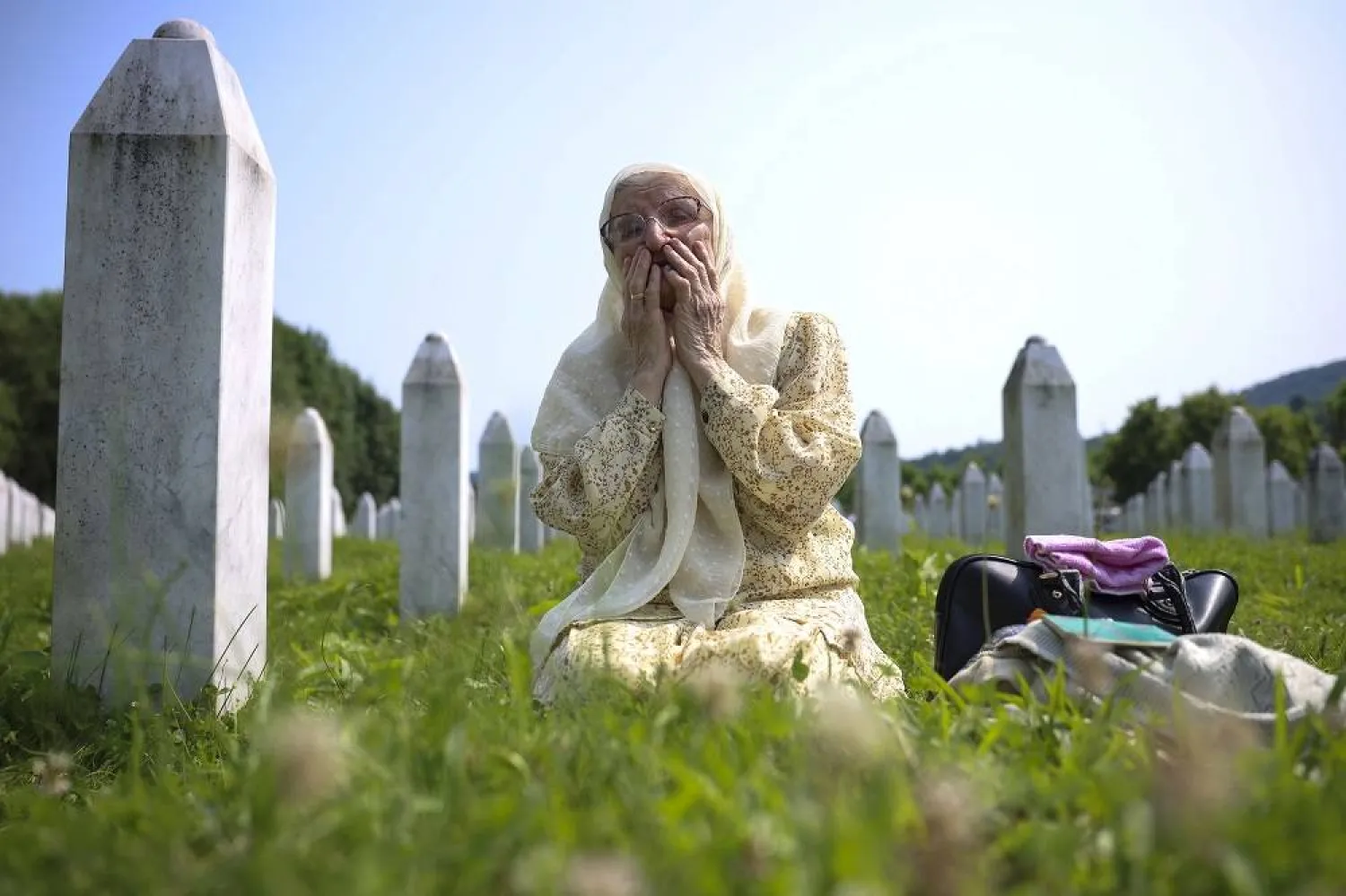
A Bosnian Muslim woman mourns next to the grave of her relative, victim of the Srebrenica genocide, in Memorial Centre in Potocari, Bosnia, Tuesday, July 11, 2023. (AP)
TT

In Srebrenica, Thousands Gather to Remember 1995 Massacre, Bury Newly Identified Dead

A Bosnian Muslim woman mourns next to the grave of her relative, victim of the Srebrenica genocide, in Memorial Centre in Potocari, Bosnia, Tuesday, July 11, 2023. (AP)

Tens of thousands of people from around Bosnia and abroad gathered in Srebrenica Tuesday for the annual ritual of commemorating the 1995 massacre and to give a dignified burial to the victims unearthed from mass graves and only recently identified through DNA analysis.

Twenty-eight years after they were murdered in Europe’s only acknowledged genocide since the Holocaust, 27 men and three teenage boys were laid to rest Tuesday at a vast and ever-expanding memorial cemetery just outside Srebrenica, in eastern Bosnia, joining more than 6,600 massacre victims already reburied there.

Relatives of the victims can bury only partial remains of their loved ones as they are typically found scattered over several different mass graves, sometimes miles (kilometers) apart. Such was the case of Mirsada Merdzic, who buried her father on Tuesday.

“Only a very few bones of his were retrieved because he had been found (in a mass grave) near the Drina River,” she said while huddling next to a casket shrouded in a green burial cloth. “Maybe the river washed him away.”

Selma Ramic reburied a handful of her father's bones several years ago, but still returns to the town for the anniversary to honor others who shared his fate.

“One photo is the only thing I have left of my father, but I have love for him in my heart,” said Ramic, adding: “He still lives in us. He will live on as long as we are alive.”

The Srebrenica killings were the bloody crescendo of Bosnia’s 1992-95 war, which came after the breakup of Yugoslavia unleashed nationalist passions and territorial ambitions that set Bosnian Serbs against the country’s two other main ethnic populations — Croats and Bosniaks.

On July 11, 1995, Bosnian Serbs overran a UN-protected safe area in Srebrenica. They separated at least 8,000 Muslim Bosniak men and boys from their wives, mothers and sisters and slaughtered them. Those who tried to escape were chased through the woods and over the mountains around the ill-fated town.

The perpetrators then plowed their victims’ bodies into hastily made mass graves, which they later dug up with bulldozers, scattering the remains among other burial sites to hide the evidence of their war crimes.

The Bosnian Serb wartime political leader Radovan Karadzic and his military commander Ratko Mladic were both convicted of genocide in Srebrenica by a special UN war crimes tribunal in The Hague. In all, the tribunal and courts in the Balkans have sentenced close to 50 Bosnian Serb wartime officials to more than 700 years in prison for the Srebrenica killings.

However, most Serbian and Bosnian Serb officials still celebrate Karadzic and Mladic as national heroes. They continue to downplay or even deny the Srebrenica killings and offend the massacre victims and survivors.

Adding to decades of insults, the Bosnian Serb mayor of Srebrenica, Mladen Grujicic, last week publicly described the Mothers of Srebrenica organization — founded by female relatives of massacre victims to demand the exhumation of mass graves and the dignified reburial of their loved ones — as “an engine of hate.”

“We are very sad and we will always be sad,” said Mevlija Sabanovic on Tuesday, after burying a cousin who was just 15 when he was killed.

“We are being humiliated constantly and that is not right. We must find a way to live together,” she added.

Since the end of the war, Srebrenica has been located in the Serb-run Bosnian entity of Republika Srpska, while many of its pre-war inhabitants live in the country’s other entity, the Bosniak-Croat Federation. The two entities — linked by shared, state-wide institutions — were created by the 1995 US-brokered Dayton peace accord that ended the Bosnian war.

Bosnian Serb leaders have never given up on the desire to separate their mini-state from the rest of the country. Stirring fears of a new conflict, in recent weeks they have stepped up their campaign by passing laws rejecting the authority in their territory of Bosnia’s multi-ethnic Constitutional Court and the top international overseer of the 1995 peace agreement, German politician Christian Schmidt.

The European Union’s top diplomat, Josep Borrell, and enlargement commissioner Oliver Varhelyi, however, used the occasion of the massacre anniversary to pledge to “defend peace and protect life” in Bosnia.

“Europe remembers its responsibility and failure to protect ... we vow to do better,” they said in a statement issued ahead of the commemoration ceremony.


Satellite Imagery Shows ‘Recent Activity’ at Iran Nuclear Facility

An inspector of the International Atomic Energy Agency sets up surveillance equipment at a uranium conversion facility in Iran in 2005. Photograph: Mehdi Ghasemi/AP
TT

Satellite Imagery Shows ‘Recent Activity’ at Iran Nuclear Facility

An inspector of the International Atomic Energy Agency sets up surveillance equipment at a uranium conversion facility in Iran in 2005. Photograph: Mehdi Ghasemi/AP

New satellite imagery shows recent activity at the Natanz nuclear facility that was damaged during June's 12-day war with Israel, according to the US-based Institute for Science and International Security (ISIS).

During the June conflict, the IAEA confirmed Israeli strikes hit Iran's Natanz underground enrichment plant.

The think tank said the satellite imagery from December 13 show panels placed on top of the remaining anti-drone structure at the Pilot Fuel Enrichment Plant (PFEP), providing cover for the damaged facility.

It suggested the new covering allows Iran to examine or retrieve materials from the rubble while limiting external observation.

The Natanz uranium enrichment facility, located some 250 km south of the Iranian capital Tehran, is one of Iran's most important and most controversial nuclear facilities in the Middle East.

Although the facility “likely held several kilograms of highly enriched uranium,” ISIS stressed that such material is “not negligible” in the broader context of Iran’s nuclear capabilities.

While PFEP shows renewed activity, ISIS said it has not observed similar signs at other major nuclear sites, including the underground Fordow facility also damaged in June by airstrikes.

Inspections
On December 15, IAEA chief Rafael Grossi has reiterated that Iran must allow inspectors access to the three key nuclear facilities that enrich uranium and were hit by the US and Israeli airstrikes last June.

Speaking to RIA Novosti, Grossi said the agency’s activities in Iran are very limited. “We are only allowed to access sites that were not hit.”

In October, the head of the UN nuclear watchdog told AP that Iran does not appear to be actively enriching uranium but that the agency has recently detected renewed movement at the country’s nuclear sites.

Grossi said that despite being unable to fully access Iranian nuclear sites, inspectors have not seen any activity via satellite to indicate that Tehran has accelerated its production of uranium enriched beyond what it had compiled before the 12-day war with Israel in June.

“However, the nuclear material enriched at 60% is still in Iran,” Grossi said in an interview at the United Nations headquarters in New York.

“And this is one of the points we are discussing because we need to go back there and to confirm that the material is there and it’s not being diverted to any other use,” he added, “This is very, very important.”

Iran’s Foreign Minister Abbas Araghchi said on December 8 that resuming the agency’s inspections is currently not possible because “there is no protocol or guideline” for inspecting facilities he described as “peaceful.”

ISIS reported on October 3 that new satellite imagery shows that Iran is ongoing construction efforts at a mountainous area just south of the Natanz enrichment site known as Kuh-e Kolang Gaz La, or Pickaxe Mountain.

On Sept. 26, The Washington Post said according to a review of satellite imagery and independent analysis, Iran has increased construction at a mysterious underground site in the months since the US and Israel pummeled its main nuclear facilities, suggesting Tehran has not entirely ceased work on its suspected weapons program and may be cautiously rebuilding.


Rubio: Venezuela Cooperates with Iran, Hezbollah

Secretary of State Marco Rubio speaks during a news conference at the State Department, Friday, Dec. 19, 2025, in Washington. (AP Photo/Julia Demaree Nikhinson)
TT

Rubio: Venezuela Cooperates with Iran, Hezbollah

Secretary of State Marco Rubio speaks during a news conference at the State Department, Friday, Dec. 19, 2025, in Washington. (AP Photo/Julia Demaree Nikhinson)

US Secretary of State Marco Rubio has accused the illegitimate regime in Venezuela of cooperating with criminals that threaten the national security of the United States.

Rubio said Friday the regime of President Nicolas Maduro openly cooperates with Iran, Hezbollah, and drug trafficking groups.

“They (Venezuela regime) operate and cooperate with terrorist organizations against the national interest of the United States, not just cooperate, but partner with and participate in activities to threaten the national interest of the United States,” he told reporters at a news conference at the State Department.

According to Rubio, Venezuela is a country that is not just an illegitimate regime that does not cooperate with the US but also a regime that openly cooperates with criminal and terrorist elements, including Hezbollah, Iran and others.

“And clearly these narco groups cooperate openly from there,” the Secretary of State said.

“We have a regime that cooperates with Iran, that cooperates with Hezbollah; that cooperates with narcotrafficking and narcoterrorist organizations, inclusive not just protecting their shipments and allowing them to operate with impunity, but also allows some of them to control territory,” he added.

Earlier, US President Donald Trump said he was leaving the possibility of war with Venezuela on the table, according to an interview with NBC News published on Friday.

“I don't rule it out, no,” he told NBC News in a phone interview.

Trump also said there would be additional seizures of oil tankers near Venezuelan waters, according to the interview. The US seized a sanctioned oil tanker off the coast of Venezuela last week.

“If they're foolish enough to be sailing along, they'll be sailing along back into one of our harbors,” he told NBC News.

On Tuesday, Trump ordered a “blockade” of all sanctioned oil tankers entering and leaving Venezuela, in Washington's latest move to increase pressure on Nicolas Maduro's government, targeting its main source of income, following which Venezuela's government said it rejected Trump's “grotesque threat.”


Iran Says it Executed Man Accused of Spying for Israel

A general view of the snow-covered mountains surrounding Tehran, Iran, 19 Dec 2025. EPA/ABEDIN TAHERKENAREH
TT

Iran Says it Executed Man Accused of Spying for Israel

A general view of the snow-covered mountains surrounding Tehran, Iran, 19 Dec 2025. EPA/ABEDIN TAHERKENAREH

Iran executed on Saturday a man convicted of spying for the Israeli intelligence and army, state media reported.

According to The Associated Press, State TV identified the executed man as Aghil Keshavarz, saying he had “close intelligence cooperation” with the Mossad and took photos of Iranian military and security areas.

Keshavarz was arrested while taking pictures of a military headquarters in the northwestern city of Urmia, some 600 kilometers northwest of the capital Tehran in May. He was accused of carrying out more than 200 similar assignments for the Mossad in various cities of Iran, including Tehran.

He was tried and given the death sentence, a ruling the Supreme Court upheld, the report said.

Keshavarz, 27, reportedly studied architecture.

Iran is known to have executed 11 people for espionage since a 12-day air war that Israel waged against Iran in June, killing nearly 1,100 people, including military commanders and nuclear scientists. In return, Iran’s missile barrage killed 28 in Israel.

In October, Iran executed an unknown person convicted of spying for Israel’s intelligence agency Mossad in the city of Qom.
