Rival Koreas Mark Armistice Anniversary in Two Different Ways that Highlight Rising Tensions

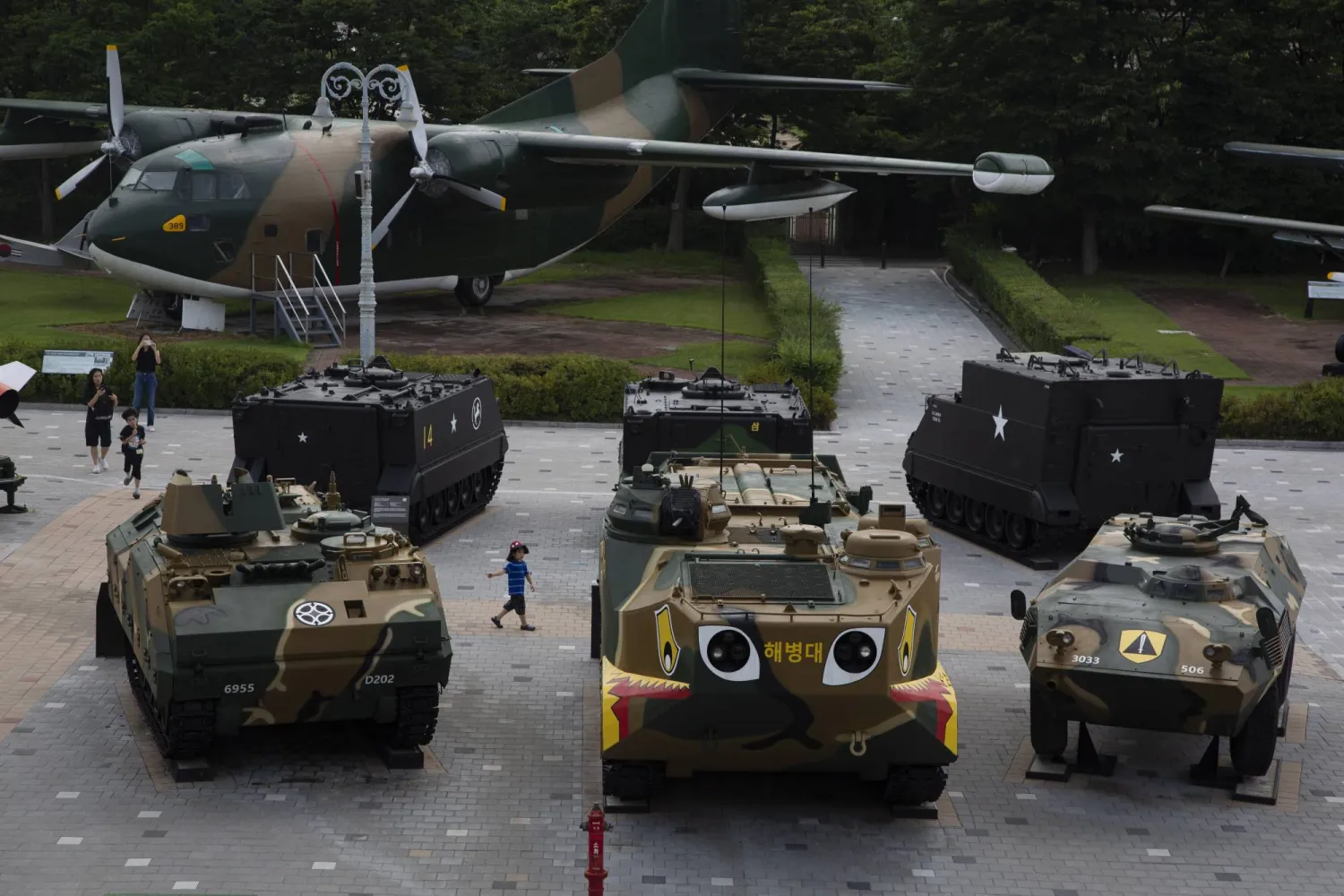
People visit the War Memorial Museum in Seoul, South Korea, 25 July 2023, ahead of the 70th anniversary of the Korean War Armistice Agreement, on 27 July 2023.  EPA/JEON HEON-KYUN
People visit the War Memorial Museum in Seoul, South Korea, 25 July 2023, ahead of the 70th anniversary of the Korean War Armistice Agreement, on 27 July 2023. EPA/JEON HEON-KYUN
TT

Rival Koreas Mark Armistice Anniversary in Two Different Ways that Highlight Rising Tensions

People visit the War Memorial Museum in Seoul, South Korea, 25 July 2023, ahead of the 70th anniversary of the Korean War Armistice Agreement, on 27 July 2023.  EPA/JEON HEON-KYUN
People visit the War Memorial Museum in Seoul, South Korea, 25 July 2023, ahead of the 70th anniversary of the Korean War Armistice Agreement, on 27 July 2023. EPA/JEON HEON-KYUN

The truce that stopped the bloodshed in the Korean War turns 70 years old on Thursday and the two Koreas are marking the anniversary in starkly different ways, underscoring their deepening nuclear tensions.
North Korea has invited delegations from China and Russia as it prepares to stage huge celebrations with thousands of citizens who have rehearsed for months to commemorate the armistice it sees as a victory in the “Grand Fatherland Liberation War.” The festivities are likely to be capped by a giant military parade in the capital, Pyongyang, where leader Kim Jong Un could showcase his most powerful, nuclear-capable missiles designed to target neighboring rivals and the US mainland.
The mood is more somber in South Korea, where President Yoon Suk Yeol has invited dozens of foreign war veterans to honor the fallen soldiers of the 1950-53 conflict, which killed and injured millions and set the stage for decades of animosity among the Koreas and the United States, The Associated Press said.
Yoon, a conservative condemned by Pyongyang as a “traitor,” will likely use this week's events to highlight the North’s growing threat and double down on his goals of strengthening the South’s defense and its alliance with the US
Tensions between the rivals are at their highest point in years, as the pace of North Korean missile tests and US-South Korean joint military exercises has intensified in a tit-for-tat cycle. The dueling military activities have been punctuated by verbal threats, including North Korean talk of preemptive nuclear strikes and US vows to “end” Kim’s regime in the event of such an attack.
The frictions provide a renewed reminder that the armistice has left the Korean Peninsula in a technical state of war. Through their 70 years of diplomatic ups and downs, the Koreas have consistently seen each other as existential threats, which is essentially why the armistice was never replaced by a peace treaty as originally intended.
Managing tensions is now more complicated than ever as Kim continues to reject dialogue with the US while aggressively expanding a nuclear arsenal he sees as his strongest guarantee of survival.
Kim is also pushing for deeper cooperation with authoritarian allies China and Russia, which are locked in their own confrontations with Washington over regional influence and the war in Ukraine, as he aims to counter US efforts to tighten trilateral security cooperation with Seoul and Tokyo.
North Korean state media on Wednesday highlighted the arrival of a Russian delegation led by Defense Minister Sergei Shoigu, who was greeted at Pyongyang’s airport by senior North Korean officials including Defense Minister Kang Sun Nam. China’s ruling Communist Party is also sending a mid-level official, Li Hongzhong, in hopes of further facilitating bilateral exchanges.
For Kim, bringing Shoigu and Li to his balcony at Pyongyang’s main square to watch a massive parade featuring goose-stepping soldiers, tanks and missiles would be the biggest accomplishment he could show to his domestic audience for the anniversary, said Park Won Gon, a professor at Seoul’s Ewha University.
Kim already displayed his most powerful missiles during a previous parade in February and there might not be meaningful new hardware to show after the North failed in its first attempt to launch a military spy satellite into orbit in May. Economic achievements have been scarce after pandemic-related border closures decimated an economy already crippled by decades of mismanagement and US-led sanctions over Kim’s nuclear ambitions.
Park said the invitations of the Chinese and Russian delegations could also reflect Kim’s unease about the strengthening security cooperation between the US and South Korea, which have included larger joint military exercises, increased deployments of strategic US military assets and new rounds of nuclear contingency planning meetings.
Thursday’s anniversary comes after North Korea conducted three separate rounds of ballistic and cruise missile firings since last week, apparently to protest the US sending major naval assets to the South in a show of force. They include the USS Kentucky, which last week became the first US nuclear-armed submarine to dock in South Korea since the 1980s.
“The strengthening of nuclear deterrence strategies between South Korea, the United States and Japan and military moves like the docking of the ballistic-missile submarine (in South Korea) are a huge burden and threat for North Korea,” Park said. “Since North Korea has limited ability to deal with these moves on its own, emphasizing cooperation with Moscow and Beijing for a combined response would be important (for Kim).”
Moscow and Beijing have already thwarted US-led efforts since last year to strengthen UN Security Council sanctions on Pyongyang over its intensified missile testing activity, underscoring a divide between the council’s permanent members deepened over Russia’s war on Ukraine.
When asked about the visits, US State Department deputy spokesperson Vedant Patel urged Beijing and Moscow to play a more constructive role in defusing tensions and to bring Pyongyang back to dialogue.
The Korean War was triggered by a North Korean sneak attack on the South. The North was backed by forces from the newly created People’s Republic of China, which was aided by the then-Soviet air force. South Korea, the US and troops from various countries under the direction of the United Nations fought to push back the invasion.
For South Koreans, the major outcome of the 1953 armistice was the subsequent signing of the US-South Korea Mutual Defense Treaty, which was mainly aimed at calming South Korean security jitters about the truce and continues to serve as the foundation for the countries’ military alliance. Facing growing nuclear threats, Yoon is now seeking stronger US assurances that it would swiftly and decisively use its nuclear weapons to defend the South in the event of a North Korean nuclear attack.
Thousands of people are expected to attend an armistice ceremony Thursday in South Korea's southern port city of Busan, which is the location of a cemetery honoring the UN soldiers killed during the war.
While there have been several skirmishes between the Koreas along their border in past years, the armistice has prevented a return to large-scale hostilities. A recent border incident involving an American soldier who bolted into the North through the truce village of Panmunjom — named after a town where the armistice was signed — has highlighted how the agreement could serve as a safety valve when relations are strained.
The US-led UN Command, which was created to fight the war and then remained in the South to supervise the armistice’s implementation, says it is using the armistice’s communications mechanisms to negotiate the release of Pvt. Travis King. It’s likely referring to the so-called pink phone, a telephone line between the command and the North Korean People’s Army at Panmunjom.
“Despite innumerable provocations, challenges, misunderstandings and even deaths that resulted since the signing of the armistice agreement, it has in general withstood the test of 70 years,” Andrew Harrison, a British lieutenant general who is the deputy commander at the UN Command, said during a news conference Monday.



Trump to Attend Ceremony to Witness Return of US Personnel Killed in Syria

US President Donald Trump speaks to the media - Reuters
TT

Trump to Attend Ceremony to Witness Return of US Personnel Killed in Syria

US President Donald Trump speaks to the media - Reuters

US President Donald Trump and first lady Melania Trump will attend a ceremony on Wednesday to honor US personnel killed in Syria over the weekend by a suspected ISIS attacker.

Trump and his wife will travel to Dover Air Force Base in Delaware to be present for what the Air Force calls the "dignified transfer" of the bodies from overseas back into the United States in the presence of their families. The ceremony is scheduled to take place at 1:15 p.m. EST (1815 GMT), Reuters reported.

Two US Army soldiers and a civilian interpreter were killed on Saturday in the central Syrian town of Palmyra by an attacker who targeted a convoy of American and Syrian forces before being shot dead, according to the U.S. military.

Trump called the incident terrible, vowed retaliation and referred to the three that were slain as "great patriots."

Three US soldiers were also wounded in the attack.

US presidents, vice presidents and dignitaries regularly attend the solemn transfer ceremonies at Dover during times of war or conflict that result in the deaths of US troops. Flag-draped transfer cases are brought off of a military plane with the bodies of the fallen and put with precision in an awaiting vehicle as officials and family members watch and often weep.


Putin Says Russia will Achieve War Goals, Keep Expanding 'Buffer Zone'

Russian President Vladimir Putin attends a meeting with Kazbek Kokov, head of the North Caucasus region of Kabardino-Balkaria, in Moscow, Russia December 16, 2025. Sputnik/Mikhail Metzel/Pool via REUTERS
TT

Putin Says Russia will Achieve War Goals, Keep Expanding 'Buffer Zone'

Russian President Vladimir Putin attends a meeting with Kazbek Kokov, head of the North Caucasus region of Kabardino-Balkaria, in Moscow, Russia December 16, 2025. Sputnik/Mikhail Metzel/Pool via REUTERS

President Vladimir Putin said on Wednesday that Russia would achieve its goals in Ukraine by diplomatic or military means, and would seek to expand a "security buffer zone" there.

"First, the goals of the special military operation will undoubtedly be achieved. We would prefer to do this and address the root causes of the conflict through diplomacy," Putin said.

"If the opposing side and their foreign patrons refuse to engage in substantive discussions, Russia will achieve the liberation of its historical lands by military means. The task of creating and expanding a security buffer zone will also be consistently addressed."

Of the regions of Ukraine that Russia has claimed as its own territory, it currently controls Crimea, around 90% of the Donbas region and 75% of Kherson and Zaporizhzhia, Reuters reported.

In addition, Russia holds some territory in the adjoining regions of Kharkiv, Sumy, Dnipropetrovsk and Mykolaiv. Putin's comments signalled that Moscow would seek further gains on some of these fronts.

With the war at a key juncture as US President Donald Trump pushes hard for a quick peace agreement, Putin said Russia was advancing on all fronts.

But his defense minister, Andrei Belousov, acknowledged that Ukrainian forces were trying to take back control of the northeastern town of Kupiansk - an effort he said was not succeeding.

Ukraine said on Wednesday it had taken 90% of the town, which Russia said it had captured in November.

Putin said people in Europe were being indoctrinated with fears of a war with Russia, and accused their leaders of whipping up hysteria.

"I have repeatedly stated: this is a lie, nonsense, pure nonsense about some imaginary Russian threat to European countries. But this is being done quite deliberately," he said.

Putin has said Russia is not seeking war with Europe, but is ready for war if that is Europe's choice.


Pakistan Says ‘Hostile Countries’ behind False Online Claims Linking it to Australia Shootings

A man waves Pakistan's flag as he along with others gather in support of Pakistan Army, day after the ceasefire announcement between India and Pakistan, in Islamabad, Pakistan, May 11, 2025. REUTERS/Akhtar Soomro
TT

Pakistan Says ‘Hostile Countries’ behind False Online Claims Linking it to Australia Shootings

A man waves Pakistan's flag as he along with others gather in support of Pakistan Army, day after the ceasefire announcement between India and Pakistan, in Islamabad, Pakistan, May 11, 2025. REUTERS/Akhtar Soomro

Pakistan’s information minister said Wednesday that his country has been the victim of a coordinated online disinformation campaign following the mass shooting at Australia’s Bondi Beach.

Attaullah Tarar accused “hostile countries,” including India, of spreading false claims that one of the two attackers was a Pakistani national.

Speaking at a news conference in Islamabad, Tara said Pakistan's leadership strongly condemned Sunday's attack, which killed 15 people in an antisemitic shooting targeting Jews celebrating Hanukkah, The AP news reported.

The minister said misleading information began circulating almost immediately after the attack, with social media posts falsely identifying one of the suspects as a Pakistani national named Naveed Akram. He said the claims spread rapidly across digital platforms and were repeated by some media outlets without verification.

Tarar said subsequent findings, including confirmation by Indian police, established that one of the attackers, Sajid Akram, was from India, while his 24-year-old son, Naveed Akram — who was also involved — was born in Australia.

The minister said the misinformation appeared to stem from a case of mistaken identity, as a Pakistani man living in Sydney shares the same name as one of the two suspects.

“How do we restore the situation to where it was before the Bondi Beach attack?” Tarar asked, adding that the Pakistani man — also named Naveed Akram — had released a video denying any involvement and urging the public not to associate him with the attack.

Tara said the Pakistani man was “a victim of a malicious and organized campaign” and that the disinformation effort originated in India.

There was no immediate response from Indian officials.

Tarar called on media outlets that published the false reports to issue apologies and said Pakistan had not yet decided whether to pursue legal action.

Pakistan and India, nuclear-armed rivals, have a long history of strained relations and have fought three wars since gaining independence from British rule in 1947, most of them over the disputed Himalayan region of Kashmir. The two sides came close to war in May before US President Donald Trump brokered a ceasefire.