Niger Says 17 of its Soldiers Killed in Ambush Near Burkina Faso Border 

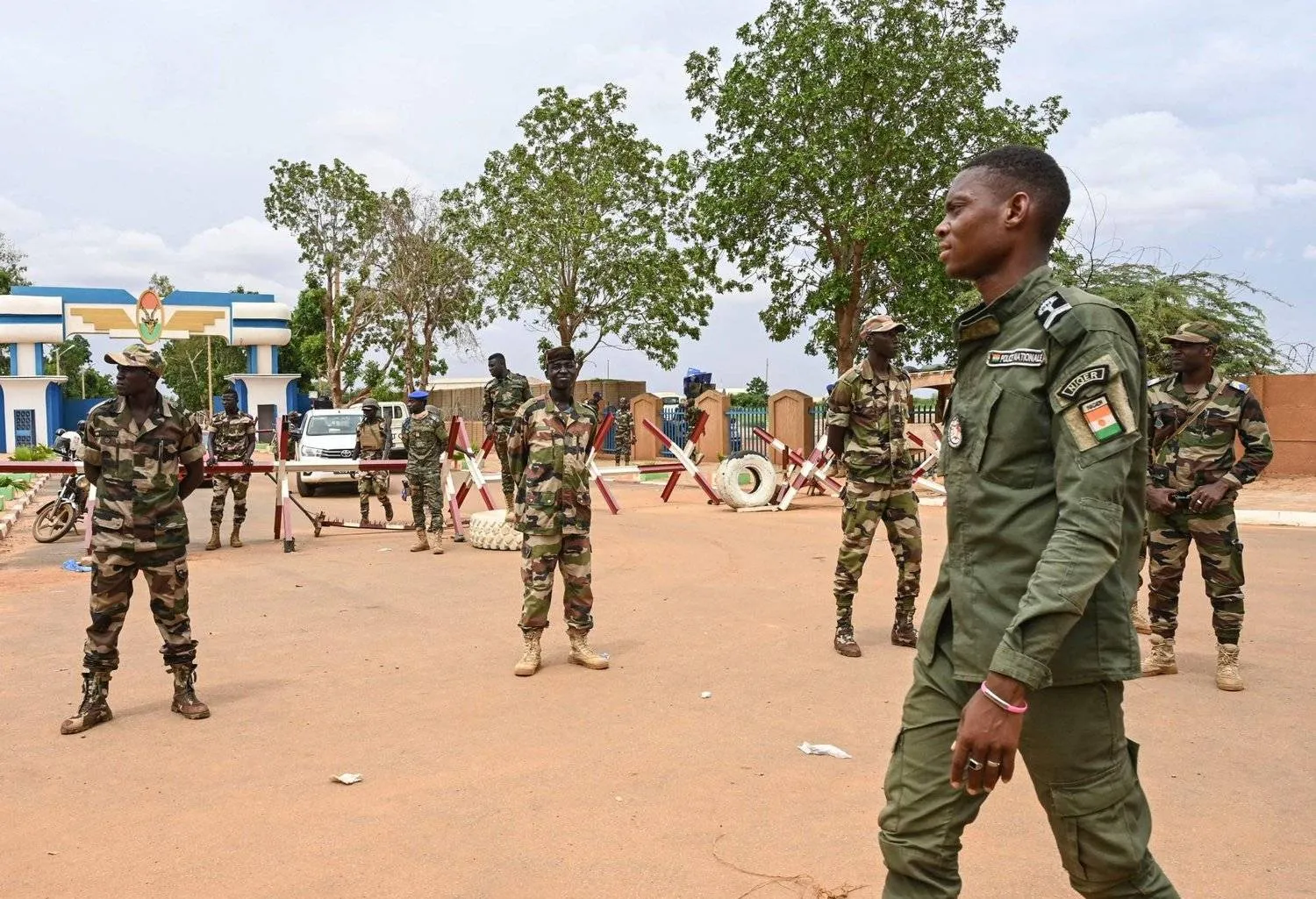
Nigerien soldiers are seen in Niamey during pro-coup rallies. (AFP file photo)
TT

Niger Says 17 of its Soldiers Killed in Ambush Near Burkina Faso Border 

Nigerien soldiers are seen in Niamey during pro-coup rallies. (AFP file photo)

Niger's defense ministry said that 17 of its soldiers had been killed in an ambush on Tuesday in a southwest region bordering Burkina Faso.

Attacks in Niger have been falling since 2021 but security remains a major problem, especially in the southwest near the border with neighboring Mali.

On the Malian side, the departure of French troops last year left a security vacuum that groups linked to ISIS and Al-Qaeda have expanded into.

A detachment of Niger's army was attacked in an ambush next to Torodi commune, the defense ministry said in a statement. It added that more than a hundred "terrorists" were neutralized.

"The swift reaction of the soldiers and the air-land response at the scene of the skirmish enabled the enemy to be dealt with," the statement said.


Turkish-Owned Ship Allowed to Pass Through Strait of Hormuz, Minister Says

A man walks along the shore as oil tankers and cargo ships line up in the Strait of Hormuz, seen from Khor Fakkan, United Arab Emirates, Wednesday, March 11, 2026. (AP)
TT

Turkish-Owned Ship Allowed to Pass Through Strait of Hormuz, Minister Says

A man walks along the shore as oil tankers and cargo ships line up in the Strait of Hormuz, seen from Khor Fakkan, United Arab Emirates, Wednesday, March 11, 2026. (AP)

A Turkish-owned ship that had been waiting near Iran was allowed to pass through the Strait of Hormuz after authorities received permission from Tehran, Turkish Transport Minister Abdulkadir ‌Uraloglu was reported ‌as saying by ‌local ⁠media.

Ankara was continuing ⁠contacts with Iranian officials regarding the situation of the remaining 14 Turkish-owned vessels there, Uraloglu told reporters ⁠late on Thursday, ‌news website ‌Haberturk said.

"Fifteen ships (with Turkish ‌owners) were there; we ‌obtained permission from the Iranian authorities for one of them, which had used ‌an Iranian port, and it passed," Uraloglu ⁠was ⁠quoted as saying.

The US-Israeli war on Iran has effectively shut the Strait of Hormuz, leaving tankers and other ships stranded, which has stoked concerns about global energy supply.


US Wants to 'Divide Europe', EU's Kallas Tells FT

European Union foreign policy chief Kaja Kallas arrives for a meeting of EU foreign ministers and representatives of the Gulf Cooperation Council at the European Council building in Brussels, Belgium, Thursday, March 5, 2026. (AP Photo/Virginia Mayo)
TT

US Wants to 'Divide Europe', EU's Kallas Tells FT

European Union foreign policy chief Kaja Kallas arrives for a meeting of EU foreign ministers and representatives of the Gulf Cooperation Council at the European Council building in Brussels, Belgium, Thursday, March 5, 2026. (AP Photo/Virginia Mayo)

European Union foreign policy chief Kaja Kallas said the US wants to "divide Europe" and doesn't "like the European Union" in an interview published by the Financial Times on Friday, after more than a year of turmoil in transatlantic relations.

"What I think is actually important for everybody to understand is that the US has been very clear that they ‌want to divide ‌Europe. They don't like the ‌European ⁠Union," Kallas told the ⁠FT.

US President Donald Trump has repeatedly targeted the European Union in his second term, imposing tariffs on member countries and others and talking about annexing Greenland - a move that could effectively end the NATO alliance.

This week, Trump's administration ⁠launched trade investigations into the EU and ‌other countries, including ‌China, India, Japan, South Korea and Mexico, over what ‌it said were unfair trade practices. Under the ‌investigation, the countries could face new tariffs by this summer, after the US Supreme Court tore down much of Trump's tariff program last month.

Kallas said ‌the United States' approach to the EU echoed tactics used by the bloc's ⁠adversaries, ⁠according to the FT.

EU countries should not be looking to deal with Trump bilaterally, she said, and instead should deal with him together, "because we are equal powers when we are together," the FT reported.

On defense, however, Kallas said the bloc needed "to buy from America because we don't have the assets or the possibilities or the capabilities that we need," adding that Europe needed to invest in its own defense industry.


Israelis Demand Netanyahu Clarify War’s Exit Strategy

Israelis take shelter in a subway station as sirens warn of incoming Iranian missiles over Tel Aviv on March 7 (AP)
TT

Israelis Demand Netanyahu Clarify War’s Exit Strategy

Israelis take shelter in a subway station as sirens warn of incoming Iranian missiles over Tel Aviv on March 7 (AP)

Growing public unease in Israel over the war with Iran has prompted mounting calls for Prime Minister Benjamin Netanyahu to clarify the conflict’s objectives and trajectory.

The demands follow conflicting statements about when the war might end, coupled with Netanyahu’s continued refusal to answer questions from the press. Instead, the prime minister has released daily video statements as the conflict entered its 13th day. Government ministers have also reportedly been instructed not to speak with journalists.

Media outlets sharply criticized the government on Thursday, arguing that the public is being left in the dark about the war’s goals or its possible duration.

Some commentators say both Netanyahu and US President Donald Trump entered the conflict without a clear exit strategy. Trump has suggested that the war’s objectives have largely been achieved, while Netanyahu has said the fighting will continue “as long as necessary,” without specifying a timeline.

Tensions ran high overnight Wednesday after rumors spread of a major coordinated missile attack by Iran and Hezbollah. Israeli journalists who investigated the reports found that the information appeared credible. However, attempts to publish the story were blocked by Israel’s military censor.

Reporters initially assumed the censorship was intended to protect intelligence sources. But within an hour, the same information appeared on the American network CNN, citing security sources in Tel Aviv, prompting anger among Israeli journalists.

As rumors circulated, fear among residents quickly escalated into panic, with some people rushing to shelters even though no air-raid sirens had sounded.

The incident triggered sharp criticism of the military censor in Israeli media. Journalists and analysts accused authorities of withholding critical information from the public.

Nitzan Shapira, a correspondent for Channel 12 whose report was blocked, said the decision deprived citizens of the opportunity to prepare calmly for incoming missiles.

“Instead of Israeli citizens receiving timely information that would allow them to move to shelters in an orderly way, the censor intervened and withheld the information until people heard it from foreign sources,” he said. “This is an absurd situation.”

A military commentator on the right-leaning Channel 14 went further, accusing the army of weakness. He argued that intelligence warnings about a potential wave of Hezbollah rocket fire should have prompted stronger military action, including strikes on Hezbollah strongholds in southern Beirut.

Meanwhile, Israeli social media circulated statements attributed to Iran’s Revolutionary Guard Corps claiming Tehran could launch large-scale attacks using Kheibar, Qader, and Khorramshahr missiles capable of striking wide-ranging areas for hours.

Israeli military officials said they had no evidence that simultaneous activity from Iran and Lebanon was part of a coordinated campaign. Still, the possibility of attacks on two fronts heightened public concern.

Local leaders in Israel’s northern Galilee region, returning from a meeting with Home Front Command, urged residents to remain close to shelters and maintain heightened readiness.

There has also been growing unease along Israel’s northern border. Since Hezbollah joined the conflict, it has carried out repeated rocket attacks. Although fewer in number than earlier barrages before the last ceasefire, some reportedly included precision missiles with ranges of up to 165 kilometers.

Yet, Israeli army spokesman Effie Defrin sought to calm the public, saying the military was aware of concerns about a possible escalation.

“There is no change in the protective guidelines issued by the Home Front Command,” Defrin said, urging Israelis to follow civil defense instructions.

In Israeli media, Defrin has become the main official voice addressing the public, while many journalists say they remain constrained by censorship.

Some now openly question whether such restrictions are appropriate for what they describe as a Western democracy in 2026.