


IAEA Monitors Iran's 60% Uranium Enrichment Reduction

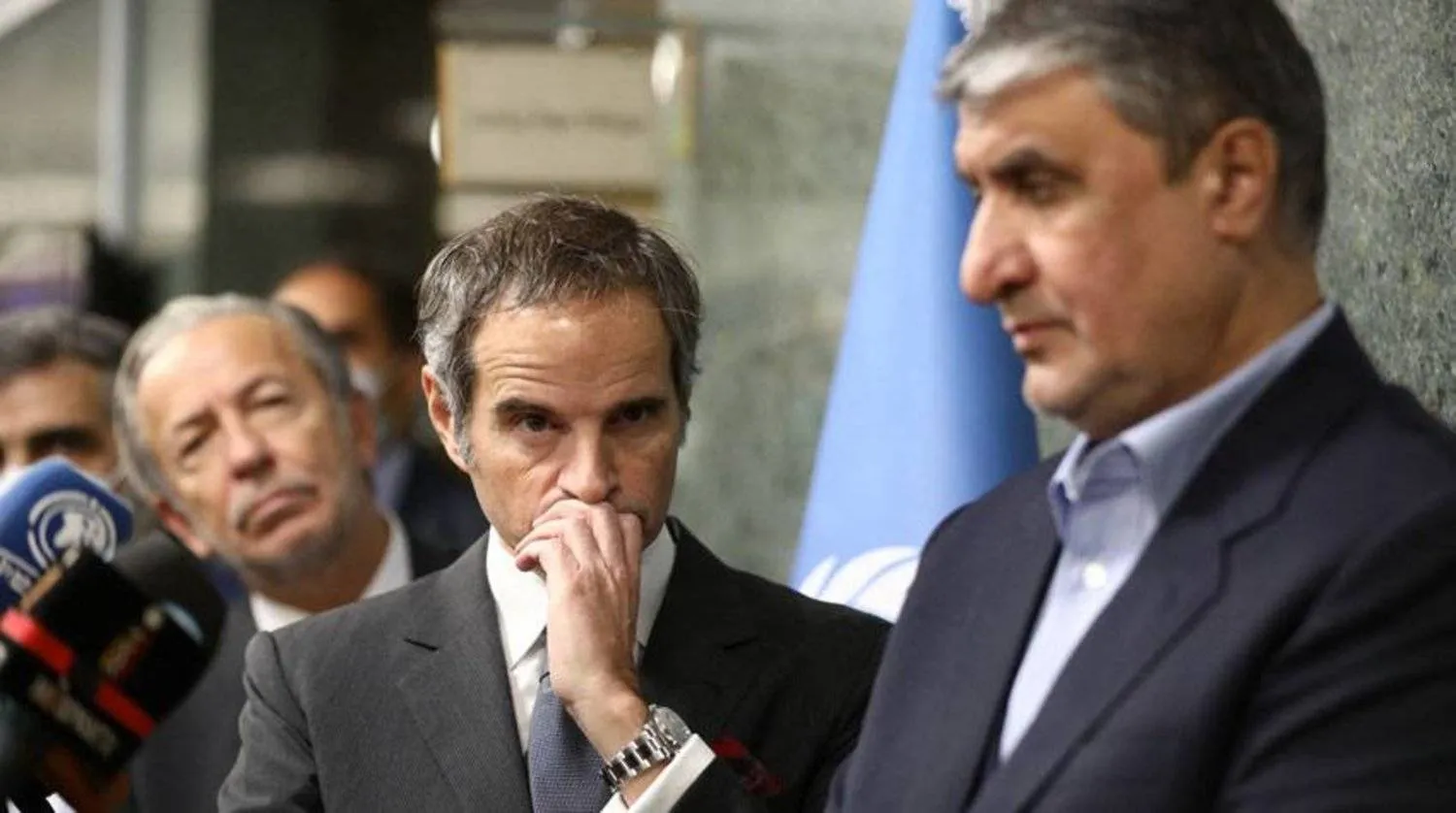
Director of the International Atomic Energy Agency (IAEA), Rafael Grossi, and head of the Iranian Atomic Energy Organization, Mohammad Eslami (File photo: Reuters)
TT

IAEA Monitors Iran's 60% Uranium Enrichment Reduction

Director of the International Atomic Energy Agency (IAEA), Rafael Grossi, and head of the Iranian Atomic Energy Organization, Mohammad Eslami (File photo: Reuters)

International Atomic Energy Agency (IAEA) inspectors are monitoring Iran as it is slowing the rate at which it's stockpiling near weapons-grade uranium, according to Bloomberg.

The step comes in reducing tensions between Washington and Tehran after they reached an informal understanding that includes a deal to release prisoners and increase the flow of Iranian oil to global markets in exchange for releasing Iran's frozen assets.

IAEA director Rafael Grossi is preparing to publish his quarterly report on Iran's safeguards before the board meeting on Sept. 11 in Vienna.

Bloomberg said that some nuclear officials expect the IAEA's quarterly report to show Iran reducing its uranium enrichment production by 60 percent.

Tehran and the major powers participating in the 2015 nuclear agreement entered a diplomatic path to revive the deal in April 2021.

Tehran began enriching uranium by 60 percent in response to the 2021 attack on the largest nuclear fuel station at Natanz, for which Israel held responsibility.

Earlier this month, Iran said that informal contacts could eventually lead to the resumption of nuclear talks. It has modulated uranium output to signal diplomatic readiness in the past.

US officials secretly admitted that they had already begun to ease the application of sanctions on Iranian oil sales, allowing Tehran to restore production to the highest level since the restrictions kicked in five years ago.

With the world's No. 4 oil reserves, Iran has been shipping the most crude to China in a decade, and government officials say they're confident output will only grow.

Meanwhile, Reuters quoted consultants and companies that track tanker shipments saying that Iran's oil output and exports jumped in August despite US sanctions, as Tehran sells to buyers including China.

Analysts said the higher exports result from Iran's success in evading US sanctions and Washington's discretion in enforcing them as the two countries seek better relations.

The United States has sought to limit Iran's oil exports since Donald Trump exited a 2015 nuclear accord in 2018 and re-imposed sanctions aimed at curbing revenues to Iran's government.

According to the industry trackers, exports have risen during President Joe Biden's term, with China a top buyer.

SVB International, a consultant, estimates Iran's oil production increased in August to 3.15 million barrels per day (bpd), the highest since 2018, with crude oil and condensate exports at just under 2 million bpd.

Sarah Vakhshouri, from the company, said that Iran is on the path to recover its pre-sanctions oil production.

Three other trackers contacted by Reuters had similar estimates.

The United States is in talks with Iran over a potential agreement in which Iran would release five US citizens and $6 billion in Iranian funds in South Korea would be unfrozen.

White House National Security Adviser Jake Sullivan has declined to offer a timeline on a deal.

Analysts said Iran has for years evaded oil sanctions through ship-to-ship transfers and "spoofing," or manipulating GPS transponders so that ships show up in different positions. Tehran is only getting better at those tactics.

According to figures from the Organization of the Petroleum Exporting Countries (OPEC), of which Iran is a member, a production rate of 3.15 million bpd would be the highest figure for Iran since 2018.

TankerTrackers.com, which assesses oil shipments, estimates Iran's crude and condensate exports averaged 1.92 million bpd in the first 27 days of August, of which the crude portion was 1.77 million bpd, in figures provided to Reuters.

According to the company's figures, the August oil exports would be the highest monthly rate this year.

Another tanker-tracking firm that declined to be named said August crude exports exceeded 1.5 million bpd.

Kpler, a flow data provider, expects August crude exports to average about 1.2 million bpd, down from a 2018 high of 1.54 million bpd in May. The company often revises up its figures.

Iran has said it expects higher supply in the near term. State media quoted Iran's oil minister as saying crude output will reach 3.4 million bpd by the end of September.

The rise from Iran comes as OPEC+, which includes OPEC, Russia, and others, is cutting output to support the oil market, where expectations that economic weakness will dent demand have weighed on prices.



Why Japan Issued an Advisory for a Possible Megaquake in the Country’s North 

A car is stranded on a collapsed road in Tohoku, Aomori prefecture, northeastern Japan, 09 December 2025. (EPA/Jiji Press)
TT

Why Japan Issued an Advisory for a Possible Megaquake in the Country’s North 

A car is stranded on a collapsed road in Tohoku, Aomori prefecture, northeastern Japan, 09 December 2025. (EPA/Jiji Press)

Japan issued a megaquake advisory Tuesday after a magnitude 7.5 earthquake struck off the eastern coast of Aomori, the northernmost prefecture of Japan's main island of Honshu, and just south of the northern island of Hokkaido. Damage from this quake was modest — 34 mostly mild injuries and some damage to roads and buildings.

Officials said the advisory is not a prediction and the probability of a magnitude 8 or larger quake is only about 1%. But there’s hope the advisory will serve as a wake-up call for a quake that could have the devastation of the 2011 disaster that killed nearly 20,000 people and destroyed a nuclear plant.

There's said to be an increased risk of a subsequent, magnitude-8 or larger quake within the next week. Officials are urging residents, especially along coastal areas, to be well prepared so they can grab an emergency bag and run as soon as possible if a bigger quake hits.

This advisory seemed mindful compared with another advisory last year. The southern half of Japan's Pacific coastline received a "Nankai Trough" megaquake advisory in the summer of 2024, but the ambiguity of that warning led to panic buying of emergency food, event cancellations and business closures.

A megaquake advisory for Japan's northeastern coast

The Japan Meteorological Agency says Monday's powerful quake temporarily increased potential risks in the regions of Hokkaido and the Sanriku coast. That's where the Pacific Plate beneath Japan forms the two trenches — the Japan Trench and Chishima Trench — that have caused many large quakes in the past.

Experts say the deadly quake and tsunami in 2011 was caused by movement associated with the Japan Trench. It spans from off the eastern coast of Chiba to Aomori, and the Chishima Trench goes from the eastern coast of Hokkaido to the northern islands and the Kurils.

In explaining the advisory, the JMA said the magnitude 9.0 quake on March 11, 2011, that devastated large swaths of Japan's northern coast occurred two days after a magnitude 7.3 temblor that occurred at the Japan Trench off the eastern coast of Iwate, one of the hardest-hit areas in that disaster as well as in Monday's quake.

The 2011 quake caused a tsunami that battered northern coastal towns in Iwate, Miyagi and Fukushima prefectures. The tsunami, which topped 15 meters (50 feet) in some areas, slammed into and destroyed the Fukushima Daiichi nuclear power plant. That created deep fears of radiation that linger to this day.

A megaquake could cause a 98-foot tsunami and kill nearly 200,000

Another offshore megaquake in the Hokkaido-Sanriku area could cause up to a 30-meter (98-foot) tsunami in the region, kill as many as 199,000 people, destroy up to 220,000 houses and buildings, and cause estimated economic damages of up to 31 trillion yen ($198 billion), according to an estimate by the government. It says as many as 42,000 people could suffer from hypothermia in the winter.

The areas covered by the advisory extend across 182 municipalities from Hokkaido to Chiba prefecture.

Japan's separate advisory for an even more damaging megaquake stemming from the Nankai Trough, which affects the southern half of Japan's Pacific coast, was activated for the first time last August after a magnitude 7.1 quake occurred off the eastern coast of Miyazaki.

In a 2013 damage estimate for a possible Nankai Trough megaquake, the government said a magnitude 9.1 quake could generate a tsunami exceeding 10 meters (33 feet) within minutes, killing as many as 323,000 people, destroying more than 2 million buildings and causing economic damage exceeding 200 trillion yen ($1.28 trillion) in the region.

Officials call on people to be calm and prepared

Officials are stressing that the latest advisory has no prediction for any megaquake happening at any specific time or location, a Cabinet official for disaster prevention, Tsukasa Morikubo, told a news conference early Tuesday. He called on residents to be cautious and prepared while continuing their daily activity and work.

Officials urge people to keep an emergency bag containing a few days' worth of daily necessities along with shoes and helmets. People in the region are also advised to discuss evacuation procedures with family members and sleep in day clothes, not in pajamas, so they can flee immediately. Furniture should also be fixed to the floor or the wall.

The designated municipalities explained the advisory on their websites and started inspecting stocks of relief goods and equipment to be used at evacuation centers.

Iwaki City in Fukushima urged residents to register for emergency emails, while officials in the town of Oarai in Ibaraki prefecture, northeast of Tokyo, inspected wireless communication devices.

Japan's first megaquake advisory in August of last year contained a lot of scientific jargon. It worried and baffled many across the country. Some towns closed beaches and canceled annual events, disappointing many travelers during local holidays.

Many people postponed planned trips and rushed to stock up on rice, dried noodles, bottled water and portable toilets, leaving shelves empty at many supermarkets in western Japan and even Tokyo, which is outside of the at-risk area.


Bolivia and Israel Restore Ties Severed Over War in Gaza 

An Israeli soldier walks past a military vehicle and rubble in Rafah in the southern Gaza Strip, December 8, 2025. (Reuters)
TT

Bolivia and Israel Restore Ties Severed Over War in Gaza 

An Israeli soldier walks past a military vehicle and rubble in Rafah in the southern Gaza Strip, December 8, 2025. (Reuters)

Bolivia's new right-wing government said Tuesday that it restored diplomatic relations with Israel, the latest sign of the dramatic geopolitical realignment underway in the South American country that was once among the most vocal critics of Israeli policies toward Palestinians.

Bolivian Foreign Minister Fernando Aramayo met his Israeli counterpart Gideon Saar in Washington and signed a declaration agreeing to revive bilateral ties, which Bolivia's previous left-wing government severed two years ago over Israel's devastating campaign against Hamas in Gaza.

Bolivia's ministry said the two countries would reinstate ambassadors in the near future and dispatch officials on visits.

As part of a new foreign policy strategy under conservative President Rodrigo Paz, the rapprochement "represents a return to trust, intelligent cooperation and the ties that have always existed, but which are now being revitalized with a modern perspective," the ministry said in a statement after the meeting late Tuesday.

Aramayo, as well as Bolivian Economy Minister José Gabriel Espinoza, launched this week into a whirlwind of meetings with American officials as their government works to warm long-chilly relations with the United States and unravel nearly two decades of hard-line, anti-Western policies under the Movement Toward Socialism, or MAS, party that left Bolivia economically isolated and diplomatically allied with China, Russia and Venezuela.

Paz's government eased visa restrictions on American and Israeli travelers last week.

In announcing his meeting with Aramayo on Monday, Israeli Foreign Minister Saar thanked Bolivia for scrapping Israeli visa controls and said he spoke to Paz after the center-right senator's Oct. 19 election victory to express "Israel’s desire to open a new chapter" in relations with Bolivia.

Paz entered office last month, ending the dominance of the MAS party founded by Evo Morales, the charismatic former coca-growing union leader who became Bolivia's first Indigenous president in 2006. Not long after taking power, Morales sent Israel's ambassador packing and cozied up to Iran over their shared enmity toward the US and Israel.

When protests over Morales' disputed 2019 reelection prompted him to resign under pressure from the military, a right-wing interim government took over and restored full diplomatic relations with the US and Israel as it sought to undo many of Morales’ popular policies.

But 2020 elections brought the MAS party back to power with the presidency of Luis Arce, who in 2023 once again cut ties with Israel in protest over its military actions in Gaza.

Other left-wing Latin American countries, like Chile and Colombia, soon made similar moves, recalling their ambassadors and joining South Africa’s genocide case against Israel before the United Nations’ highest judicial body.


Florida Governor Designates CAIR, Muslim Brotherhood as Terrorist Organizations 

Florida Governor Ron DeSantis speaks about Hurricane Helene as Adjutant General of Florida Major General John Haas looks on during a press briefing at the Emergency Operations Center in Tallahassee, Florida, US, September 26, 2024. (Reuters)
TT

Florida Governor Designates CAIR, Muslim Brotherhood as Terrorist Organizations 

Florida Governor Ron DeSantis speaks about Hurricane Helene as Adjutant General of Florida Major General John Haas looks on during a press briefing at the Emergency Operations Center in Tallahassee, Florida, US, September 26, 2024. (Reuters)

Florida Governor Ron DeSantis signed an executive order designating one of the country’s most prominent Muslim civil rights groups, the Council on American-Islamic Relations, as a “foreign terrorist organization,” becoming the second high-profile Republican governor to do so in recent weeks.

CAIR's Florida chapter announced a lawsuit challenging the order at a Tuesday press conference in Tampa, where Hiba Rahim, the chapter's interim executive director, called the order "defamatory and unconstitutional."

"To our governor: your designation has no basis in law or fact," she said.

DeSantis' order alleges that CAIR has ties to Hamas, the Palestinian group that attacked Israel on October 7, 2023, killing approximately 1,200 people. Israel’s response on Hamas-governed Gaza has killed more than 70,000 people, according to the Gazan health ministry, and left much of the enclave in ruins.

CAIR has denied any ties to Hamas.

Last month, Texas Governor Greg Abbott took a similar step against CAIR, which also challenged that order in federal court in Texas as an unconstitutional effort to punish the organization simply because of its views.

DeSantis told reporters on Tuesday that he welcomed the lawsuit because it could offer the state an opportunity to examine CAIR's financial records and other documents as part of legal discovery.

As with Abbott’s order, DeSantis’ order also named the Muslim Brotherhood, founded in Egypt, as a foreign terrorist organization.

The US government has not designated CAIR or the Muslim Brotherhood as foreign terrorist organizations, but President Donald Trump last month began the process of doing so for certain Muslim Brotherhood chapters, such as those in Lebanon, Egypt and Jordan.

The Florida order instructs agencies to take action to prevent CAIR from receiving any state contracts, employment or funding.

CAIR was founded in 1994 and has chapters in nearly two dozen US states.