


Russia Says Ruling Party Wins Most Votes in Ukrainian Regions It Controls

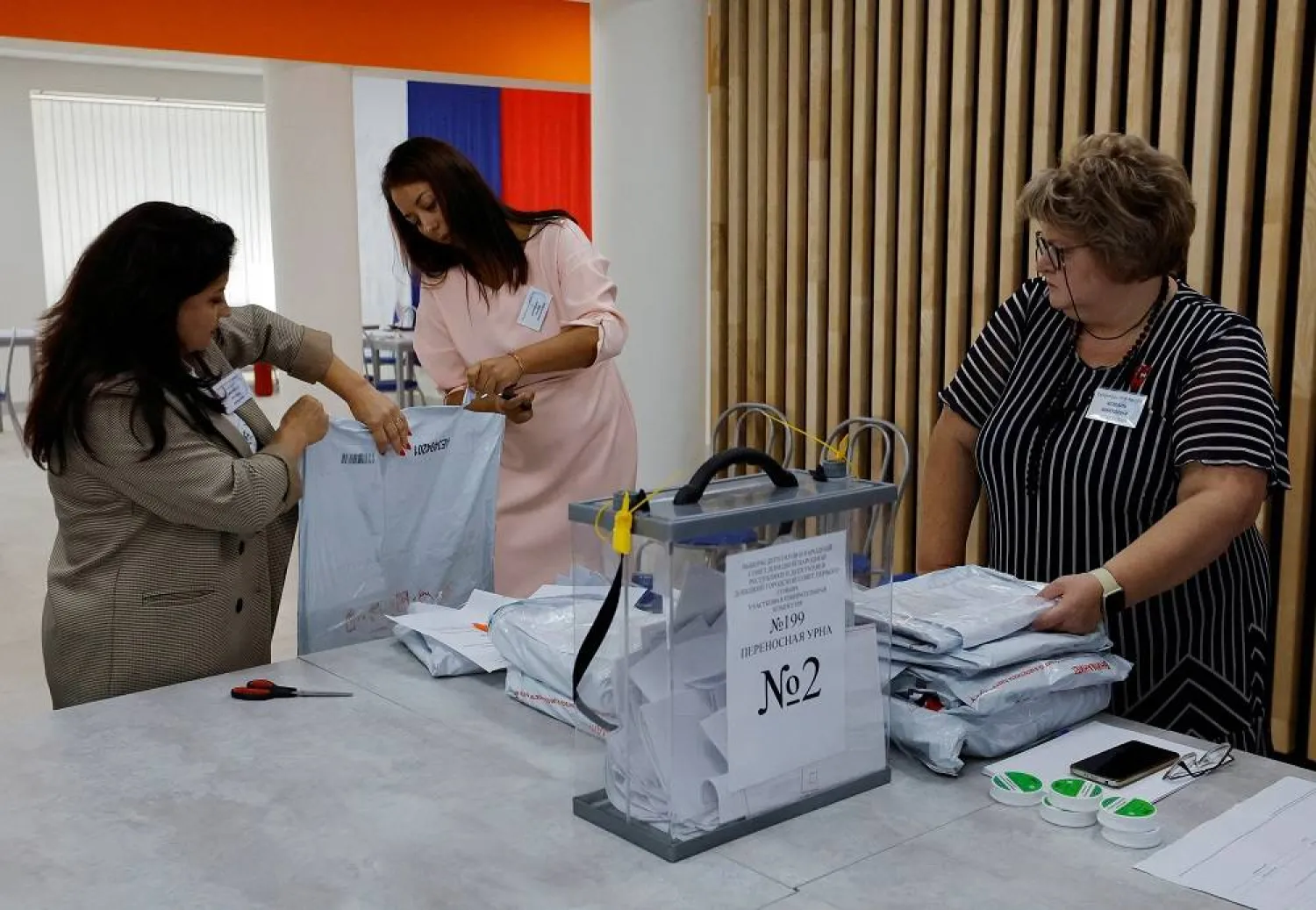
Members of an electoral commission prepare ballots for counting at a polling station during local elections held by the Russian-installed authorities in the course of Russia-Ukraine conflict in Donetsk, Russian-controlled Ukraine, September 10, 2023. (Reuters)
TT

Russia Says Ruling Party Wins Most Votes in Ukrainian Regions It Controls

Members of an electoral commission prepare ballots for counting at a polling station during local elections held by the Russian-installed authorities in the course of Russia-Ukraine conflict in Donetsk, Russian-controlled Ukraine, September 10, 2023. (Reuters)

Russia’s Central Election Commission said Monday that the country’s ruling party won the most votes in elections held in occupied Ukrainian regions, as Kyiv and the West denounced the ballots as a sham.

The votes were held as Russian authorities attempt to tighten their grip on territories Moscow illegally annexed a year ago and still does not fully control.

Voting for Russia-installed legislatures began last week. According to the Central Election Commission, lawmakers from the ruling party, United Russia, came out on top in the four Ukrainian regions Moscow annexed in 2022 — Donetsk, Kherson, Luhansk and Zaporizhzhia — and on the Crimean Peninsula, which the Kremlin annexed in 2014.

Western countries have denounced the elections as a violation of international law. “We strongly reject this further futile attempt by Russia to legitimize or normalize its illegal military control and attempted annexation of parts of Ukrainian territories,” the European Commission said Monday in a statement, promising “consequences” for Russia's leadership.

On Friday, Ukraine's Foreign Ministry urged other countries not to recognize the results of what it called “fake elections.”

The votes in the Ukrainian regions were timed to coincide with nationwide elections for local legislatures and governors across 16 Russian regions. There were also multiple votes for city and municipal councils across the country and races for a few vacant seats in the State Duma, Russia’s lower house of parliament.

In Moscow, United Russia received the most votes, returning Sergei Sobyanin as mayor. He won against candidates from other Kremlin-backed parties with more than 76% of the vote, according to the election commission.

Russia’s Central Election Commission head Ella Pamfilova said the turnout, averaging 43.5%, was the highest since 2017. The figure includes Russia and the occupied Ukrainian regions.

In one of the annexed Ukrainian regions, Russian state media reported turnout was even higher. Marina Zakharova, the Russia-installed chair of the Kherson election commission, said Sunday that 65.36% of Kherson residents cast ballots in the election.

The Kherson region is not under complete Russian control, and local residents and Ukrainian activists have alleged that Russian poll workers make house calls accompanied by armed soldiers in both provinces, detaining those who refuse to vote and pressuring them into writing “explanatory statements” that could be used as grounds for a criminal case.

Ukraine's armed forces suggested in a statement Sunday that Moscow could use the votes to identify men who could potentially be recruited into the Russian army.

On Sunday, Russian electoral officials reported attempts to sabotage voting in the occupied regions, where guerrilla forces loyal to Kyiv had previously killed pro-Moscow officials, blown up bridges and helped the Ukrainian military by identifying key targets.

A drone strike destroyed one polling station in the Zaporizhzhia region hours before it opened Sunday, Russia’s Central Election Commission deputy chair Nikolai Bulaev told reporters. He said no staff were at the station at the time of the attack.

A Russian-appointed official in the neighboring Kherson region said a live grenade was discovered Saturday near a polling station there. According to Zakharova, the Russia-installed election official, the grenade was hidden in bushes outside the station, and voting had to be halted while emergency services disposed of it.

Denis Pushilin, the acting head of the Russian-occupied part of the Donetsk region, also said in a statement Sunday that polling station staff there had been “wounded and injured,” without giving details.

Moscow has partially occupied Kherson and Zaporizhzhia since early in the war in Ukraine, while parts of Donetsk and Luhansk regions were overrun by Russian-backed separatists in 2014. Ukrainian forces have since retaken Kherson’s namesake local capital and are pressing a counteroffensive in Zaporizhzhia that has been making slow progress.

There are hardly any exciting races, political analyst Abbas Gallyamov noted before polls closed, mainly because “the most important issue in Russian politics — the issue of war and peace — is not on the agenda at all.”

“The voter sees that it’s not interesting,” Gallyamov, who once worked as a speechwriter for Russian President Vladimir Putin, told The Associated Press in an interview.

He said no one wants to campaign in favor of the war because it is not popular and it would affect their poll ratings. At the same time, it's impossible to campaign against the war because “you will be barred from running, thrown in jail and named the enemy of the country. So all candidates avoid this issue."

“The voters feel that the elections are not about what is actually real and important. ... These are empty elections,” Gallyamov said.



Erdogan Warns Black Sea Should Not Be 'Area of Confrontation' after Strikes

Turkish President Recep Erdogan addresses the media after the conclusion on the G20 Summit held at the Nasrec Expo Center in Johannesburg, South Africa, 23 November 2025. EPA/HALDEN KROG
TT

Erdogan Warns Black Sea Should Not Be 'Area of Confrontation' after Strikes

Turkish President Recep Erdogan addresses the media after the conclusion on the G20 Summit held at the Nasrec Expo Center in Johannesburg, South Africa, 23 November 2025. EPA/HALDEN KROG

Turkish President Recep Tayyip Erdogan on Saturday warned that the Black Sea should not turn into an "area of confrontation" between Russia and Ukraine, after several strikes in recent weeks.

"The Black Sea should not be seen as an area of confrontation. This would not benefit Russia or Ukraine. Everyone needs safe navigation in the Black Sea," he was quoted as telling reporters aboard his plane, according to the official Anadolu news agency.


Indonesia Flood Death Toll Passes 1,000

The deadly torrential rains are one of the worst recent disasters to strike Sumatra. (AFP)
TT

Indonesia Flood Death Toll Passes 1,000

The deadly torrential rains are one of the worst recent disasters to strike Sumatra. (AFP)

Devastating floods and landslides have killed 1,003 people in Indonesia, rescuers said Saturday as the Southeast Asian nation grapples with relief efforts.

The disaster, which has hit the northwestern island of Sumatra over the past fortnight, has also injured more than 5,400, the National Disaster Mitigation Agency said in its latest toll.

The deadly torrential rains are one of the worst recent disasters to strike Sumatra, where a tsunami wreaked havoc in 2004 in Aceh province, which lies at the northern tip of the island.

The final toll is expected to rise, with the disaster agency reporting 218 people are still missing.

With vast tracts of territory hit, 1.2 million residents have been forced to take refuge in temporary shelters.

Frustration has grown among flood victims, who have complained about the pace of relief efforts.

President Prabowo Subianto said Saturday the situation has improved, with several areas which had been cut off now accessible.

"Here and there, due to natural and physical conditions, there have been slight delays, but I checked all the evacuation sites: their conditions are good, services for them are adequate, and food supplies are sufficient," Prabowo said after visiting Langkat in North Sumatra province.

Costs to rebuild after the disaster could reach 51.82 trillion rupiah ($3.1 billion) and the Indonesian government has so far shrugged off suggestions that it call for international assistance.


Moscow, Tehran ‘Working Closely’ on Nuclear Program

Russian President Vladimir Putin and Iranian President Masoud Pezeshkian on the sidelines of the Peace Summit in Ashgabat, Turkmenistan, on Friday (Tasnim). 
TT

Moscow, Tehran ‘Working Closely’ on Nuclear Program

Russian President Vladimir Putin and Iranian President Masoud Pezeshkian on the sidelines of the Peace Summit in Ashgabat, Turkmenistan, on Friday (Tasnim). 

Russian President Vladimir Putin said on Friday that relations between Moscow and Tehran are “developing very positively,” stressing that the two countries are working in close coordination at the United Nations on Iran’s nuclear program.

He made the remarks during talks with Iranian President Masoud Pezeshkian on the sidelines of the International Peace and Trust Summit in Ashgabat.

According to Russian media, Putin said Russia is cooperating with Iran at the Bushehr nuclear power plant and on major infrastructure projects, including the North–South Transport Corridor.

He added that the two sides are also exploring cooperation in the gas and electricity sectors.

Pezeshkian, quoted by Iranian and Russian media, reaffirmed Tehran’s commitment to implementing the comprehensive strategic partnership agreement with Moscow.

He said Iran is “determined to activate the agreement” and expects Russia to accelerate implementation of joint understandings, particularly in energy, transport and strategic transit corridors.

The Iranian president said Iran would complete its share of the groundwork for the North–South Corridor by the end of the year, noting growing economic and trade cooperation between the two countries.

He also called for strengthening multilateral partnerships within frameworks such as the Shanghai Cooperation Organization and BRICS to counter what he described as “unilateralism.”

Russia and Iran aim to expand economic ties through projects such as the International North–South Transport Corridor, a multimodal route linking northern and southern Asia via sea, rail and road networks.

The corridor is intended to speed up cargo transport between Russia and India through Iran and other countries while reducing costs compared with traditional routes. The project is seen as part of Moscow’s efforts to deepen trade links with Central Asia and Europe and to lessen reliance on longer maritime routes.

Putin said bilateral trade between Russia and Iran increased by 13 percent last year and by 8 percent in the first nine months of the current year, underscoring continued cooperation in energy and infrastructure. He added that coordination between Moscow and Tehran on international issues remains “close and ongoing.”

On the sidelines of the summit, Pezeshkian also met Pakistani Prime Minister Shehbaz Sharif, with both sides agreeing on the need to accelerate implementation of bilateral agreements and enhance cooperation in transport, transit, energy and border infrastructure, according to Iran’s Mehr News Agency.