


700 Million People Going Hungry Worldwide

The World Food Program (WFP) Executive Director, Cindy McCain (on screen) speaks at a Security Council open debate on advancing public-private humanitarian partnership via a video link at the UN Headquarters in New York, on Sept. 14, 2023 (UN)
TT

700 Million People Going Hungry Worldwide

The World Food Program (WFP) Executive Director, Cindy McCain (on screen) speaks at a Security Council open debate on advancing public-private humanitarian partnership via a video link at the UN Headquarters in New York, on Sept. 14, 2023 (UN)

The global hunger crisis has left more than 700 million people not knowing when or if they will eat again, and demand for food is rising relentlessly while humanitarian funding is drying up, the World Food Program (WFP) Executive Director, Cindy McCain, has said.

At the halfway point to the deadline set for achieving the 2030 Agenda for Sustainable Development, the world is seeing little to no improvement in most of the food and agriculture-related goals, according to another report by the Food and Agriculture Organization, released ahead of a UN sustainable development summit next week in New York.

“The lingering effects of the COVID-19 pandemic, along with other crises such as climate change and armed conflicts, are having widespread impacts,” the report said. “Progress made in the past two decades has stagnated, and in some cases even reversed.”

Global food insecurity spiked sharply in 2020 as the pandemic disrupted food markets and drove up unemployment, but hunger has not returned to pre-pandemic levels. About 29.6% of the global population - 2.4 billion people - was moderately or severely food insecure in 2022, up from 1.75 billion in 2015, the report said.

Undernourishment is worst in the global south, with hunger rising most in Sub-Saharan Africa.

The world has also seen no improvement towards a goal to halve food waste, which has remained at about 13% since 2016. Countries should craft policy to reduce food loss, the report said.

For her part, McCain, the widow of the late US senator John McCain, said Thursday that because of the lack of funding, the agency has been forced to cut food rations for millions of people, and “more cuts are on the way.”

“We are now living with a series of concurrent and long-term crises that will continue to fuel global humanitarian needs,” she told the UN Security Council. “This is the humanitarian community’s new reality — our new normal — and we will be dealing with the fallout for years to come.”

The WFP chief said the agency estimates that nearly 47 million people in over 50 countries are just one step from famine — and a staggering 45 million children under the age of five are now estimated to suffer from acute malnutrition.

According to WFP estimates from 79 countries where the Rome-based agency operates, up to 783 million people — one in 10 of the world’s population — still go to bed hungry every night. More than 345 million people are facing high levels of food insecurity this year, an increase of almost 200 million people from early 2021 before the COVID-19 pandemic, the agency said.

At the root of the soaring numbers, WFP said, is “a deadly combination of conflict, economic shocks, climate extremes and soaring fertilizer prices.”

The economic fallout from the pandemic and the war in Ukraine have pushed food prices out of the reach of millions of people across the world at the same time that high fertilizer prices have caused falling production of maize, rice, soybeans and wheat, the agency said.

“Our collective challenge is to ramp up the ambitious, multi-sectoral partnerships that will enable us to tackle hunger and poverty effectively, and reduce humanitarian needs over the long-term,” McCain noted.

The Security Council meeting was also attended by Michael Miebach, CEO of Mastercard, who said that “humanitarian relief has long been the domain of government” and development institutions, and the private sector was seen as a source of financial donations for supplies.

“Money is still important, but companies can offer so much more,” he said. “The private sector stands ready to tackle the challenges at hand in partnership with the public sector.”

Miebach stressed that “business cannot succeed in a failing world” and humanitarian crises impact fellow citizens of the world. A business can use its expertise, he said, to strengthen infrastructure, “innovate new approaches and deliver solutions at scale” to improve humanitarian operations.

Jared Cohen, president of global affairs at Goldman Sachs, told the Council that the revenue of many multinational companies rivals the GDP of some of the Group of 20 countries with the largest economies.

“Today’s global firms have responsibilities to our shareholders, clients, staff, communities, and the rules-based international order that makes it possible for us to do business,” he said.

Cohen said businesses can fulfill those responsibilities during crises first by not scrambling “to reinvent the wheel every time,” but by drawing on institutional memory and partnering with other firms and the public sector.

He said businesses also need “to act with speed and innovate in real time,” use local connections, and bring their expertise to the humanitarian response.

Lana Nusseibeh, the United Arab Emirates ambassador, said the UN appealed for over $54 billion this year, “and until now, 80% of those funds remain unfulfilled,” which shows that “we are facing a system in crisis.”

She said public-private partnerships that were once useful additions are now crucial to humanitarian work.

Her US counterpart, Ambassador Linda Thomas-Greenfield, said the funding gap has left the world’s most vulnerable people “in a moment of great peril.”

She said companies have stepped up, including in Haiti and Ukraine and to help refugees in the United States, but for too long, “we have turned to the private sector exclusively for financing.”

Meanwhile, the World Meteorological Organization (WMO) warned that halfway through the 2030 Agenda, the world is today far from meeting the climate targets within the Sustainable Development Goals.

It said this failure to meet the goals and undermines global efforts to tackle hunger, poverty and ill health, improve access to clean water and energy, and many other aspects of the 2030 Agenda.

In a joint report prepared by 18 specialized organizations, WMO said that barely 15% of the sustainable goals is progressing.

The report specified that 2023 has demonstrated all too clearly that climate change is already here, record temperatures scorching the earth and warming the sea, while extreme weather conditions wreak havoc across the planet.

WMO Secretary-General Petteri Taalas said revolutionary scientific and technological advances, such as high-resolution climate modeling, artificial intelligence and current forecasting, can catalyze the transformation to achieve the goals.

He also noted that a Universal Early Warning System, to be achieved by 2027, would not only save lives and livelihoods, but would also help safeguard sustainable development.
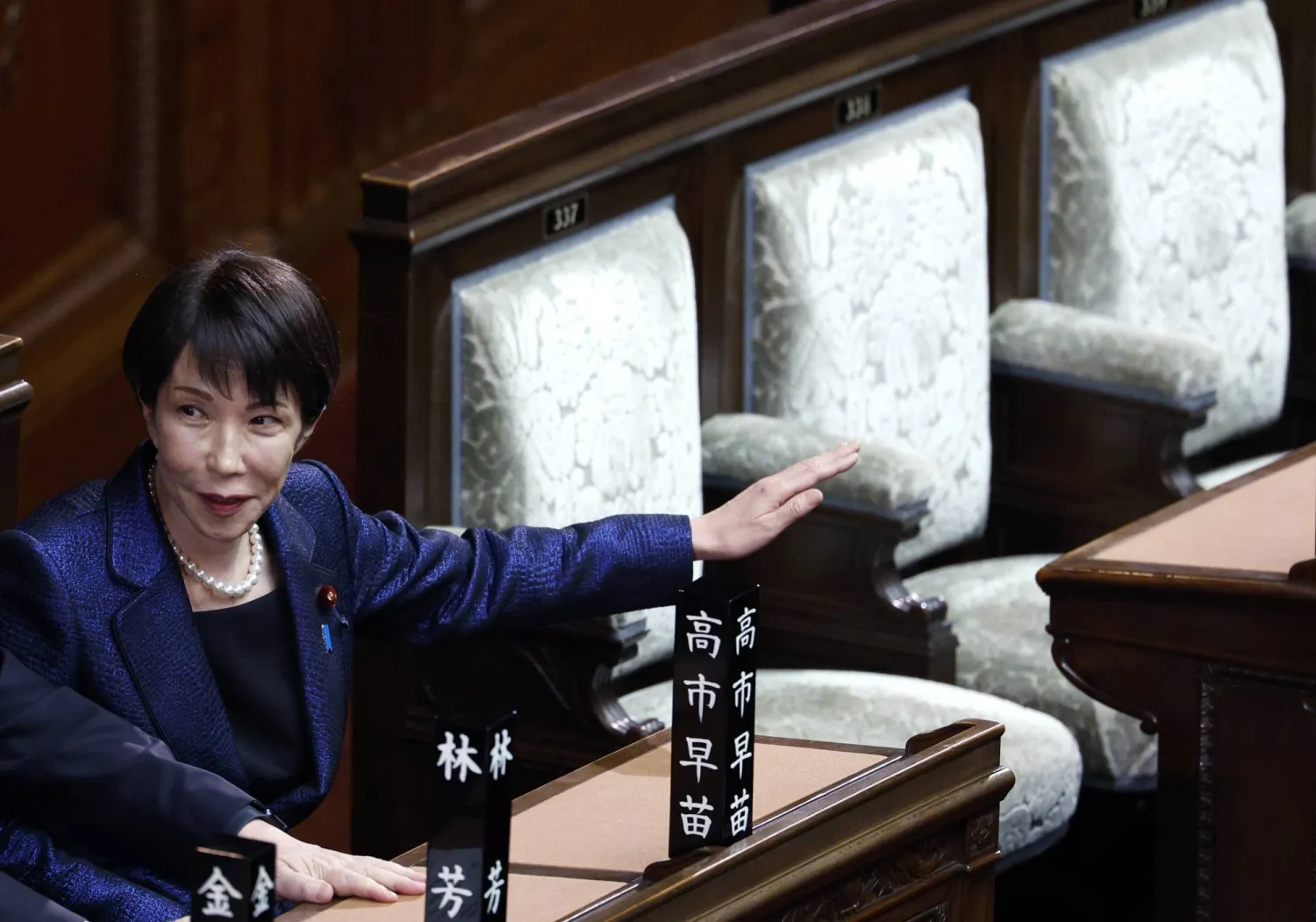



Japan PM Takaichi Reappointed Following Election

Sanae Takaichi gestures at the Lower House of the Parliament in Tokyo, Japan, 18 February 2026. EPA/FRANCK ROBICHON
TT

Japan PM Takaichi Reappointed Following Election

Sanae Takaichi gestures at the Lower House of the Parliament in Tokyo, Japan, 18 February 2026. EPA/FRANCK ROBICHON

Japan's lower house formally reappointed Sanae Takaichi as prime minister on Wednesday, 10 days after her historic landslide election victory.

Takaichi, 64, became Japan's first woman premier in October and won a two-thirds majority for her party in the snap lower house elections on February 8.

She has pledged to bolster Japan's defenses to protect its territory and waters, likely further straining relations with Beijing, and to boost the flagging economy.

Takaichi suggested in November that Japan could intervene militarily if Beijing sought to take Taiwan by force.

China, which regards the democratic island as part of its territory and has not ruled out force to annex it, was furious.

Beijing's top diplomat Wang Yi told the Munich Security Conference on Saturday that forces in Japan were seeking to "revive militarism".

In a policy speech expected for Friday, Takaichi will pledge to update Japan's "Free and Open Indo-Pacific" strategic framework, local media reported.

"Compared with when FOIP was first proposed, the international situation and security environment surrounding Japan have become significantly more severe," chief government spokesman Minoru Kihara said Monday.

In practice this will likely mean strengthening supply chains and promoting free trade through the Trans-Pacific Partnership (CPTPP) that Britain joined in 2024.

Takaichi's government also plans to pass legislation to establish a National Intelligence Agency and to begin concrete discussions towards an anti-espionage law, the reports said.

Takaichi has promised too to tighten rules surrounding immigration, even though Asia's number two economy is struggling with labor shortages and a falling population.

On Friday Takaichi will repeat her campaign pledge to suspend consumption tax on food for two years in order to ease inflationary pressures on households, local media said, according to AFP.

This promise has exacerbated market worries about Japan's colossal debt, with yields on long-dated government bonds hitting record highs last month.

Rahul Anand, the International Monetary Fund chief of mission in Japan, said Wednesday that debt interest payments would double between 2025 and 2031.

"Removing the consumption tax (on food) would weaken the tax revenue base, since the consumption tax is an important way to raise revenues without creating distortions in the economy," Anand said.

To ease such concerns, Takaichi will on Friday repeat her mantra of having a "responsible, proactive" fiscal policy and set a target on reducing government debt, the reports said.

She will also announce the creation of a cross-party "national council" to discuss taxation and how to fund ageing Japan's ballooning social security bill.

But Takaichi's first order of business will be obtaining approval for Japan's budget for the fiscal year beginning on April 1 after the process was delayed by the election.

The ruling coalition also wants to pass legislation that will outlaw destroying the Japanese flag, according to the media reports.

It wants too to accelerate debate on changing the constitution and on revising the imperial family's rules to ease a looming succession crisis.

Takaichi and many within her Liberal Democratic Party (LDP) oppose making it possible for a woman to become emperor, but rules could be changed to "adopt" new male members.


Türkiye: Ocalan Announces ‘Integration Phase’

Members of the Kurdish community take part in a protest calling for the release of convicted Kurdistan Worker's Party (PKK) leader Abdullah Ocalan in Diyarbakir on February 15, 2026. (Photo by Ilyas AKENGIN / AFP)
TT

Türkiye: Ocalan Announces ‘Integration Phase’

Members of the Kurdish community take part in a protest calling for the release of convicted Kurdistan Worker's Party (PKK) leader Abdullah Ocalan in Diyarbakir on February 15, 2026. (Photo by Ilyas AKENGIN / AFP)

The jailed leader of the Kurdistan Workers Party, Abdullah Ocalan, has said that the Ankara-PKK peace process has entered its “second phase,” as the Turkish parliament sets the stage to vote on a draft report proposing legal reforms tied to peace efforts.

A delegation from the pro-Kurdish Peoples' Equality and Democracy Party (DEM Party), including lawmakers Pervin Buldan, Mithat Sancar, and Ocalan’s lawyer Ozgur Faik, met with the jailed PKK leader on Monday on the secluded Imrali island.

Sancar said that the second phase will be focused on democratic integration into
Türkiye’s political system.

According to the lawmaker, the PKK leader considered the first phase the “negative dimension” concerned with ending the decades-old conflict between the armed group and Ankara.

“Now we are facing the positive phase,” Ocalan said, “the integration phase is the positive phase; it is the phase of construction.”

For the second phase to be implemented, Ocalan called on Turkish authorities to provide conditions that would allow him to put his “theoretical and practical capacity” to work.

The 60-page draft report on peace with the PKK was completed by a five-member writing team, which is chaired by Parliament Speaker Numan Kurtulmuş, and is scheduled for a vote on Wednesday.

The report is organized into seven sections.

In July last year, Ocalan said the group's armed struggle against Türkiye has ended and called for a full shift to democratic politics.


Iranians Chant Slogans Against Supreme Leader at Memorials for Slain Protesters

An Iranian man holds the Iranian national flag during a memorial ceremony for those killed in anti-government protests earlier last month, at the Mosalla mosque in Tehran, Iran, 17 February 2026. (EPA)
TT

Iranians Chant Slogans Against Supreme Leader at Memorials for Slain Protesters

An Iranian man holds the Iranian national flag during a memorial ceremony for those killed in anti-government protests earlier last month, at the Mosalla mosque in Tehran, Iran, 17 February 2026. (EPA)

Iranians shouted slogans against Supreme Leader Ali Khamenei on Tuesday as they gathered to commemorate protesters killed in a crackdown on nationwide demonstrations that rights groups said left thousands dead, according to videos verified by AFP.

The country's clerical authorities also staged a commemoration in the capital Tehran to mark the 40th day since the deaths at the peak of the protests on January 8 and 9.

Officials acknowledge more than 3,000 people died during the unrest, but attribute the violence to "terrorist acts", while rights groups say many more thousands of people were killed, shot dead by security forces in a violent crackdown.

The protests, sparked by anger over the rising cost of living before exploding in size and anti-government fervor, subsided after the crackdown, but in recent days Iranians have chanted slogans from the relative safety of homes and rooftops at night.

On Tuesday, videos verified by AFP showed crowds gathering at memorials for some of those killed again shouting slogans against the theocratic government in place since the 1979 revolution.

In videos geolocated by AFP shared on social media, a crowd in Abadan in western Iran holds up flowers and commemorative photos of a young man as they shout "death to Khamenei" and "long live the shah", in support of the ousted monarchy.

Another video from the same city shows people running in panic from the sounds of shots, though it wasn't immediately clear if they were from live fire.

In the northeastern city of Mashhad a crowd in the street chanted, "One person killed, thousands have his back", another verified video showed.

Gatherings also took place in other parts of the country, according to videos shared by rights groups.

- Official commemorations -

At the government-organized memorial in Tehran crowds carried Iranian flags and portraits of those killed as nationalist songs played and chants of "Death to America" and "Death to Israel" echoed through the Khomeini Grand Mosalla mosque.

Iranian President Masoud Pezeshkian attended a similar event at the Imam Reza shrine in Mashhad.

Authorities have accused sworn enemies the United States and Israel of fueling "foreign-instigated riots", saying they hijacked peaceful protests with killings and vandalism.

Senior officials, including First Vice President Mohammad Reza Aref and Revolutionary Guards commander Esmail Qaani, attended the ceremony.

"Those who supported rioters and terrorists are criminals and will face the consequences," Qaani said, according to Tasnim news agency.

International organizations have said evidence shows Iranian security forces targeted protesters with live fire under the cover of an internet blackout.

The US-based Human Rights Activists News Agency (HRANA) has recorded more than 7,000 killings in the crackdown, the vast majority protesters, though rights groups warn the toll is likely far higher.

More than 53,500 people have been arrested in the ongoing crackdown, HRANA added, with rights groups warning protesters could face execution.

Tuesday's gatherings coincided with a second round of nuclear negotiations between Iran and the United States in Geneva, amid heightened tensions after Washington deployed an aircraft carrier group to the Middle East following Iran's crackdown on the protests.