Russia Calls for International Monitoring Mission in Gaza

Russia's Foreign Minister Sergei Lavrov waits before a meeting of Russia's President Vladimir Putin and Kyrgyzstan's President Sadyr Japarov in Bishkek, Kyrgyzstan October 12, 2023. (Sputnik/Pavel Bednyakov/Kremlin via Reuters)
TT

Russia Calls for International Monitoring Mission in Gaza

Russia's Foreign Minister Sergei Lavrov waits before a meeting of Russia's President Vladimir Putin and Kyrgyzstan's President Sadyr Japarov in Bishkek, Kyrgyzstan October 12, 2023. (Sputnik/Pavel Bednyakov/Kremlin via Reuters)

Russia on Sunday called for an international monitoring mission to go to Gaza to assess the humanitarian situation, and said it was unacceptable for Israel to use Hamas' Oct. 7 attack as justification for punishing the Palestinian people.

Israel invaded Gaza in retaliation for Hamas attack that Israel says killed 1,200 people. Israel's assault on Gaza has killed at least 17,000 people, Gaza health authorities say.

The United States on Friday vetoed a proposed UN Security Council demand for an immediate humanitarian ceasefire in the war between Israel and Palestinian militant group Hamas.

"We strongly condemned the terrorist attack against Israel on Oct. 7," Russian Foreign Minister Sergei Lavrov told Al Jazeera in an interview aired on Sunday at the Doha Forum conference.

"At the same time, we do not believe it is acceptable to use this event for the collective punishment of the millions of Palestinian people with indiscriminate shelling."

Lavrov said that for there to be "humanitarian pauses" in Gaza "some kind of monitoring on the ground" was needed.

"We addressed the Secretary General [Antonio Guterres] suggesting that he use his authority to consider some kind of monitoring - but so far to no avail," Lavrov said.

President Vladimir Putin has repeatedly accused the United States and the West of ignoring the need for an independent Palestinian state within 1967 borders. Putin on Sunday spoke to Israeli Prime Minister Benjamin Netanyahu about Gaza.

"This happened not in a vacuum," Lavrov said, pointing to decades of blockade and unfulfilled promises about a Palestinian state.

The UN's Guterres has previously said that the Hamas attack did not happen in a vacuum. Israel said Guterres had justified the Hamas attacks with such words. Guterres rejected the Israeli accusations.

Ukraine

Asked in the Al Jazeera interview if Russia was being hypocritical with its criticism about that fate of the Palestinians while Russia fights a war in Ukraine, Lavrov said neither he nor Russia were hypocritical.

Lavrov said that the West was trying to exhaust Russia in Ukraine by supplying weapons and that if peace talks were to take place then Ukrainian President Volodymyr Zelenskiy would have to annul his own presidential decree.

"It is up to the Ukrainians to recognize how deep they are in the hole where the Americans put them," Lavrov said when asked if the war was at a stalemate.

When asked by Al Jazeera what the chances were of diplomacy to bring about a ceasefire or peace in Ukraine, he said: "You'll have to call Mr. Zelenskiy because a year and half ago he signed a decree prohibiting any negotiations with Putin."

Lavrov said that a peace deal between Ukraine and Russia was almost reached in Istanbul in March and April 2022 based on the idea of Ukrainian neutrality.

"This deal was aborted - it was cancelled because the Americans and the Brits decided that if Putin is ready to sign it then let's exhaust him more. That's what they are doing now. Stalemate or no stalemate - that is the fact," Lavrov said.

Asked in the interview about the August plane crash which killed Wagner mercenary chief Yevgeny Prigozhin, Lavrov said investigators had probed the crash.

"As regards the soldiers from Wagner group... quite a number of them went to Belarus and started to serve there," Lavrov said "Others joined the regular structures of the Russian army - and they continue to serve." 


Trump Urges other Nations to Send Ships to Secure Hormuz

FILE PHOTO: A map showing the Strait of Hormuz and Iran is seen in this illustration taken June 22, 2025. REUTERS/Dado Ruvic/Illustration/File Photo
TT

Trump Urges other Nations to Send Ships to Secure Hormuz

FILE PHOTO: A map showing the Strait of Hormuz and Iran is seen in this illustration taken June 22, 2025. REUTERS/Dado Ruvic/Illustration/File Photo

US President Donald Trump on Saturday urged other nations to send ships to help secure the Strait of Hormuz, the critical chokepoint for global oil supplies disrupted by the Mideast war.

Trump, who has said the United States will soon start escorting tankers through the strait, posted on Truth Social that "Many countries, especially those who are affected by Iran's attempted closure of the Hormuz Strait, will be sending War Ships, in conjunction with the United States of America, to keep the Strait open and safe."

The US president added: "Hopefully China, France, Japan, South Korea, the UK, and others, that are affected by this artificial constraint, will send Ships to the area."

Iranian strikes have all but halted maritime traffic in the strait, through which a fifth of global crude oil and liquefied natural gas normally pass. It is just 54 kilometers (34 miles) wide at its narrowest point.

With oil prices spiking, Trump was asked Friday when the US Navy would begin escorting tankers through the Strait of Hormuz. "It'll happen soon, very soon," he said.

In his post on Saturday, Trump asserted that Iran's military capability had been eliminated but he conceded that it was still able to attack the strait.

"We have already destroyed 100% of Iran's Military capability, but it's easy for them to send a drone or two, drop a mine, or deliver a close range missile somewhere along, or in, this Waterway, no matter how badly defeated they are," he wrote.

As he urged nations to send ships to the strait, he added that "the United States will be bombing the hell out of the shoreline, and continually shooting Iranian Boats and Ships out of the water. One way or the other, we will soon get the Hormuz Strait OPEN, SAFE, and FREE!"


Israeli Defense Minister Says War with Iran Entering 'Decisive Phase'

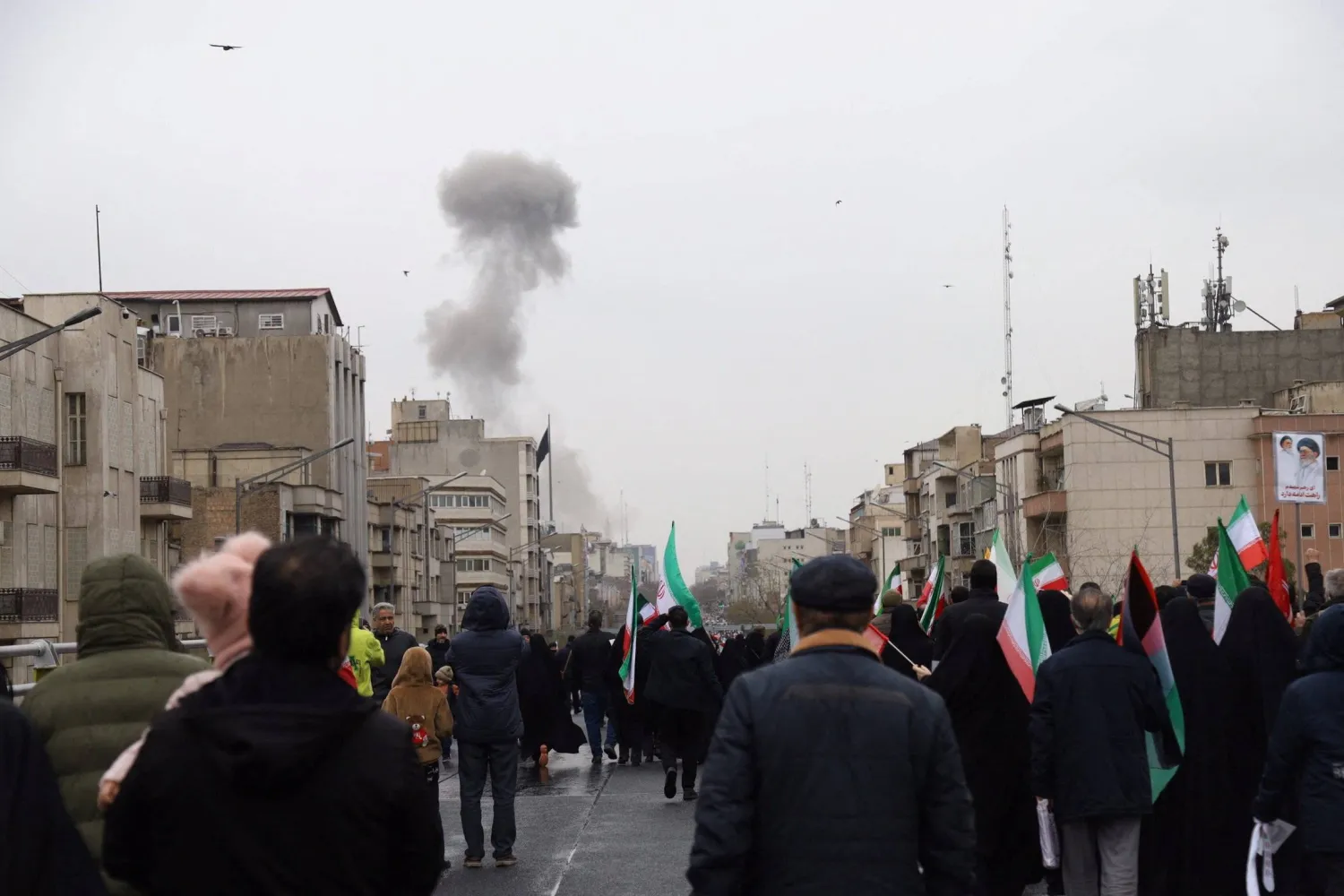
Smoke rises following an explosion during a protest marking the annual al-Quds Day (Jerusalem Day) on the last Friday of the holy month of Ramadan, amid the US-Israeli conflict with Iran, in Tehran, Iran, March 13, 2026. Elahe Asiabai/Fars News/WANA (West Asia News Agency) via REUTERS
TT

Israeli Defense Minister Says War with Iran Entering 'Decisive Phase'

Smoke rises following an explosion during a protest marking the annual al-Quds Day (Jerusalem Day) on the last Friday of the holy month of Ramadan, amid the US-Israeli conflict with Iran, in Tehran, Iran, March 13, 2026. Elahe Asiabai/Fars News/WANA (West Asia News Agency) via REUTERS

Israel said the war against Iran was entering its "decisive phase" on Saturday, as explosions rocked cities across the Middle East, with strikes on the US embassy in Baghdad and a major Emirati energy facility.

Washington's embassy in Iraq was hit by a drone, security sources told AFP, the second time it has been targeted since February 28, when the United States and Israel attacked Iran and plunged the Gulf into a conflict that has sent shockwaves through the global economy.

Millions have been displaced by waves of drone, missile and aerial bombing, while more than 1,200 people have reportedly been killed in Iran, with little sign of the conflict slowing as it entered its third week.

Oil prices have surged by 40 percent as Iran chokes off the vital Strait of Hormuz with threats to shipping and strikes on Gulf energy facilities.

Clouds of black smoke rose Saturday over Fujairah, home to a major Emirati oil storage and export terminal, shortly after Iran's military warned UAE civilians to avoid port areas.

President Donald Trump said Friday that US forces had struck Iran's Kharg Island, its biggest oil export hub, and "obliterated every MILITARY target", though sparing its energy facilities.

Iranian media confirmed the island's oil facilities were unaffected. Iran had threatened US-linked oil and energy firms would be "turned into a pile of ashes" if they were hit.

The strike could be a "turning point" with both sides escalating in a bid to force a surrender, said analyst Vali Nasr of John Hopkins University in a social media post. "The end will likely not be Iranian backing off but inflaming the Gulf."

Trump said the US Navy would start escorting tankers through the Strait of Hormuz "very soon", but governments around the world fear a prolonged blow to their economies.

Israel's Defense Minister Israel Katz said the strikes on Kharg showed the war was entering a "decisive phase", though he cautioned it would "continue as long as necessary".

Yet, despite facing superior US and Israeli firepower, Iran appears determined to fight on.

Blasts were heard by AFP journalists over Jerusalem on Saturday after the army detected missiles fired from Iran.

Iran has launched missile and drone attacks against at least 10 of its neighbors.

The Palestinian Islamist movement Hamas urged Iran to refrain from targeting Gulf neighbors.

Qatar said it intercepted two missiles over the capital's downtown area on Saturday and evacuated key areas after blasts were heard by AFP journalists in Doha.

Strikes continue in Iran, with heavy blasts shaking Tehran late Friday and local media reporting strikes in several provinces through Saturday.

Israel's army warned people in an industrial zone of Tabriz in northern Iran to evacuate, signalling an imminent attack.

Iran's health ministry says more than 1,200 people have been killed by US and Israeli attacks, numbers that could not be independently verified.

Up to 3.2 million people have been displaced inside Iran, according to the UN refugee agency.

Trump described Iran as "totally defeated" and in search of a deal he was unwilling to consider.

More than 15,000 targets in Iran have been hit by the US and Israel in two weeks, the Pentagon said.

A report this week said the first six days alone cost the US $11.3 billion and it has lost 13 military personnel.

US media raised the possibility of a ground invasion, with the New York Times and Wall Street Journal reporting the Pentagon had dispatched the Japan-based amphibious assault ship USS Tripoli to the region with some 2,500 Marines.

Iran's rulers appear intent on showing they will survive the war and maintain control, despite their supreme leader Ali Khamenei being killed on day one.

Khamenei's son Mojtaba Khamenei was named the new supreme leader, but has been absent from public view and is reportedly wounded.

Reza Pahlavi, the US-based son of Iran's last shah, said on social media Saturday that he was ready to lead a transition "as soon as the Islamic Republic falls".

But Iran's Revolutionary Guards have threatened a heavy crackdown on any anti-government protests. Thousands were killed in mass demonstrations in January, and a near-total internet blackout has been imposed since since the war began.


Iranian Official Says Kharg Oil Exports 'Normal', after US Strikes

A satellite image of Iran's Kharg Island (AFP)
TT

Iranian Official Says Kharg Oil Exports 'Normal', after US Strikes

A satellite image of Iran's Kharg Island (AFP)

Oil export operations from Iran's Kharg island in the Gulf were proceeding as normal Saturday after US strikes on the crude export hub which caused no casualties, a regional official said.

Activities of oil companies "at this export terminal are continuing as normal", said Ehsan Jahaniyan, deputy governor of Iran's southern Bushehr province, quoted by the IRNA news agency.

The Fars news agency, citing sources on the island, earlier reported there had been no damage to oil facilities after President Donald Trump said US strikes had destroyed only military targets, AFP reported.

Trump had threatened to target oil infrastructure on the island, a crucial hub for Iran, if Tehran continues to block the strategic Strait of Hormuz.

Iran has, in turn, threatened to target US-linked oil infrastructure.

Deputy governor Jahaniyan said that after the attacks "daily life and routine activities of the residents are also fully maintained."

The attack "did not cause any casualties among military personnel, company employees, or residents of Kharg island, he added.

According to Fars, the US operation "tried to damage the army's defenses, the Joshan naval base, the airport control tower and the helicopter hangar of the Iran Continental Shelf Oil Company."

Kharg Island, a scrubby stretch of land in the northern Gulf around 30 kilometres (19 miles) off the Iranian mainland, handles roughly 90 percent of Iran's crude exports.