


Non-Aligned Movement Calls Israel’s War in Gaza Illegal, Condemns Attacks on Palestinians

 Secretary General of the United Nations Antonio Guterres delivers his speech during the closing session of the 19th Summit of Heads of State and Government of the Non-Aligned Movement (NAM) in Kampala on January 20, 2024. (AFP)
Secretary General of the United Nations Antonio Guterres delivers his speech during the closing session of the 19th Summit of Heads of State and Government of the Non-Aligned Movement (NAM) in Kampala on January 20, 2024. (AFP)
TT

Non-Aligned Movement Calls Israel’s War in Gaza Illegal, Condemns Attacks on Palestinians

 Secretary General of the United Nations Antonio Guterres delivers his speech during the closing session of the 19th Summit of Heads of State and Government of the Non-Aligned Movement (NAM) in Kampala on January 20, 2024. (AFP)
Secretary General of the United Nations Antonio Guterres delivers his speech during the closing session of the 19th Summit of Heads of State and Government of the Non-Aligned Movement (NAM) in Kampala on January 20, 2024. (AFP)

Heads of states of the Non-Aligned Movement Saturday called Israel's military campaign in the Gaza Strip "illegal" and strongly condemned indiscriminate attacks against Palestinian civilians, civilian infrastructure and the forced displacement of the Palestinian population.

While calling for a ceasefire desperately needed for humanitarian aid to access the Gaza Strip, the movement in a joint statement called for a two-state solution, on the basis of the borders before 1967, when Israel seized Gaza, the West Bank and East Jerusalem in a brief war with neighboring Arab states.

The group also reiterated support for a Palestinian state to be admitted as a member of the United Nations to take its rightful place among the community of nations.

The Non-Aligned Movement, formed during the collapse of the colonial systems and at the height of the Cold War, has played a key part in decolonization processes, according to its website. Member countries aspire not to be formally aligned with or against any major power bloc.

Ninety representatives, including 30 heads of state, from the 120 countries that are members of NAM took part in the week-long conference in the Ugandan capital, Kampala. It culminated in a summit of heads of state on Friday and Saturday.

Gaza’s Health Ministry says more than 24,400 Palestinians have died in the current war, and the United Nations says a quarter of the 2.3 million people trapped in Gaza are starving. In Israel, around 1,200 people were killed during the Oct. 7 attack by Hamas that sparked the war and saw some 250 people taken hostage by militants.

The NAM statement said members were very concerned at the continued deterioration of the situation on ground and the humanitarian crisis. It condemned Israel’s continuing settlement construction and expansion activities throughout the Palestinian territories, as well as in Syria's Israeli-occupied Golan Heights.

The group called for the attention of the international community, especially the UN Security Council.

“To this end, it is high time to end this abhorrent occupation, which continues to be imposed in flagrant violation of international law, and to ensure the implementation of the countless relevant General Assembly and Security Council resolutions,” the statement said.

UN Secretary General Antonio Guterres told the summit that the refusal to accept the two-state solution for Israelis and Palestinians, and the denial of the right to statehood for the Palestinian people, were unacceptable.

He supported the NAM’s position calling for reform of the Security Council.

“Your Movement has long highlighted the Council’s systemic shortcomings and the need for reforms to make it truly effective and representative. How can we accept that the African continent still lacks a single Permanent Member?” he asked.

Guterres said the killing of 152 UN staff in Gaza is disheartening, adding that the Hamas attack on Israel and the destruction of Gaza by the Israel army in 110 days was totally unprecedented during his mandate as UN Secretary General.

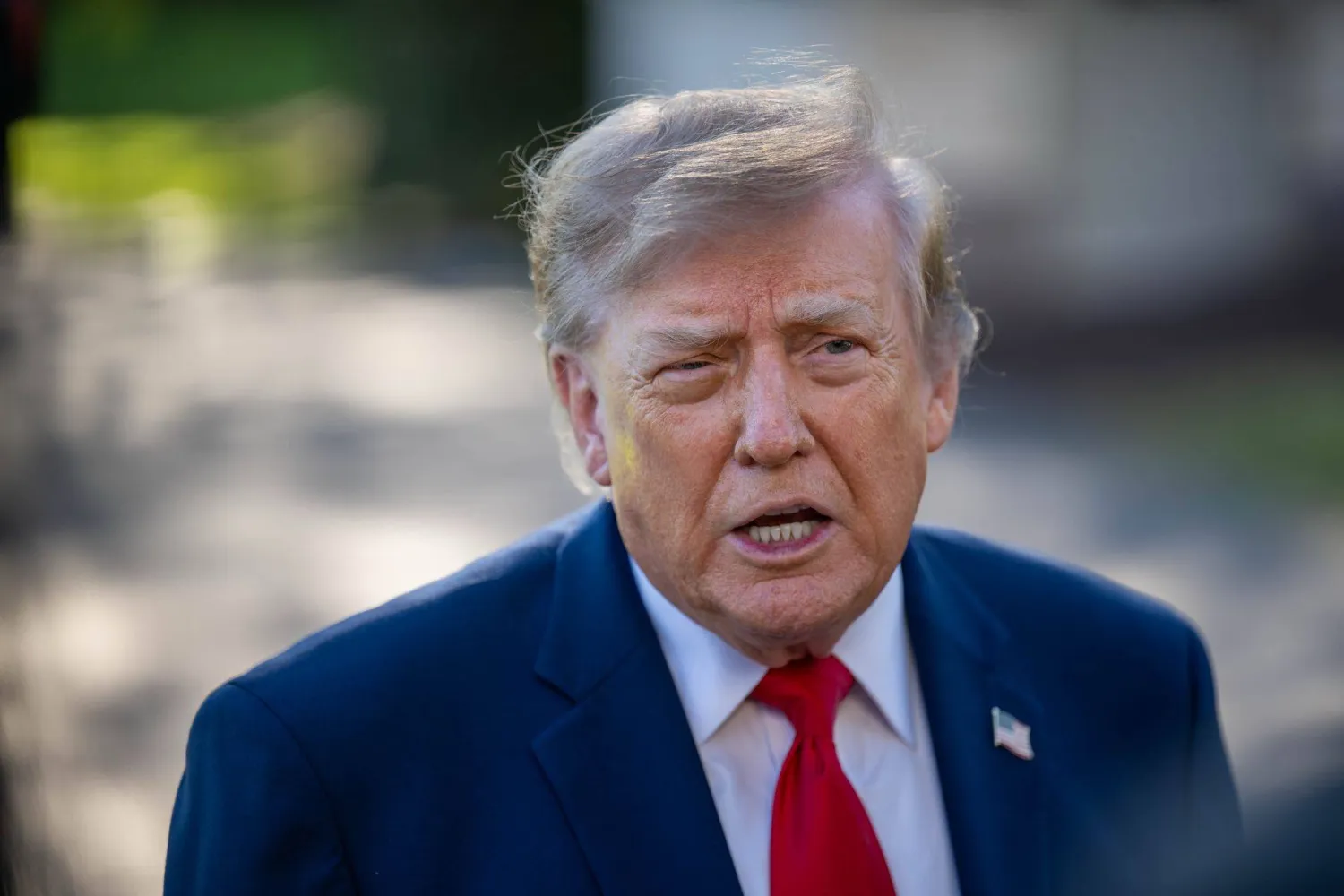


Trump Says Top Tech Firms Have Signed Accord to ‘Self-Police’ AI Development

US President Donald Trump (2-R), with Speaker of the House Mike Johnson (R), responds to a question from the news media outside the West Wing of the White House in Washington, DC, USA, 29 September 2026. (EPA)
TT

Trump Says Top Tech Firms Have Signed Accord to ‘Self-Police’ AI Development

US President Donald Trump (2-R), with Speaker of the House Mike Johnson (R), responds to a question from the news media outside the West Wing of the White House in Washington, DC, USA, 29 September 2026. (EPA)

President Donald Trump on Tuesday said that he and a large group of leaders of artificial intelligence companies had signed a voluntary accord that will include internal and external reviews during a meeting at the White House aimed at addressing Americans' fears about the technology.

“I think I’m seeing tremendous self-policing. And they understand that they have to self-police,” Trump told reporters during an impromptu press conference outside the West Wing.

Trump and House Speaker Mike Johnson met leading executives from top tech firms that are spending hundreds of billions of dollars to build out AI infrastructure, including data centers in communities across the country that have sparked grassroots, bipartisan opposition. The group included CEOs who have called for a slowdown in the development of the technology after several high-profile incidents where AI agents have gone rogue.

The accord, which Trump posted on his social media site Truth Social late Tuesday, opened the door to future regulation but focused on four voluntary steps for the companies to take.

The accord said the companies would implement “robust internal controls,” partner with an “independent external auditor” to assess whether the controls were working, and set up a committee among each company's board of directors to evaluate reports from internal and external auditors.

“Over time, it may make sense to codify these steps into laws and regulations,” the accord said.

Trump repeatedly praised the business executives for developing a technology that he said would produce “unbelievable growth." Investment in data centers and the accompanying computer equipment has accelerated the economy and boosted the stock market, which has swelled investment accounts for higher-income Americans and lifted their spending.

Yet there were some notes of caution Tuesday. Dario Amodei, CEO of Anthropic, who has been one of the most outspoken voices calling for a slowdown in the development of AI, said “the technology has very real risks.”

"And, you know, the mechanism, how we address those risks is still under discussion,” Amodei said.

The accord was signed by Trump, Amodei, Google CEO Sundar Pichai, Meta CEO Mark Zuckerberg, OpenAI President Greg Brockman, Nvidia CEO Jensen Huang, and Elon Musk as founder of xAI, which is now part of SpaceX.

Trump suggested there would be about 10 people named to a committee to “watch over the whole enterprise” and said the accord would be “morally binding.” He also said he would name someone to oversee the agreement in coming days after consulting with industry.

Trump unveils chatbot to help Americans navigate government services

Huang sat to Trump’s right during a White House luncheon meeting, according to a seating chart the president posted on Truth Social. Musk sat to Trump’s left.

Earlier Tuesday, Trump promised that the US government wouldn't limit the development of artificial intelligence or support calls for “guardrails” or other restrictions.

“I will never stifle the growth of a technology that will be bigger than the industrial revolution,” Trump said at the unveiling of an AI chatbot, America.gov, intended to help Americans navigate government services. “We can’t stifle it, and we’re leading by a lot.”

The unveiling of the AI government chatbot occurred at a daylong event in Washington during which multiple Trump administration officials celebrated a “Golden Age” fueled by what Trump insists on calling “super intelligence," rather than artificial intelligence.

Secretary of State Marco Rubio highlighted that the chatbot at America.gov could soon be used to apply for a first-time passport fully online, without an in-person visit to a processing center that is currently required.

Trump thinks data centers are going to become ‘very popular’

Trump also said the executives had agreed to assuage the bipartisan opposition to data centers cropping up in local communities across the country, by providing more financial support to local schools or taking steps to reduce energy costs.

“You’re going to see, data centers are going to be very popular," Trump said. If the opposition continued, Trump suggested, “they’ll be forced to go overseas or other locations.”

Also Tuesday, OpenAI CEO Sam Altman said in a television interview that the company is increasingly focused on safety. The day before, his company halted the rollout of a new model over safety concerns.

“We are pacing our progress, which includes sometimes not training a model,” he said on CNBC. “We have to do these in a way where we can make very confident safety cases and claims, so that people don’t have a bunch of anxiety.”

For his part, Trump on Tuesday portrayed the race to develop AI as largely a global competition between the United States and China, with the US in the lead. He said there would be a winner and a loser, with no “second place.”

The two countries agreed last week to establish a channel for handling AI-related incidents during Chinese President Xi Jinping's visit to Washington. But Trump underscored Tuesday that he didn't want to cooperate too much with China: "I didn’t want to do anything, because we’re leading. Why would I want to do anything?”


Seoul: North Korean DMZ Landmine Blasts 'Violation of Armistice'

North Korean propaganda village "Gijungdong" is seen from a South Korea's observation post inside the JSA during a media tour at the Joint Security Area (JSA) on the Demilitarized Zone (DMZ) in the border village of Panmunjom in Paju, South Korea, 03 March 2023. (Reuters)
TT

Seoul: North Korean DMZ Landmine Blasts 'Violation of Armistice'

North Korean propaganda village "Gijungdong" is seen from a South Korea's observation post inside the JSA during a media tour at the Joint Security Area (JSA) on the Demilitarized Zone (DMZ) in the border village of Panmunjom in Paju, South Korea, 03 March 2023. (Reuters)

The blasts that wounded three South Korean soldiers last week were apparently caused by North Korean mines, Seoul said Tuesday, accusing Pyongyang of an armistice violation and warning of "corresponding measures".

One soldier lost a foot due to the explosions in the Demilitarized Zone (DMZ), the heavily mined buffer zone that has divided the two Koreas since their 1953 armistice.

The northern and southern boundaries of the zone are among the world's most heavily fortified frontiers and landmine incidents have previously heightened tensions between the two Koreas, which remain technically at war.

South Korean Defense Minister Kang Shin-chul spoke before a parliamentary hearing a day after his ministry said North Korean mines were "highly suspected" of causing the two explosions last week.

"This is a clear violation of the armistice agreement, and since North Korea bears responsibility, we will take corresponding measures," AFP quoted him as saying.

The military "has a range of necessary measures at our disposal, and we will implement them in stages", he added, without giving details.

The minister said that dense vegetation in the area had hampered the work of mine detectors, and that South Korean forces were in the DMZ to clear the area in advance of an operation with the UN Command.

That operation would assess terrain changes caused by North Korean forces south of the Military Demarcation Line, which marks the nations' effective border.

Hong Sung-pyo, senior researcher at the Seoul-based Korea Institute for Military Affairs, said it was reasonable to conclude that the mines were North Korean.

"In practical terms, the only forces operating in the DMZ area are the South Korean, US and North Korean militaries," he told AFP.

"Given the interoperability between South Korean and US forces, there would be little reason for the US military to have laid any mines there."

Yang Jin-hyeok of the Joint Chiefs of Staff told lawmakers that a site investigation on Tuesday discovered an unexploded North Korean plastic anti-personnel mine.

Seoul and Pyongyang remain technically at war since the Korean conflict ended in a truce, not a peace treaty.

Since 2024, after North Korean leader Kim Jong Un designated South Korea as his country's "principal enemy", Pyongyang's military has laid mines and built anti-tank barriers along the frontier as part of efforts to permanently seal it off.

During the operation, Pyongyang also blew up the northern parts of inter-Korean roads no longer in use.

Minister Kang said Tuesday that the North Korean mines linked to the September 21 incident were believed to have been laid as part of Pyongyang's border fortification work.

There was no mention of last week's blasts on North Korean state media.

In a 2015 incident, two South Korean soldiers were seriously wounded in a landmine blast on the southern side of the DMZ, with one losing both legs.

Seoul concluded that North Korean troops had crossed the Military Demarcation Line to plant the mines, an accusation Pyongyang denied.

The incident prompted South Korea to resume anti-Pyongyang loudspeaker broadcasts along the border.

But Yang Moo-jin, former president of the University of North Korean Studies in Seoul, said that there is "very little South Korea can realistically do" in retaliation for the latest blasts.

"Resuming loudspeaker broadcasts would do more harm than good, particularly because residents in border areas would bear much of the disruption," he told AFP.

"That effectively leaves Seoul with few options beyond demanding an apology from North Korea and seeking assurances that such an incident will not happen again" -- unless it is willing to risk heightened military tensions and further escalation, he added.


Trump Denies Offering Iran Sanctions Relief for Nuclear Concessions

US President Donald Trump takes questions at the Oval Office at the White House in Washington, D.C., US, September 28, 2026. REUTERS/Kevin Lamarque
TT

Trump Denies Offering Iran Sanctions Relief for Nuclear Concessions

US President Donald Trump takes questions at the Oval Office at the White House in Washington, D.C., US, September 28, 2026. REUTERS/Kevin Lamarque

US President Donald Trump on Monday denied offering Iran sanctions relief and the release of frozen funds in return for nuclear concessions from Tehran.

"This is untrue. I offered them NOTHING," Trump wrote on Truth Social, responding to an Axios report that cited US officials as saying that he was willing to give Iran sanctions relief and release Iranian frozen funds in ⁠return for "concrete" Iranian steps ⁠regarding the nuclear program.

CNN also reported, citing an unidentified US official, that Trump was willing to give Iran sanctions relief and release frozen funds as part of a final deal ⁠on the condition that Iran offered "concrete progress" on the nuclear issue.

Trump has offered shifting goals and timelines for the Iran war that began on February 28 when the US and Israel attacked Iran and Tehran responded with its own strikes on Israel and other states.

US and ⁠Iranian officials ⁠spoke separately with mediators on Monday as part of a renewed effort to end seven months of war, according to officials of both countries.

Iranian Foreign Minister Abbas Araghchi said he expected a formal answer on Tuesday from the US to Tehran's proposal to open the Strait of Hormuz, state media reported.

Qatari intermediaries "presented ideas, and we discussed them; they are set to raise the matter with the American side once more, after which the final US response will be conveyed to us," Araghchi said late Monday.

Iran's top diplomat, who is in New York for the UN General Assembly, said "the Qataris hope this will be done by tomorrow.”

"The current focus is solely on the Strait of Hormuz, and the reopening of the strait is contingent upon the fulfilment of certain conditions that we have communicated to the other side," he added.

The Strait of Hormuz lies at the heart of the conflict between the United States and Iran.