Out of Options, Rohingya are Fleeing Myanmar and Bangladesh by Boat Despite Soaring Death Toll

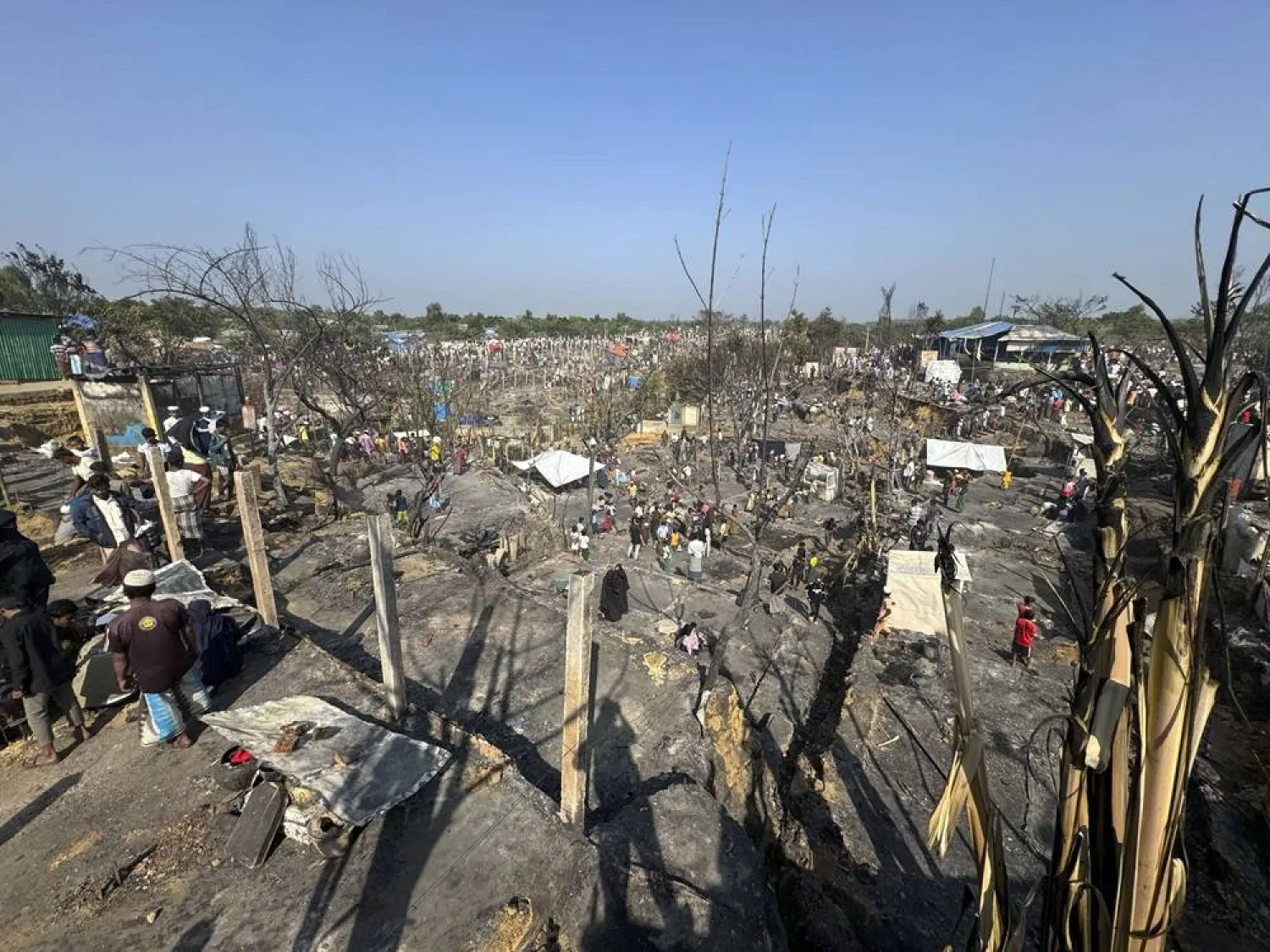
 Rohingya refugees look on after a midnight fire raced through their refugee camp at Kutupalong in Cox's Bazar district, Bangladesh, Sunday, Jan. 7, 2024. (AP)
Rohingya refugees look on after a midnight fire raced through their refugee camp at Kutupalong in Cox's Bazar district, Bangladesh, Sunday, Jan. 7, 2024. (AP)
TT

Out of Options, Rohingya are Fleeing Myanmar and Bangladesh by Boat Despite Soaring Death Toll

 Rohingya refugees look on after a midnight fire raced through their refugee camp at Kutupalong in Cox's Bazar district, Bangladesh, Sunday, Jan. 7, 2024. (AP)
Rohingya refugees look on after a midnight fire raced through their refugee camp at Kutupalong in Cox's Bazar district, Bangladesh, Sunday, Jan. 7, 2024. (AP)

Across a treacherous stretch of water, the Rohingya came by the thousands, then died by the hundreds. And though they know the dangers of fleeing by boat, many among this persecuted people say they will not stop — because the world has left them with no other choice.
Last year, nearly 4,500 Rohingya — two-thirds of them women and children — fled their homeland of Myanmar and the refugee camps in neighboring Bangladesh by boat, the United Nations’ refugee agency reported. Of those, 569 died or went missing while crossing the Bay of Bengal and Andaman Sea, the highest death toll since 2014, The Associated Press said.
The numbers mean one out of every eight Rohingya who attempted the crossing never made it, the United Nations High Commissioner for Refugees said last week.
Yet despite the risks, there are no signs the Rohingya will stop. On Thursday, Indonesian officials said another boat carrying Rohingya refugees landed in the country’s northern province of Aceh.
Fishermen provided food and water to 131 Rohingya, mostly women and children, who had been on board, said Marzuki, the leader of the local tribal fishing community, who like many Indonesians goes by one name.
Some passengers told officials they had been at sea for weeks and their boat's engine had broken down, leaving them adrift, said Lt. Col. Andi Susanto, commander of the navy base in Lhokseumawe.
“Southeast Asian waters are one of the deadliest stretches in the world and a graveyard for many Rohingya who have lost their lives,” says Babar Baloch, UNHCR’s spokesperson for Asia and the Pacific. “The rate of Rohingya who are dying at sea without being rescued — that’s really alarming and worrying.”
Inside the squalid refugee camps in Bangladesh, where more than 750,000 ethnic Rohingya Muslims fled in 2017 following sweeping attacks by Myanmar’s military, the situation has grown increasingly desperate. Not even the threat of death at sea is enough to stop many from trying to traverse the region’s waters in a bid to reach Indonesia or Malaysia.
“We need to choose the risky journey by boat because the international community has failed their responsibility,” says Mohammed Ayub, who is saving up money for a spot on one of the rickety wooden fishing boats traffickers use to ferry passengers 1,800 kilometers (1,100 miles) from Bangladesh to Indonesia.
Global indifference toward the Rohingya crisis has left those languishing in the overcrowded camps with few alternatives to fleeing. Because Bangladesh bans the Rohingya from working, their survival is dependent upon food rations, which were slashed last year due to a drop in global donations.
Returning safely to Myanmar is virtually impossible for the Rohingya, because the military that attacked them overthrew Myanmar’s democratically elected government in 2021. And no country is offering the Rohingya any large-scale resettlement opportunities.
Meanwhile, a surge in killings, kidnappings and arson attacks by militant groups in the camps has left residents fearing for their lives. And so, starving, scared and out of options, they continue to board the boats.
Ayub has lived in a sweltering, cramped shelter for more than six years in a camp where security and sanitation are scarce, and hope even scarcer. There is no formal schooling for his children, no way for him to earn money, no prospects for returning to his homeland and no refuge for his family amid spiraling gang violence.
“Of course I understand how dangerous the boat journey by sea is,” Ayub says. “We could die during the journey by boat. But it depends on our fate. ... It’s better to choose the dangerous way even if it’s risky, because we are afraid to stay in the camps.”
Two hundred of the people who died or went missing at sea last year were aboard one boat that left Bangladesh in November. Eyewitnesses on a nearby boat told The Associated Press that the missing vessel, which was crowded with babies, children and mothers, broke down and was taking on water before it drifted off during a storm as its passengers screamed for help. It has not been seen since.
It was one of several distressed boats that the region’s coastal countries neglected to save, despite the United Nations refugee agency's requests for those countries to launch search and rescue missions.
“When no action is taken, lives are lost,” says UNHCR’s Baloch. “If there is no hope restored in Rohingya lives either in Myanmar or in Bangladesh, there are no rescue attempts, (then) sadly we could see more desperate people dying in Southeast Asian seas under the watch of coastal authorities who could act to save lives.”
Six of Mohammed Taher’s family members were aboard the boat that vanished in November, including his 15-year-old brother, Mohammed Amin, and two of Taher’s nephews, ages 3 and 4. Their ultimate destination was Malaysia, a Muslim-majority country where many Rohingya seek relative safety.
Taher and his parents now struggle to sleep or eat, and spend their days agonizing over what became of their loved ones. Taher’s mother saw a fortune teller who said her relatives were still alive. Taher, meanwhile, dreamed that the boat made it to shore, where his relatives took refuge in a school and were able to bathe in warm water. But he remains unconvinced their journey ended so happily.
And so he has vowed to tell everyone to stay off the boats, no matter how unbearable life on land has become.
“I will never leave by boat on this difficult journey,” Taher says. “All the people who reached their destination are saying that it’s horrific traveling by boat.”
Yet such warnings are often futile. Ayub is now preparing to sell his daughter’s jewelry to help pay for his spot on a boat. While he is frightened by the stories of those who didn’t make it, he is motivated by the stories of those who did.
“Nobody would consider taking a risk by boat on a dangerous journey if they had better opportunities,” he says. “Fortunately, some people did reach their destination and got a better life. I am staying positive that Allah will save us.”



Senior Iranian Official: New Talks with US Planned in Early March, Interim Deal Possible

Pedestrians walk past a billboard depicting a US aircraft carrier with damaged fighter jets on its deck and a sign in Farsi and English reading, "If you sow the wind, you'll reap the whirlwind," in Tehran, Iran, Sunday, Feb. 22, 2026. (AP Photo/Vahid Salemi)
TT

Senior Iranian Official: New Talks with US Planned in Early March, Interim Deal Possible

Pedestrians walk past a billboard depicting a US aircraft carrier with damaged fighter jets on its deck and a sign in Farsi and English reading, "If you sow the wind, you'll reap the whirlwind," in Tehran, Iran, Sunday, Feb. 22, 2026. (AP Photo/Vahid Salemi)

Iran and the United States have differing views over the scope and mechanism to lift sanctions on Tehran in exchange for curbs on its nuclear program, a senior Iranian official told Reuters on Sunday, adding that new talks were planned in early March.

The official said Tehran could seriously ⁠consider a combination of ⁠exporting part of its highly enriched uranium (HEU) stockpile, diluting the purity of its HEU and a regional consortium for enriching uranium, but in return Iran's ⁠right to "peaceful nuclear enrichment" must be recognized.

"The negotiations continue and the possibility of reaching an interim agreement exists," the official said.

Iran's Foreign Minister Abbas Araqchi said on Friday that he expected to have a draft counterproposal ready within days following nuclear talks with the ⁠United ⁠States this week, while US President Donald Trump said he was considering limited military strikes.

The senior official said Tehran will not hand over control of its oil and mineral resources but US companies can always participate as contractors in Iran’s oil and gas fields.


Witkoff Says Trump Questioning why Iran Has Not 'Capitulated'

US Special Envoy Steve Witkoff listens as President Donald Trump (not pictured) speaks at the inaugural Board of Peace meeting at the US Institute of Peace in Washington, D.C., US, February 19, 2026. REUTERS/Kevin Lamarque
TT

Witkoff Says Trump Questioning why Iran Has Not 'Capitulated'

US Special Envoy Steve Witkoff listens as President Donald Trump (not pictured) speaks at the inaugural Board of Peace meeting at the US Institute of Peace in Washington, D.C., US, February 19, 2026. REUTERS/Kevin Lamarque

US envoy Steve Witkoff said on Saturday that President Donald Trump is questioning why Iran has not "capitulated" in the face of Washington's military build-up aimed at pressuring them into a nuclear deal.

The United States and Iran this week resumed Oman-mediated talks in Geneva aimed at averting the possibility of military action, after Washington dispatched two aircraft carriers, jets and weaponry to the region to back its warnings.

In a Fox News interview with Trump's daughter-in-law Lara, Witkoff said the president was "curious" about Iran's position after he had warned them of severe consequences in the event they failed to strike a deal.

"I don't want to use the word 'frustrated,' because he understands he has plenty of alternatives, but he's curious as to why they haven't... I don't want to use the word 'capitulated,' but why they haven't capitulated," AFP quoted him as saying.

"Why, under this pressure, with the amount of seapower and naval power over there, why haven't they come to us and said, 'We profess we don't want a weapon, so here's what we're prepared to do'? And yet it's sort of hard to get them to that place."

The US envoy also confirmed in the interview that he had met with Reza Pahlavi, who has not returned to Iran since before the 1979 Iranian Revolution that ousted the monarchy.

"I met him at the direction of the president," he said, without providing further details.

US-based Pahlavi last week told a crowd in Munich that he was ready to lead the country to a "secular democratic future" after Trump said regime change would be best for the country.

Witkoff's comments come after Iranian Foreign Minister Abbas Araghchi said a draft proposal for an agreement with Washington would be ready in a matter of days.

Trump said on Thursday that Iran had at most 15 days to make a deal on concerns starting with its nuclear program.

As talks between the two nations continued in Geneva, Iran's supreme leader Ali Khamenei on Tuesday said that Trump would not succeed in destroying the country.


Will Trump Accept a ‘Token’ Nuclear Enrichment in Iran?

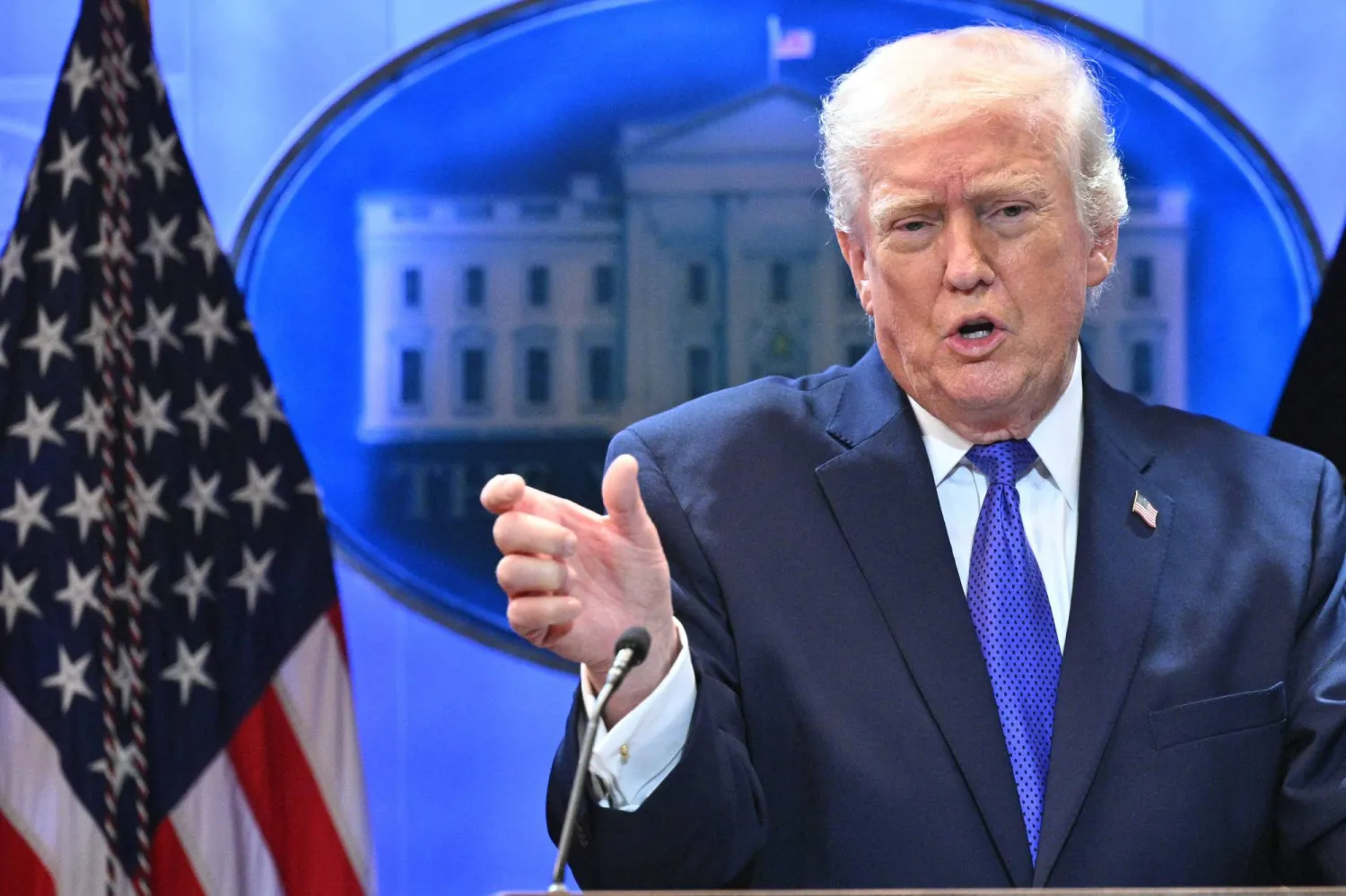
(FILES) US President Donald Trump speaks during a press conference in the Brady Press Briefing Room of the White House in Washington, DC, on February 20, 2026. (Photo by Mandel NGAN / AFP)
TT

Will Trump Accept a ‘Token’ Nuclear Enrichment in Iran?

(FILES) US President Donald Trump speaks during a press conference in the Brady Press Briefing Room of the White House in Washington, DC, on February 20, 2026. (Photo by Mandel NGAN / AFP)

The Trump administration is prepared to consider a proposal that allows Iran “token” nuclear enrichment if it leaves no possible path to a bomb, a senior US official told Axios on Saturday.

This suggests there could be an opening, if only a small one, between the red lines set by the US and Iran for a deal to constrain Iran's nuclear capabilities and prevent war, according to Axios.

The report published this week said that after the Geneva talks, US President Donald Trump's envoys Steve Witkoff and Jared Kushner asked Iranian Foreign Minister Abbas Araghchi to produce a detailed proposal addressing all the US concerns regarding Iran's nuclear program.

A senior US official said Witkoff and Kushner told Araghchi that Trump's position was “zero enrichment” on Iranian soil.

But the official said that if the proposal includes “small, token enrichment,” and if the Iranians offer detailed proof that it poses no threat, the US will study it.
Another senior Trump adviser said: “Trump is keeping his options open. He could decide on an attack at any moment.”

Pezeshkian: We Will Not Bow Our Heads

Meanwhile, Iranian ⁠President Masoud Pezeshkian said on Saturday that his country would not bow its ⁠head to pressure from world powers.

“World powers are lining up to force us to bow our heads... but we will not bow our heads despite all the problems that they are creating for us,” Pezeshkian said in a speech carried live by ⁠state TV.

But a senior US official told Axios that “Trump will be ready to accept a deal that would be substantive and that he can sell politically at home. If the Iranians want to prevent an attack they should give us an offer we can't refuse. The Iranians keep missing the window. If they play games there won't be a lot of patience.”

At the same time, Trump has been presented with military options that involve directly targeting the supreme leader.

The Trump adviser said the Pentagon had presented the US President with numerous options.

“They have something for every scenario. One scenario takes out the ayatollah and his son and the mullahs,” the adviser said, referring to Supreme Leader Ali Khamenei and his son Mojtaba, who is seen as a potential successor. “What the president chooses no one knows. I don't think he knows.”

A second source confirmed a plan to kill Khamenei and his son was floated to Trump several weeks ago.

Another senior Trump adviser said: “Trump is keeping his options open. He could decide on an attack at any moment.”

Zero Enrichment

In return, a senior US official said Witkoff and Kushner told Araghchi that Trump's position was “zero enrichment” on Iranian soil. But the official said that if the proposal includes “small, token enrichment,” and if the Iranians offer detailed proof that it poses no threat, the US will study it.

A source familiar with the talks told Axios that regional mediators told Iran and the US in recent days that any deal must enable both sides to claim victory and, if possible, also be something that Gulf countries can accept.

With the region bracing for war, the US official insisted that Washington would wait for Iran's proposal before deciding how to proceed, and whether there will be another round of talks.

CBS News quoted US officials as saying on Wednesday that Iran had floated the idea of pausing uranium enrichment for a specified period of time, possibly one to three years or five years, while some said this period covered the remainder of Trump's years in the White House.

For his part, Araghchi said on Friday that “Washington has not asked Tehran to permanently suspend uranium enrichment,” adding Tehran had not offered the US a temporary suspension of its uranium enrichment.

Iran's foreign minister said he expected to have a draft counterproposal ready within days following nuclear talks with the United States this ⁠week, while Trump said he was considering limited military strikes.

Two US officials told Reuters that US military planning on Iran had reached an advanced stage, with options including targeting individuals as part of an attack and even pursuing leadership change in Tehran, if ordered by Trump.

Araghchi said after indirect discussions in Geneva this week with Witkoff and Kushner that the sides had reached an understanding on main “guiding principles,” but that did not mean a deal was ⁠imminent.

The foreign minister, in an interview on MS NOW, said he had a draft counterproposal that could be ready in the next two or three days for top Iranian officials to review, with more US-Iran talks possible in a week or so.