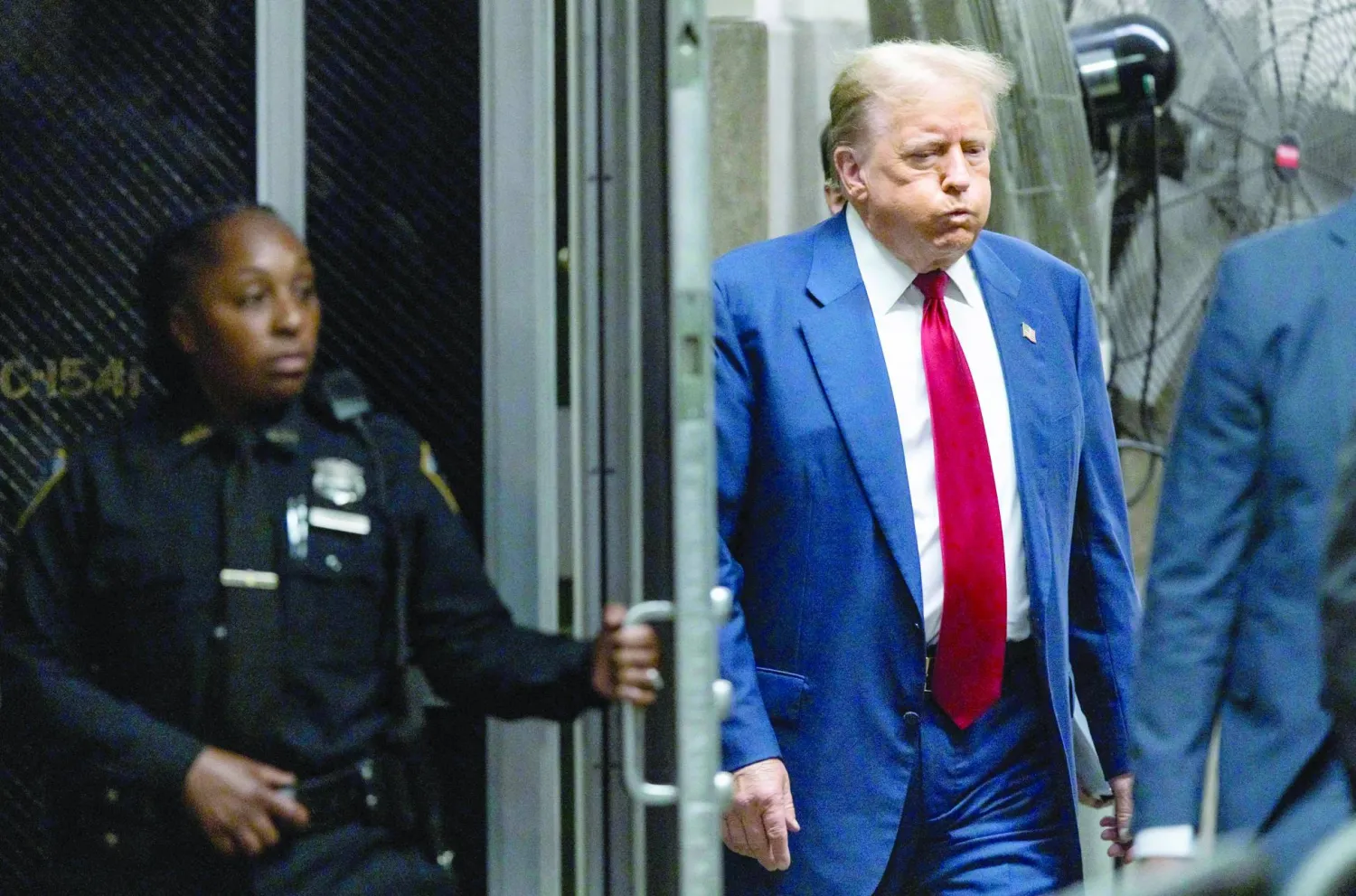
Trump Held in Contempt, Fined $9K for Violating Gag Order in Hush Money Trial

Former US President Donald Trump walks back to the courtroom after a break in his trial for allegedly covering up hush money payments linked to extramarital affairs, at Manhattan Criminal Court in New York City, on April 30, 2024. (Photo by JUSTIN LANE / POOL / AFP)
TT

Trump Held in Contempt, Fined $9K for Violating Gag Order in Hush Money Trial

Former US President Donald Trump walks back to the courtroom after a break in his trial for allegedly covering up hush money payments linked to extramarital affairs, at Manhattan Criminal Court in New York City, on April 30, 2024. (Photo by JUSTIN LANE / POOL / AFP)

Donald Trump was held in contempt of court Tuesday and fined $9,000 for repeatedly violating a gag order that barred him from making public statements about witnesses, jurors and some others connected to his New York hush money case. If he does it again, the judge warned, he could be jailed.
Prosecutors had alleged 10 violations, but New York Judge Juan M. Merchan found there were nine. Trump stared down at the table in front of him as the judge read the ruling, frowning slightly.
It was a stinging rebuke of the presumptive Republican presidential nominee’s insistence that he was exercising his free speech rights and a reminder that he’s a criminal defendant subject to the harsh realities of trial procedure. And the judge’s remarkable threat to jail a former president signaled that Trump’s already precarious legal standing could further spiral depending on his behavior during the remainder of the trial.
Merchan wrote that he is “keenly aware of, and protective of,” Trump’s First Amendment rights, “particularly given his candidacy for the office of President of the United States.”
“It is critically important that defendant’s legitimate free speech rights not be curtailed, that he be able to fully campaign for the office which he seeks and that he be able to respond and defend himself against political attacks,” Merchan wrote.
Still, he warned that the court would not tolerate "willful violations of its lawful orders and that if necessary and appropriate under the circumstances, it will impose an incarceratory punishment.”
With that statement, the judge drew nearer the specter of Trump becoming the first former president of the United States behind bars.
“This gag order is totally unconstitutional,” Trump said as court adjourned after a day that included testimony from a Hollywood lawyer who negotiated two of the hush money deals at issue in the case. “I’m the Republican candidate for president of the United States ... and I’m sitting in a courthouse all day long listening to this stuff.”
Trump is used to having constant access to his social media bullhorn to slam opponents and speak his mind. After he was banned from Twitter following the Jan. 6, 2021, attack on the Capitol by his supporters, Trump launched his own platform, where his posts wouldn’t be blocked or restricted. He has long tried to distance himself from controversial messages he’s amplified to his millions of followers by insisting they’re “only retweets.”
But he does have experience with gag orders, which were also imposed in other legal matters. After he was found to have violated orders in his civil fraud trial, he paid more than $15,000 in fines.
Trump also is subject to a gag order in his federal criminal election interference case in Washington. That order limits what he can say about known or reasonably foreseeable witnesses in the case and about court staff and other lawyers, though an appeals court freed him to speak about special counsel Jack Smith, who brought the case.
Tuesday's ruling in New York came at the start of the second week of testimony in the historic case, which involves allegations that Trump and his associates took part in an illegal scheme to influence the 2016 presidential campaign by purchasing and then burying seamy stories. The payouts went to a doorman with a torrid yarn; ex-Playboy model Karen McDougal, who had accusations of an affair; and to porn performer Stormy Daniels, who alleged a sexual encounter with Trump. He has pleaded not guilty and says the stories are all fake.
Trump deleted, as ordered, the offending posts from his Truth Social account and campaign website and has until Friday to pay the fine. The judge was also weighing other alleged gag-order violations by Trump and will hear arguments Thursday. He also announced that he will halt the trial on May 17 to allow Trump to attend his son Barron's high school graduation.
Of the 10 posts, the one Merchan ruled was not a violation came on April 10, a post referring to witnesses Michael Cohen and Daniels as “sleaze bags." Merchan said Trump’s contention that he was responding to previous posts by Cohen “is sufficient to give” him pause on whether the post was a violation.
Merchan cautioned that the gag order “not be used as a sword instead of a shield by potential witnesses” and that if people who are protected by the order, like Cohen, continue to attack Trump “it becomes apparent” they don’t need the gag order’s protection.
Cohen, Trump’s former attorney, has said he will refrain from commenting about Trump until after he testifies. On Tuesday, he said in a text message to The Associated Press: “Judge Merchan’s decision elucidates that this behavior will not be tolerated and that no one is above the law."
In other developments, testimony resumed Tuesday with a banker who helped Cohen open accounts, including one used to buy Daniels' silence. Trump’s attorneys have suggested that the payments were aimed at protecting his name and his family — not influencing the outcome of the presidential election.
Jurors also began hearing from Keith Davidson, a lawyer who represented McDougal and Daniels in their negotiations with the National Enquirer and Cohen. He testified that he arranged a meeting at his Los Angeles office during the summer of 2016 to see whether the tabloid's parent company American Media, Inc. was interested in McDougal’s story. At first they demurred, saying she “lacked documentary evidence of the interaction,” Davidson testified.
But the tabloid at the behest of publisher David Pecker eventually bought the rights, and Davidson testified that he understood — and McDougal preferred — it would never be published. Asked why American Media Inc., would buy a story it didn’t intend to run, Davidson said he was aware of two reasons.
“One explanation I was given is they were trying to build Karen into a brand and didn’t want to diminish her brand,” he said. “And the second was an unspoken understanding that there was an affiliation between David Pecker and Donald Trump and that AMI wouldn’t run this story, any story related to Karen, because it would hurt Donald Trump.”
As for Daniels, the October 2016 leak of Trump’s 2005 “Access Hollywood” tape — in which Trump bragged about grabbing women sexually without asking permission — had “tremendous influence” on the marketability of her story. Before the video was made public, “there was very little if any interest” in her claims, Davidson told jurors.
A deal was reached with the tabloid for Daniels story, but the Enquirer backed out. Though Pecker testified that he had agreed to serve as the Trump campaign’s “eyes and ears” by helping to squelch unflattering rumors and claims about Trump and women, he drew the line with Daniels after paying out $180,000 to scoop up and sit on stories. Davidson began negotiating with Cohen directly, hiked up the price to $130,000, and reached a deal.
But Daniels and Davidson grew frustrated as weeks passed and instead of the money, she got excuses from Cohen about broken computers, Secret Service “firewalls” and the Jewish holiday of Yom Kippur.
“I thought he was trying to kick the can down the road until after the election,” Davidson said.
While Cohen never explicitly said he was negotiating the deal on Trump’s behalf, Davidson felt the implication was clear.
“Every single time I talked to Michael Cohen, he leaned on his close affiliation with Donald Trump,” Davidson said. Plus, he figured that Trump “was the beneficiary of this contract.”
The GOP presidential hopeful is charged with 34 felony counts of falsifying business records in connection with the hush money payments. The detailed evidence on business transactions and bank accounts is setting the stage for testimony from Cohen, who went to federal prison after pleading guilty in 2018 to campaign finance violations and other crimes.
The trial — the first of Trump's four criminal cases to come before a jury — is expected to last for another month or more.



US Military Tells Trump It's ‘Ready’ to Strike Iran as Soon as Saturday

A shot showing personnel preparations aboard the US aircraft carrier "Gerald Ford" (US Navy)
TT

US Military Tells Trump It's ‘Ready’ to Strike Iran as Soon as Saturday

A shot showing personnel preparations aboard the US aircraft carrier "Gerald Ford" (US Navy)

Top national security officials have told President Trump the military is ready for potential strikes on Iran as soon as Saturday, but the timeline for any action is likely to extend beyond this weekend, sources familiar with the discussions told CBS News.

Trump has not yet made a final decision about whether to strike, said the officials, who spoke under condition of anonymity to discuss sensitive national matters.

The conversations have been described as fluid and ongoing, as the White House weighs the risks of escalation and the political and military consequences of restraint, added CBS.

Over the next three days, the Pentagon is moving some personnel temporarily out of the Middle East region — primarily to Europe or back to the United States — ahead of potential action or counterattacks by Iran if the US were to move ahead with its operation, according to multiple officials.

It's standard practice for the Pentagon to shift assets and personnel ahead of a potential US military activity and doesn't necessarily signal an attack on Iran is imminent, one of the sources told CBS.

Contacted by CBS News on Wednesday afternoon, a Pentagon spokesperson said they had no information to provide.

Iran was discussed in the White House Situation Room on Wednesday, a US official and a senior military official told CBS News. All military forces deployed to the region are expected to be in place by mid-March.

Axios had also said that a war between the United States and Iran is looming — and there are several factors suggesting President Trump might push the button soon.

On Wednesday, Iran's top diplomat Abbas Araghchi said that Tehran was "drafting" a framework for future talks with the United States, as the US energy secretary said Washington would stop Iran's nuclear ambitions "one way or another".


Satellite Images Show Iran Repairing and Fortifying Sites amid US Tensions

A satellite image shows tunnel entrances covered with soil at Isfahan nuclear complex, in Isfahan, Iran, February 10, 2026. Vantor/Handout via REUTERS
TT

Satellite Images Show Iran Repairing and Fortifying Sites amid US Tensions

A satellite image shows tunnel entrances covered with soil at Isfahan nuclear complex, in Isfahan, Iran, February 10, 2026. Vantor/Handout via REUTERS

Satellite images show that Iran has recently built a concrete shield over a new facility at a sensitive military site and covered it in soil, experts say, advancing work at a location reportedly bombed by Israel in 2024 amid tensions with the US.

Images also show that Iran has buried tunnel entrances at a nuclear site bombed by the US during Israel's 12-day war with Iran last year, fortified tunnel entrances near another, and has repaired missile bases struck in the conflict.

They offer a glimpse of Iranian activities at some of the sites at the center of tensions with Israel and the US, as Washington seeks to negotiate a deal with Tehran on its nuclear program while threatening military action if talks fail.

Some 30 km (20 miles) southeast of Tehran, the Parchin complex is one of Iran's most sensitive military sites. Western intelligence has suggested Tehran carried out tests relevant to nuclear bomb detonations there more than two decades ago.

Iran has always denied seeking atomic weapons. Israel reportedly struck Parchin in October 2024.

Satellite imagery taken before and after that attack shows extensive damage to a rectangular building at Parchin, and apparent reconstruction in images from November 6, 2024.

Imagery from October 12, 2025 shows development at the site, with the skeleton of a new structure visible and two smaller structures adjacent to it. Progress is apparent in imagery from November 14, with what appears to be a metallic roof covering the large structure.

But imagery from December 13 shows the facility partly covered. By February 16, it cannot be seen at all, hidden by what experts say is a concrete structure.

The Institute for Science and International Security (ISIS), in a January 22 analysis of satellite imagery, pointed to progress in the construction of a "concrete sarcophagus" around a newly built facility at the site, which it identified as Taleghan 2.

ISIS reported in November that imagery showed "ongoing construction and the presence of what appears to resemble a long, cylindrical chamber, maybe a high-explosives containment vessel, likely measuring approximately 36 meters long and 12 meters in diameter placed inside a building".

"High-explosive containment vessels are critical to the development of nuclear weapons," ISIS added, "but can also be used in many other conventional weapons development processes."

William Goodhind, a forensic imagery analyst with Contested Ground, said the roof had a similar hue to the surrounding area, adding: "It has most likely been covered with dirt to obscure the concrete color."

ISIS founder David Albright wrote on X: "Stalling the negotiations has its benefits: Over the last two to three weeks, Iran has been busy burying the new Taleghan 2 facility ... More soil is available and the facility may soon become a fully unrecognizable bunker, providing significant protection from aerial strikes."

TUNNEL ENTRANCES BURIED AT ISFAHAN NUCLEAR COMPLEX

The Isfahan complex is one of three Iranian uranium-enrichment plants bombed by the United States in June.

In addition to facilities that are part of the nuclear fuel cycle, Isfahan includes an underground area where diplomats say much of Iran's enriched uranium has been stored.

Satellite images taken in late January showed new efforts to bury two tunnel entrances at the complex, ISIS reported on January 29. In a February 9 update, ISIS said a third entrance had also been backfilled with soil, meaning all entrances to the tunnel complex were now "completely buried".

A February 10 image shows all three tunnels buried, Goodhind said.

ISIS reported on February 9 that "backfilling the tunnel entrances would help dampen any potential airstrike and also make ground access in a special forces raid to seize or destroy any highly enriched uranium that may be housed inside difficult".

TUNNEL ENTRANCES FORTIFIED AT COMPLEX NEAR NATANZ SITE

ISIS has reported that satellite images point to ongoing efforts since February 10 to "harden and defensively strengthen" two entrances to a tunnel complex under a mountain some 2 km (1.2 miles) from Natanz - the site that holds Iran's other two uranium enrichment plants.

Imagery shows "ongoing activity throughout the complex related to this effort, involving the movement of numerous vehicles, including dump trucks, cement mixers, and other heavy equipment", ISIS wrote.

Iran's plans for the facility, called Pickaxe Mountain, are unclear, ISIS said.

SHIRAZ SOUTH MISSILE BASE

About 10 km (6 miles) south of Shiraz in southern Iran, this is one of 25 primary bases capable of launching medium-range ballistic missiles, according to Alma Research and Education Center, an Israeli organization. Alma assessed the site had suffered light, above-ground damage in last year's war.

A comparison of images taken on July 3, 2025 and January 30 shows reconstruction and clearance efforts at the main logistics and likely command compound at the base, Goodhind said.

"The key takeaway is that the compound has yet to return to its full operational capacity from prior to the airstrikes."

QOM MISSILE BASE

Some 40 km north of the city of Qom, this base suffered moderate above-ground damage, according to Alma.

A comparison of images taken between July 16, 2025, and February 1 shows a new roof over a damaged building. The roof repairs appear to have begun on November 17 and were most likely complete 10 days later, Goodhind said.


Iranian Mourning Ceremonies Prompt New Crackdowns in Echo of 1979 Revolution

Iranians walk on a street in Tehran, Iran, 16 February 2026. (EPA)
TT

Iranian Mourning Ceremonies Prompt New Crackdowns in Echo of 1979 Revolution

Iranians walk on a street in Tehran, Iran, 16 February 2026. (EPA)

Iranians have returned to the streets this week to mourn those killed by security forces during last month's anti-government demonstrations, sparking some new crackdowns in an echo of the 1979 revolution that brought down the US-backed Shah.

The anti-Shah revolutionaries turned Shiite Muslim memorial processions 40 days after each death into new protests, which prompted renewed violence from the authorities and fresh "martyrs" for the cause.

The clerical establishment's opponents, deploying the same tactics after five decades, have yet to match the momentum of those times, but Iran's clerical rulers, threatened with military attack by US President Donald Trump over their nuclear and security policies, have demonstrated their concern.

They deployed security forces to some cemeteries and invited citizens to attend state-organized 40-day "Chehelom" ceremonies on Tuesday after apologizing to "all those affected" by violence they blamed on people described as "terrorists".

"They tried to prevent history repeating itself by holding these ceremonies in mosques across ‌the country. To ‌prevent any gatherings of angry families in cemeteries, but they failed," said one rights activist ‌in ⁠Iran who declined ⁠to be named for fear of retribution.

SECURITY FORCES CLASH WITH MOURNERS

Videos circulating on social media showed families holding their own memorials across Iran on Tuesday, 40 days after security forces began two days of widespread shooting that human rights groups say killed thousands of protesters.

Some of Tuesday's memorials turned into wider anti-government protests and some were met with deadly force.

In the Kurdish town of Abdanan in Ilam province, witnesses and activists said security forces opened fire on hundreds of mourners gathered at a cemetery.

Videos showed people scattering as gunfire rang out amid chants of "Death to the dictator", a reference to Iran's Supreme Leader Ali Khamenei.

Reuters journalists verified that ⁠the videos were filmed at the cemetery. They were unable to verify the date but ‌found no versions posted before Tuesday: eyewitnesses and activists said that was when ‌people gathered at the cemetery were fired upon.

Hengaw, a Kurdish Iranian rights group, said at least three people were injured and nine ‌arrested in Abdanan. Similar clashes were reported in Mashhad and Hamedan. Sources in Iran said internet access was heavily restricted ‌in those cities.

WEDNESDAY IS 40 DAYS SINCE HEIGHT OF JANUARY PROTESTS

More mourning ceremonies were expected to be taking place on Wednesday, 40 days since the deadliest two days of the January unrest, although communications restrictions meant that it was not immediately possible to tell how many or their outcome.

January's unrest grew from modest economic protests in December among traders in Tehran's Grand Bazaar into the gravest threat to ‌Iran's theocracy in nearly five decades, with protesters calling for ruling clerics to step down.

Authorities cut internet access, blaming "armed terrorists" linked to Israel and the United States ⁠for the violence, and have arrested ⁠journalists, lawyers, activists, human rights advocates and students, rights groups say.

Iranian officials have told Reuters the leadership is worried a US strike could erode its grip on power by fueling more protests. Repression, inequality, corruption and the sponsorship of proxies abroad are the main grievances.

"How long can they kill people to stay in power? People are angry, people are frustrated," said government employee Sara, 28, from the central city of Isfahan.

"The Islamic Republic has brought nothing but war, economic misery and death to my country".

Trump has deployed aircraft carriers, fighter jets, guided-missile destroyers and other capabilities to the Middle East for a possible attack if talks to limit Iran's nuclear program and weaken its foreign proxies do not yield results.

Even without a US attack, continued isolation from Western sanctions would likely fuel further public anger.

In 1979, the anti-Shah revolt in provincial towns and villages was amplified by oil workers whose strikes cut most of Iran's revenue, and bazaar merchants who funded the rebel clerics.

This time there have been no reports of either, but people have adopted some of the small-scale tactics, chanting “Allah is great” and “Death to the dictator”, often from rooftops, during nightly demonstrations, according to witnesses and social media posts.