


French Vote Gives Leftists Most Seats over Far-Right, but Leaves Hung Parliament and Deadlock

Fireworks go off as people gather in front of "Le triomphe de la Republique" statue during an election night rally following the first results of the second round of France's legislative election at Republique Square in Paris on July 7, 2024. (AFP)
TT

French Vote Gives Leftists Most Seats over Far-Right, but Leaves Hung Parliament and Deadlock

Fireworks go off as people gather in front of "Le triomphe de la Republique" statue during an election night rally following the first results of the second round of France's legislative election at Republique Square in Paris on July 7, 2024. (AFP)

A coalition of the French left won the most seats in high-stakes legislative elections Sunday, according to near-final results, beating back a far-right surge but failing to win a majority. The outcome left France facing the stunning prospect of a hung parliament and threatened political paralysis in a pillar of the European Union and Olympic host country.

That could rattle markets and the French economy, the EU’s second-largest, and have far-ranging implications for the war in Ukraine, global diplomacy and Europe’s economic stability.

In calling the election on June 9, after the far-right surged in French voting for the European Parliament, Macron said sending voters back to the ballot boxes would provide "clarification."

On almost every level, that gamble appears to have backfired. Results so far showed France plunged into a political fog, with the three main blocs — a leftist coalition, the far-right National Rally and Macron's centrists — all falling well short of the 289 seats needed to control the 577-seat National Assembly.

French Prime Minister Gabriel Attal addresses the media after the announcement of the results of the second round of the legislative elections at Hotel Matignon in Paris, France, 07 July 2024. (EPA)

"Our country is facing an unprecedented political situation and is preparing to welcome the world in a few weeks," said Prime Minister Gabriel Attal, who plans to offer his resignation on Monday.

With the Olympics looming, he said he was ready to stay at his post "as long as duty demands." Macron has three years remaining on his presidential term.

Attal made clearer than ever his disapproval of Macron's shock decision to call the election, saying "I didn't choose this dissolution" of the outgoing National Assembly, where the president's centrist alliance used to be single biggest group, albeit without an absolute majority. Still, it was able to govern for two years, pulling in lawmakers from other camps to fight off efforts to bring it down.

The new legislature appears shorn of such stability. With most ballots counted, the leftist coalition was leading Macron’s centrist alliance, with the far-right in third. That confirms the picture also given by pollsters’ projections.

In Paris’ Stalingrad square, supporters on the left cheered and applauded as projections showing the alliance ahead flashed up on a giant screen. Cries of joy also rang out in Republique plaza in eastern Paris, with people spontaneously hugging strangers and several minutes of nonstop applause after the projections landed.

Marielle Castry, a medical secretary, was on the metro in Paris, when the projections were first announced.

"Everybody had their smartphones and were waiting for the results and then everybody was overjoyed," said the 55-year-old. "I had been stressed out since June 9 and the European elections. ... And now, I feel good. Relieved."

Protesters hold a banner as they march during a demonstration following the announcement of the first results of the second round of France's crunch legislative elections in Nantes, western France on July 7, 2024. (AFP)

A redrawn political map Even before votes were cast, the election redrew France's political map. It galvanized parties on the left to put differences aside and join together in a new alliance, the New Popular Front, behind pledges to roll back many of Macron's headline reforms, embark on a massively costly program of public spending and, in foreign policy, take a far tougher line against Israel because of the war with Hamas.

Macron described the left's coalition as "extreme" and warned that its economic program of many tens of billions of euros in public spending, partly financed by tax hikes for high earners and on wealth, could be ruinous for France, already criticized by EU watchdogs for its debt.

Yet, with the projections and then the near-final results showing the New Popular Front with the most seats, its leaders immediately pushed Macron to give the alliance the first chance to form a government and propose a prime minister to share power with the president.

The most prominent of the leftist coalition’s leaders, Jean-Luc Mélenchon, said it "is ready to govern."

Although the National Rally fell far short of its hopes of securing an absolute majority that would have given France its first far-right government since World War II, the anti-immigration party with historical links to antisemitism and racism was on track to have more seats than ever in the National Assembly.

After the party finished top of the first-round vote last weekend, its rivals worked together to dash its hopes of an outright victory in Sunday’s runoff, by strategically withdrawing candidates from many districts. That left many far-right candidates in head-to-head contests against just one opponent, making it harder for them to win.

Many voters decided that keeping the far-right from power was more important to them than anything else, backing its opponents in the second round, even if they weren’t from the political camp they usually support.

National Rally leader Marine Le Pen, thought to be eyeing what would be her forth run for the French presidency in 2027, said the elections laid the groundwork for "the victory of tomorrow."

"The tide is rising," she said. "It did not rise high enough this time."

"The reality is that our victory is only deferred," she added.

French far-right leader Marine Le Pen talks to journalists after partial results in the second round of the early French parliamentary elections, at the French far-right Rassemblement National (National Rally - RN) party venue in Paris, France, July 7, 2024. (Reuters)

Jordan Bardella, Le Pen’s 28-year-old protégé who’d been hoping to become prime minister, rued that the outcome of the vote "throws France into the arms of the extreme left."

In a statement from his office, Macron indicated that he wouldn’t be rushed into inviting a potential prime minister to form a government. It said he was watching as results come in and would wait for the new National Assembly to take shape before taking "the necessary decisions."

A hung parliament is unknown territory for modern France.

Unlike other countries in Europe that are more accustomed to coalition governments, France doesn’t have a tradition of lawmakers from rival political camps coming together to form a majority. France is also more centralized than many other European countries, with many more decisions made in Paris.

The president was hoping that with France’s fate in their hands, voters might shift from the far-right and left and return to mainstream parties closer to the center — where Macron found much of the support that won him the presidency in 2017 and again in 2022.

But rather than rally behind him, millions of voters seized on his surprise decision as an opportunity to vent their anger.

In last weekend’s first round of balloting, voters backed candidates from the National Rally, while the coalition of parties on the left took second and his centrist alliance was a distant third.

The sharp polarization of French politics – especially in this torrid and quick campaign – is sure to complicate any coalition-building effort. Racism and antisemitism marred the electoral campaign, along with Russian disinformation campaigns, and more than 50 candidates reported being physically attacked — highly unusual for France.



Pope Leo Downplays Feud with Trump, Says ‘Not in My Interest’ to Debate Him

Pope Leo XIV delivers a speech during a meeting with the authorities, civil society and the diplomatic corps at the Presidential Palace in Luanda, Angola, 18 April 2026. (EPA)
TT

Pope Leo Downplays Feud with Trump, Says ‘Not in My Interest’ to Debate Him

Pope Leo XIV delivers a speech during a meeting with the authorities, civil society and the diplomatic corps at the Presidential Palace in Luanda, Angola, 18 April 2026. (EPA)

Pope Leo sought to downplay his feud with US President Donald Trump on Saturday, saying reporting about comments he has made so far during his Africa tour "has not been accurate in all its aspects".

Speaking to reporters in English aboard his flight to Angola for the third leg of his ambitious 10-day Africa tour, the first US pope said comments he made two days earlier in Cameroon decrying that the world was being "ravaged by a handful of tyrants" were not aimed at Trump.

That speech, said Leo, "was prepared two weeks ago, well before the president ‌ever commented on ‌myself and on the message of peace that ‌I ⁠am promoting".

Vice President ⁠JD Vance, who had criticized the pope's remarks last week, welcomed his latest comments.

"I am grateful to Pope Leo for saying this," Vance posted on social media platform X. "While the media narrative constantly gins up conflict — and yes, real disagreements have happened and will happen — the reality is often much more complicated."

On Sunday, as Leo prepared to embark on his ⁠tour, Trump called him "WEAK on Crime, and terrible for ‌Foreign Policy" in a post on Truth ‌Social.

Pope Leo told Reuters on Monday that he would keep speaking out about the war, and ‌Trump reiterated his criticism on Tuesday. On Thursday, Pope Leo blasted leaders who spend billions on wars and said ⁠the world ⁠was "being ravaged by a handful of tyrants", though he did not mention Trump directly again.

"As it happens, it was looked at as if I was trying to debate the president, which is not in my interest at all," the pontiff said on Saturday.

Leo, originally from Chicago, kept a relatively low profile for a pope in his first 10 months but has debuted a new forceful speaking style in Africa, sharply denouncing war, inequality and global leaders.

His Africa tour is one of the most complicated ever arranged for a pontiff, with stops in 11 cities and towns in four countries, traversing nearly 18,000 km (11,185 miles) over 18 flights.


Iran Says Final Deal Still Far off as Hormuz Strait Shuttered

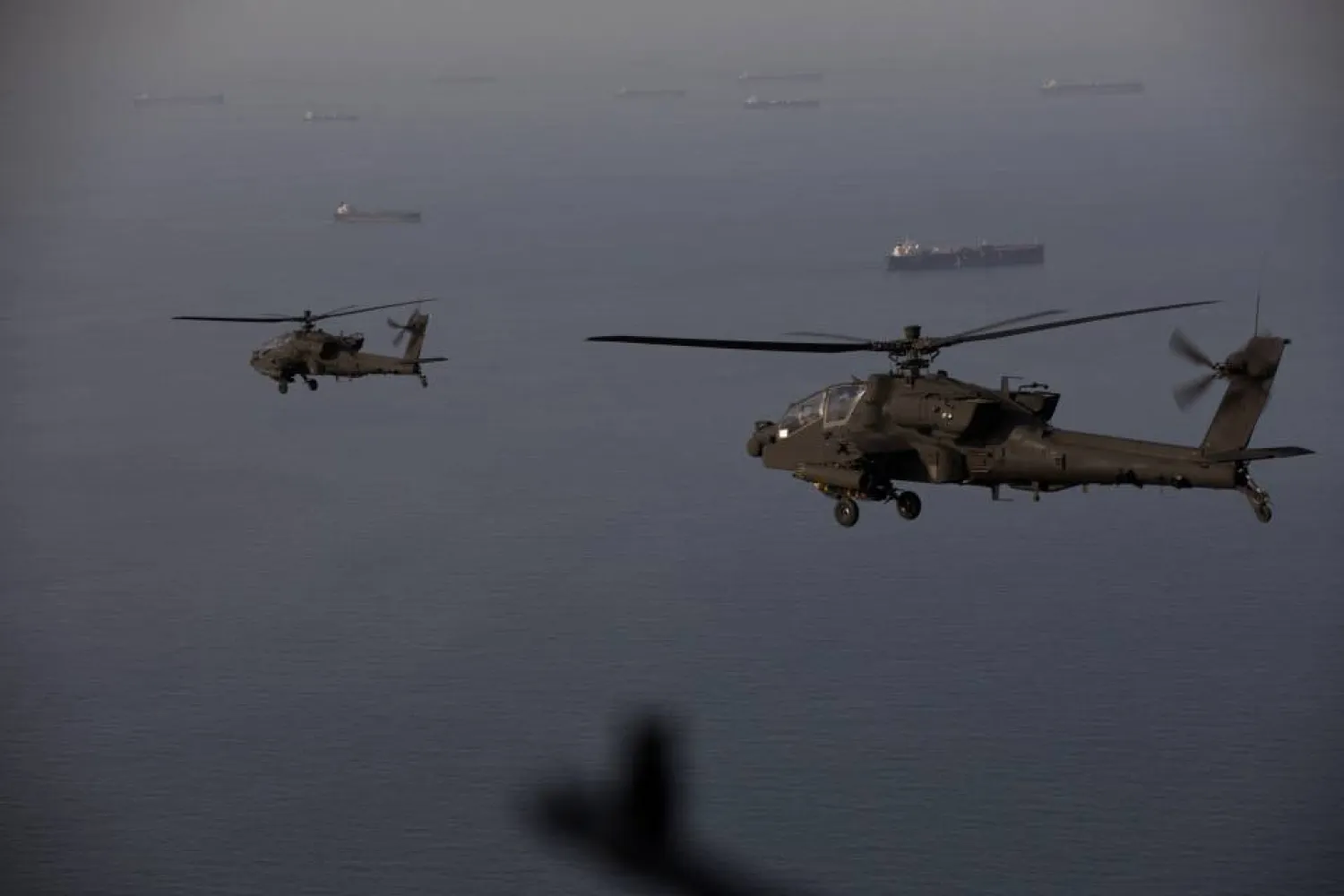
This handout photo released by US Central Command via their X account (@CENTCOM) on April 18, 2026 shows AH-64 Apaches flying above the Strait of Hormuz during a patrol on April 17, 2026. (US Central Command (CENTCOM) / AFP)
TT

Iran Says Final Deal Still Far off as Hormuz Strait Shuttered

This handout photo released by US Central Command via their X account (@CENTCOM) on April 18, 2026 shows AH-64 Apaches flying above the Strait of Hormuz during a patrol on April 17, 2026. (US Central Command (CENTCOM) / AFP)

The strategic Strait of Hormuz was again closed on Sunday in the stand-off between Iran and the United States, with Iran's powerful parliament speaker signalling a final peace deal remained "far" off despite some movement in negotiations. 

As mediation efforts continued following high-level talks in Pakistan that failed to reach a deal, Iran said it will not allow the crucial maritime trade chokepoint to re-open until the United States ends a blockade of Iranian ports. 

Mohammad Bagher Ghalibaf, speaker of the Iranian parliament, said in a televised address on Saturday night that there had been "progress" with Washington "but there are many gaps and some fundamental points remain". 

"We are still far from the final discussion," said Ghalibaf, one of Tehran's negotiators in the talks aimed at ending the war launched by Israel and the United States against Iran. 

A two-week ceasefire is set to end on Wednesday unless it is renewed. 

US President Donald Trump said "very good conversations" were going on with Iran but warned Tehran against trying to "blackmail" the United States. 

On Friday, Tehran had declared the Strait of Hormuz, through which a fifth of the world's oil and liquefied natural gas usually transits, open after a temporary ceasefire was agreed to halt Israel's war with Iran's ally Hezbollah in Lebanon. 

That prompted elation in global markets and sent oil prices plunging, but Tehran reversed course after Trump insisted the US blockade of Iranian ports would continue until a final deal was struck. 

"If America does not lift the blockade, traffic in the Strait of Hormuz will definitely be limited," Ghalibaf said. 

Iran's supreme leader Mojtaba Khamenei, who has yet to be seen since taking power after his father was killed in the war's opening strikes, said in a written message that Iran's navy "stands ready" to defeat the United States. 

Trump accused Iran of getting "a little cute" with its recent moves and warned Tehran not to try to "blackmail" Washington by flip-flopping on the strait. 

"We have very good conversations going on," the president told reporters at the White House, adding that the United States was "taking a tough stand". 

- 'Targeted' - 

Iran's Revolutionary Guards warned that any attempt to pass through the strait without permission "will be considered cooperation with the enemy, and the offending vessel will be targeted". 

A handful of oil and gas tankers crossed the strait early on Saturday during the brief reopening, tracking data showed, but others retreated and hardly any vessels were crossing the waterway by the late afternoon. 

A UK maritime security agency said the Revolutionary Guards fired at one tanker, while security intelligence firm Vanguard Tech reported the force had threatened to "destroy" an empty cruise ship that was fleeing the Gulf. 

In a third incident, the UK agency said it received a report of a vessel "being hit by an unknown projectile, which caused damage" to shipping containers but no fire. 

The Indian foreign ministry said it had summoned the Iranian ambassador to lodge a protest over a "shooting incident" involving two Indian-flagged ships in the strait. 

- French UN peacekeeper killed - 

On the diplomatic front, Egypt, which has been involved in mediation efforts with Pakistan, appeared optimistic on Saturday with Foreign Minister Badr Abdelatty saying Cairo and Islamabad hoped to secure a final agreement "in the coming days". 

A major sticking point has been Iran's stockpile of near-weapons-grade enriched uranium. 

Trump said Friday that Iran had agreed to hand over its roughly 440 kilograms of enriched uranium. "We're going to get it by going in with Iran, with lots of excavators," he said. 

Iran's foreign ministry has said the stockpile, thought to be buried deep under rubble from US bombing in last June's 12-day war, was "not going to be transferred anywhere" and surrendering it "to the US has never been raised in negotiations". 

The Middle East war began on February 28 with a massive wave of US-Israeli attacks on Iran, despite Washington and Tehran being engaged in negotiations at the time. 

The conflict rapidly spread across the region, with Iran targeting neighboring Gulf countries that are home to US military bases, and Iran-backed Hezbollah dragging Lebanon into the war by launching rockets at Israel. 

A French soldier was killed and three others wounded in an ambush on Saturday on UN peacekeepers in Lebanon that France's president blamed on Hezbollah, an accusation the group denied. 

Israel's military reported that two of its soldiers had also been killed in combat in southern Lebanon since the start of a 10-day truce on Friday between Israel and Lebanon. 


North Korea Fires Multiple Ballistic Missiles into Sea

People watch a television screen showing a news broadcast with file footage of a North Korean missile test, at a train station in Seoul on April 19, 2026. (AFP)
TT

North Korea Fires Multiple Ballistic Missiles into Sea

People watch a television screen showing a news broadcast with file footage of a North Korean missile test, at a train station in Seoul on April 19, 2026. (AFP)

North Korea test-fired multiple short-range ballistic missiles on Sunday, South Korea's military said, the latest in a recent flurry of launches by the nuclear-armed state.

The Sunday launches add to a series of weapons tests Pyongyang has carried out in recent weeks, including ballistic missiles, anti-warship cruise missiles and cluster munitions.

"Our military detected several short-range ballistic missiles fired into the East Sea from the Sinpo area of North Korea at around 6:10 am (GMT 21:10)," South Korea's Joint Chiefs of Staff said, referring to a body of water also known as the Sea of Japan.

"The missiles flew approximately 140 kilometers (86.9 miles), and South Korean and US intelligence authorities are conducting a detailed analysis of their exact specifications," it added.

Seoul is maintaining a "firm combined defense posture" with the United States -- a security ally that stations about 28,000 troops in the South to help it defend against military threats from the North -- and will "respond overwhelmingly to any provocation", it said.

South Korea's presidential office said it held an emergency security meeting over the launches.

Analysts said the tests signaled Pyongyang's latest rejection of attempts by Seoul to repair strained ties.

Among them was an expression of regret from Seoul over civilian drone incursions into the North in January, a gesture initially described as "very fortunate and wise behavior" by Kim Yo Jong, the powerful sister of the North Korean leader.

But this month, a senior North Korean official described the South as "the enemy state most hostile" to Pyongyang, reviving a label previously used by leader Kim Jong Un.

North Korea is subject to multiple United Nations sanctions banning its nuclear weapons development and use of ballistic missile technology, restrictions it has repeatedly flouted.

- Two more destroyers -

Earlier in April, North Korean leader Kim Jong Un oversaw tests of strategic cruise missiles launched from a naval warship, with official photos showing him watching the firings flanked by military officials.

Those tests were carried out from the Choe Hyon, one of two 5,000-ton destroyers in the North's arsenal, both launched last year as Kim Jong Un seeks to ramp up the country's naval capabilities.

The North is also building two more 5,000-ton class destroyers to add to its fleet.

A South Korean lawmaker said this month that North Korea appeared to be speeding up construction of a destroyer at the western port city of Nampo.

Citing satellite imagery from a US-based intelligence firm, Yoo Yong-won of the opposition People Power Party said North Korea was "accelerating the naval forces' modernization on the back of military assistance from Russia".

North Korea has sent ground troops and artillery shells to support Russia's invasion of Ukraine, and observers say Pyongyang is receiving military technology assistance from Moscow in return.