

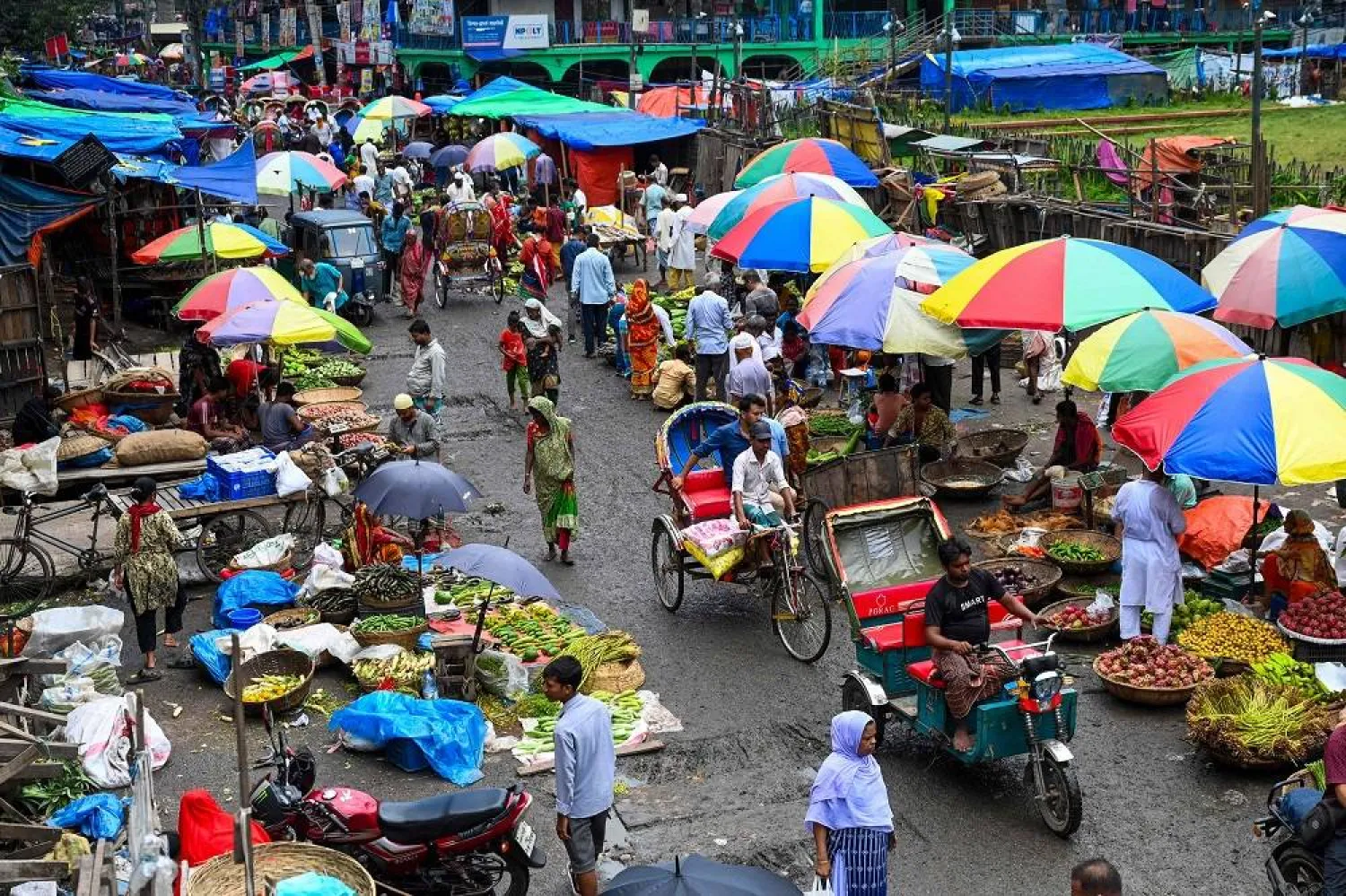

Bangladesh Relaxes Curfew as Unrest Recedes 

People shop at a market as the curfew is relaxed after the anti-quota protests, in Dhaka on July 25, 2024. (AFP)
TT

Bangladesh Relaxes Curfew as Unrest Recedes 

People shop at a market as the curfew is relaxed after the anti-quota protests, in Dhaka on July 25, 2024. (AFP)

Bangladesh further eased a nationwide curfew Thursday as students weighed the future of their protest campaign against civil service hiring rules that sparked days of deadly unrest last week.

Last week's violence killed at least 191 people including several police officers, according to an AFP count of victims reported by police and hospitals during some of the worst unrest of Prime Minister Sheikh Hasina's tenure.

Thousands of troops are still patrolling cities and a nationwide internet shutdown remains largely in effect, but clashes have subsided since protest leaders announced a temporary halt to new demonstrations.

Hasina's government ordered another relaxation to the curfew it imposed at the height of the unrest, allowing free movement for seven hours between 10:00 am and 5:00 pm.

Streets in the capital Dhaka, a sprawling megacity of 20 million people, were choked with commuter traffic in the morning, days after ferocious clashes between police and protesters had left them almost deserted.

Banks, government offices and the country's economically vital garment factories had already reopened on Wednesday after all being shuttered last week.

Student leaders were set to meet later Thursday to decide whether or not to again extend their protest moratorium, which is due to expire on Friday.

Students Against Discrimination, the group responsible for organizing this month's rallies, said it expected a number of concessions from the government.

"We demand an apology from Prime Minister Sheikh Hasina to the nation for the mass murder of students," Asif Mahmud, one of the group's coordinators, told AFP.

"We also want the sacking of the home minister and education minister."

Mahmud added that the estimated toll in the unrest was understated, with his group working on its own list of confirmed deaths.

Police have arrested at least 2,500 people since the violence began last week, according to an AFP tally.

Protests began after the June reintroduction of a scheme reserving more than half of government jobs for certain candidates, including nearly a third for descendants of veterans from Bangladesh's independence war.

With around 18 million young people in Bangladesh out of work, according to government figures, the move deeply upset graduates facing an acute jobs crisis.

Critics say the quota is used to stack public jobs with loyalists to Hasina's Awami League.

The Supreme Court cut the number of reserved jobs on Sunday but fell short of protesters' demands to scrap the quotas entirely.

Hasina, 76, has ruled the country since 2009 and won her fourth consecutive election in January after a vote without genuine opposition.

Her government is also accused by rights groups of misusing state institutions to entrench its hold on power and stamp out dissent, including the extrajudicial killing of opposition activists.



Train Crash Near Peru’s Machu Picchu Kills One, Injures 40

Police officers carry an injured passenger from one of the two trains affected after a head-on collision connecting Machu Picchu with Ollantaytambo in Pampacahua, Cusco Department, Peru, on December 30, 2025. (AFP)
TT

Train Crash Near Peru’s Machu Picchu Kills One, Injures 40

Police officers carry an injured passenger from one of the two trains affected after a head-on collision connecting Machu Picchu with Ollantaytambo in Pampacahua, Cusco Department, Peru, on December 30, 2025. (AFP)

A head-on collision between two trains on the line that services Peru's Machu Picchu killed one person and injured at least 40 others, authorities said, updating an earlier toll.

The deceased was the conductor of one of the two trains, according to the prosecutor's office in Cusco, the city closest to the famous Inca citadel.

Officials said they were working to identify the injured train passengers, many of them foreign visitors and most of them seriously hurt.

Videos sent by passengers to the RPP television channel showed injured victims lying next to the tracks with two damaged locomotives standing idle nearby.

A dozen ambulances and medical personnel were rushed to the site in a remote Andean area without direct road access.

Police wearing hardhats and neon-colored jackets carried injured passengers on stretchers from the trains to receive treatment.

A UNESCO World Heritage Site since 1983, the ancient fortified complex of Machu Picchu receives some 4,500 visitors on average each day, many of them foreigners, according to the tourism ministry.

Most tourists take a train and a bus to reach the historic site high in the Andes mountains.

Rail agency Ferrocarril Transandino said a train operated by PeruRail collided with another belonging to Inca Rail around lunchtime on the single track that links the town of Ollantaytambo with Machu Picchu.

The cause of the accident was not yet known.

In September, about 1,400 tourists were evacuated from the Aguas Calientes train station that serves Machu Picchu and 900 others were left stranded after protesters blocked the railway tracks with logs and rocks.

Locals were demanding a new bus company be chosen in a fair bidding process to ferry visitors to the foot of Machu Picchu, and have repeatedly protested to press their demands.

The Inca empire's ancient capital Machu Picchu was built in the 15th century at an altitude of 2,500 meters (about 8,200 feet) on orders from the Inca ruler Pachacutec. It is considered a marvel of architecture and engineering.


Russia’s Gerasimov Says Putin Ordered Ukraine Buffer Zone Expansion in 2026

Russian President Vladimir Putin (L) chairs a meeting to discuss Russia's "special military operation" in Ukraine, as Chief of the General Staff of the Russian Armed Forces, First Deputy Defense Minister Valery Gerasimov (R) sits nearby, at the Kremlin in Moscow, Russia, 29 December 2025. (EPA/Mikhail Metzel/Sputnik/Kremlin Pool)
TT

Russia’s Gerasimov Says Putin Ordered Ukraine Buffer Zone Expansion in 2026

Russian President Vladimir Putin (L) chairs a meeting to discuss Russia's "special military operation" in Ukraine, as Chief of the General Staff of the Russian Armed Forces, First Deputy Defense Minister Valery Gerasimov (R) sits nearby, at the Kremlin in Moscow, Russia, 29 December 2025. (EPA/Mikhail Metzel/Sputnik/Kremlin Pool)

Russia’s top general said its forces were pressing forward in northeastern Ukraine and President Vladimir ​Putin had ordered expansion of territory Moscow calls a buffer zone there in 2026, Russian news agencies said on Wednesday.

Chief of the General Staff Valery Gerasimov said Putin ordered expansion in 2026 of the buffer zone in Ukraine’s regions ‌of Sumy and ‌Kharkiv near the ‌Russian ⁠border, ​RIA ‌said, adding that he inspected the “North” troop grouping.

The grouping, formed in early 2024, has operated in northeastern Ukraine, seeking to create a buffer along the border and trying to push back Ukrainian forces there for further ⁠advances.

Gerasimov's remarks follow Russia's vow to retaliate for what ‌it claimed, without evidence, was ‍an attempt to ‍attack Putin's residence, an allegation Kyiv denied, ‍saying it was aimed at derailing peace talks as the war nears its fourth year.

There was no immediate reaction from Ukraine ​to the Gerasimov report.

Putin has repeatedly portrayed the buffer zone as a way ⁠to push Ukrainian forces and weapons farther from Russia’s border, citing cross-border shelling and drone attacks on regions such as Belgorod and Kursk.

Kyiv has rejected Moscow’s buffer zone calling it an idea Russia is using to justify deeper incursions into Ukrainian territory.

President Volodymyr Zelenskiy has said Moscow’s plans for Sumy and Kharkiv are “mad” and will be ‌resisted as Ukraine defends the regions.


World Bids Farewell to 2025, a Year of Trump, Truces and Turmoil

Residents secure spots for their boats near the Sydney Opera House ahead of the New Year's Eve fireworks display in Sydney on December 31, 2025. (AFP)
TT

World Bids Farewell to 2025, a Year of Trump, Truces and Turmoil

Residents secure spots for their boats near the Sydney Opera House ahead of the New Year's Eve fireworks display in Sydney on December 31, 2025. (AFP)

New Year's Eve revelers celebrated the end of 2025 on Wednesday, waving goodbye to 12 months packed with Trump tariffs, a Gaza truce and vain hopes for peace in Ukraine.

It was one of the warmest years on record, the stifling heat stoking wildfires in Europe, droughts in Africa and deadly rains across Southeast Asia.

There was a somber tinge to party preparations in Australia's harbor city Sydney, the self-proclaimed "New Year's capital of the world".

Barely two weeks have passed since a father and son allegedly opened fire on a Jewish festival at Bondi Beach, killing 15 people in the nation's deadliest mass shooting for almost 30 years.

Parties will pause for a minute of silence at 11:00 pm (1200 GMT) as the famed Sydney Harbor Bridge is bathed in white light to symbolize peace.

"It has been a difficult year for so many people," said Steph Grant, a 32-year-old Sydney resident.

"Here's hoping the world looks like a brighter place in 2026," said Grant, who works in advertising.

Hundreds of thousands of spectators are expected to line Sydney's foreshore as nine tons of fireworks explode on the stroke of midnight.

Security will be tighter than usual, with squads of heavily armed police patrolling the crowds.

Sydney kicks off a chain of celebrations stretching from glitzy New York to the Hogmanay festival on the chilly streets of Scotland.

More than two million people are expected to pack Brazil's lively Copacabana Beach for what authorities have billed as the world's biggest New Year's Eve party.

- Truce and tariffs -

Labubu dolls became a worldwide craze in 2025, thieves plundered the Louvre in a daring heist, and K-pop heartthrobs BTS made their long-awaited return.

The world lost pioneering zoologist Jane Goodall, the Vatican chose a new pope, and the assassination of right-wing activist Charlie Kirk laid bare America's deep political divisions.

Donald Trump returned to the White House in January, launching a tariff blitz that sent global markets into meltdown.

The US president used his Truth Social platform to lash out at his sliding approval ratings ahead of midterm elections in 2026.

"The polls are rigged," he wrote, without providing evidence.

"Our Country is 'hotter' than ever before. Isn't it nice to have a STRONG BORDER, No Inflation, a powerful Military, and great Economy??? Happy New Year!"

But many expect tough times to continue in 2026.

"The economic situation is also very dire, and I'm afraid I'll be left without income," said Ines Rodriguez, 50, a merchant in Mexico City.

"All our colleagues are in the same situation: very little work and not very profitable," said Buenos Aires business owner Fernando Selvaggi, 61.

After two years of war that left much of the Gaza Strip in ruins, US pressure helped land a fragile ceasefire between Israel and Hamas in October.

But with each side already accusing the other of flagrant violations, no one is sure how long the break in hostilities will hold.

Hamas fighters stormed into southern Israel on October 7, 2023, resulting in the deaths of more than 1,200 people, most of them civilians.

Israel's retaliatory assault on Gaza has killed more than 70,000, also mostly civilians, according to the health ministry in the Hamas-run territory, a figure the UN deems credible.

World leaders including China's Xi Jinping and Russian counterpart Vladimir Putin began exchanging New Year greetings.

Both countries have made much of their presidents' supposedly close friendship, and Putin was an honored guest at a spectacular Chinese military parade in September.

Xi said he was "ready to maintain close exchanges with Putin to jointly push for continuous new progress in bilateral ties", Chinese state news agency Xinhua reported Wednesday.

The war in Ukraine -- sparked by Russia's full-scale invasion in 2022 -- meanwhile grinds towards its four-year anniversary in February.

There were hopes a renewed burst of diplomacy might produce a breakthrough this year.
But Russia shot down any notion of a temporary ceasefire in the final days of 2025.

As envoys shuttle between Moscow, Washington and Kyiv, one major obstacle remains: Ukraine is reluctant to give up land, and Russia is unwilling to give it back.

- Sports, space and AI -

The coming 12 months promise to be full of sports, space travel and serious questions over artificial intelligence.

More than 50 years since the last Apollo lunar mission, 2026 looks to be the year that humankind once again sets its sights towards the moon.

NASA's Artemis II mission, backed by Elon Musk, plans to launch a crewed spacecraft that will circle that moon during a 10-day test flight.

After years of unbridled enthusiasm, artificial intelligence is starting to face mounting scrutiny.

Nervous investors are already questioning whether the years-long AI boom might be starting to resemble something more like a market bubble.

Athletes will gather on Italy's famed Dolomites to hit the slopes for the Winter Olympics.
And for a brief few weeks between June and July, nations will come together for the biggest football World Cup in history.

For the first time, 48 teams will compete in the world's most-watched sports event, playing in venues across the United States, Mexico and Canada.

From the beaches of Brazil to the far-flung reaches of New Zealand, the tournament is expected to draw millions of fans.