Harris is Calibrating Her Policy Pitch for Going to Battle with Trump

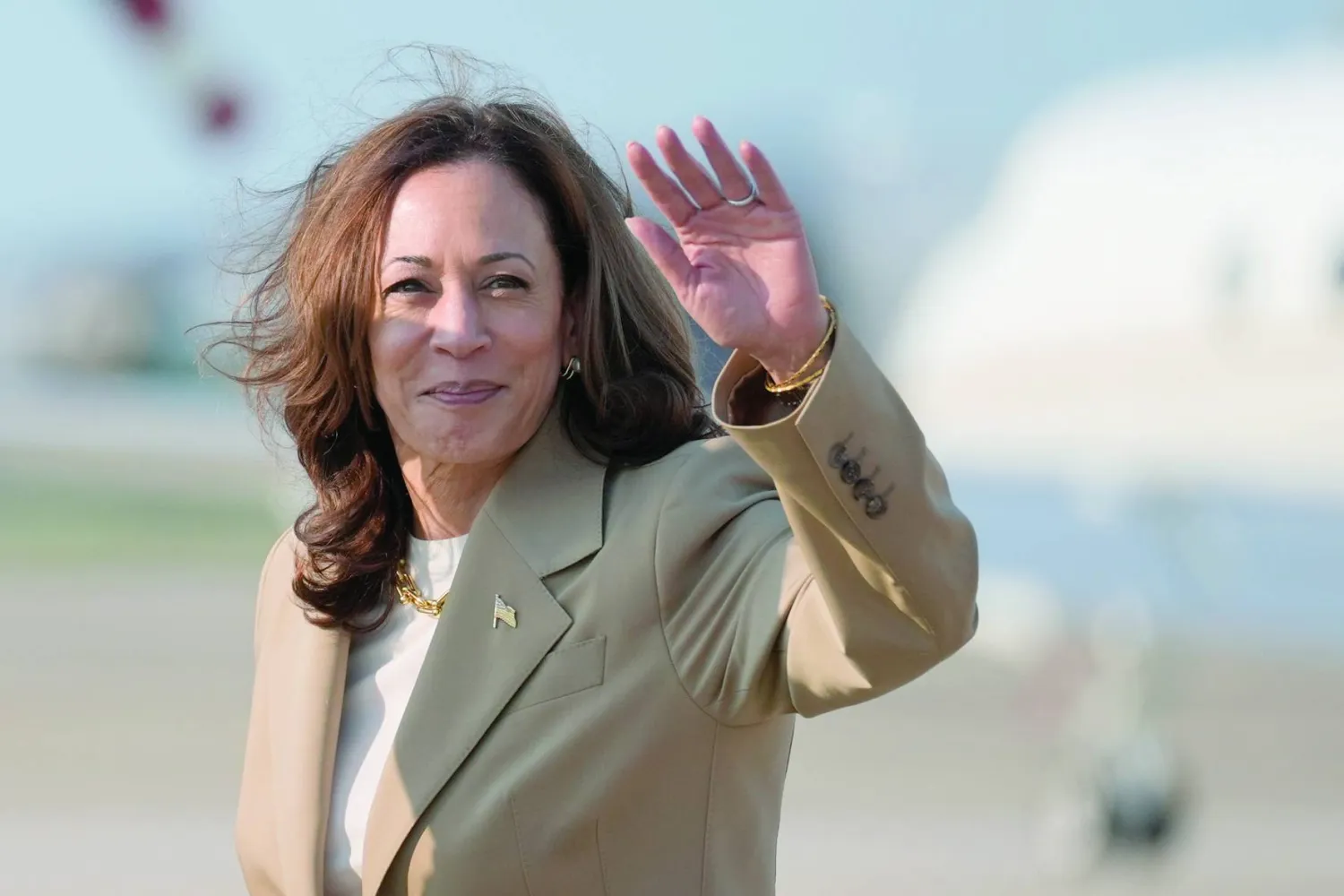
Vice President Kamala Harris waves upon arrival at Andrews Air Force Base in Md., Saturday, July 27, 2024. (AP Photo/Stephanie Scarbrough, Pool)
TT

Harris is Calibrating Her Policy Pitch for Going to Battle with Trump

Vice President Kamala Harris waves upon arrival at Andrews Air Force Base in Md., Saturday, July 27, 2024. (AP Photo/Stephanie Scarbrough, Pool)

Vice President Kamala Harris is facing the delicate task of calibrating her policy pitch to American voters, a standard task for any White House hopeful but one that comes with additional challenges this year.
First, Harris is running for president while serving under President Joe Biden, meaning she's linked to anything that happened — or will happen — on his watch. She inherits accomplishments like limiting the cost of insulin but also the administration's struggle to prevent illegal border crossings, The Associated Press said.
Second, Harris has baggage from her own failed campaign for president before she became Biden's running mate four years ago. During that Democratic primary, she backed an array of progressive proposals that Republicans have highlighted to paint her as “dangerously liberal.”
Harris has already disavowed some of her earlier positions, such as a ban on fracking and support for single-payer healthcare. And she's pledging to keep some of Biden's promises, including no tax increases on anyone making less than $400,000 a year.
That means Harris' path to the White House could depend on her ability to chart a course toward the country's future while being selective about her past. Success will mean keeping Democrats united behind her vision while keeping the focus on Republican candidate Donald Trump's record of undermining abortion rights and his challenges to democratic traditions.
Everything will have to happen at unprecedented speed because Harris was abruptly thrust into the spotlight after Biden decided to drop his reelection bid a little more than a week ago. Her newly designed campaign website doesn't even include a policy section.
“You’re building the plane while you’re flying it,” said Bakari Sellers, a Harris ally who co-chaired her campaign four years ago.
Sellers said Harris should make sure to focus on bread-and-butter issues like medical debt.
“You can see the history she represents. You can hear that in her voice," Sellers said. "But you still have to attract voters who don’t know who you are, who don’t subscribe to the historic nature of your campaign.”
Unsurprisingly, Harris has embraced much of the same platform as Biden. In her stump speeches since jumping into the presidential race, she promotes affordable child care, paid family leave and expanded health care.
On Tuesday in Atlanta, she promised to target price gouging and hidden bank fees. She always emphasizes restoring the nationwide right to abortion, which was eliminated two years ago by the US Supreme Court.
She's also endorsing new proposals announced by Biden since she took over the campaign, including term limits for Supreme Court justices and binding ethics rules. In a statement, Harris said the court faces a “clear crisis of confidence” that needs to be addressed.
Presidential candidates often detail their policy ideas during primaries as they try to differentiate themselves within their party. However, Harris leapfrogged that step this year, and she may face less pressure in the compressed campaign to spell out exactly how new programs will be funded and implemented.
“In this environment, the Democratic candidate needs enough policy to tell people how she’s going to bring her fight for the future alive, but not so much that it weighs down the speeches,” said Jamal Simmons, a former communications director in the vice president's office.
Kevin Munoz, a spokesperson for Harris, said she would “build on the Biden-Harris Administration’s historic agenda" and offer a “stark contrast” to Trump's plans to cut taxes for the wealthy and eliminate the Affordable Care Act.
Harris wants to keep Democrats united as the campaign enters its final few months. So far, intra-party skirmishes have been rare but not eliminated.
Two billionaire donors said that Harris should replace Lina Khan, the chair of the Federal Trade Commission appointed by Biden, if elected because of her aggressive use of antitrust law. In response, liberals rallied to Khan’s defense and called on Harris to leave her in place. Harris hasn’t commented on the issue.
Adam Green, co-founder of the Progressive Change Campaign Committee, said the White House has built “high trust” with liberal groups that will buoy Harris through the election. He doubted she would dramatically change course from the Biden administration, but expected that “she will have her own unique flavor and point of emphasis.”
Green added, “I don’t think anybody should be afraid of a gut check.”
Some of Harris’ shifts may be more about emphasis than outright changes. For example, her recent remarks on the Gaza war did not create any daylight between her and Biden, but Harris placed more emphasis on Palestinian suffering. She also included clearer outreach to Americans who have been demoralized by the conflict.
“To everyone who has been calling for a cease-fire and to everyone who yearns for peace, I see you and I hear you,” she said.
Republicans want to prevent Harris from reinventing herself for the general election, aiming to saddle her with Biden-era controversies and her own campaign from four years ago.
“She was involved in every one of Joe Biden’s failures, but we’ve also seen what her vision is for president,” said Mike Berg, communications director for the National Republican Senatorial Committee. “She would make things even worse.”
Trump's team and its allies have been sifting through videos where Harris talked about providing healthcare to immigrants who are in the country illegally and decriminalizing border crossings. And they're blaming her for migration challenges that took place before border crossings dropped under Biden's latest policies.
Although Trump is hardly consistent when it comes to policy proposals, Berg said there's more risk to Harris because she's less well-known and public views on her can still be shaped.
“She’s going to come off as a liar," he said. "Was she lying then or is she lying now?”
Simmons doubted voters would care about her past positions on issues like the “defund the police” movement, which Harris praised for questioning whether money was being wisely spent on public safety, because she served in an administration that pumped more money into law enforcement.
“Five years ago she said one thing, but two years ago she did something about it, and the crime rate is lower today," he said.



Satellite Images Show Iran Repairing and Fortifying Sites amid US Tensions

A satellite image shows tunnel entrances covered with soil at Isfahan nuclear complex, in Isfahan, Iran, February 10, 2026. Vantor/Handout via REUTERS
TT

Satellite Images Show Iran Repairing and Fortifying Sites amid US Tensions

A satellite image shows tunnel entrances covered with soil at Isfahan nuclear complex, in Isfahan, Iran, February 10, 2026. Vantor/Handout via REUTERS

Satellite images show that Iran has recently built a concrete shield over a new facility at a sensitive military site and covered it in soil, experts say, advancing work at a location reportedly bombed by Israel in 2024 amid tensions with the US.

Images also show that Iran has buried tunnel entrances at a nuclear site bombed by the US during Israel's 12-day war with Iran last year, fortified tunnel entrances near another, and has repaired missile bases struck in the conflict.

They offer a glimpse of Iranian activities at some of the sites at the center of tensions with Israel and the US, as Washington seeks to negotiate a deal with Tehran on its nuclear program while threatening military action if talks fail.

Some 30 km (20 miles) southeast of Tehran, the Parchin complex is one of Iran's most sensitive military sites. Western intelligence has suggested Tehran carried out tests relevant to nuclear bomb detonations there more than two decades ago.

Iran has always denied seeking atomic weapons. Israel reportedly struck Parchin in October 2024.

Satellite imagery taken before and after that attack shows extensive damage to a rectangular building at Parchin, and apparent reconstruction in images from November 6, 2024.

Imagery from October 12, 2025 shows development at the site, with the skeleton of a new structure visible and two smaller structures adjacent to it. Progress is apparent in imagery from November 14, with what appears to be a metallic roof covering the large structure.

But imagery from December 13 shows the facility partly covered. By February 16, it cannot be seen at all, hidden by what experts say is a concrete structure.

The Institute for Science and International Security (ISIS), in a January 22 analysis of satellite imagery, pointed to progress in the construction of a "concrete sarcophagus" around a newly built facility at the site, which it identified as Taleghan 2.

ISIS reported in November that imagery showed "ongoing construction and the presence of what appears to resemble a long, cylindrical chamber, maybe a high-explosives containment vessel, likely measuring approximately 36 meters long and 12 meters in diameter placed inside a building".

"High-explosive containment vessels are critical to the development of nuclear weapons," ISIS added, "but can also be used in many other conventional weapons development processes."

William Goodhind, a forensic imagery analyst with Contested Ground, said the roof had a similar hue to the surrounding area, adding: "It has most likely been covered with dirt to obscure the concrete color."

ISIS founder David Albright wrote on X: "Stalling the negotiations has its benefits: Over the last two to three weeks, Iran has been busy burying the new Taleghan 2 facility ... More soil is available and the facility may soon become a fully unrecognizable bunker, providing significant protection from aerial strikes."

TUNNEL ENTRANCES BURIED AT ISFAHAN NUCLEAR COMPLEX

The Isfahan complex is one of three Iranian uranium-enrichment plants bombed by the United States in June.

In addition to facilities that are part of the nuclear fuel cycle, Isfahan includes an underground area where diplomats say much of Iran's enriched uranium has been stored.

Satellite images taken in late January showed new efforts to bury two tunnel entrances at the complex, ISIS reported on January 29. In a February 9 update, ISIS said a third entrance had also been backfilled with soil, meaning all entrances to the tunnel complex were now "completely buried".

A February 10 image shows all three tunnels buried, Goodhind said.

ISIS reported on February 9 that "backfilling the tunnel entrances would help dampen any potential airstrike and also make ground access in a special forces raid to seize or destroy any highly enriched uranium that may be housed inside difficult".

TUNNEL ENTRANCES FORTIFIED AT COMPLEX NEAR NATANZ SITE

ISIS has reported that satellite images point to ongoing efforts since February 10 to "harden and defensively strengthen" two entrances to a tunnel complex under a mountain some 2 km (1.2 miles) from Natanz - the site that holds Iran's other two uranium enrichment plants.

Imagery shows "ongoing activity throughout the complex related to this effort, involving the movement of numerous vehicles, including dump trucks, cement mixers, and other heavy equipment", ISIS wrote.

Iran's plans for the facility, called Pickaxe Mountain, are unclear, ISIS said.

SHIRAZ SOUTH MISSILE BASE

About 10 km (6 miles) south of Shiraz in southern Iran, this is one of 25 primary bases capable of launching medium-range ballistic missiles, according to Alma Research and Education Center, an Israeli organization. Alma assessed the site had suffered light, above-ground damage in last year's war.

A comparison of images taken on July 3, 2025 and January 30 shows reconstruction and clearance efforts at the main logistics and likely command compound at the base, Goodhind said.

"The key takeaway is that the compound has yet to return to its full operational capacity from prior to the airstrikes."

QOM MISSILE BASE

Some 40 km north of the city of Qom, this base suffered moderate above-ground damage, according to Alma.

A comparison of images taken between July 16, 2025, and February 1 shows a new roof over a damaged building. The roof repairs appear to have begun on November 17 and were most likely complete 10 days later, Goodhind said.


Iranian Mourning Ceremonies Prompt New Crackdowns in Echo of 1979 Revolution

Iranians walk on a street in Tehran, Iran, 16 February 2026. (EPA)
TT

Iranian Mourning Ceremonies Prompt New Crackdowns in Echo of 1979 Revolution

Iranians walk on a street in Tehran, Iran, 16 February 2026. (EPA)

Iranians have returned to the streets this week to mourn those killed by security forces during last month's anti-government demonstrations, sparking some new crackdowns in an echo of the 1979 revolution that brought down the US-backed Shah.

The anti-Shah revolutionaries turned Shiite Muslim memorial processions 40 days after each death into new protests, which prompted renewed violence from the authorities and fresh "martyrs" for the cause.

The clerical establishment's opponents, deploying the same tactics after five decades, have yet to match the momentum of those times, but Iran's clerical rulers, threatened with military attack by US President Donald Trump over their nuclear and security policies, have demonstrated their concern.

They deployed security forces to some cemeteries and invited citizens to attend state-organized 40-day "Chehelom" ceremonies on Tuesday after apologizing to "all those affected" by violence they blamed on people described as "terrorists".

"They tried to prevent history repeating itself by holding these ceremonies in mosques across ‌the country. To ‌prevent any gatherings of angry families in cemeteries, but they failed," said one rights activist ‌in ⁠Iran who declined ⁠to be named for fear of retribution.

SECURITY FORCES CLASH WITH MOURNERS

Videos circulating on social media showed families holding their own memorials across Iran on Tuesday, 40 days after security forces began two days of widespread shooting that human rights groups say killed thousands of protesters.

Some of Tuesday's memorials turned into wider anti-government protests and some were met with deadly force.

In the Kurdish town of Abdanan in Ilam province, witnesses and activists said security forces opened fire on hundreds of mourners gathered at a cemetery.

Videos showed people scattering as gunfire rang out amid chants of "Death to the dictator", a reference to Iran's Supreme Leader Ali Khamenei.

Reuters journalists verified that ⁠the videos were filmed at the cemetery. They were unable to verify the date but ‌found no versions posted before Tuesday: eyewitnesses and activists said that was when ‌people gathered at the cemetery were fired upon.

Hengaw, a Kurdish Iranian rights group, said at least three people were injured and nine ‌arrested in Abdanan. Similar clashes were reported in Mashhad and Hamedan. Sources in Iran said internet access was heavily restricted ‌in those cities.

WEDNESDAY IS 40 DAYS SINCE HEIGHT OF JANUARY PROTESTS

More mourning ceremonies were expected to be taking place on Wednesday, 40 days since the deadliest two days of the January unrest, although communications restrictions meant that it was not immediately possible to tell how many or their outcome.

January's unrest grew from modest economic protests in December among traders in Tehran's Grand Bazaar into the gravest threat to ‌Iran's theocracy in nearly five decades, with protesters calling for ruling clerics to step down.

Authorities cut internet access, blaming "armed terrorists" linked to Israel and the United States ⁠for the violence, and have arrested ⁠journalists, lawyers, activists, human rights advocates and students, rights groups say.

Iranian officials have told Reuters the leadership is worried a US strike could erode its grip on power by fueling more protests. Repression, inequality, corruption and the sponsorship of proxies abroad are the main grievances.

"How long can they kill people to stay in power? People are angry, people are frustrated," said government employee Sara, 28, from the central city of Isfahan.

"The Islamic Republic has brought nothing but war, economic misery and death to my country".

Trump has deployed aircraft carriers, fighter jets, guided-missile destroyers and other capabilities to the Middle East for a possible attack if talks to limit Iran's nuclear program and weaken its foreign proxies do not yield results.

Even without a US attack, continued isolation from Western sanctions would likely fuel further public anger.

In 1979, the anti-Shah revolt in provincial towns and villages was amplified by oil workers whose strikes cut most of Iran's revenue, and bazaar merchants who funded the rebel clerics.

This time there have been no reports of either, but people have adopted some of the small-scale tactics, chanting “Allah is great” and “Death to the dictator”, often from rooftops, during nightly demonstrations, according to witnesses and social media posts.


Iran ‘Drafting Framework to Advance’ Future US Talks, Says FM

Iranian Foreign Minister Abbas Araghchi speaks during the Conference on Disarmament at the European headquarters of the United Nations in Geneva, Switzerland, 17 February 2026. (EPA)
TT

Iran ‘Drafting Framework to Advance’ Future US Talks, Says FM

Iranian Foreign Minister Abbas Araghchi speaks during the Conference on Disarmament at the European headquarters of the United Nations in Geneva, Switzerland, 17 February 2026. (EPA)

Iran's top diplomat Abbas Araghchi said on Wednesday that Tehran was "drafting" a framework for future talks with the United States, as the US energy secretary said Washington would stop Iran's nuclear ambitions "one way or another".

Diplomatic efforts are underway to avert the possibility of US military intervention in Iran, with Washington conducting a military build-up in the region.

Iran and the US held a second round of Oman-mediated negotiations on Tuesday in Geneva, after talks last year collapsed following Israel's attack on Iran in June, which started a 12-day war.

Araghchi said on Tuesday that Tehran had agreed with Washington on "guiding principles", but US Vice President JD Vance said Tehran had not yet acknowledged all of Washington's "red lines".

On Wednesday, Araghchi held a phone call with Rafael Grossi, the head of the UN nuclear watchdog, the International Atomic Energy Agency.

In the call, Araghchi "stressed Iran's focus on drafting an initial and coherent framework to advance future talks", according to a statement from the Iranian foreign ministry.

Also on Wednesday, US Energy Secretary Chris Wright warned that Washington would deter Tehran from acquiring nuclear weapons "one way or the other".

"They've been very clear about what they would do with nuclear weapons. It's entirely unacceptable," Wright told reporters in Paris on the sidelines of meetings of the International Energy Agency.

Earlier on Wednesday, Reza Najafi, Iran's permanent representative to the IAEA in Vienna, held a joint meeting with Grossi and the ambassadors of China and Russia "to exchange views" on the upcoming session of the agency's board of governors meetings and "developments related to Iran's nuclear program", Iran's mission in Vienna said on X.

Tehran has suspended some cooperation with the IAEA and restricted the watchdog's inspectors from accessing sites bombed by Israel and the United States, accusing the UN body of bias and of failing to condemn the strikes.

- Displays of military might -

The Omani-mediated talks were aimed at averting the possibility of US military action, while Tehran is demanding the lifting of US sanctions that are crippling its economy.

Iran has insisted that the discussions be limited to the nuclear issue, though Washington has previously pushed for Tehran's ballistic missiles program and support for armed groups in the region to be on the table.

US President Donald Trump has repeatedly threatened to intervene militarily against Iran, first over a deadly crackdown on protesters last month and then more recently over its nuclear program.

On Wednesday, Israeli President Isaac Herzog sent a message to Iranians, saying "I want to send the people of Iran best wishes for the month of Ramadan, and I truly hope and pray that this reign of terror will end and that we will see a different era in the Middle East," according to a statement from his office.

Washington has ordered two aircraft carriers to the region, with the first, the USS Abraham Lincoln with nearly 80 aircraft, positioned about 700 kilometers (435 miles) from the Iranian coast as of Sunday, satellite images showed.

Iran has also sought to display its own military might, with its Islamic Revolutionary Guard Corps beginning a series of war games on Monday in the Strait of Hormuz.

Iranian politicians have repeatedly threatened to block the strait, a major global conduit for oil and gas.

On Tuesday, state TV reported that Tehran would close parts of the waterway for safety measures during the drills.

Iran's supreme leader warned on Tuesday that the country had the ability to sink a US warship deployed to the region.