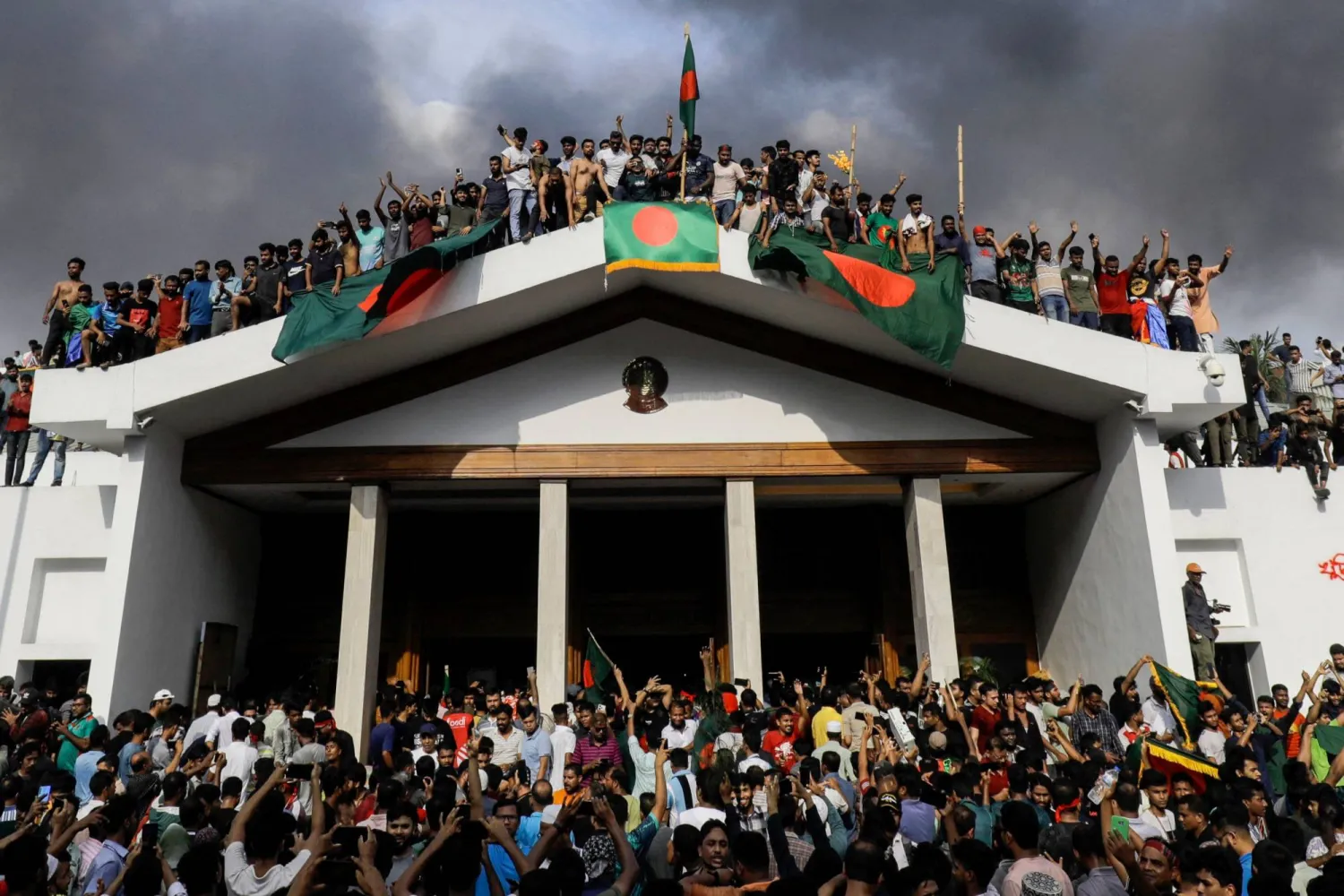
What's Next after Protests Forced Bangladesh's Prime Minister to Quit and Flee the Country?

Anti-government protestors display Bangladesh's national flag as they storm Prime Minister Sheikh Hasina's palace in Dhaka on August 5, 2024. (Photo by K M ASAD / AFP)
TT

What's Next after Protests Forced Bangladesh's Prime Minister to Quit and Flee the Country?

Anti-government protestors display Bangladesh's national flag as they storm Prime Minister Sheikh Hasina's palace in Dhaka on August 5, 2024. (Photo by K M ASAD / AFP)

What began as peaceful protests by students in Bangladesh against a quota system for government jobs eventually turned into an uprising that forced Prime Minister Sheikh Hasina to resign and flee the country by helicopter.
Now, opposition leaders and the country's military are talking about appointing an interim government that is expected to organize new elections in what critics of Hasina say is a restoration of democracy, The Associated Press said.
The end to Hasina's 15 years in power came after weeks of violent unrest during which nearly 300 people died, according to local media reports.
The government repeatedly tried to quell demonstrations they blamed on sabotage and opposition parties with bullets, curfews and internet outages, but these heavy-handed moves backfired, fueling outrage and further protests.
On Monday, protesters defied a military curfew to march into the capital's center, following a weekend of violence left dozens of people dead. As troops pulled back and internet access was restored, tens of thousands of people began to celebrate in the streets, and thousands stormed the leader's official residence.
Here’s what we know:
Who will lead the next government? Shortly after Hasina resigned, the country's military chief said the army would seek the figurehead president's guidance to appoint an interim government.
President Mohammed Shahabuddin announced late Monday after meeting with Gen. Waker-uz-Zamam and opposition politicians that Parliament would be dissolved as soon as possible, leading to fresh elections.
The next day, a key student leader said that the movement wanted Nobel Peace Prize laureate Muhammad Yunus to head the interim government.
Nahid Islam said in a video posted on social media that student protest leaders had already talked with Yunus, who consented to take over considering the present situation of the country.
Yunus faced a number of corruption accusations and was put on trial during Hasina’s rule. He received the Nobel in 2006 after he pioneered microlending, and he said the corruption charges against him were motivated by vengeance.
Gen. Waker-uz-Zaman also promised to launch an investigation into the deadly crackdowns that fueled outrage against the government.
“Keep faith in the military, we will investigate all the killings and punish the responsible,” he said. “I have ordered that no army and police will indulge in any kind of firing.”
He asked for patience as a new government is formed.
“Now, the students’ duty is to stay calm and help us,” he added.
How did the protests start? The protests, which have drawn hundreds of thousands, began in July with students demonstrating against a controversial quota system that allocated government jobs.
It turned violent on July 15 as student protesters clashed with security officials and pro-government activists, prompting authorities to disperse tear gas, fire rubber bullets and to close schools and impose a curfew with a shoot-on-sight order. The internet and mobile data were also turned off.
The government says nearly 150 people died last month, while local media have reported that more than 200 were killed.
Why were they protesting? At first, the demonstrations were against a quota system that set aside up to 30% of government jobs for family members of veterans who fought in Bangladesh’s 1971 war of independence against Pakistan.
Protesters said the system was discriminatory and benefited supporters of Prime Minister Sheikh Hasina’s Awami League party, which led the independence movement.
The furor highlighted the extent of economic distress in Bangladesh, where exports have fallen and foreign exchange reserves are running low. There’s a lack of quality jobs for young graduates, who increasingly seek the more stable and lucrative government jobs.
As the violence crested, the Supreme Court last month ruled that the veterans’ quota must be cut to 5%, with 93% of jobs to be allocated on merit. The remaining 2% will be set aside for members of ethnic minorities and transgender and disabled people.
The government accepted the decision, and restored the internet thinking that the situation would ease. But the protests grew, with new demands for investigations into the deadly crackdowns, and eventually for Hasina and her cabinet to step down.



Serbia Urges Citizens to Quit Iran ‘As Soon as Possible’

People walk past an anti-US billboard in Tehran, Iran, January 26, 2026. Majid Asgaripour/WANA (West Asia News Agency) via Reuters
TT

Serbia Urges Citizens to Quit Iran ‘As Soon as Possible’

People walk past an anti-US billboard in Tehran, Iran, January 26, 2026. Majid Asgaripour/WANA (West Asia News Agency) via Reuters

Serbia has urged its citizens in Iran to leave the country "as soon as possible", after US President Donald Trump threatened military action over the country's nuclear program.

The Balkan nation had already invited Serbian nationals in mid-January to leave Iran and not to travel there, as the country's clerical authorities launched a bloody crackdown on a mass protest movement.

"Due to the deteriorating security situation, citizens of the Republic of Serbia are not recommended to travel to Iran in the coming period," the foreign ministry said in a statement on its website published overnight Friday to Saturday.

"All those who are in Iran are recommended to leave the country as soon as possible."

Iran said on Friday that it was hoping for a quick deal with the United States on Tehran's nuclear program, long a source of discord between the two foes.

But Trump, after ordering a major naval build-up in the Middle East aimed at heaping pressure on Tehran, said on Friday that he was "considering" a limited military strike if the negotiations proved unfruitful.


Trump to Remove Vietnam from Restricted Tech List

(FILES) US President Donald Trump holds a chart as he delivers remarks on reciprocal tariffs during an event in the Rose Garden entitled "Make America Wealthy Again" at the White House in Washington, DC, on April 2, 2025. (Photo by Brendan SMIALOWSKI / AFP)
TT

Trump to Remove Vietnam from Restricted Tech List

(FILES) US President Donald Trump holds a chart as he delivers remarks on reciprocal tariffs during an event in the Rose Garden entitled "Make America Wealthy Again" at the White House in Washington, DC, on April 2, 2025. (Photo by Brendan SMIALOWSKI / AFP)

US President Donald Trump told Vietnam's top leader To Lam he would "instruct the relevant agencies" to remove the country from a list restricted from accessing advanced US technologies, Vietnam's government announced Saturday.

The two leaders met in person for the first time at the White House on Friday, after Lam attended the inaugural meeting of Trump's "Board of Peace" in Washington, said AFP.

"Donald Trump said he would instruct the relevant agencies to soon remove Vietnam from the strategic export control list," Hanoi's Government News website said.

The two countries were locked in protracted trade negotiations when the US Supreme Court ruled many of Trump's sweeping tariffs were illegal.

Three Vietnamese airlines announced nearly $37 billion in purchases this week, in a series of contracts signed with US aerospace companies.

Fledgling airline Sun PhuQuoc Airways placed an order for 40 of Boeing's 787 Dreamliners, a long-haul aircraft, with an estimated total value of $22.5 billion, while national carrier Vietnam Airlines placed an $8.1 billion order for around 50 Boeing 737-8 aircraft.

When Trump announced his "Liberation Day" tariffs in April, Vietnam had the third-largest trade surplus with the US of any country after China and Mexico, and was targeted with one of the highest rates in Trump's tariff blitz.

But in July, Hanoi secured a minimum 20 percent tariff with Washington, down from more than 40 percent, in return for opening its market to US products including cars.

Trump signed off on a global 10-percent tariff on Friday on all countries hours after the Supreme Court ruled many of his levies on imports were illegal.


NORAD Intercepts 5 Russian Aircraft near Alaska, Though Military Says There Was No Threat

An F-16 fighter jet takes off (file photo - Reuters)
TT

NORAD Intercepts 5 Russian Aircraft near Alaska, Though Military Says There Was No Threat

An F-16 fighter jet takes off (file photo - Reuters)

Military jets were launched to intercept five Russian aircraft that were flying in international airspace off Alaska’s western coast, but military officials said Friday the Russian aircraft were not seen as provocative.

The North American Aerospace Defense Command said it detected and tracked two Russian Tu-95s, two Su-35s and one A-50 operating near the Bering Strait on Thursday, The Associated Press said.

In response, NORAD launched two F-16s, two F-35s, one E-3 and four KC-135 refueling tankers to intercept, identify and escort the Russian aircraft until they departed the area, according to a release from the command.

“The Russian military aircraft remained in international airspace and did not enter American or Canadian sovereign airspace,” according to the NORAD statement. It also noted this kind of activity “occurs regularly and is not seen as a threat.”

The Russian aircraft were operating in an area near the Bering Strait, a narrow body of water about 50 miles (80 kilometers) wide separating the Pacific and Arctic oceans, called the Alaskan Air Defense Identification Zone.

Such zones begin where sovereign airspace ends. While it’s international airspace, all aircraft are required to identify themselves when entering zones in the interest of national security, NORAD said.

The command used satellites, ground and airborne radars and aircraft to detect and track aircraft

NORAD is headquartered at Peterson Space Force Base, Colorado, but has its Alaska operations based at Joint Base Elmendorf-Richardson in Anchorage.