Crowds of Pro-Palestinian Protesters Rally Outside Democratic Convention's 3rd Night

Organizers of Wednesday's demonstration drew on the Chicago area's Palestinian community, one of the largest in the country, by bringing buses from suburban mosques - The AP
TT

Crowds of Pro-Palestinian Protesters Rally Outside Democratic Convention's 3rd Night

Organizers of Wednesday's demonstration drew on the Chicago area's Palestinian community, one of the largest in the country, by bringing buses from suburban mosques - The AP

More than 2,000 pro-Palestinian protesters marched Wednesday past a park where pro-Israel demonstrators had gathered earlier and toward the arena hosting the third night of the Democratic National Convention.

The demonstration, which stayed largely peaceful, came a day after violent clashes between police and protesters led to 56 arrests at a much smaller unsanctioned protest outside the Israeli Consulate.

Organizers of Wednesday's demonstration drew on the Chicago area's Palestinian community, one of the largest in the country, by bringing buses from suburban mosques.

Raed Shuk, 48, came with his children from the suburbs, including his 2-year-old son, who sat on Shuk’s shoulders ahead of the march. Shuk, whose parents are Palestinian, said they have come to so many rallies that his son knows the chants by heart.

“Everybody’s humanity needs to be equally addressed here and there,” The AP quoted him saying of Gaza. “I want to help my children learn from this experience that you always like to stand up for your rights and always peacefully protest.”

The march, one of the largest anticipated demonstrations of the week, took on a festive tone at times as a drum line led marchers and a sea of Palestinian flags waved above the crowds. Some kids ate popsicles as they walked, and others were pushed in strollers or rode in wagons.

The crowd stopped outside a park that is roughly a block from the United Center and used megaphones and air horns to call out elected leaders, including Illinois Gov. JB Pritzker, for being “complicit” in the war in Gaza. The two-term Democrat, who was under consideration as Vice President Kamala Harris’ running mate, criticized a ceasefire resolution Chicago approved in January.

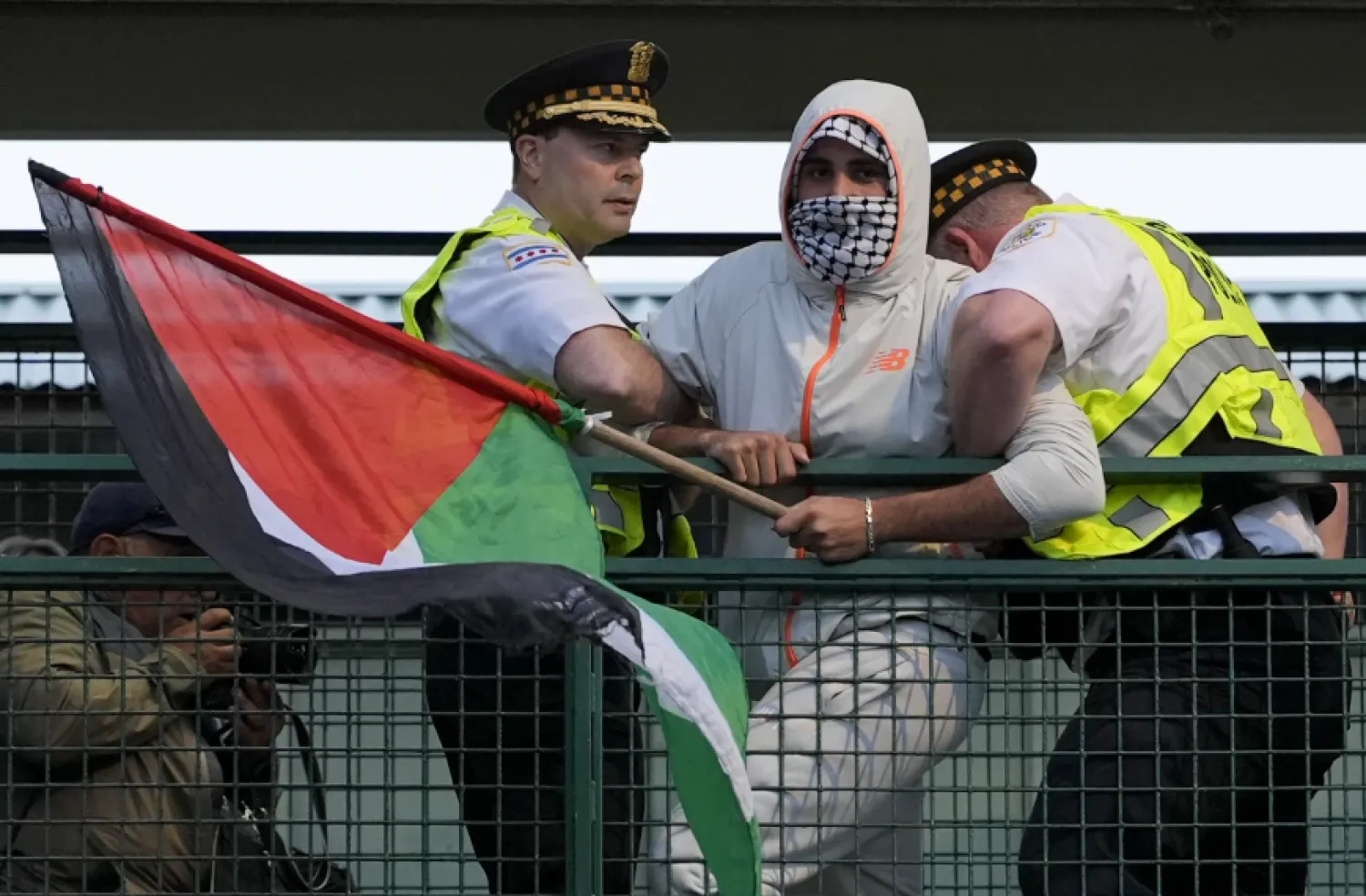
As marchers passed under a new elevated train station near the United Center that was completed just before the DNC, officers were seen bringing a person to the ground on the platform above. In response, hundreds of protesters pushed against the edge of the station, banging on the glass with their hands and flag poles as they called on police to free the person. The person left through the station’s emergency exit moments later, accompanied by officers but not in handcuffs, prompting cheers from the crowd.

The crowds of pro-Palestinian protesters included many families and people of different faiths. Small groups of Muslims gathered in prayer at a park just ahead of the march’s kickoff, using keffiyeh as prayer rugs. Rabbis were among the leaders of the march, and a small group marched through in the crowd holding a sign that said “Christians for Ceasefire.”

Rabbi Brant Rosen, a founder of the Jewish Voice for Peace Rabbinical Council, condemned Democrats for not speaking out about the war in Gaza at the convention

“The word Palestine is not allowed inside the Democratic National Convention. The word ceasefire has barely been uttered,” he said. “This is a Hollywood-style coronation of a candidate. They assume they are entitled to our votes, but they are not entitled to our votes.”

Earlier in the day, police escorted pro-Israel demonstrators out of a park near the United Center as the area was blocked off ahead of the march of activists heading there.

The rally near the United Center was organized by the US Palestinian Community Network, a Palestinian and Arab community-based organization. It was in stark contrast to the protest Tuesday night outside the Israeli Consulate, where protesters not affiliated with a coalition of more than 200 groups that has the city's permission for demonstrations ended up in an intense standoff with Chicago police.

Chicago Police Superintendent Larry Snelling said those arrested Tuesday night outside the Israeli Consulate, about 2 miles (3.2 kilometers) from the United Center, “showed up with the intention of committing acts of violence, vandalism.” Snelling called police response “proportionate.”

Thirty of the people detained by police were issued citations for disorderly conduct, according to Chicago police. One person was arrested on a felony charge of resisting police, while nine were charged with misdemeanors including disorderly conduct, resisting officers, battery, assault and criminal damage to property, police said.

Snelling said that two people were taken to the hospital with minor injuries, one for knee pain and one with a finger injury. Two officers were injured but they refused medical attention because they did not want to leave fellow officers, Snelling said. He said three journalists were among those arrested, but he did not have details on charges.

Hatem Abudayyeh, co-founder of the US Palestinian Community Network, put the onus on police to keep the peace when asked about the clashes between pro-Palestinian protesters and police. The police “only have one responsibility here,” he said. “They have the responsibility of not infringing on our First Amendment rights.”

The Israeli Consulate has been the site of numerous demonstrations since the war in Gaza began in October, and protests during the DNC have largely focused on opposing the Israel-Hamas war..

The largest protest so far, which attracted about 3,500 people on Monday, was largely peaceful and resulted in 13 arrests, most related to a breach of security fencing. Two were arrested Sunday night during another mostly peaceful march.

Also on Wednesday, a man who escaped from a Mississippi courthouse and is wanted on murder and armed robbery charges was taken into custody following a standoff with police at a restaurant about half a mile from the United Center. There was no indication that he had any connection to the convention.


Netanyahu Vows to Eliminate Iran Threat ‘Once and for All’

10 November 2026, Israel, Jerusalem: Caretaker Israeli Prime Minister Benjamin Netanyahu delivers a speech on the sidelines of the opening session of the new Knesset. (dpa)
TT

Netanyahu Vows to Eliminate Iran Threat ‘Once and for All’

10 November 2026, Israel, Jerusalem: Caretaker Israeli Prime Minister Benjamin Netanyahu delivers a speech on the sidelines of the opening session of the new Knesset. (dpa)

Israel's caretaker prime minister Benjamin Netanyahu on Saturday reiterated his calls for a national unity government with his opponent Gadi Eisenkot, as well as his vow to eliminate the threat from Iran.

A meeting with Eisenkot on Thursday "only strengthened the conviction that it is essential to form a national unity government" to guarantee Israel's security, Netanyahu said in a video statement, adding that such a government could "eliminate the Iranian threat once and for all".


Ukraine’s Zelenskiy Escalates Criticism of SpaceX Over Speed Caps

Ukraine's President Volodymyr Zelenskiy holds a press briefing in Copenhagen November 10, 2026. (AFP)
TT

Ukraine’s Zelenskiy Escalates Criticism of SpaceX Over Speed Caps

Ukraine's President Volodymyr Zelenskiy holds a press briefing in Copenhagen November 10, 2026. (AFP)

Ukraine's President Volodymyr Zelenskiy ‌escalated his criticism of SpaceX on Saturday, saying speed restrictions on its military-grade Starshield satellite terminals had dangerous political implications and undermined critical air defenses.

Zelenskiy said Starshield terminals operating in temporarily Russian-occupied territories of Ukraine had been limited to a maximum speed of 161 kph for the past five days, hampering Ukraine's military capabilities.

The Ukrainian Defense Ministry has raised the issue with SpaceX at the ‌institutional level, ‌Zelenskiy said.

"The restrictions have now ‌been ⁠in place for ⁠five days. They say it is some kind of technical issue. We do not believe that is the case," Zelenskiy told reporters in remarks released by his office on Saturday.

"If you impose restrictions there, you are already partially recognizing the temporarily ⁠occupied territories as not ours. And ‌that is why I ‌believe we have the right to raise this ‌issue and restore the speed – so that there ‌are no restrictions at all."

Zelenskiy said the speed restrictions made it more difficult for Ukrainian air defense units to intercept Russian jet-powered drones and made Ukrainian cities ‌more vulnerable. He said he had ordered his top military and foreign ministry ⁠officials ⁠to address the issue and seek clarification.

SpaceX has pushed back against the allegations, denying that it introduced new restrictions or made any changes to its satellite operations.

It is the second such outage in recent weeks. In mid-October, Ukrainian officials said that SpaceX limited the speed of Starlink and its Starshield communication systems to about 160 kph (100 mph) amid tensions with US President Donald Trump's administration over Ukrainian attacks on Russian oil refineries. Service was then restored on October 24.


UN Official Urges Iran, US to Let Fertilizers Through Hormuz Strait

Jorge Moreira da Silva, Executive Director of UNOPS (United Nations Office for Project Services), and coordinator of the UN Strait of Hormuz Task Force established by the UN Secretary-General, speaks during an interview with AFP on the sidelines of the 31st United Climate Change Conference (COP31), at the media center located on the Antalya Expo Center in Antalya on November 14, 2026. (AFP)
TT

UN Official Urges Iran, US to Let Fertilizers Through Hormuz Strait

Jorge Moreira da Silva, Executive Director of UNOPS (United Nations Office for Project Services), and coordinator of the UN Strait of Hormuz Task Force established by the UN Secretary-General, speaks during an interview with AFP on the sidelines of the 31st United Climate Change Conference (COP31), at the media center located on the Antalya Expo Center in Antalya on November 14, 2026. (AFP)

Iran and the United States should "immediately" allow fertilizer shipments through the Strait of Hormuz to ease the crisis in some of the most vulnerable countries, a senior UN official said Saturday.

Jorge Moreira da Silva, head of the UN Office for Project Services, told the COP31 climate talks in the Turkish resort city of Antalya that the lack of fertilizers could push millions into poverty.

The Iranian blockade of the vital waterway, which started after the joint US-Israeli attack against Iran in late February, has choked shipping in the region and beyond. The US blockade of Iranian ports has further complicated matters.

While Iran and the United States are still trying to negotiate an end to the conflict, Moreira da Silva said he had the same message for both countries.

"They should continue their negotiations about the comprehensive deal -- but that deal should not avoid an immediate, exceptional, limited, and time-bound solution for the fertilizers," he said.

"Basically, what we need is five vessels a day with fertilizers," he added.

- Millions at risk -

Moreira da Silva heads up the UN task force dedicated to facilitating the safe passage of fertilizers during the crisis.

Before the conflict, a third of the world's fertilizers passed through the Strait of Hormuz, and since the blockades, their prices had risen by 30 percent, he said.

"But what I think is not sufficiently recognized is the disproportionate impact on the most vulnerable countries," he added.

Sudan's finance minister recently told him that the price of food there had doubled in six months, he added. In Nepal, they had told him that farmers could no longer afford to buy fertilizers.

"So, it's very important that we are aware that countries such as Mozambique, Kenya, Sudan, Somalia, Nepal, Bangladesh, Sri Lanka are facing very significant impact."

The effects of this shortage could be catastrophic, he warned.

"If we continue missing the planting seasons in different parts of the world we may have 45 million people facing severe and acute food insecurity," he said.

"We may have 30 million people being forced into poverty."

The UN had a system ready to get fertilizer shipments moving within seven to 10 days, he said.