

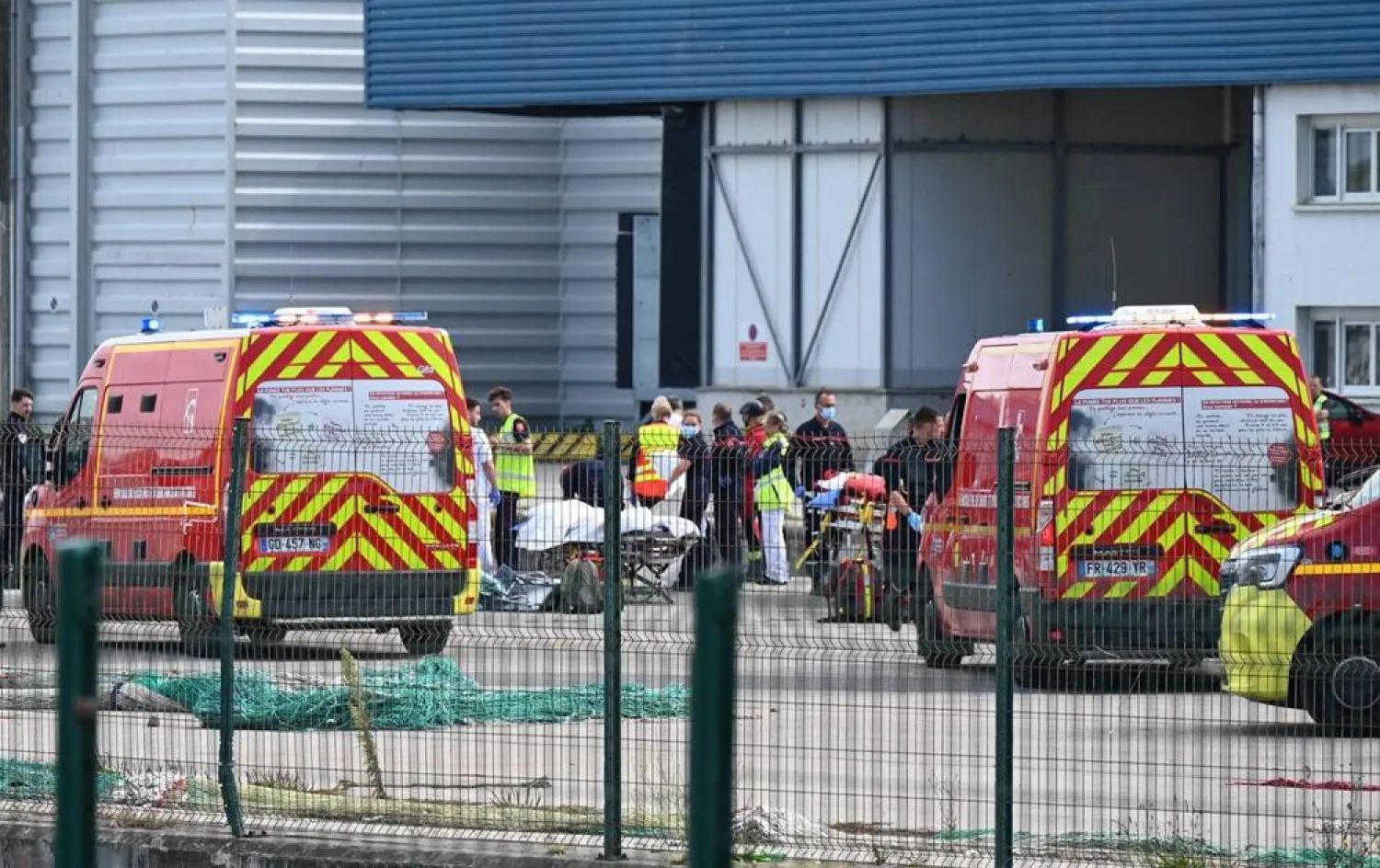

12 Killed as Boat with Dozens of Migrants Rips Apart in English Channel off France

Firefighters handle the bodies of migrants who died trying to cross the Channel to England in Boulogne-sur-Mer, northern France on September 3, 2024. (AFP)
TT

12 Killed as Boat with Dozens of Migrants Rips Apart in English Channel off France

Firefighters handle the bodies of migrants who died trying to cross the Channel to England in Boulogne-sur-Mer, northern France on September 3, 2024. (AFP)

A boat carrying migrants ripped apart in the English Channel as they attempted to reach Britain from northern France on Tuesday, plunging dozens into the treacherous waterway and leaving 12 dead, authorities said.

Most of the victims were believed to be women, some under 18, and many of the passengers didn't have life preservers, officials said, with one calling it the deadliest migrant accident in the channel this year.

“Unfortunately, the bottom of the boat ripped open,” said Olivier Barbarin, mayor of Le Portel near Boulogne-sur-Mer, where a first aid post was set up to treat victims. “If people don’t know how to swim in the agitated waters ... it can go very quickly."

Europe’s increasingly strict asylum rules, growing xenophobia and hostile treatment of migrants have been pushing them north. Before Tuesday’s accident, at least 30 migrants had died or gone missing while trying to cross to the UK this year, according to the International Organization for Migration.

Rescuers pulled a total of 65 people from the English Channel on Tuesday in a search that lasted more than four hours, according to Lt. Etienne Baggio, a spokesman for the French agency that oversees the stretch of sea where the boat ripped apart. Doctors confirmed 12 died, he said.

Another 12 people were hospitalized, and two were in very serious conditions, authorities said.

Baggio called it the deadliest migrant boat tragedy in the English Channel this year. In July, four migrants died while attempting the crossing on an inflatable boat that capsized and punctured. Five others, including a child, died in another attempt in April. And five dead were recovered from the seas or found washed up along a beach after a migrant boat ran into difficulties in the dark and winter cold of January.

Many of those aboard the vessel that broke up in the English Channel on Tuesday didn't have life vests, Baggio said. It was not immediately clear what kind of boat it was. Three helicopters, a plane, two fishing boats and more than six other vessels were involved in the rescue operation.

In another sea tragedy Tuesday involving migrants seeking a better life in Europe, a boat carrying migrants capsized off the Libyan coast, leaving one person dead and 22 missing, Libyan authorities said.

The agency overseeing the rescue operation in the English Channel said the boat got into difficulty off Gris-Nez point between Boulogne-sur-Mer and the port of Calais further north. Sea temperatures off northern France were around 20 degrees C, or about 68 F.

Interior Minister Gerald Darmanin went to Boulogne-sur-Mer to meet those involved in handling what he described as the “terrible shipwreck.” He said the boat was frail and small -- less than 7 meters (23 feet) long -- and that smugglers are packing more and more people aboard such vessels. Most of the people on the boat were believed to be from Eritrea, and most of the victims were women, he said.

Last week, the leaders of France and Britain agreed to deepen cooperation on illegal migration in the channel.

UK Home Secretary Yvette Cooper called it “a horrifying and deeply tragic incident” and paid tribute to French rescuers “who undoubtedly saved many lives, but sadly could not save everyone.”

“The gangs behind this appalling and callous trade in human lives have been cramming more and more people onto increasingly unseaworthy dinghies, and sending them out into the Channel even in very poor weather,” she said.

“They do not care about anything but the profits they make, and that is why — as well as mourning the awful loss of life — the work to dismantle these dangerous and criminal smuggler gangs and to strengthen border security is so vital and must proceed apace.”

At least 2,109 migrants have tried to cross the English Channel on small boats in the past seven days, according to UK Home Office data updated Tuesday. The data includes people found in the channel or on arrival.



UN Votes to Cut Peacekeeping Force in South Sudan

Member of the South Sudan Red Cross takes cover from the thrust as a United Nations helicopter arrives at the wreckage of a Cessna 208 Caravan operated by CityLink Aviation, that lost communication and crashed while flying from Yei to Juba International Airport, in Juba, South Sudan April 27, 2026. REUTERS/Samir Bol
TT

UN Votes to Cut Peacekeeping Force in South Sudan

Member of the South Sudan Red Cross takes cover from the thrust as a United Nations helicopter arrives at the wreckage of a Cessna 208 Caravan operated by CityLink Aviation, that lost communication and crashed while flying from Yei to Juba International Airport, in Juba, South Sudan April 27, 2026. REUTERS/Samir Bol

The UN Security Council voted Thursday to reduce the ceiling for the peacekeeping force in conflict-torn South Sudan from 17,000 to 12,000 troops with a mandate to prevent a return to civil war in the world's newest nation.

The vote on the US-drafted resolution was 13-0 with Russia and China abstaining. It extends the mandate of the force until April 30, 2027, The Associated Press reported.

US Ambassador Mike Waltz told the council the resolution seeks to get the force “back to basics” — keeping the peace, protecting civilians and supporting access to humanitarian aid.

There were high hopes when oil-rich South Sudan gained independence from Sudan in 2011 after a long conflict. But the country slid into a civil war in December 2013, largely based on ethnic divisions, when forces loyal to Salva Kiir, an ethnic Dinka, battled those loyal to Riek Machar, an ethnic Nuer.

More than 400,000 people were killed in the war, which ended with a peace agreement in 2018 and a national unity government with Kiir as president and Machar as vice president. But Kiir’s government put Machar under house arrest in March 2025, accusing him of subversive activities, and he now faces treason charges.

Machar’s removal coincided with a sharp increase in violence and a breakdown of the 2018 peace deal, though a long-delayed presidential election is still scheduled for December.

Waltz said the US is concerned that Kiir's government is “exploiting international support and obstructing those that are genuinely trying to help.”

For example, Waltz said, between October and March the UN force recorded more than 480 incidents where peacekeepers were blocked, humanitarian access was denied, repatriation flights were obstructed, bases were forced to close “and millions of dollars were lost and wasted.”

He said the United States is serious when it says the UN's far-flung peacekeeping missions are meant to be temporary to help governments “navigate peace and security crises.”

Russia’s deputy ambassador Anna Evstigneeva argued for maintaining the mission's ceiling.
“The mission must be ready for any scenario and security challenges,” she said. “It should have a sufficient level of resources for that.”


UK Police Charge Man with Stabbing Attack on 2 Jewish Londoners

Local residents look on from outside a cordoned off area in the Golders Green neighbourhood of north London on April 29, 2026, following the stabbing to two people nearby. (Photo by JUSTIN TALLIS / AFP)
TT

UK Police Charge Man with Stabbing Attack on 2 Jewish Londoners

Local residents look on from outside a cordoned off area in the Golders Green neighbourhood of north London on April 29, 2026, following the stabbing to two people nearby. (Photo by JUSTIN TALLIS / AFP)

UK police said on Friday they had charged a 45-year-old man over the stabbing of two Jewish men in north London, the latest in a string of hate attacks.

"Essa Suleiman... has been charged with two counts of attempted murder and one count of possession of a bladed article in a public place in relation to an attack in Golders Green on Wednesday," the Metropolitan Police said in a statement.

UK Prime Minister Keir Starmer vowed Thursday to boost security for the Jewish community after accusations from angry British Jews that his government has repeatedly failed to protect them.

He said: “I absolutely understand the high levels of anxiety and concern that there are.”

“Antisemitism is an old, old hatred. History shows that the roots are deep, and if you turn away, it grows back," he said during a televised statement at 10 Downing St. “Yet far too many people in this country diminish it.”

Later Thursday, the interior ministry announced that the country's terrorism threat level had been raised to "severe", the second highest in the five-tier system and meaning another attack "is highly likely in the next six months."

The two men were attacked in broad daylight in Golders Green, a north London area with a large Jewish population.

The victims, aged 76 and 34, were in a stable condition in hospital.

The suspected attacker is a British national who was born in Somalia and came to the UK as a child.

Britain’s Jewish community, which numbers about 300,000 people, has faced growing attacks online and in the streets.

The number of antisemitic incidents reported across the UK has soared since the attack by Hamas-led militants on southern Israel on Oct. 7, 2023, and the subsequent war in Gaza, according to the Community Security Trust charity.

In October, an attacker drove his car into people gathered outside a Manchester synagogue on Yom Kippur and fatally stabbed one man. Another man died during the attack after being inadvertently shot by police.

Since the start of the Iran war on Feb. 28, there have been a string of arson attacks on synagogues and other Jewish sites in London as well as on opponents of the Iranian government.

Police say that 28 people have been arrested over those attacks, which did not cause any injuries. A handful have been charged and one teenager has been convicted after pleading guilty.


Iran’s Supreme Leader Vows to Protect Nuclear and Missile Capabilities

A woman holds up a picture of the Iranian Supreme Leader Mojtaba Khamenei during a state-organized rally in Tehran, Iran, Wednesday, April 29, 2026. (AP)
TT

Iran’s Supreme Leader Vows to Protect Nuclear and Missile Capabilities

A woman holds up a picture of the Iranian Supreme Leader Mojtaba Khamenei during a state-organized rally in Tehran, Iran, Wednesday, April 29, 2026. (AP)

Iran’s supreme leader defiantly vowed Thursday to protect the country’s nuclear and missile capabilities, which US President Donald Trump has sought to curtail through airstrikes and as part of a wider deal to cement the war’s shaky ceasefire.

In a statement read by a state television anchor, Mojtaba Khamenei said the only place Americans belonged in the Gulf is “at the bottom of its waters" and that a “new chapter” was being written in the region's history.

Khamenei has not been seen in public since taking over as supreme leader following the killing of his father in the war’s opening airstrikes.

His remarks come as Iran's economy is reeling and its oil industry is being squeezed by a US Navy blockade halting its tankers from getting out to sea. The world economy is also under pressure as Iran maintains its chokehold on the Strait of Hormuz, through which a fifth of all crude oil is transported. On Thursday, the global benchmark for oil, Brent crude, traded as high as $126 a barrel.

That shock to oil supplies and prices is putting pressure on Trump, who is floating a new plan to reopen the critical passageway used by the Gulf to export their oil and gas.

Under the plan, the US would continue its blockade on Iranian ports, while coordinating with allies to impose higher costs on Iran’s attempts to subvert the free flow of energy, according to a senior administration official, who spoke on condition of anonymity because they were not authorized to comment publicly.

In a cable sent Tuesday, the US State Department instructed American diplomats around the world — except those in Belarus, China, Cuba and Russia — to seek their host government’s support for the Trump administration's call for assistance in establishing a “maritime freedom construct” that would ensure free and unimpeded access to shipping through the strait.

“This commitment reflects broad international consensus on the need for coordinated action to counter Iranian maritime provocations and ensure navigational rights and freedoms in the Strait of Hormuz,” said the cable, a copy of which was obtained by The Associated Press on Thursday.

The initiative, being led by the State Department and the Pentagon’s Central Command, “is a fundamentally defensive response to protect the rights of all countries to navigate international waters freely and safely and to hold Iran accountable for its aggressive and illegal actions to impede the free flow of commerce,” the cable said.

At the same time, Trump has also floated possible changes to US troop presence in allied countries in Europe. The day after the president announced his administration was conducting a review on potentially reducing the US troop presence in Germany, he was asked by a reporter whether he’d weigh pulling US forces out of Italy and Spain — which have sparred with the United States over use of bases for Iran-related operations.

“Why shouldn’t I,” Trump answered. “Italy has not been of any help to us, and Spain has been horrible, absolutely horrible.”

Ceasefire shaken as strait remains shut

The US blockade, which as of Thursday has turned back some 44 commercial vessels, according to US Central Command, is designed to prevent Iran from selling its oil, depriving it of crucial revenue while also potentially creating a situation where Tehran has to shut off production because it has nowhere to store oil.

A recent Iranian proposal would push negotiations on the country’s nuclear program to a later date. Trump said one of the major reasons he went to war was to deny Iran the ability to develop nuclear weapons. Iran has long maintained its program is peaceful, though it enriched uranium at near-weapons-grade levels of 60%.

Pakistan on Thursday said it was still facilitating indirect talks between the US and Iran aimed at easing tensions, but that Islamabad would also welcome direct communication between the two sides, even by phone.

“If the two parties can engage in real-time conversations, that could ease the sticking points,” said Ministry of Foreign Affairs spokesperson Tahir Andrabi at a weekly news briefing. He declined to share details of any Iranian or US proposals.

Khamenei's remarks signaled that nuclear issues and Iran's ballistic missile program wouldn't be traded away.

“Ninety million proud and honorable Iranians inside and outside the country regard all of Iran’s identity-based, spiritual, human, scientific, industrial and technological capacities — from nanotechnology and biotechnology to nuclear and missile capabilities — as national,” Khamenei said.

Khamenei referred to America as the “Great Satan,” a long-hurled insult by Iranian leaders toward the US since the 1979 revolution.

Khamenei signals strait will remain shut

In his remarks, Khamenei seemed to signal Iran would maintain its control over the waterway, which sits in the territorial waters of Iran and Oman. Iran had been charging some ships reportedly $2 million apiece to travel through the strait.

He said that Iran's control of the Strait of Hormuz will make the Gulf more secure, and that Tehran's “legal rules and new management” of the strait will benefit all the region’s nations.

However, the world considered the strait an international waterway, open to all without paying tolls. Gulf Arab nations have decried Iran's control of the strait as akin to piracy.

Crackdown intensifies in Iran

Iran announced Thursday it hanged a 21-year-old man over charges stemming from the nationwide protests in January, the judiciary’s Mizan news agency reported.

The agency identified the executed man as Sasan Azadvar, from Isfahan. It said he was hanged for the crime of “effectively cooperating with the enemy by attacking police officers” during the protests.

Activists and rights groups say a crackdown on dissent, including a wave of executions, has further intensified since the US-Israel war with Iran.

UN Human Rights Chief Volker Turk said on Wednesday at least 21 people have been executed since the start of the war.

Iran routinely holds closed-door trials in which defendants are unable to challenge the accusations they face, rights groups say, warning that several other people remain at risk of execution.

Fighting continues in southern Lebanon

Despite a ceasefire between Israel and Lebanon-based, Iran-backed Hezbollah, the group has continued to claim attacks on Israeli troops in southern Lebanon. Israel's military said one of its soldiers was killed in battle there Thursday, raising the troop casualties to 17 since the Iran war started.

Air raid sirens sounded multiple times in border communities in northern Israel on Thursday, too. The Israeli military said it struck military structures used by Hezbollah, and the Lebanese Health Ministry said 9 were killed in strikes, including women and children.

Late on Thursday, the foreign ministry of United Arab Emirates — which has come under attack by Iran during war — announced a travel ban for its citizens covering Iran, Lebanon and Iraq, and urged those already in those countries to return home.