UN Votes to Cut Peacekeeping Force in South Sudan

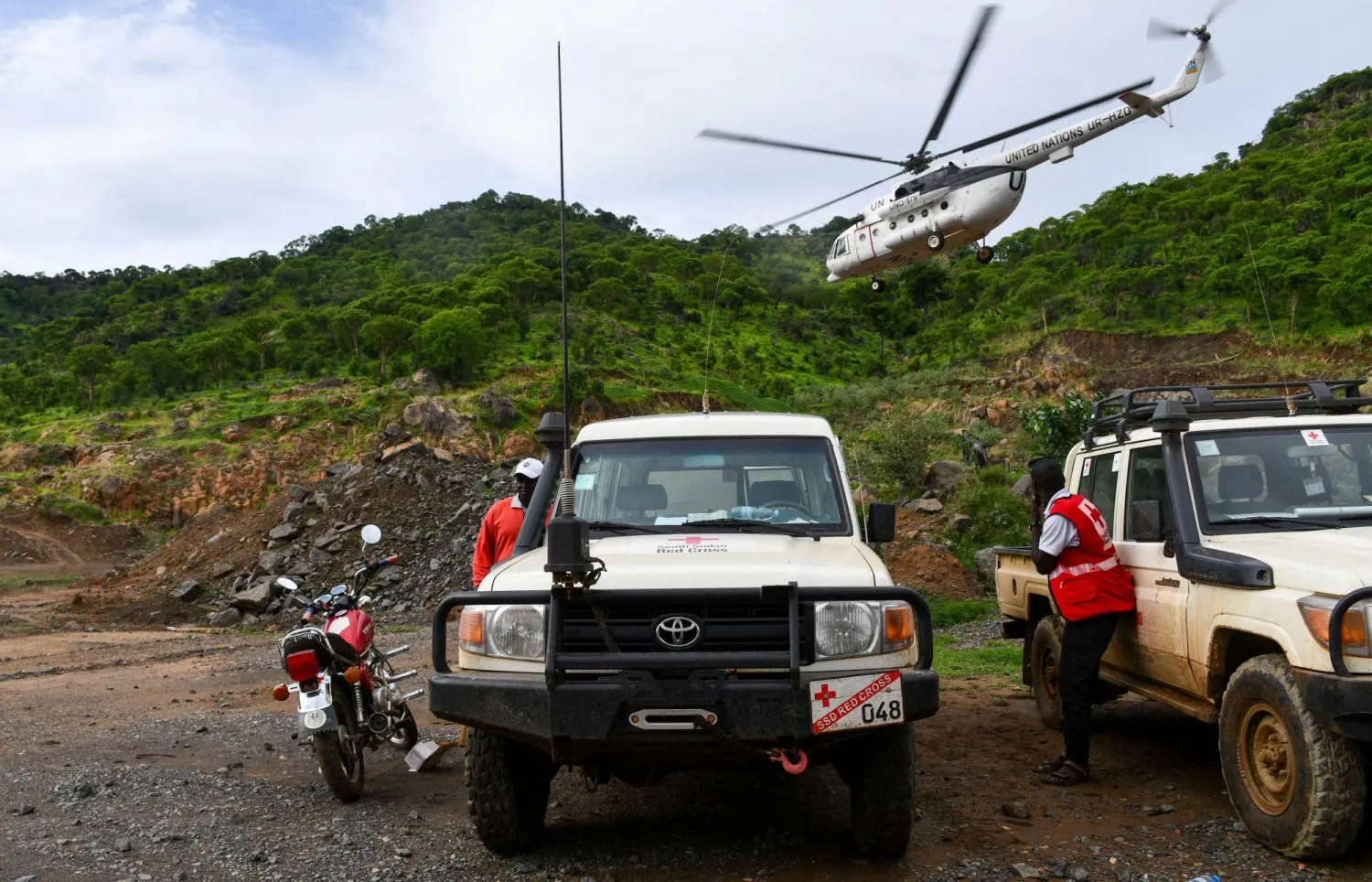
Member of the South Sudan Red Cross takes cover from the thrust as a United Nations helicopter arrives at the wreckage of a Cessna 208 Caravan operated by CityLink Aviation, that lost communication and crashed while flying from Yei to Juba International Airport, in Juba, South Sudan April 27, 2026. REUTERS/Samir Bol
TT

UN Votes to Cut Peacekeeping Force in South Sudan

Member of the South Sudan Red Cross takes cover from the thrust as a United Nations helicopter arrives at the wreckage of a Cessna 208 Caravan operated by CityLink Aviation, that lost communication and crashed while flying from Yei to Juba International Airport, in Juba, South Sudan April 27, 2026. REUTERS/Samir Bol

The UN Security Council voted Thursday to reduce the ceiling for the peacekeeping force in conflict-torn South Sudan from 17,000 to 12,000 troops with a mandate to prevent a return to civil war in the world's newest nation.

The vote on the US-drafted resolution was 13-0 with Russia and China abstaining. It extends the mandate of the force until April 30, 2027, The Associated Press reported.

US Ambassador Mike Waltz told the council the resolution seeks to get the force “back to basics” — keeping the peace, protecting civilians and supporting access to humanitarian aid.

There were high hopes when oil-rich South Sudan gained independence from Sudan in 2011 after a long conflict. But the country slid into a civil war in December 2013, largely based on ethnic divisions, when forces loyal to Salva Kiir, an ethnic Dinka, battled those loyal to Riek Machar, an ethnic Nuer.

More than 400,000 people were killed in the war, which ended with a peace agreement in 2018 and a national unity government with Kiir as president and Machar as vice president. But Kiir’s government put Machar under house arrest in March 2025, accusing him of subversive activities, and he now faces treason charges.

Machar’s removal coincided with a sharp increase in violence and a breakdown of the 2018 peace deal, though a long-delayed presidential election is still scheduled for December.

Waltz said the US is concerned that Kiir's government is “exploiting international support and obstructing those that are genuinely trying to help.”

For example, Waltz said, between October and March the UN force recorded more than 480 incidents where peacekeepers were blocked, humanitarian access was denied, repatriation flights were obstructed, bases were forced to close “and millions of dollars were lost and wasted.”

He said the United States is serious when it says the UN's far-flung peacekeeping missions are meant to be temporary to help governments “navigate peace and security crises.”

Russia’s deputy ambassador Anna Evstigneeva argued for maintaining the mission's ceiling.
“The mission must be ready for any scenario and security challenges,” she said. “It should have a sufficient level of resources for that.”


Putin Threatens Retaliatory Seizures of European Ships

Russian President Vladimir Putin holds a meeting aboard the Guards missile cruiser Varyag during the final stage of the Pacific Fleet's exercises off the coast of Sakhalin region, Russia, 12 August 2026. (EPA/Gavriil Grigorov Kremlin / Pool)
TT

Putin Threatens Retaliatory Seizures of European Ships

Russian President Vladimir Putin holds a meeting aboard the Guards missile cruiser Varyag during the final stage of the Pacific Fleet's exercises off the coast of Sakhalin region, Russia, 12 August 2026. (EPA/Gavriil Grigorov Kremlin / Pool)

Russian President Vladimir Putin on Wednesday threatened to seize ships belonging to European countries in retaliation for plans to sell off cargo seized from Russian "shadow fleet" vessels.

Several European companies have intercepted ships carrying Russian oil in contravention of European sanctions targeting the vital revenue source.

New sanctions passed last month permit EU members to sell the oil or any other cargo seized from the ships.

Moscow has bristled at the moves, with Putin calling it "piracy and banditry".

"We will be forced to respond in kind," the Kremlin chief said while overseeing naval drills in Russia's Far East.

Moscow would act "wherever we ourselves deem necessary and appropriate -- anywhere," he added.

Swedish court documents obtained by AFP earlier in August showed Stockholm will transfer to Kyiv a seized Russian ship suspected of transporting grain from occupied Ukraine.

Putin was speaking aboard the Russian cruiser Varyag off the island of Sakhalin, where Russia's navy was conducting drills.

The exercises come a week before joint US-South Korean war games, designed to simulate a possible invasion from North Korea.

Tensions are high in the region amid accusations from Kyiv and Seoul that Pyongyang and Moscow are further intensifying their military cooperation.


Pakistan Interior Minister in Iran to Discuss Regional Security

A handout photo made available by the Iranian Foreign Ministry Office shows Iranian Foreign Minister Abbas Araghchi (R) meeting with Pakistan's Minister of Interior Mohsin Naqvi in Tehran on August 11, 2026. (Iran Foreign Ministry / AFP)
TT

Pakistan Interior Minister in Iran to Discuss Regional Security

A handout photo made available by the Iranian Foreign Ministry Office shows Iranian Foreign Minister Abbas Araghchi (R) meeting with Pakistan's Minister of Interior Mohsin Naqvi in Tehran on August 11, 2026. (Iran Foreign Ministry / AFP)

Pakistan's interior minister is visiting Iran to discuss regional security, stability and other developments, the Pakistani foreign office said Wednesday, as Islamabad tries to mediate a resolution to the Middle East war.

Mohsin Naqvi, previously involved in mediation efforts between Iran and the US, is known to be close to the powerful head of the Pakistani army, Asim Munir.

Iranian state news agency IRNA reported late Tuesday that Naqvi met with Iranian President Masoud Pezeshkian, Foreign Minister Abbas Araghchi and Interior Minister Eskandar Momeni.

"He is discussing bilateral relations, security, regional security and stability, and constructive engagement amongst the parties in the region and regional developments," Pakistani foreign ministry spokesman Tahir Andrabi told reporters in Islamabad.

The Iranian government's website said Naqvi conveyed to Pezeshkian "a message from the Pakistani prime minister and the chief of the army", without specifying its content.

Tehran insists on retaining control of the Strait of Hormuz after the war and wants to charge fees for passage, repeatedly striking ships it accuses of attempting to circumvent its preferred route. The US has imposed a rival blockade on Iranian ports.

Attacks in the waterway, which was free to transit before the war, led to the collapse of an April ceasefire, and mediators have urged both sides to return to the terms of a subsequent June memorandum that set out a path for peace talks.

Last week Iran said it had agreed a route with neighboring Oman for ships transiting the strait and was finalizing arrangements for jointly managing the strategic waterway.

On Tuesday the US military announced that it had fired on a Panama-flagged cargo ship that attempted to break the American blockade of Iran's ports.


North Korea Fires Missile Ahead of Major US-South Korea Drills

People watch a news broadcast on a television screen showing a report on a missile launch, at a railway station in Seoul, South Korea, 12 August 2026. (EPA)
TT

North Korea Fires Missile Ahead of Major US-South Korea Drills

People watch a news broadcast on a television screen showing a report on a missile launch, at a railway station in Seoul, South Korea, 12 August 2026. (EPA)

North Korea fired a ballistic missile on Wednesday toward the sea off the Korean peninsula's east coast, South Korean and Japanese authorities said, days ahead of major joint military exercises by Seoul and Washington long denounced by Pyongyang.

The missile was launched from the North's Wonsan area at about 6 a.m. (2100 GMT Tuesday), South Korea's Joint Chiefs of Staff (JCS) said, six days after North Korea fired another ballistic missile from the same area.

The launch came ahead of South Korean and US military drills, dubbed Ulchi Freedom Shield, set to run from August 17 to August 27, aimed at countering Pyongyang's evolving nuclear and weapons capabilities.

Hong Min, a senior researcher at the Korea Institute for National Unification in Seoul, said the launch ‌was likely part of ‌North Korea's existing weapons development schedule, but the timing could also have been ‌selected ⁠to send a ⁠message ahead of the exercises.

"Even if it was a test of a weapon under development, choosing when to conduct it requires a political decision," Hong said.

There was no immediate statement from North Korea on the Wonsan launch, but Pyongyang on Wednesday afternoon criticized the nuclear ambitions of South Korea and Japan.

South Korea said North Korea also fired a ballistic missile from Wonsan on August 6, but Pyongyang did not report that launch in state media. Hong said that test may have failed to achieve its intended objective.

North Korea's series of tests this year has featured short-range ballistic missiles, artillery rockets and other tactical weapons.

Wednesday's ⁠launch was its 11th suspected ballistic missile test in 2026, according to South Korean ‌assessments.

South Korean and Japanese defense authorities said the missile flew about 700 ‌km (435 miles).

Seoul's Joint Chiefs of Staff did not identify it as a short-range ballistic missile, saying authorities would conduct a detailed ‌analysis.

The omission leaves open the question of what type of missile it was, analysts said. Ballistic missiles with ‌ranges of 300 km to 1,000 km (186 miles to 620 miles) are generally classified as short-range.

Hong said the range, trajectory and launch site suggested it may have been a type of hypersonic missile, though a submarine-launched missile was also possible.

CONDEMNATION AND HEIGHTENED TENSIONS

South Korea and Japan both condemned the launch.

"Japan lodged a strong protest with North Korea through diplomatic channels at the Japanese Embassy ‌in Beijing and strongly condemned the action," Japanese Defense Minister Shinjiro Koizumi told reporters.

South Korea's Office of National Security convened an emergency meeting and expressed concern over North Korea's continued ⁠ballistic-missile launches following the ⁠August 6 firing. It urged Pyongyang to halt provocations that violate UN Security Council resolutions.

South Korea's military said it was maintaining readiness to respond "overwhelmingly" to any provocation under its combined defense posture with the United States.

The US Indo-Pacific Command said it was consulting closely with allies and partners, adding that its initial assessment was that the launch posed no immediate threat to US personnel or territory, or to its allies.

On Tuesday, Ukrainian President Volodymyr Zelenskiy said Moscow used North Korean ballistic missiles during a Russian attack that killed seven workers at a steel plant in the southeastern city of Zaporizhzhia.

In a statement, a North Korean Foreign Ministry official responsible for South Korean affairs said Seoul's plans to develop nuclear-powered submarines would heighten instability in the region, for a "serious challenge" to the North's security.

Pyongyang needed the capability to counter its adversaries' military moves with retaliatory strikes that would make their "survival and recovery impossible", the statement added.

In a separate commentary state news agency KCNA accused Japan of seeking nuclear weapons under the guise of peaceful use of atomic energy, citing its nuclear power program and debate among Japanese politicians over nuclear armament.