
Iran Summons 4 European Envoys Over Accusations It Supplied Ballistic Missiles to Russia https://english.aawsat.com/world/5060514-iran-summons-4-european-envoys-over-accusations-it-supplied-ballistic-missiles-russia
Iran Summons 4 European Envoys Over Accusations It Supplied Ballistic Missiles to Russia
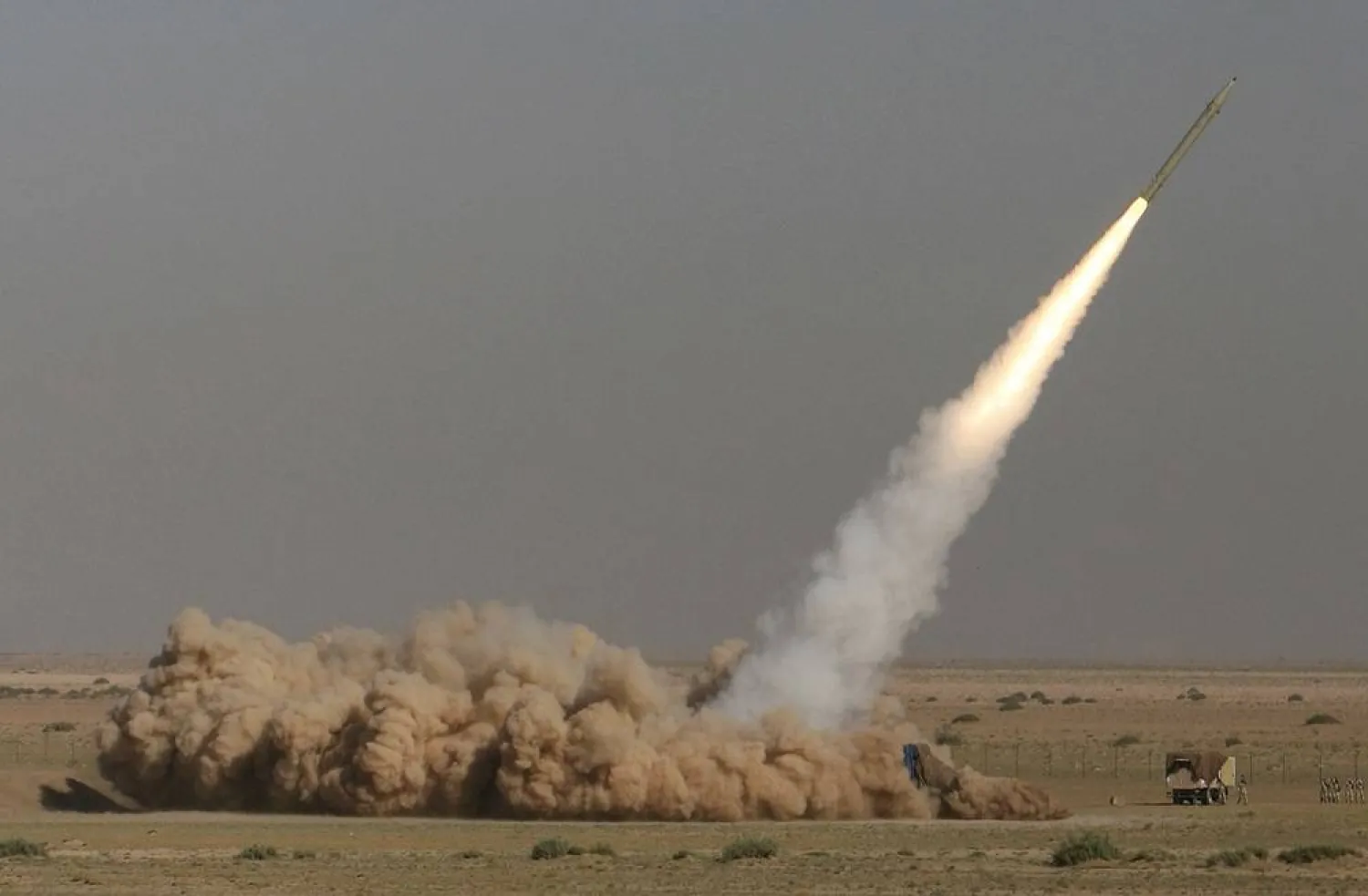
In this photo released by the Iranian semi-official Fars News Agency, Revolutionary Guard's Fateh missile is launched in a drill near the city of Qom, 80 miles (130 kilometers) south of the capital Tehran, Iran, Sept. 27, 2009. (Ali Shaigan/Fars News Agency via AP File)
TT
TT
Iran Summons 4 European Envoys Over Accusations It Supplied Ballistic Missiles to Russia
In this photo released by the Iranian semi-official Fars News Agency, Revolutionary Guard's Fateh missile is launched in a drill near the city of Qom, 80 miles (130 kilometers) south of the capital Tehran, Iran, Sept. 27, 2009. (Ali Shaigan/Fars News Agency via AP File)
Iran's government on Thursday summoned the envoys of Britain, France, Germany and the Netherlands over their accusations that Tehran supplied short-range ballistic missiles to Russia to use against Ukraine.
State-run IRNA news agency reported that the country’s foreign ministry summoned the envoys separately on Thursday to strongly condemn the accusations.
IRNA said the ministry also condemned Britain, France, and Germany for issuing a joint statement against Iran and called it an "unconventional and non-constructive statement."
The joint statement, issued Tuesday, condemned the alleged transfer of missiles, calling it "an escalation by both Iran and Russia" and "a direct threat to European security."
The three countries also announced new sanctions against Iran, including the cancellation of air services agreements with Iran, which will restrict Iran Air’s ability to fly to the UK and Europe.
IRNA said that Iran’s foreign ministry told the envoys that their insistence on taking such positions is seen as part of the West’s ongoing hostile policy against the Iranian people. The actions will "be met with an appropriate response from the Islamic Republic of Iran."
US Secretary of State Antony Blinken said this week that Iran had ignored warnings that the transfer of such weapons would be a profound escalation of the conflict.
He told reporters during a trip to London that dozens of Russian military personnel had been trained in Iran to use the Fath-360 close-range ballistic missile system, which has a maximum range of 75 miles (120 kilometers).
Philippines, US, Japanese Planes Drill over Bashi Channelhttps://english.aawsat.com/world/5245367-philippines-us-japanese-planes-drill-over-bashi-channel
This handout photo taken on February 26, 2026 and released on February 27 by the Armed Forces of the Philippines-Public Affairs Office (AFP-PAO) shows a Philippine air force FA-50 fighter jet (L) flying alongside a Japan Maritime Self-Defense Force's P-3 Orion maritime patrol aircraft during a joint military exercise in the disputed South China Sea. Handout / AFP
Philippines, US, Japanese Planes Drill over Bashi Channel
This handout photo taken on February 26, 2026 and released on February 27 by the Armed Forces of the Philippines-Public Affairs Office (AFP-PAO) shows a Philippine air force FA-50 fighter jet (L) flying alongside a Japan Maritime Self-Defense Force's P-3 Orion maritime patrol aircraft during a joint military exercise in the disputed South China Sea. Handout / AFP
The Philippine, US and Japanese militaries conducted joint exercises this week over the Bashi Channel that separates the Philippines from Taiwan, officials said Friday.
Aircraft from the three nations patrolled over the Philippines' northernmost Batanes islands in drills aimed at showcasing their "ability to operate seamlessly together in complex maritime environments", the Philippine military said in a statement.
It marks the first time that so-called Multilateral Maritime Cooperative Activities (MMCAs) involving the countries have expanded beyond the South China Sea, where the Philippines and China have engaged in repeated clashes over disputed territory.
Little more than 100 kilometers (60 miles) separates the Philippines and self-ruled Taiwan, which China views as its territory and has not ruled out taking by force.
"Air operations were conducted within airspace over Philippine territory and its territorial sea, north of Luzon," the Philippine military said in a statement, adding naval vessels had stayed west of the Batanes island chain.
Armed forces public affairs chief Colonel Xerxes Trinidad told AFP it was the "first time" MMCA operations had been conducted in the "said operational box".
The military's statement said that box extended "up to the northern tip of Luzon, particularly Mavulis Island", which hosts small Philippine navy and marine detachments.
China's military reacted angrily to the drills on Friday.
"The Philippines co-opted countries outside the region to organize the so-called joint patrols, disrupting peace and stability in the region," said Zhai Shichen, spokesperson for the PLA's Southern Theater Command.
He added that China had conducted a "routine patrol" of the South China Sea from February 23 to 26.
In November, Japanese Prime Minister Sanae Takaichi sent relations with Beijing into a tailspin by suggesting that Tokyo could intervene militarily in any attack on Taiwan.
Beijing imposed export restrictions and warned its citizens against visiting Japan, while accusing Tokyo of attempting to "revive militarism".
Japan's defense minister upped the ante by saying on Tuesday that Tokyo planned to deploy surface-to-air missiles on one of its remote western islands located near Taiwan by early 2031.
In August, Philippine President Ferdinand Marcos warned that the Philippines would be dragged "kicking and screaming" into any war over Taiwan.
"I hope it doesn't happen... But if it does, we have to plan for it already," he said, citing the large numbers of Filipinos working in Taiwan.
The Philippine-US-Japanese exercise took place over six days and concluded on Thursday. It included a live-fire gunnery exercise conducted by the guided missile frigate BRP Antonio Luna.
US Offers $10 Million for Capture of Brothers Said to Lead Mexico's Sinaloa Cartelhttps://english.aawsat.com/world/5245365-us-offers-10-million-capture-brothers-said-lead-mexicos-sinaloa-cartel
A soldier stands guard by a charred vehicle after it was set on fire, in Cointzio, Michoacán state, Mexico, Sunday, Feb. 22, 2026, following the death of the leader of the Jalisco New Generation Cartel, Nemesio Oseguera, known as "El Mencho." (AP Photo/Armando Solis)
US Offers $10 Million for Capture of Brothers Said to Lead Mexico's Sinaloa Cartel
A soldier stands guard by a charred vehicle after it was set on fire, in Cointzio, Michoacán state, Mexico, Sunday, Feb. 22, 2026, following the death of the leader of the Jalisco New Generation Cartel, Nemesio Oseguera, known as "El Mencho." (AP Photo/Armando Solis)
The US State Department said Thursday that it would pay up to $10 million for information leading to the arrests or convictions of two brothers identified as leaders of Mexico's Sinaloa cartel in the state of Baja California, which includes Tijuana.
The reward offer came the same day that authorities announced a new indictment against Rene Arzate Garcia, 42, known as “La Rana" ("The Frog"). He was initially charged with drug crimes in San Diego. The superseding indictment includes charges of conspiracy, narcoterrorism and material support to a designated foreign terrorist organization, The Associated Press reported.
The US is offering $5 million each for information on Rene Arzate Garcia and Alfonso Arzate Garcia, 52, known as “Aquiles” ("Achilles"). Their whereabouts are unknown.
“As controllers of a critical trafficking node in Tijuana at the US border, the Arzate-Garcia brothers have become key essential components of the cartel’s command-and-control structure,” the State Department said.
“Their control of the Tijuana Plaza offers the Sinaloa Cartel a tactical advantage in maintaining dominance over rival organizations, ensuring no interruption to the busiest border crossing in the Western Hemisphere.”
California's border with Mexico has been a battleground between the Sinaloa and Jalisco New Generation cartels.
The rewards were announced four days after the Mexican army killed the leader of the Jalisco New Generation Cartel, Nemesio Rubén Oseguera Cervantes, “El Mencho,” decapitating what had become Mexico’s most powerful cartel. The drug lord was the Mexican government’s biggest prize yet to show the Trump administration in its efforts to crack down on the cartels.
Sources: Trump Iranian Missile Claim Unsupported by US Intelligencehttps://english.aawsat.com/world/5245359-sources-trump-iranian-missile-claim-unsupported-us-intelligence
24 February 2026, US, Washington: US President Donald Trump delivers the State of the Union Address in the House chamber at the US Capitol in Washington. Photo: Michael Brochstein/ZUMA Press Wire/dpa
Sources: Trump Iranian Missile Claim Unsupported by US Intelligence
24 February 2026, US, Washington: US President Donald Trump delivers the State of the Union Address in the House chamber at the US Capitol in Washington. Photo: Michael Brochstein/ZUMA Press Wire/dpa
US President Donald Trump’s claim that Iran will soon have a missile that can hit the United States is not backed by US intelligence reports, and appears to be exaggerated, according to three sources familiar with the reports, casting doubt on part of his case for a possible attack on the country.
In his State of the Union address to Congress on Tuesday, Trump began making his case to the American public for why the US could launch strikes against Iran, saying Tehran was “working on missiles that will soon reach” the United States.
But there have been no changes, two sources said, to an unclassified 2025 US Defense Intelligence Agency assessment that Iran could take until 2035 to develop a "militarily viable intercontinental ballistic missile" (ICBM) from its existing satellite-lofting space-launch vehicles (SLV).
“President Trump is absolutely right to highlight the grave concern posed by Iran, a country that chants ‘death to America,’ possessing intercontinental ballistic missiles," said White House spokesperson Anna Kelly.
A combination picture of satellite images shows Shiraz South Missile Base in Shiraz South, Iran, before reconstruction, July 3, 2025 (LEFT), and after reconstruction and clearance efforts, January 30, 2026. Planet Labs PBC/Handout via REUTERS
According to Reuters, one source said that even if China or North Korea - which closely cooperate with Iran - provided technological assistance, Iran would probably take up to eight years at the earliest to produce "something that is actually ICBM level and operational."
The sources, who spoke on condition of anonymity in order to discuss sensitive intelligence, said they were unaware of any US intelligence assessments that Iran was developing a missile that could soon range the US homeland but did not rule out the possibility of a new intelligence report they were unaware of.
The New York Times first reported that US intelligence agencies believe Iran is probably years away from having missiles that can hit the United States.
In his address on Tuesday, Trump pointed to Tehran's support for militant groups, its killing of protesters and the country's missile and nuclear programs as threats to the region and the United States.
Without providing evidence, Trump said that Tehran was beginning to rebuild the nuclear program that he claimed had been “obliterated” by US airstrikes last June on three major sites involved with uranium enrichment.
US Secretary of State Marco Rubio on Wednesday referred to Iran’s ballistic missile program in less definitive terms than Trump, saying that Tehran is "on a pathway to one day being able to develop weapons that could reach the continental US."
In an interview with India Today TV released on Wednesday, Iranian Foreign Minister Abbas Araghchi denied that Iran was expanding its missile capabilities.
"We are not developing long range missiles. We have limited range to below 2000 kilometers intentionally," he said. "We don’t want it to be a global threat. We only have (them) to defend ourselves. Our missiles build deterrence."
The US intelligence community and the International Atomic Energy Agency (IAEA), the UN nuclear watchdog, have said that Iran shuttered a nuclear weapons development program in 2003.
But according to the IAEA, Tehran has in recent years continued enriching uranium, including to near weapons-grade.
Trump has threatened to attack Iran if it executes people arrested during nationwide anti-government protests in January or fails to agree a deal on its nuclear program in talks with the US.
David Albright, a former UN nuclear inspector, said Iran was a long way away from being able to mount atop a missile a nuclear warhead-carrying re-entry vehicle that could survive the extreme heat and forces of plunging through Earth’s atmosphere.
"Iran can launch a very long-range missile because of its space launch program," said Albright, the president of the Institute for Science and International Security think tank. "But it needs lots of work to develop an adequate RV (re-entry vehicle)."
Albright and other experts noted that Israeli airstrikes last year and in 2024 had badly damaged key facilities where Tehran produces liquid- and solid-fuel ballistic missiles.
لم تشترك بعد
انشئ حساباً خاصاً بك لتحصل على أخبار مخصصة لك ولتتمتع بخاصية حفظ المقالات وتتلقى نشراتنا البريدية المتنوعة