Heavily Indebted Sri Lanka Votes in Election to Decide Economic Future

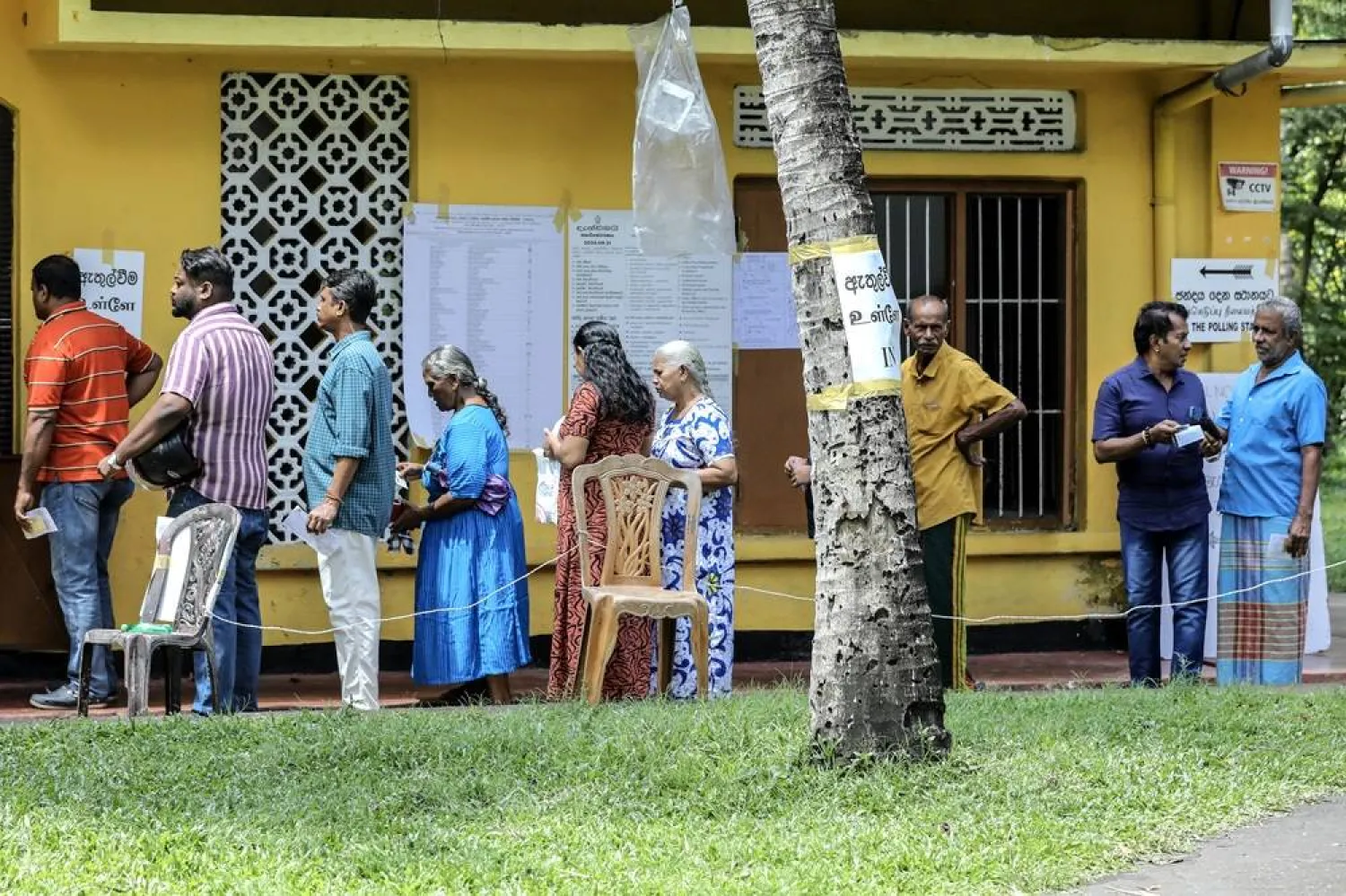
Sri Lankan voters stand in a queue to enter a polling station during the presidential election, in Colombo, Sri Lanka, 21 September 2024. (EPA)
TT

Heavily Indebted Sri Lanka Votes in Election to Decide Economic Future

Sri Lankan voters stand in a queue to enter a polling station during the presidential election, in Colombo, Sri Lanka, 21 September 2024. (EPA)

Millions of Sri Lankans were casting their votes on Saturday to elect a president who will face the task of bolstering the South Asian country's fragile economic recovery following its worst financial crisis in decades.

More than 17 million of Sri Lanka's 22 million people are eligible to vote in an election that has shaped up to be a close contest between President Ranil Wickremesinghe, main opposition leader Sajith Premadasa and Marxist-leaning challenger Anura Kumara Dissanayake, who led in one recent opinion poll.

Well-organized polling booths manned by public officials and police guided Sri Lankans on how to cast their vote as citizens in Colombo, the country's biggest city, lined up after voting began at 7 a.m. (0130 GMT).

At Visakha Vidyalaya, a school about 15 km from Colombo, brisk polling was seen early in the morning as families, some of them accompanying their ageing parents, lined up next to coir ropes that created orderly lines for voters.

A large blow-up of the ballot paper was visible at the entrance to the booth set up next to blooming flower beds and a stretch of classrooms.

"I think we desperately need a change and I think a lot of people feel the same way. For us to have a future the entire country must have a future, first," said Niroshan Perera, 36, a supporter of Dissanayake.

Voting was proceeding peacefully across the island nation and queues outside booths lengthened as the day progressed, local TV channels showed. Polls close at 4 p.m. (1030 GMT), with counting scheduled to start shortly afterward. The Election Commission is expected to announce the winner on Sunday.

Over 13,000 polling stations were set up across the country and 250,000 public officials deployed to manage the election, R.M.L. Rathnayake, the head of Sri Lanka's election commission, told Reuters.

This is the first election since Sri Lanka's economy buckled in 2022 under a severe foreign exchange shortage, leaving the Indian Ocean island nation unable to pay for imports of essentials including fuel, medicine and cooking gas.

Thousands of protesters marched in Colombo in 2022 and occupied the president's office and residence, forcing then-President Gotabaya Rajapaksa to flee and later resign.

Buttressed by a $2.9 billion bailout program from the International Monetary Fund, Sri Lanka's economy has posted a tentative recovery, but the high cost of living remains a core issue for many voters.

Although inflation cooled to 0.5% last month from a crisis high of 70%, and the economy is forecast to grow in 2024 for the first time in three years, millions remain mired in poverty and debt, with many pinning hopes of a better future on their next leader.

"This is an election that will change the history of Sri Lanka. People are voting enthusiastically," Dissanayake said after casting his vote at a temple in the outskirts of Colombo.

The winner will have to ensure Sri Lanka sticks with the IMF program until 2027 to get its economy on a stable growth path, reassure markets, attract investors and help a quarter of its people climb out of crisis-induced poverty.

"The people have to decide the future of this country. I ask everyone to vote peacefully," Wickremesinghe, accompanied by his wife, said after voting at the University of Colombo. "We have stabilized the government and the democratic system. I'm happy I've been able to make a major contribution to that."

Sri Lanka's ranked voting system allows voters to cast three preferential votes for their chosen candidates.

If no candidate wins 50% in the first count, there is a second round between the two frontrunners, with the preferential votes of other candidates redistributed, an outcome analysts say is likely given the close nature of the election.


Netanyahu Vows to Eliminate Iran Threat ‘Once and for All’

10 November 2026, Israel, Jerusalem: Caretaker Israeli Prime Minister Benjamin Netanyahu delivers a speech on the sidelines of the opening session of the new Knesset. (dpa)
TT

Netanyahu Vows to Eliminate Iran Threat ‘Once and for All’

10 November 2026, Israel, Jerusalem: Caretaker Israeli Prime Minister Benjamin Netanyahu delivers a speech on the sidelines of the opening session of the new Knesset. (dpa)

Israel's caretaker prime minister Benjamin Netanyahu on Saturday reiterated his calls for a national unity government with his opponent Gadi Eisenkot, as well as his vow to eliminate the threat from Iran.

A meeting with Eisenkot on Thursday "only strengthened the conviction that it is essential to form a national unity government" to guarantee Israel's security, Netanyahu said in a video statement, adding that such a government could "eliminate the Iranian threat once and for all".


Ukraine’s Zelenskiy Escalates Criticism of SpaceX Over Speed Caps

Ukraine's President Volodymyr Zelenskiy holds a press briefing in Copenhagen November 10, 2026. (AFP)
TT

Ukraine’s Zelenskiy Escalates Criticism of SpaceX Over Speed Caps

Ukraine's President Volodymyr Zelenskiy holds a press briefing in Copenhagen November 10, 2026. (AFP)

Ukraine's President Volodymyr Zelenskiy ‌escalated his criticism of SpaceX on Saturday, saying speed restrictions on its military-grade Starshield satellite terminals had dangerous political implications and undermined critical air defenses.

Zelenskiy said Starshield terminals operating in temporarily Russian-occupied territories of Ukraine had been limited to a maximum speed of 161 kph for the past five days, hampering Ukraine's military capabilities.

The Ukrainian Defense Ministry has raised the issue with SpaceX at the ‌institutional level, ‌Zelenskiy said.

"The restrictions have now ‌been ⁠in place for ⁠five days. They say it is some kind of technical issue. We do not believe that is the case," Zelenskiy told reporters in remarks released by his office on Saturday.

"If you impose restrictions there, you are already partially recognizing the temporarily ⁠occupied territories as not ours. And ‌that is why I ‌believe we have the right to raise this ‌issue and restore the speed – so that there ‌are no restrictions at all."

Zelenskiy said the speed restrictions made it more difficult for Ukrainian air defense units to intercept Russian jet-powered drones and made Ukrainian cities ‌more vulnerable. He said he had ordered his top military and foreign ministry ⁠officials ⁠to address the issue and seek clarification.

SpaceX has pushed back against the allegations, denying that it introduced new restrictions or made any changes to its satellite operations.

It is the second such outage in recent weeks. In mid-October, Ukrainian officials said that SpaceX limited the speed of Starlink and its Starshield communication systems to about 160 kph (100 mph) amid tensions with US President Donald Trump's administration over Ukrainian attacks on Russian oil refineries. Service was then restored on October 24.


UN Official Urges Iran, US to Let Fertilizers Through Hormuz Strait

Jorge Moreira da Silva, Executive Director of UNOPS (United Nations Office for Project Services), and coordinator of the UN Strait of Hormuz Task Force established by the UN Secretary-General, speaks during an interview with AFP on the sidelines of the 31st United Climate Change Conference (COP31), at the media center located on the Antalya Expo Center in Antalya on November 14, 2026. (AFP)
TT

UN Official Urges Iran, US to Let Fertilizers Through Hormuz Strait

Jorge Moreira da Silva, Executive Director of UNOPS (United Nations Office for Project Services), and coordinator of the UN Strait of Hormuz Task Force established by the UN Secretary-General, speaks during an interview with AFP on the sidelines of the 31st United Climate Change Conference (COP31), at the media center located on the Antalya Expo Center in Antalya on November 14, 2026. (AFP)

Iran and the United States should "immediately" allow fertilizer shipments through the Strait of Hormuz to ease the crisis in some of the most vulnerable countries, a senior UN official said Saturday.

Jorge Moreira da Silva, head of the UN Office for Project Services, told the COP31 climate talks in the Turkish resort city of Antalya that the lack of fertilizers could push millions into poverty.

The Iranian blockade of the vital waterway, which started after the joint US-Israeli attack against Iran in late February, has choked shipping in the region and beyond. The US blockade of Iranian ports has further complicated matters.

While Iran and the United States are still trying to negotiate an end to the conflict, Moreira da Silva said he had the same message for both countries.

"They should continue their negotiations about the comprehensive deal -- but that deal should not avoid an immediate, exceptional, limited, and time-bound solution for the fertilizers," he said.

"Basically, what we need is five vessels a day with fertilizers," he added.

- Millions at risk -

Moreira da Silva heads up the UN task force dedicated to facilitating the safe passage of fertilizers during the crisis.

Before the conflict, a third of the world's fertilizers passed through the Strait of Hormuz, and since the blockades, their prices had risen by 30 percent, he said.

"But what I think is not sufficiently recognized is the disproportionate impact on the most vulnerable countries," he added.

Sudan's finance minister recently told him that the price of food there had doubled in six months, he added. In Nepal, they had told him that farmers could no longer afford to buy fertilizers.

"So, it's very important that we are aware that countries such as Mozambique, Kenya, Sudan, Somalia, Nepal, Bangladesh, Sri Lanka are facing very significant impact."

The effects of this shortage could be catastrophic, he warned.

"If we continue missing the planting seasons in different parts of the world we may have 45 million people facing severe and acute food insecurity," he said.

"We may have 30 million people being forced into poverty."

The UN had a system ready to get fertilizer shipments moving within seven to 10 days, he said.