IAEA Chief Sees Willingness from Iran to Re-Engage on Nuclear File

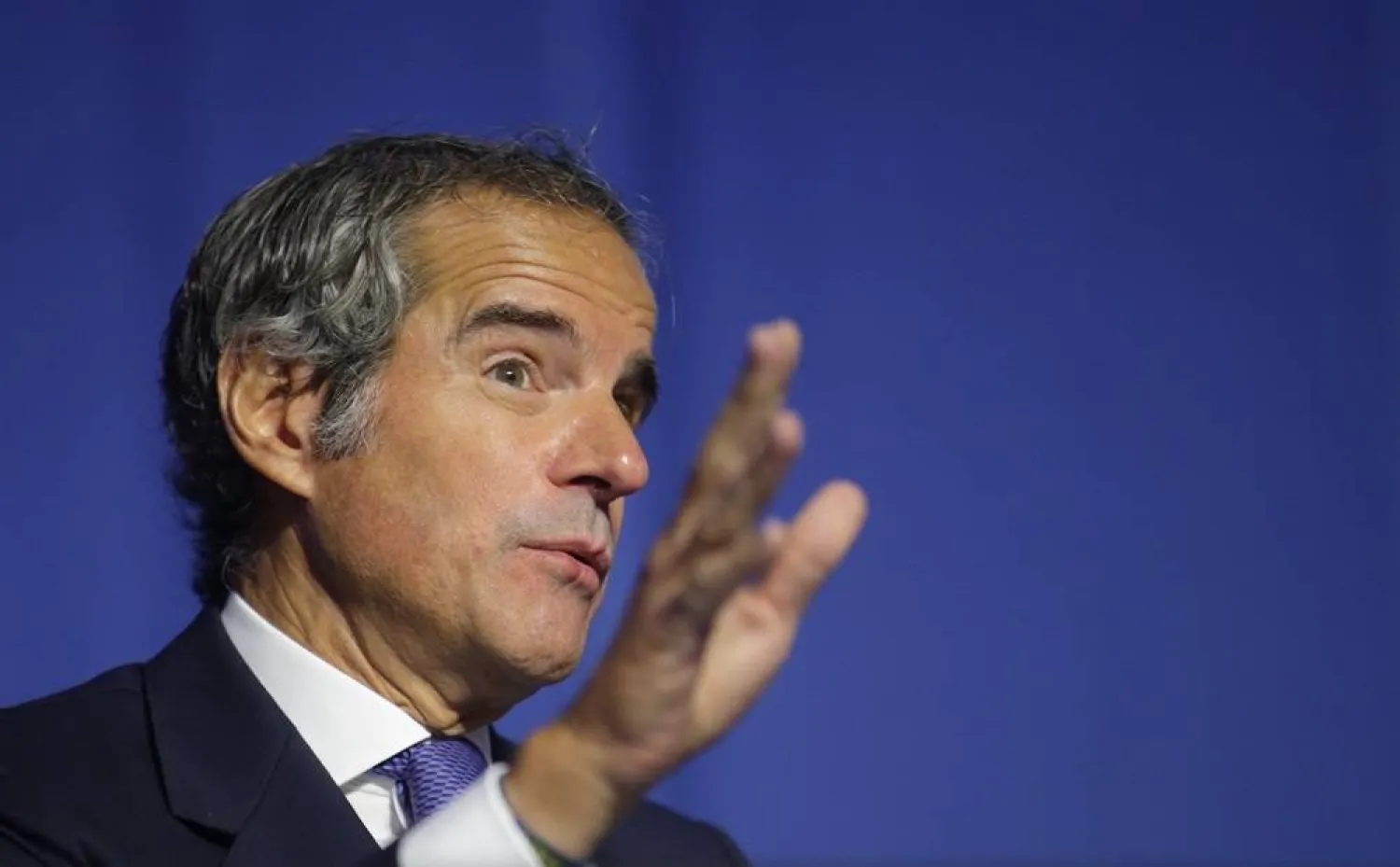
International Atomic Energy Agency (IAEA) Director General Rafael Grossi attends the 68th IAEA General Conference in Vienna, Austria, 16 September 2024. (EPA)
TT

IAEA Chief Sees Willingness from Iran to Re-Engage on Nuclear File

International Atomic Energy Agency (IAEA) Director General Rafael Grossi attends the 68th IAEA General Conference in Vienna, Austria, 16 September 2024. (EPA)

UN nuclear watchdog chief Rafael Grossi said on Tuesday he had sensed a greater willingness by Iranian officials to engage with the agency in a more meaningful way after talks in New York, and that he hoped to travel to Tehran in October.

Several long-standing issues have dogged relations between Iran and the International Atomic Energy Agency, including Tehran's barring of uranium-enrichment experts on the inspection team and its failure for years to explain uranium traces found at undeclared sites.

Grossi held talks with Iranian Foreign Minister Abbas Araqchi, one of the key architects to the 2015 accord that limited Iran's ability to enrich uranium in return for a lifting of Western sanctions, on the sidelines of the UN General Assembly.

"What I see is an expressed willingness to re-engage with us in a more meaningful fashion," Grossi told Reuters in an interview.

With nuclear diplomacy largely stalled between the Iranian presidential election and the US one on Nov. 5, Iranian and European officials have met in New York to test their mutual willingness to reduce tensions amid Tehran's disputed nuclear program, its role in Ukraine and mounting regional tensions.

Grossi said he wanted to make real progress in restoring proper technical discussions with Iran quickly and was aiming to travel to Tehran in October to meet with Iranian President Masoud Pezeshkian.

"Of course, now we have to give content and substance to this because we are not starting from zero. We have had relatively protracted process without replies to some of the questions we have," he said.

"We also need to calibrate together with them how we go through this period where they are waiting to see what is going to happen with their other partners, starting with the United States."

IAEA board resolutions ordering Iran to cooperate urgently with the investigation into the uranium traces and calling on it to reverse its barring of inspectors have brought little change, and quarterly IAEA reports seen by Reuters on Aug. 29 showed no progress.

Development of Iran's nuclear program has also advanced. By the end of the quarter, the latest IAEA reports showed Iran had completed installation of eight new cascades at Fordow but still not brought them online.

At its larger underground site at Natanz, which is enriching to up to 5% purity, it had brought 15 new cascades of other advanced models online.

"Iran has kept a regular pace without accelerating too much, but it continues," Grossi said, adding that the Fordow cascades remained offline.

Iran has stepped up nuclear work since 2019, after then-US President Donald Trump abandoned an agreement reached under his predecessor Barack Obama.

When asked about the prospects of a revival of nuclear talks, Grossi said the preparatory work needed to start now, notably for the IAEA to get the necessary clarity on Iran's activities since it reduced cooperation with the agency.

"I think we need to, or the ambition should be to get results in a different way, because the old way is simply not going to be possible anymore," he said, adding that he foresaw a more active role for the agency.


Netanyahu Vows to Eliminate Iran Threat ‘Once and for All’

10 November 2026, Israel, Jerusalem: Caretaker Israeli Prime Minister Benjamin Netanyahu delivers a speech on the sidelines of the opening session of the new Knesset. (dpa)
TT

Netanyahu Vows to Eliminate Iran Threat ‘Once and for All’

10 November 2026, Israel, Jerusalem: Caretaker Israeli Prime Minister Benjamin Netanyahu delivers a speech on the sidelines of the opening session of the new Knesset. (dpa)

Israel's caretaker prime minister Benjamin Netanyahu on Saturday reiterated his calls for a national unity government with his opponent Gadi Eisenkot, as well as his vow to eliminate the threat from Iran.

A meeting with Eisenkot on Thursday "only strengthened the conviction that it is essential to form a national unity government" to guarantee Israel's security, Netanyahu said in a video statement, adding that such a government could "eliminate the Iranian threat once and for all".


Ukraine’s Zelenskiy Escalates Criticism of SpaceX Over Speed Caps

Ukraine's President Volodymyr Zelenskiy holds a press briefing in Copenhagen November 10, 2026. (AFP)
TT

Ukraine’s Zelenskiy Escalates Criticism of SpaceX Over Speed Caps

Ukraine's President Volodymyr Zelenskiy holds a press briefing in Copenhagen November 10, 2026. (AFP)

Ukraine's President Volodymyr Zelenskiy ‌escalated his criticism of SpaceX on Saturday, saying speed restrictions on its military-grade Starshield satellite terminals had dangerous political implications and undermined critical air defenses.

Zelenskiy said Starshield terminals operating in temporarily Russian-occupied territories of Ukraine had been limited to a maximum speed of 161 kph for the past five days, hampering Ukraine's military capabilities.

The Ukrainian Defense Ministry has raised the issue with SpaceX at the ‌institutional level, ‌Zelenskiy said.

"The restrictions have now ‌been ⁠in place for ⁠five days. They say it is some kind of technical issue. We do not believe that is the case," Zelenskiy told reporters in remarks released by his office on Saturday.

"If you impose restrictions there, you are already partially recognizing the temporarily ⁠occupied territories as not ours. And ‌that is why I ‌believe we have the right to raise this ‌issue and restore the speed – so that there ‌are no restrictions at all."

Zelenskiy said the speed restrictions made it more difficult for Ukrainian air defense units to intercept Russian jet-powered drones and made Ukrainian cities ‌more vulnerable. He said he had ordered his top military and foreign ministry ⁠officials ⁠to address the issue and seek clarification.

SpaceX has pushed back against the allegations, denying that it introduced new restrictions or made any changes to its satellite operations.

It is the second such outage in recent weeks. In mid-October, Ukrainian officials said that SpaceX limited the speed of Starlink and its Starshield communication systems to about 160 kph (100 mph) amid tensions with US President Donald Trump's administration over Ukrainian attacks on Russian oil refineries. Service was then restored on October 24.


UN Official Urges Iran, US to Let Fertilizers Through Hormuz Strait

Jorge Moreira da Silva, Executive Director of UNOPS (United Nations Office for Project Services), and coordinator of the UN Strait of Hormuz Task Force established by the UN Secretary-General, speaks during an interview with AFP on the sidelines of the 31st United Climate Change Conference (COP31), at the media center located on the Antalya Expo Center in Antalya on November 14, 2026. (AFP)
TT

UN Official Urges Iran, US to Let Fertilizers Through Hormuz Strait

Jorge Moreira da Silva, Executive Director of UNOPS (United Nations Office for Project Services), and coordinator of the UN Strait of Hormuz Task Force established by the UN Secretary-General, speaks during an interview with AFP on the sidelines of the 31st United Climate Change Conference (COP31), at the media center located on the Antalya Expo Center in Antalya on November 14, 2026. (AFP)

Iran and the United States should "immediately" allow fertilizer shipments through the Strait of Hormuz to ease the crisis in some of the most vulnerable countries, a senior UN official said Saturday.

Jorge Moreira da Silva, head of the UN Office for Project Services, told the COP31 climate talks in the Turkish resort city of Antalya that the lack of fertilizers could push millions into poverty.

The Iranian blockade of the vital waterway, which started after the joint US-Israeli attack against Iran in late February, has choked shipping in the region and beyond. The US blockade of Iranian ports has further complicated matters.

While Iran and the United States are still trying to negotiate an end to the conflict, Moreira da Silva said he had the same message for both countries.

"They should continue their negotiations about the comprehensive deal -- but that deal should not avoid an immediate, exceptional, limited, and time-bound solution for the fertilizers," he said.

"Basically, what we need is five vessels a day with fertilizers," he added.

- Millions at risk -

Moreira da Silva heads up the UN task force dedicated to facilitating the safe passage of fertilizers during the crisis.

Before the conflict, a third of the world's fertilizers passed through the Strait of Hormuz, and since the blockades, their prices had risen by 30 percent, he said.

"But what I think is not sufficiently recognized is the disproportionate impact on the most vulnerable countries," he added.

Sudan's finance minister recently told him that the price of food there had doubled in six months, he added. In Nepal, they had told him that farmers could no longer afford to buy fertilizers.

"So, it's very important that we are aware that countries such as Mozambique, Kenya, Sudan, Somalia, Nepal, Bangladesh, Sri Lanka are facing very significant impact."

The effects of this shortage could be catastrophic, he warned.

"If we continue missing the planting seasons in different parts of the world we may have 45 million people facing severe and acute food insecurity," he said.

"We may have 30 million people being forced into poverty."

The UN had a system ready to get fertilizer shipments moving within seven to 10 days, he said.