China and Japan Agree to Talks on Security Issues as They Seek to Mend Ties

In this photo released by Xinhua News Agency, China's Foreign Minister Wang Yi, right, shakes hands with Japan's Minister for Foreign Affairs Takeshi Iwaya in Beijing, Wednesday, Dec. 25, 2024. (Li Xiang/Xinhua via AP)
TT

China and Japan Agree to Talks on Security Issues as They Seek to Mend Ties

In this photo released by Xinhua News Agency, China's Foreign Minister Wang Yi, right, shakes hands with Japan's Minister for Foreign Affairs Takeshi Iwaya in Beijing, Wednesday, Dec. 25, 2024. (Li Xiang/Xinhua via AP)

China and Japan agreed Wednesday to set up talks on often contentious security issues as they seek to improve a relationship riven in recent years by a range of issues, from territorial disputes to the discharge of water from Japan's tsunami-wrecked nuclear power plant.

Japanese Foreign Minister Takeshi Iwaya, on his first trip to China since assuming the post in October, sounded positive after meetings with Chinese Premier Li Qiang and Foreign Minister Wang Yi, saying the talks were "very candid" and wide-ranging.

"I feel we were able to build a personal relationship that would lead to the future," he told reporters in the Chinese capital.

Wang agreed to visit Japan next year for a high-level economic dialogue including cooperation on the environment, energy conservation and health and nursing care. Japan announced an easing of visa requirements for Chinese visitors, following China's recent decision to allow Japanese to enter without a visa.

The two countries also have major differences. Iwaya raised Japan's concerns about China's military activity near a group of uninhabited islands that both countries claim, as well as China's territorial disputes with other countries in the South China Sea.

Efforts to improve ties are in their early stages following a commitment to do so made by Chinese President Xi Jinping and Japanese Prime Minister Shigeru Ishiba at a meeting last month during the Asia-Pacific Economic Cooperation summit in Peru.

"Currently China-Japan relations are at a critical period of improvement and development," Li said at the start of his meeting with Iwaya. "China is willing to work together with Japan to move toward the important direction proposed by the leaders of the two countries."

Iwaya's one-day trip came just before US President-elect Donald Trump takes office in January and the uncertainty his presidency is expected to bring to America's global relations.

Trump has threatened to hike tariffs on Chinese goods, reigniting a trade war he unleashed in his first administration. It's unclear how he will impact the US-Japan alliance, which President Joe Biden has sought to buttress during the last four years as part of his strategy to confront a rising China.

Japan has revamped its approach to defense i n response to Chinese actions in recent years, boosting military spending and shifting away from a principle of self-defense. Earlier this year, Japan protested when a Chinese military plane flew into Japan’s airspace, while in the summer, a Chinese survey ship sailed into Japanese territorial waters.

Wang agreed to Iwaya's proposal for a Japan-China security dialogue, which would try to improve communication over some of these issues.

Iwaya called for an early lifting of a ban on Japanese seafood imports that China imposed after a Japanese utility began discharging treated but still radioactive water from the former nuclear power plant in Fukushima.

The two sides agreed to keep working on the issue, and also resume talks on Japanese beef and rice exports to China.

Japan's easing of visa requirements included allowing group tours to stay for 30 days, up from 15, and increasing the validity of multiple-entry tourist visas from five to 10 years.

Both sides hope that people-to-people exchanges can help improve relations.


Tehran: More Than 3,000 Iranians Killed During War

Men walks past an anti-USA and anti-Israel mural, in Tehran on April 8, 2026. (Photo by ATTA KENARE / AFP) /
TT

Tehran: More Than 3,000 Iranians Killed During War

Men walks past an anti-USA and anti-Israel mural, in Tehran on April 8, 2026. (Photo by ATTA KENARE / AFP) /

More than 3,000 people were killed throughout Iran during the war ⁠that began on February ⁠28, Iran's forensic chief ⁠told state media on Thursday, adding that 40% of the dead needed forensic work ⁠to be ⁠identified and returned to families.

Semiofficial news agencies in Iran published a chart suggesting the country’s Revolutionary Guard put sea mines into the Strait of Hormuz during the war, as uncertainty hangs over a two-week ceasefire and further negotiations are expected in Pakistan.

The shaky ceasefire has been largely holding between the US, Israel and Iran, although Tehran and Washington have offered vastly different explanations of the initial terms.

The chief of Iran’s nuclear agency said that protecting Tehran’s right to enrich uranium is “necessary” for any ceasefire talks with the United States.

Mohammad Eslami, who leads the Atomic Energy Organization of Iran, made the remarks to journalists in Tehran during commemorations for the late Supreme Leader Ali Khamenei.


French Military Chief Says Possible War with Russia His 'Primary Concern'

General Chief of Staff of the French armed Forces Fabien Mandon delivers remarks during the Paris Defense Strategy Forum at the Ecole Militaire (military school) in Paris on March 24, 2026. (Photo by STEPHANE DE SAKUTIN / AFP)
TT

French Military Chief Says Possible War with Russia His 'Primary Concern'

General Chief of Staff of the French armed Forces Fabien Mandon delivers remarks during the Paris Defense Strategy Forum at the Ecole Militaire (military school) in Paris on March 24, 2026. (Photo by STEPHANE DE SAKUTIN / AFP)

France's top general on Thursday said the possibility of a war with Russia in the next few years remained his "primary concern" as he defended efforts to ramp up defense spending.

The chief of the defense staff General Fabien Mandon spoke in parliament as he presented France's draft legislation to boost defense spending between 2024 and 2030.

"The persistence of a Russian threat on our continent, with the possibility of an open war, remains my primary concern in terms of military preparedness," Mandon told the defense committee of parliament's lower house during a hearing devoted to the updated military programming draft law, said AFP.

According to the draft legislation unveiled by the government on Wednesday, 36 billion euros ($42 billion) were to be added to France's defense spending, on top of the 413 billion euros ($483 billion) allocated for the period of 2024 to 2030.

Russia and Ukraine have been at war since Moscow in 2022 launched the full-scale invasion of its neighbor.

European powers, including France, have backed Ukraine with increasing supplies of weapons but have always insisted they are not directly involved in the conflict.

Citing intelligence estimates, Mandon said Russia was expected to have a bigger army and more weapons by 2030.

Russia is projected to have 1.9 million-strong army by 2030, up from 1.3 million last year, he said.

The number of Russian heavy tanks was set to rise to 7,000 in 2030 from 4,000 in 2025, while the number of combat vessels in the Russian navy was expected to be between 230 and 240, Mandon added.

"This is... based on intelligence," Mandon said. "This military planning law is crucial for the defense of our fellow citizens".

"We are in a dangerous period. We must not cause alarm, but simply raise awareness because we need this defense investment," he added.

In November, Mandon warned France must be ready to "lose its children" against the background of the threat posed by Russia, sparking an outcry.

"An unrestricted use of force" and a "terrorist threat" in the Middle East, Asia and Africa also justified the ramping up of the defenses, Mandon said, pointing to Washington's wavering commitment to Europe.

"We can no longer have the same level of confidence in the Americans' commitment to our security", he said, adding however that dialogue with US military officials remained of "high quality."


4 Dead, 38 Rescued during Attempted Channel Crossing from France to UK

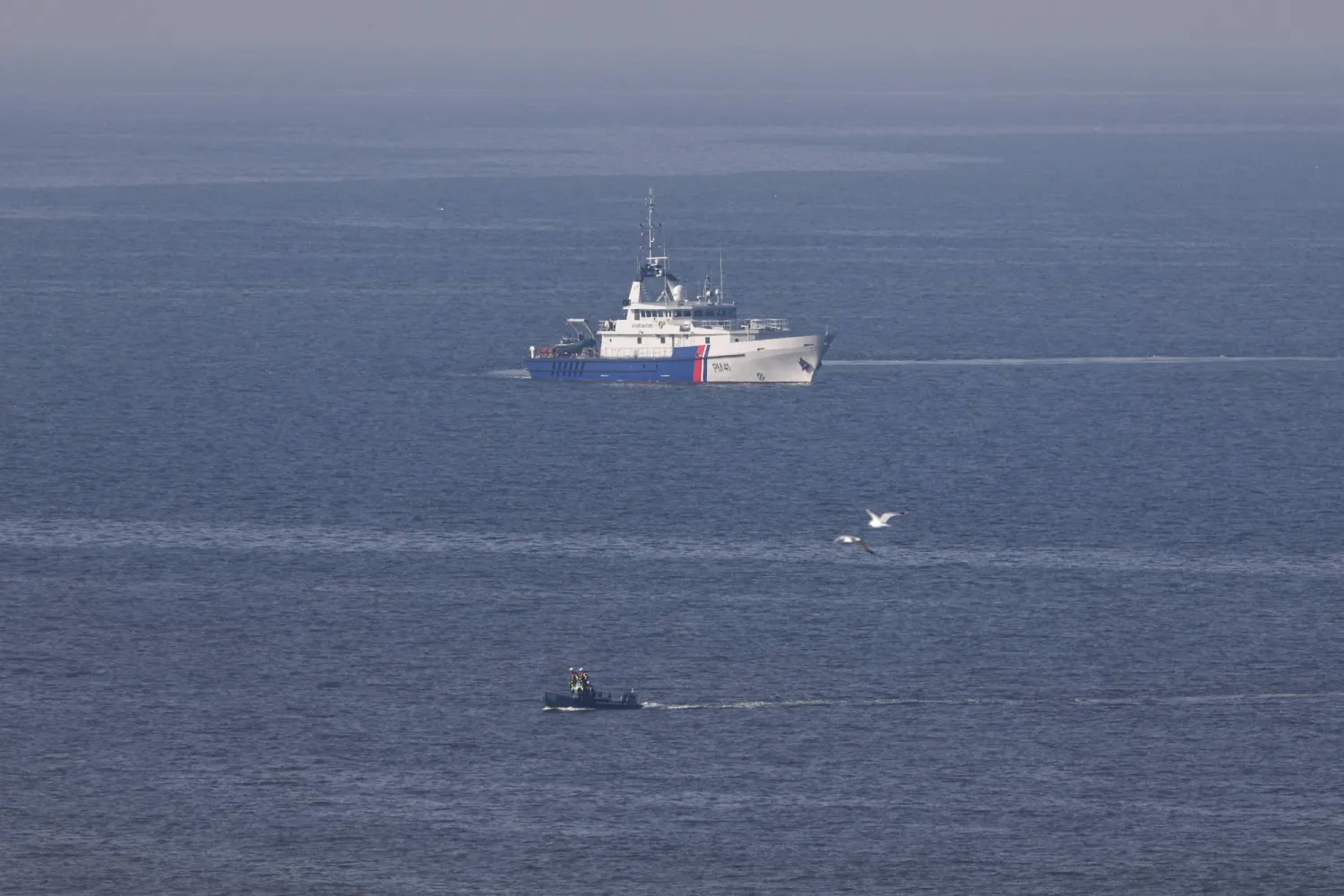
A vessel from the Maritime Affairs Department is sailing off France's Pas-de-Calais northern coastal city of Equihen-Plage after an attempt to cross the English Channel illegally turned tragic with several migrants found in cardiac arrest, on April 9, 2026. (Photo by Sameer AL-DOUMY / AFP)
TT

4 Dead, 38 Rescued during Attempted Channel Crossing from France to UK

A vessel from the Maritime Affairs Department is sailing off France's Pas-de-Calais northern coastal city of Equihen-Plage after an attempt to cross the English Channel illegally turned tragic with several migrants found in cardiac arrest, on April 9, 2026. (Photo by Sameer AL-DOUMY / AFP)

French authorities said that at least four people, two men and two women, died on Thursday as they were trying to get onboard an inflatable boat to attempt the perilous sea crossing from northern France to the UK. 

The prefect of the Pas-de-Calais region in northern France, François-Xavier Lauch, said 38 others were rescued, including one whose condition involved medical emergency. He spoke while rescue operations were still ongoing on Equihen Beach on Thursday morning. 

Lauch said migrants were carried away by dangerous currents as they were trying to embark on a “taxi-boat,” the name authorities use for small motorized boats, usually inflatable, used by traffickers to pick up people along large stretches of the northern French coast, The Associated Press said. 

Thursday's incident happened along a broad expanse of sand, backed by dunes and a forest where people attempting the perilous crossing hide out, sometimes for days at a time, as they wait for boats and suitable weather and sea conditions. Police patrol on buggies and keep watch from the remains of World War II-era bunkers but cannot prevent all departures on a beach so long. 

Attempted crossings and deaths have surged in recent days. French maritime authorities said Wednesday 102 people have been rescued in two separate operations while trying to cross the channel. Last week, two people died in a similar incident off the coast north of Calais. 

Unlike inflatable boats that migrants carry themselves into the water, so-called “taxi boats” set off largely empty from secluded spots along the coast and pick up migrants from prearranged rendezvous areas on beaches. 

An Associated Press reporter attended such scenes on Wednesday in Malo-les-Bains, near Dunkirk. 

Migrants wade into the sea, with adults carrying children in their arms or on their shoulders, then clamber aboard the inflatables that wait offshore. Once loaded up, they set off on the cross-channel journey, sometimes picking up more people along the way. 

Depending on tides, weather and police patrols, migrants sometimes have to wade far from the water’s edge, up to their torsos, to reach the boats, increasing the risk of losing their footing, being caught by currents, or wading too deep. 

Campaign groups for migrant rights have long warned that increasingly vigorous efforts by French police to prevent boat departures from beaches, including using knives to hack and puncture inflatable boats to render them unusable, are encouraging the use of “taxi boats,” which increases the risks of drownings, injuries and the need for rescues.