China Hopes Aging Dalai Lama Can 'Return to Right Path'

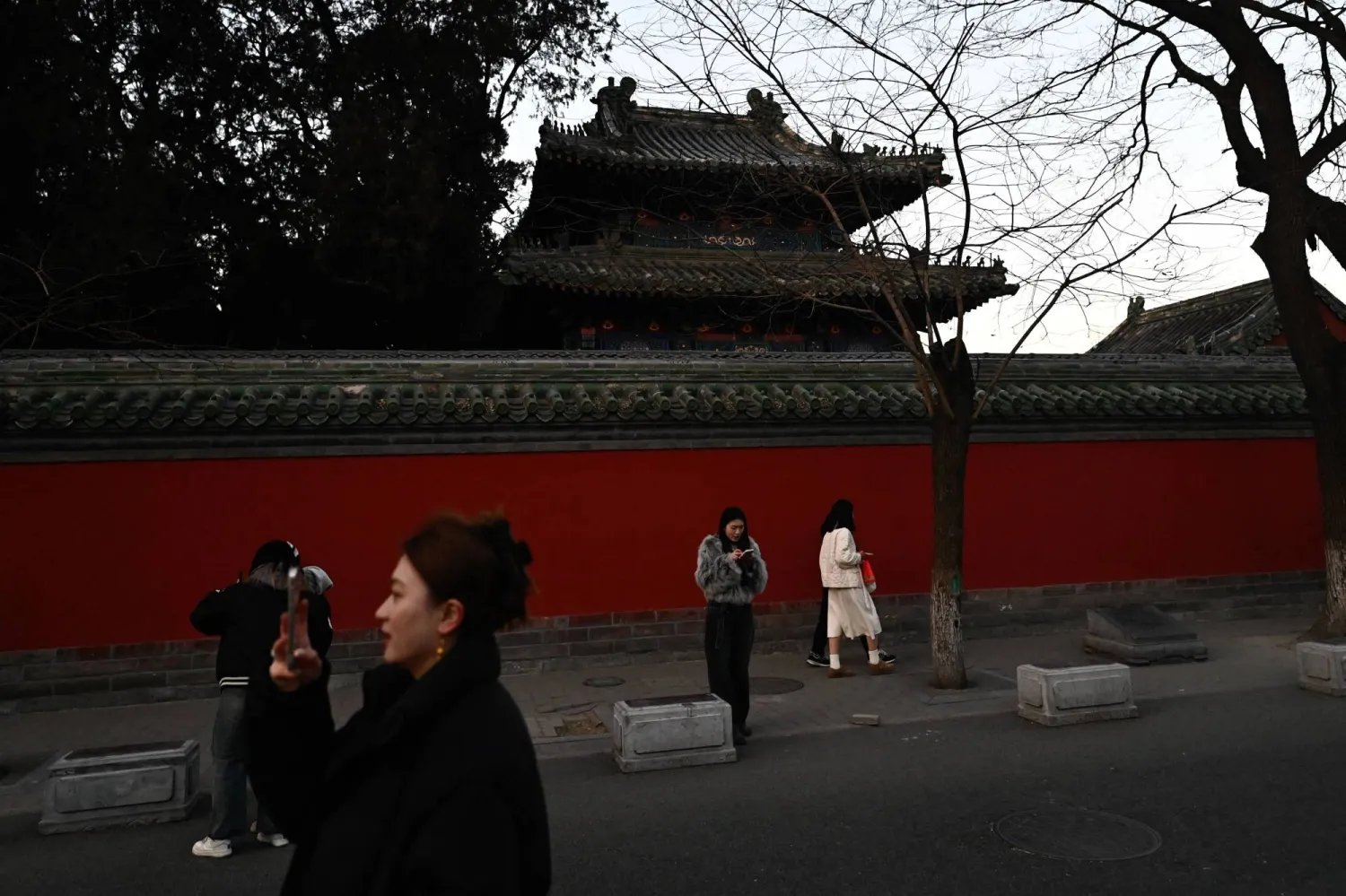
People stroll in Guozijian Hutong alley in Beijing on February 9, 2025. (Photo by Pedro PARDO / AFP)
TT

China Hopes Aging Dalai Lama Can 'Return to Right Path'

People stroll in Guozijian Hutong alley in Beijing on February 9, 2025. (Photo by Pedro PARDO / AFP)

China hopes the Dalai Lama can "return to the right path" and is open to discussions about the Nobel Peace laureate's future as long as certain conditions are met, the foreign ministry said on Monday.

The exiled leader of Tibetan Buddhism, who turns 90 this year, fled Tibet in 1959 for India after a failed uprising against Chinese rule, but has expressed a desire to return to Tibet before he dies.

China is open to talks about the future of the Dalai Lama as long as he abandons his position of splitting the "motherland," a foreign ministry spokesperson, Guo Jiakun, told a regular press conference, according to Reuters.

Guo was responding to a request for comment on the death of the spiritual leader's elder brother Gyalo Thondup, who had previously acted as his unofficial envoy in talks with Chinese officials.
Gyalo Thondup died on Saturday, aged 97, in his home in the Indian town of Kalimpong.
The Dalai Lama needs to openly recognize that Tibet and Taiwan are inalienable parts of China, whose sole legal government is that of the People's Republic of China, Guo said, using the country's official name.
The Dalai Lama stepped down in 2011 as the political leader of the Tibetan government-in-exile, which Beijing does not recognize. Official talks with his representatives have stalled since.
As the Dalai Lama ages, the question of his successor has also become increasingly urgent. China insists it will choose his successor as Tibet's spiritual leader.
But the Dalai Lama says he will clarify questions about the succession, such as if and where he will be reincarnated, in line with Tibetan Buddhist belief, around the time of his 90th birthday in July.
A new book by the Dalai Lama, due out in March to coincide with the anniversary of the uprising, is expected to outline a framework for the future of Tibet "even after I am gone", he has said.


Israeli Intelligence Reveals Major Fracture in Iran’s Leadership

A member of the Iranian security forces stands guard next to a banner honoring Iran's slain supreme leader Ali Khamenei in Tehran on March 31, 2026. (AFP)
TT

Israeli Intelligence Reveals Major Fracture in Iran’s Leadership

A member of the Iranian security forces stands guard next to a banner honoring Iran's slain supreme leader Ali Khamenei in Tehran on March 31, 2026. (AFP)

Tel Aviv has confirmed a major fracture in the Iranian leadership, which implies a partial collapse of the regime in Tehran in wake of the US-Israeli war on Iran, revealed a report by the Military Intelligence Directorate of the Israeli Army (Aman).

According to Aman, the absence of Supreme Leader Ali Khamenei, killed in joint US-Israeli air strike on February 28, has left a significant power vacuum in the country.

It said his son and successor, Mojtaba, lacks the charisma of his father and does not command the same religious stature or political weight. He is also still recovering from severe injuries sustained from a strike during the war and therefore, is considered unable to take real power.

The Aman report, published by the Walla website on Sunday, listed the names of Iran’s current leaders who remained in power after the US and Israeli strikes eliminated 55 key leading figures.

In addition to Mojtaba Khamenei, the list includes former Iranian Revolutionary Guards Corps (IRGC) intelligence chief Hossein Taeb, who is also a senior adviser to Mojtaba and his secretary. Taeb is regarded as a hardline official, who considers any agreement with the West as betrayal and an existential threat to the regime.

Another survivor of the Iranian leadership is IRGC commander Ahmed Vahidi, a former Minister of Defense and Interior, who is widely considered a major hardliner.

The list also includes parliament speaker and one of Iran’s top negotiators, Mohammad Bagher Ghalibaf, a veteran conservative politician who is interested in improving the economy and preventing Iran’s social and political collapse.

Among the reformists, the list includes President Masoud Pezeshkian, who is pursuing a more moderate path focused on economic reform and easing international sanctions. However, his powers are constrained by the IRGC.

Another reformist is Iranian Foreign Minister Abbas Araghchi, who was a negotiator in the first nuclear deal in 2015. A senior Aman official said Araghchi is viewed as a diplomat skilled in navigating complex negotiations while attempting to preserve Iranian “dignity” against US demands.

An Israeli general in Aman said the Israeli and US strikes has decimated the inner circle of the supreme leader, forcing Tehran to rely on a more fragmented and weak leadership structure that suffers from internal tensions despite the ceasefire.

The general added that the war, assassinations, the absence of Ali Khamenei, the destruction and lack of communication among security and political figures, have all fractured the Iranian leadership, complicating its ability to make decisions and coordinate.

Aman said the hardliners have gained more power in Iran and are now capable to ruin any deal reached between reformists and the US.


Ukrainian Drones Kill Man in South Russia

This handout satellite image courtesy of 2026 Vantor taken and made available on April 16, 2026, shows smoke rising from the Tuapse oil refinery of in Tuapse, south-western Russia. (Handout / Satellite image ゥ2026 Vantor / AFP)
TT

Ukrainian Drones Kill Man in South Russia

This handout satellite image courtesy of 2026 Vantor taken and made available on April 16, 2026, shows smoke rising from the Tuapse oil refinery of in Tuapse, south-western Russia. (Handout / Satellite image ゥ2026 Vantor / AFP)

A Ukrainian drone attack killed a man and wounded another in the resort city of Tuapse on the Black Sea in southern Russia, the regional governor said Monday.

It was the second assault on the seaport in a matter of days, with drone debris damaging windows in buildings across the city, including apartments, a primary school, kindergarten, museum and church, Veniamin Kondratiev added.

"Tuapse came under yet another massive drone attack tonight. As a result, one man was killed at the seaport, according to preliminary information. I extend my deepest condolences to his family," Kondratiev said.

Another man was also wounded in the attack and received medical assistance, he added.

On Thursday, a 14-year-old girl and a young woman were killed by a nighttime drone attack on the same city, according to a previous statement by the governor.

Russia's defense ministry also reported that its air defenses had "destroyed 112 Ukrainian drones" overnight Sunday to Monday.


North Korea Uses Cluster Bombs in Latest Missile Test

This picture taken on April 19, 2026 and released by North Korea's official Korean Central News Agency (KCNA) on April 20, 2026 shows North Korean leader Kim Jong Un (L) and his daughter Kim Ju Ae (R) inspecting the test-fire of a ballistic missile at an undisclosed location in North Korea. (KCNA via KNS / AFP)
TT

North Korea Uses Cluster Bombs in Latest Missile Test

This picture taken on April 19, 2026 and released by North Korea's official Korean Central News Agency (KCNA) on April 20, 2026 shows North Korean leader Kim Jong Un (L) and his daughter Kim Ju Ae (R) inspecting the test-fire of a ballistic missile at an undisclosed location in North Korea. (KCNA via KNS / AFP)

North Korea fired multiple short-range ballistic missiles that tested the power of its cluster munitions, its government news agency said on Monday, confirming the latest in a flurry of launches by the nuclear-armed state.

The Sunday launches, which were supervised by leader Kim Jong Un, aimed to "verify the characteristics and power of cluster bomb warhead and fragmentation mine warhead applied to the tactical ballistic missile", the Korean Central News Agency (KCNA) reported.

They followed other tests in recent weeks of weaponry, including ballistic missiles, anti-warship cruise missiles and cluster munitions.

Neither Korea has signed the 2008 Oslo convention against cluster bombs.

South Korea condemned the launches and called on the North to cease "provocations".

KCNA said the maneuver tested the warhead of the Hwasongpho-11 Ra surface-to-surface tactical ballistic missile.

Five projectiles were fired towards a target area around an island about 136 kilometers (85 miles) from the launch site, it said.

They struck an area of 12.5 to 13 hectares with "very high density, fully displaying their combat might".

Kim "expressed great satisfaction over the test results" and noted that the development of cluster bomb warheads "can... boost the high-density striking capability to quell a specific target area as well as the high-precision striking capability", KCNA said.

Hong Min, a senior research fellow at the Korea Institute for National Unification, said the reported range would put Seoul and key US military installations within Pyongyang's reach.

"This system appears designed to fill the gap between multiple rocket launchers and short-range ballistic missiles," he said.

Yang Moo-jin, a professor at Seoul's University of North Korean Studies, noted that frontline corps commanders observed the test, in contrast to the weapons researchers who watched previous ones.

"This suggests the system is nearing operational deployment, with the capability to be launched directly from forward positions against South Korea and US bases," he said.

The United States stations about 28,000 troops in the South to help it defend against military threats from the North.

- 'Firm' defense posture -

South Korea reported the test on Sunday, saying its military had "detected several short-range ballistic missiles" fired from the Sinpo area in eastern North Korea.

Seoul said it was maintaining a "firm combined defense posture" with the United States and would "respond overwhelmingly to any provocation".

"Pyongyang must immediately halt its successive missile provocations that are heightening tensions", and "actively engage in the South Korean government's efforts to establish peace", the defense ministry said.

But analysts said the tests signaled that Pyongyang had rejected Seoul's attempts to repair strained ties.

Among them was an expression of regret from Seoul over civilian drone incursions into the North in January, a gesture that Pyongyang initially seemed to welcome before reverting to describing the South as its "most hostile" enemy state.

- Two more destroyers -

North Korea is subject to multiple United Nations sanctions banning its nuclear weapons development and use of ballistic missile technology, restrictions it has repeatedly flouted.

Earlier in April, Kim Jong Un oversaw tests of strategic cruise missiles launched from a naval warship, with official photos showing him watching the firings flanked by military officials.

Those tests were carried out from the Choe Hyon, one of two 5,000-ton destroyers in the North's arsenal, both launched last year.

The North is also building two more 5,000-ton class destroyers to add to its fleet.

Citing satellite imagery from a US-based intelligence firm, a South Korean lawmaker said this month that the North was "accelerating the naval forces' modernization on the back of military assistance from Russia".

North Korea has sent ground troops and artillery shells to support Russia's invasion of Ukraine, and observers say Pyongyang is receiving military technology assistance from Moscow in return.