


Pope Francis is Conscious and Receiving Supplemental Oxygen Following a Respiratory crisis

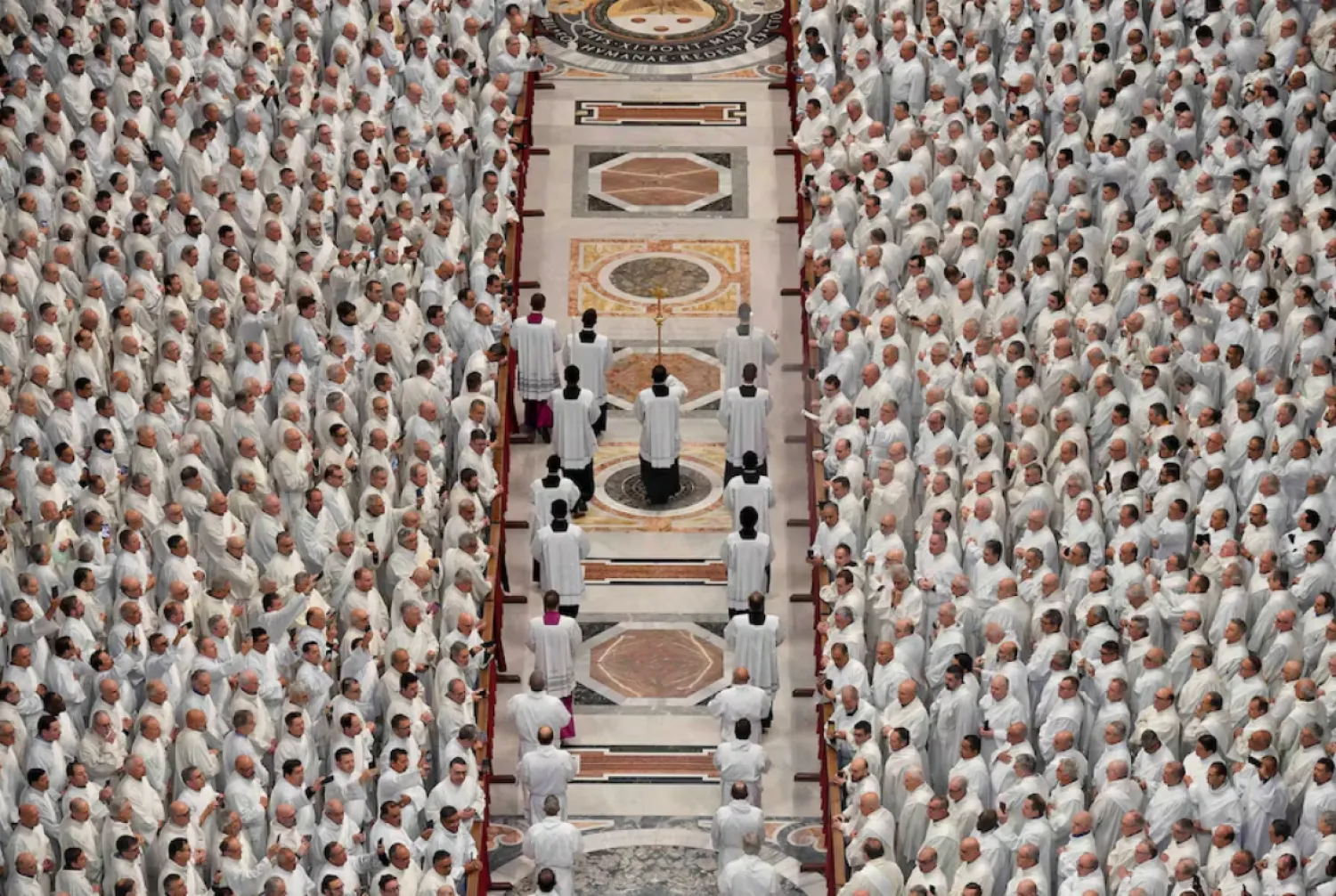
Archbishop Rino Fisichella presides over Sunday's mass instead of Pope Francis. The Vatican, February 23, 2025. Vatican Media/­Simone Risoluti/Handout via REUTERS
TT

Pope Francis is Conscious and Receiving Supplemental Oxygen Following a Respiratory crisis

Archbishop Rino Fisichella presides over Sunday's mass instead of Pope Francis. The Vatican, February 23, 2025. Vatican Media/­Simone Risoluti/Handout via REUTERS

Pope Francis was conscious but still receiving high flows of supplemental oxygen Sunday following a respiratory crisis and blood transfusions, as he remains in critical condition with a complex lung infection, the Vatican said.

“The night passed quietly, the pope rested,” Vatican spokesman Matteo Bruni said in an early statement.

Further clinical tests were being performed on the 88-year-old pope, who had part of one lung removed as a young man, and a more detailed medical update was expected later Sunday.

On Saturday, Francis suffered a prolonged asthmatic respiratory crisis that required “high flows” of oxygen to help him breathe through a nasal tube. He also received blood transfusions after tests showed low counts of platelets, which are needed for clotting, the Vatican said, The AP reported.

Doctors said Saturday his prognosis was “reserved.”

Doctors have said Francis’ condition is touch-and-go, given his age, fragility and pre-existing lung disease. His condition has revived speculation about what might happen if he becomes unconscious or otherwise incapacitated, and whether he might resign.

Prayers for pope at Vatican Francis was supposed to have celebrated Mass on Sunday morning in St. Peter's Basilica and ordained deacons as part of the Vatican's yearlong Holy Year commemoration.

The organizer of the Holy Year, Archbishop Rino Fisichella, celebrated the Mass in his place and offered a special prayer for Francis from the altar before delivering the homily the pope had prepared.

“Even though he is in a hospital bed, we feel Pope Francis close to us, we feel him present among us,” Fisichella told the hundreds of white-robed deacons.

A pre-written message that Francis had prepared for his Sunday noon prayer but did not deliver said he was “confidently continuing my hospitalization at the Gemelli Hospital, carrying on with the necessary treatment; and rest is also part of the therapy!” The message noted the upcoming anniversary of Russia's invasion of Ukraine, “a painful and shameful occasion for the whole of humanity.”

The main threat facing the pope is sepsis Doctors have warned that the main threat facing Francis would be the onset of sepsis, a serious infection of the blood that can occur as a complication of pneumonia. As of Friday, there was no evidence of any sepsis, and Francis was responding to the various drugs he is taking, the pope’s medical team said in their first in-depth update on the pope’s condition.

Saturday’s blood tests showed that he had developed a low platelet count, a condition called platelopenia or thrombocytopenia. Platelets are cell-like fragments that circulate in the blood that help form blood clots to stop bleeding or help wounds heal. Low platelet counts can be caused by a number of things, including side effects from medicines or infections, according to the U.S. National Institutes of Health.

Francis, who has chronic lung disease and is prone to bronchitis in winter, was admitted to Gemelli hospital on Feb. 14 after a weeklong bout of bronchitis worsened.

Doctors first diagnosed the complex viral, bacterial and fungal respiratory tract infection and then the onset of pneumonia in both lungs. They prescribed “absolute rest” and a combination of cortisone and antibiotics, along with supplemental oxygen when he needs it.

Francis’ recent reforms suggest he knew he was getting older and more fragile Francis has taken several recent decisions that suggest he was well aware that he was getting old and frail.

Last year, he revised the funeral rites that will be used after he dies, simplifying the rituals to emphasize his role as a mere bishop and allowing for burial outside the Vatican in keeping with his wishes. But the core elements of the rites remain, including the three key moments that must be observed between the death of a pope and his funeral: In his home, in St. Peter’s Basilica and in the place of burial.

In December, Francis created 21 new cardinals. All but one were under age 80 and thus eligible to vote in a conclave to elect his successor. Their additions brought the overall number of voting-age cardinals to 140, well over the 120 limit set by St. John Paul II. But several of the current electors are turning 80 this year, bringing the number down.

Earlier this month, once he was already sick, Francis decided to extend the five-year term of the current dean of the College of Cardinals, Cardinal Giovanni Battista Re, 91, rather than make way for someone new. As depicted in the film “Conclave,” the dean of the College of Cardinals plays an important role in the life of the Catholic hierarchy, and is a crucial figure during the transition between one papacy and the next.

Francis also decided to extend the term of the vice-dean, Argentine Cardinal Leonardo Sandri, 81.



US Police: Person of Interest Detained in Deadly Brown University Shooting

Passers-by walk past crime scene tape at an entrance to Brown University, Sunday, Dec. 14, 2025, in Providence, R.I., following the Saturday, Dec. 13, shooting at the university. (AP Photo/Steven Senne)
TT

US Police: Person of Interest Detained in Deadly Brown University Shooting

Passers-by walk past crime scene tape at an entrance to Brown University, Sunday, Dec. 14, 2025, in Providence, R.I., following the Saturday, Dec. 13, shooting at the university. (AP Photo/Steven Senne)

A person of interest was in custody Sunday after a shooting during final exams at Brown University that killed two students and wounded nine others, though key questions remained unanswered more than 12 hours after the attack.

The attack on Saturday afternoon set off hours of chaos across the Ivy League campus and surrounding Providence neighborhoods as hundreds of officers searched for the shooter and urged students and staff to shelter in place. The lockdown, which stretched into the night, was lifted early Sunday, but authorities had not yet released information about a potential motive.

Col. Oscar Perez, the Providence police chief, said that the person in custody was in their 30s and that investigators were not searching for anyone else but that no one has been charged yet. He declined to say whether the detained person had any connection to Brown.

The person was taken into custody at a Hampton Inn hotel in Coventry, Rhode Island, about 20 miles (32 kilometers) from Providence, where police officers and FBI agents remained Sunday, blocking off a hallway with crime scene tape as they searched the area.

The shooting occurred during one of the busiest moments of the academic calendar, as final exams were underway. Brown canceled all remaining classes, exams, papers and projects for the semester and told students they were free to leave campus, underscoring the scale of the disruption and the gravity of the attack.

The gunman opened fire inside a classroom in the university’s engineering building, firing more than 40 rounds from a 9 mm handgun, a law enforcement official told The Associated Press. As of Sunday morning, authorities had not recovered a firearm but did find two loaded 30-round magazines, the official said. The official was not authorized to discuss the investigation publicly and spoke to AP on the condition of anonymity.

“Everybody’s reeling, and we have a lot of recovery ahead of us,” Brown University President Christina Paxson said at a news conference.

“Our community’s strong and we’ll get through it, but it’s devastating.”

As of Sunday morning, one student had been released from the hospital, said Paxson. Seven others were in critical but stable condition and one was in critical condition.

Some business remain closed in shocked city Many area businesses announced Sunday that they would remain closed. A scheduled 5K run was postponed until next weekend. Providence leaders said residents would notice a heavier police presence.

“We all, intellectually, knew it could happen anywhere, including here, but that’s not the same as it happening in our community, and so this is an incredibly upsetting and emotional time for Providence, for Brown, for all of us," Mayor Brett Smiley said at the news conference. “It's not something that we should have to train for, but we have.”

Investigators were not immediately sure how the shooter got inside the first-floor classroom at the Barus & Holley building, a seven-story complex that houses the School of Engineering and physics department. The building includes more than 100 laboratories, dozens of classrooms and offices, according to the university’s website.

Engineering design exams were underway. Outer doors of the building were unlocked but rooms being used for final exams required badge access, Smiley said.

Brown, the seventh-oldest higher education institution in the U.S., is one of the nation’s most prestigious colleges with roughly 7,300 undergraduates and more than 3,000 graduate students.


Zelenskyy Offers to Drop NATO Bid for Security Guarantees but Rejects US Push to Cede Territory

The chancellory is pictured during talks between representatives of the US and Ukraine in Berlin, Germany, Sunday, Dec. 14, 2025. (AP Photo/Markus Schreiber)
TT

Zelenskyy Offers to Drop NATO Bid for Security Guarantees but Rejects US Push to Cede Territory

The chancellory is pictured during talks between representatives of the US and Ukraine in Berlin, Germany, Sunday, Dec. 14, 2025. (AP Photo/Markus Schreiber)

Ukrainian President Volodymyr Zelenskyy on Sunday voiced readiness to drop his country’s bid to join NATO in exchange for Western security guarantees, but rejected the US push for ceding territory to Russia as he held talks with US envoys on ending the war.

Zelenskyy sat down with US President Donald Trump’s special envoy Steve Witkoff and Trump’s son-in-law Jared Kushner. The Ukrainian leader posted pictures of the negotiating table with German Chancellor Friedrich Merz sitting next to him facing the US delegation, The AP news reported.

Responding to journalists’ questions in audio clips on a WhatsApp group chat before the talks, Zelenskyy said that since the US and some European nations had rejected Ukraine’s push to join NATO, Kyiv expects the West to offer a set of guarantees similar to those offered to the alliance members.

“These security guarantees are an opportunity to prevent another wave of Russian aggression,” he said. “And this is already a compromise on our part.”

Russian President Vladimir Putin has cast Ukraine's bid to join NATO as a major threat to Moscow's security and a reason for launching the full-scale invasion in February 2022. The Kremlin has demanded that Ukraine renounce the bid for the alliance membership as part of any prospective peace settlement.

Zelenskyy emphasized that any security assurances would need to be legally binding and supported by the US. Congress, adding that he expected an update from his team following a meeting between Ukrainian and US military officials in Stuttgart, Germany.

Washington has tried for months to navigate the demands of each side as Trump presses for a swift end to Russia’s war and grows increasingly exasperated by delays. The search for possible compromises has run into major obstacles, including control of Ukraine’s eastern Donetsk region, which is mostly occupied by Russian forces.

Tough obstacles remain Putin wants Ukraine to withdraw its forces from the part of the Donetsk region still under its control among the key conditions for peace, a demand rejected by Kyiv.

Zelenskyy said that the US had floated an idea for Ukraine to withdraw from the Donetsk and create a demilitarized free economic zone there, a proposal he rejected as unworkable.

“I do not consider this fair, because who will manage this economic zone?” he said. “If we are talking about some buffer zone along the line of contact, if we are talking about some economic zone and we believe that only a police mission should be there and troops should withdraw, then the question is very simple. If Ukrainian troops withdraw 5–10 kilometers, for example, then why do Russian troops not withdraw deeper into the occupied territories by the same distance?”

Zelenskyy described the issue as “very sensitive” and insisted on a freeze along the line of contact, saying that “today a fair possible option is we stand where we stand.”

According to The AP, Putin's foreign affairs adviser Yuri Ushakov told the business daily Kommersant that Russian police and national guard would stay in parts of the Donetsk region even if they become a demilitarized zone under a prospective peace plan.

Ushakov warned that a search for compromise could take a long time, noting that the US proposals that took into account Russian demands had been “worsened” by alterations proposed by Ukraine and its European allies.

Speaking to Russian state TV in remarks broadcast Sunday, Ushakov said that “the contribution of Ukrainians and Europeans to these documents is unlikely to be constructive," warning that Moscow will “have very strong objections.”

Ushakov added that the territorial issue was actively discussed in Moscow when Witkoff and Kushner met with Putin earlier this month. “The Americans know and understand our position," he said.

Merz, who has spearheaded European efforts to support Ukraine alongside French President Emmanuel Macron and UK Prime Minister Keir Starmer, said Saturday that “the decades of the ‘Pax Americana’ are largely over for us in Europe and for us in Germany as well.”

He warned that Putin's aim is “a fundamental change to the borders in Europe, the restoration of the old Soviet Union within its borders.”

“If Ukraine falls, he won’t stop,” Merz warned on Saturday during a party conference in Munich.

Putin has denied plans to restore the Soviet Union or attack any European allies.

Russia and Ukraine exchange aerial attacks Ukraine’s air force said that Russia overnight launched ballistic missiles and 138 attack drones at Ukraine. The air force said 110 had been intercepted or downed, but missile and drone hits were recorded at six locations.

Zelenskyy said Sunday that hundreds of thousands of families were still without power in the south, east and northeast regions and work was continuing to restore electricity, heat and water to multiple regions following a large-scale attack the previous night.

The Ukrainian president said that in the past week, Russia had launched over 1,500 strike drones, nearly 900 guided aerial bombs and 46 missiles of various types at Ukraine.

Russia’s Defense Ministry said that air defenses downed 235 Ukrainian drones late Saturday and early Sunday.

In the Belgorod region, a drone injured a man and set his house ablaze in the village of Yasnye Zori, regional Gov. Vyacheslav Gladkov said.

Ukrainian drones struck an oil depot in Uryupinsk in the Volgograd region, triggering a fire, according to regional Gov. Andrei Bocharov.

In the Krasnodar region, the Ukrainian drones attacked the town of Afipsky, where an oil refinery is located. Authorities said that explosions shattered windows in residential buildings, but didn’t report any damage to the refinery.


Australia Hails 'Ahmed' the 'Hero' Who Stopped Gunman in His Tracks

A composite video grab shows Ahmed confronting the gunman, followed by the moment he is given medical aid after being shot (circulated)
TT

Australia Hails 'Ahmed' the 'Hero' Who Stopped Gunman in His Tracks

A composite video grab shows Ahmed confronting the gunman, followed by the moment he is given medical aid after being shot (circulated)

Australians hailed on Sunday a "hero" whose daring struggle with a gunman may have saved many lives during the country's worst mass shooting in years.

Following the shooting on Sydney's Bondi Beach, footage emerged on social media of a man grabbing one of the gunmen as he fired on civilians.

The man then wrestles the gun out of the attacker's hand, before pointing the weapon at the assailant who backs away, The AP news reported.

Local outlet 7News identified him as 43-year-old Ahmed al Ahmed, a fruit seller, and reported he had suffered two gunshot wounds.

The outlet spoke to a man called Mustapha who said he was his cousin.

"He's in hospital and we don't know exactly what's going on inside," he said.

"We do hope he will be fine. He's a hero 100 percent," he said.

Online, Ahmed was feted for his bravery and lifesaving quick thinking.

Prime Minister Anthony Albanese also hailed him and others as "heroes".

Authorities said the gunmen killed 11 and wounded many more in what police described as a "terrorist" attack targeting the Jewish community.

For his part, Israel's Benjamin Netanyahu, prime minister of Israel said: “A few months ago, I wrote a letter to the prime minister of Australia. I told him that their policies pour fuel on the antisemitic fire. It encourages the Jew hatred now stalking your streets. Antisemitism is a cancer. It spreads when leaders stay silent, and you must replace weakness with action.”

“This didn’t happen in Australia, and something terrible happened there today: cold-blooded murder. The number of those murdered, sadly, grows with each moment.”