


Tehran Objects to US Threats of Resorting to Military Option

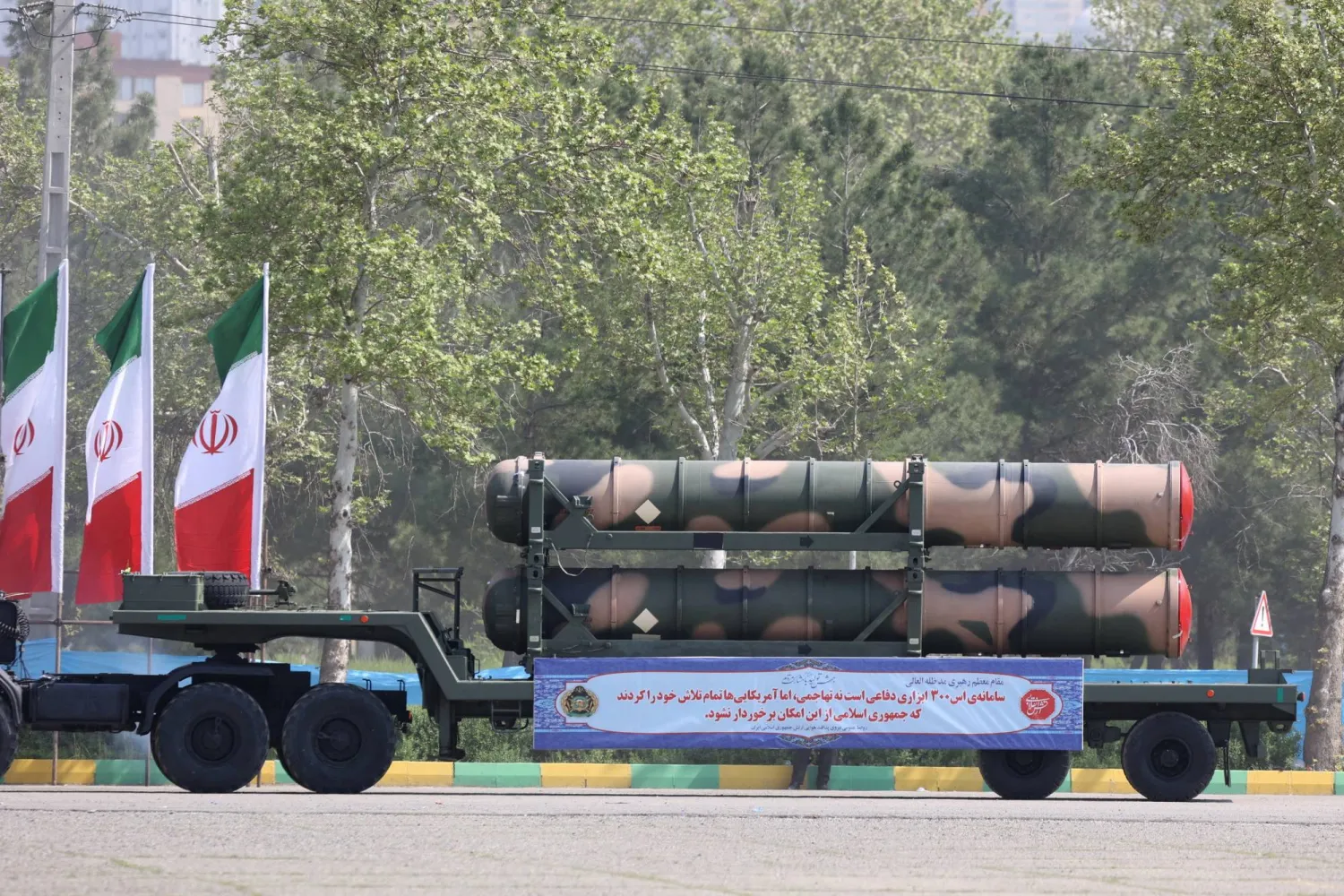
FILE PHOTO: The S-300 missile system is seen during the National Army Day parade ceremony in Tehran, Iran, April 17, 2024. Majid Asgaripour/WANA (West Asia News Agency) via REUTERS
TT

Tehran Objects to US Threats of Resorting to Military Option

FILE PHOTO: The S-300 missile system is seen during the National Army Day parade ceremony in Tehran, Iran, April 17, 2024. Majid Asgaripour/WANA (West Asia News Agency) via REUTERS

Tehran has rejected US statements that warned Washington could resort to military option to curb Iran’s nuclear program.

In an interview with Fox Business Network, broadcast on Friday, Trump said he had sent a letter to Iran's Supreme Leader Ali Khamenei, urging Iran to reopen negotiations. “I said I hope you're going to negotiate, because it's going to be a lot better for Iran,” Trump said, before warning Tehran of potential military action.

In response, Iranian Foreign Ministry spokesperson, Esmaeil Baghaei, addressed the issue during his weekly press conference on Monday, stating that the US threats are considered violations of international law and acts of aggression. “The threat of force is prohibited under international regulations and constitutes a criminal act,” he stressed.

The spokesperson added: “Negotiation under pressure and threats is meaningless, and Iran will never accept such terms.”

Baghaei said that while such threats have persisted in various forms over the years, they have only been met with steadfast resistance from the Iranian people.

He accused US politicians of using a policy of bullying, adding that Iran “has never refused to negotiate ... will never accept negotiations under pressure.”

Asked on Monday if Russia had held consultations with Iran before or after Tehran responded to a letter from Trump urging the country to negotiate a nuclear deal, the Kremlin said Iran formulates its own policy positions.

Late on Sunday, Iranian Foreign Minister Abbas Araghchi said on social media platform X, that his country would not negotiate under “intimidation.”

“We will NOT negotiate under pressure and intimidation. We will NOT even consider it, no matter what the subject may be,” he wrote.

Araghchi’s comments contrasted with a statement delivered by the Iranian mission to the United Nations on Sunday and which suggested Tehran might be willing to discuss certain issues if the objective of negotiations is to address concerns vis-a-vis any potential militarization of Iran’s nuclear program.

Baghaei denied the presence of any disagreement between Iranian officials over negotiations with Washington. He told reporters that the position of Iran’s foreign ministry is clear. “The statements made by Iranian foreign ministry officials reflect our position very clearly,” he said.

Analysts assert that Iran is forced to negotiate with Trump, especially after the “Axis of Resistance” has suffered setbacks such as the collapse of Hamas, the weakening of Hezbollah, and the fall of the Assad regime.

Regarding the continuation of talks with the European Troika (France, Germany and the UK), Baghaei said: “Another round of our talks with Europe will be held in March before the end of this year, at the expert level.”
He said talks with three European countries, in addition to Russia and China, are ongoing, namely on the nuclear issue, “and we have no restrictions on our talks with the Europeans.”

Regarding Europe's possible move to activate the snapback mechanism, the spokesman said: “We do not see any justification for activating this mechanism, and it seems that other parties are now convinced that using this tool will not achieve any goals.”

Baghaei then criticized the International Atomic Energy Agency, accusing its director general, Rafael Grossi, of making statements that were “politically motivated and only fuel tensions.”

Grossi has said that time is running out for diplomacy to impose new restrictions on Iran's activities, as Tehran continues to accelerate its enrichment of uranium to near weapons-grade.

Meanwhile, the Iranian Foreign Ministry spokesperson condemned the US decision to revoke Iraq’s sanctions waiver for purchasing Iranian electricity, calling it illegal.

Baghaei said that the United States will bear responsibility for the consequences of this decision because failure to extend the exemption granted to Iraq represents a violation of law and are considered crimes against humanity.

“These unilateral sanctions have no legal or juridical justification. The US government must be held accountable for such actions,” he said.

Trump's administration on Saturday rescinded a sanctions waiver that since 2018 has allowed Iraq to pay Iran for electricity as it presses on with its “maximum pressure” campaign against Tehran, a State Department spokesperson said.



Freed Gaza Flotilla Activists Allege Israeli Abuse Including Rape

 Italian members of the Global Sumud Flotilla arrive at the Fiumicino Airport in Rome on Thursday, May 21, 2026, after they were released and deported by the Israeli government after attempting to reach Gaza. (Cecilia Fabiano/LaPresse via AP)
Italian members of the Global Sumud Flotilla arrive at the Fiumicino Airport in Rome on Thursday, May 21, 2026, after they were released and deported by the Israeli government after attempting to reach Gaza. (Cecilia Fabiano/LaPresse via AP)
TT

Freed Gaza Flotilla Activists Allege Israeli Abuse Including Rape

 Italian members of the Global Sumud Flotilla arrive at the Fiumicino Airport in Rome on Thursday, May 21, 2026, after they were released and deported by the Israeli government after attempting to reach Gaza. (Cecilia Fabiano/LaPresse via AP)
Italian members of the Global Sumud Flotilla arrive at the Fiumicino Airport in Rome on Thursday, May 21, 2026, after they were released and deported by the Israeli government after attempting to reach Gaza. (Cecilia Fabiano/LaPresse via AP)

Activists released from Israeli custody after being detained on a flotilla trying to bring aid to Gaza were subjected to abuse, organizers said on Friday, with several hospitalized with injuries and at least 15 reporting sexual assaults, including rape.

Israel's prison service denied the allegations, and Reuters was not able to verify them independently.

Germany said some of its nationals had been injured and that some accusations were "serious", without giving further details. A legal source in Italy said prosecutors there were investigating possible crimes including kidnapping and sexual assault.

"The allegations raised are false and entirely without factual basis," an Israeli prison service spokesperson said in a statement.

"All prisoners and detainees are held in accordance with the law, with full regard for their basic rights and under the supervision of professional and trained prison staff," it said. "Medical care is provided according to professional medical judgment and in accordance with Ministry of Health guidelines."

The Israeli military referred queries to the foreign ministry, which referred them to the prison service.

Israeli forces arrested 430 people on board 50 ships in international waters on Tuesday to halt a flotilla of ‌volunteers trying to bring ‌aid supplies to the Gaza Strip.

The allegations of abuse will add to pressure on Israeli authorities to ‌explain the ⁠treatment of the ⁠detainees, after video of an Israeli cabinet minister in a prison mocking some of the activists sparked an international outcry. Italy said EU members were discussing imposing sanctions on the minister, Itamar Ben-Gvir.

ALLEGATIONS OF SEXUAL ABUSE

Global Sumud Flotilla, the organizers of the aid shipment, said the group had documented at least 15 cases of sexual abuse, with the worst occurring on one Israeli landing craft which had been converted into a makeshift prison with barbed wire and shipping containers.

Detainees were thrown into the containers and beaten over the head and ribs, the group said in a statement.

They suffered multiple cases of sexual abuse, including "humiliating strip searches, sexual taunting, groping and pulling of genitals, and multiple accounts of rape."

"At least 12 sexual assaults have been documented on that vessel alone, including anal rape and forcible penetration ⁠by a handgun," it added.

The statement was released after the Israeli prison service's blanket denial of mistreatment, rape and ‌sexual assault allegations. Reuters sent the additional specific allegations to the prison service but did not receive ‌a reply after hours on Friday, a holiday in Israel.

Ilaria Mancosu, an Italian activist, said the flotilla members were removed from their boats to two so-called prison ships. ‌Those put on one of the ships suffered more violence than the other. They were locked in a container and beaten by five soldiers, ‌suffering fractures to the ribs and arms. Some had serious injuries to their eyes and ears caused by tasers.

She said they spent two days on the prison ships with no running water and used cardboard and plastic to keep warm at night, since they had no blankets and were stripped of most of their clothes.

Once on land they were made to kneel for several hours and kicked and shoved if they moved or spoke. They were then taken to a prison where they were ‌moved from room to room periodically to keep them from sleeping, she said.

ROME PROSECUTORS INVESTIGATING POSSIBLE CRIMES

Rome prosecutors are investigating the possible crimes of kidnapping, torture and sexual assault and will hear testimony from activists ⁠who have returned to Italy over ⁠the coming days, the Italian legal source said.

A German Foreign Ministry spokesperson said consular officials who met German activists on their arrival in Istanbul reported that a number had injuries and were undergoing medical checks.

Humane treatment of German nationals was an "absolute priority," the spokesperson said, and "we naturally expect a full explanation, as some of the allegations that have been made are serious".

Sabrina Charik, who helped organize the return of 37 French citizens from the flotilla, told Reuters five French participants had been hospitalized in Türkiye, some with broken ribs or fractured vertebrae. Some had made detailed accusations of sexual violence, including of rape, she said.

In an Instagram post by an activist group verified by Reuters, French national Adrien Jouen showed bruises across his back and on his forearms.

Activists said some of the alleged abuse took place at sea after their interception by Israeli naval forces, and some following their arrest and imprisonment in Israel.

Spain's Foreign Minister Jose Manuel Albares told reporters that 44 Spanish flotilla members were expected to arrive on Friday on flights from Istanbul to Madrid and Barcelona. Four of them had received medical treatment for injuries, he added.

Western governments on Thursday had expressed their anger after Ben-Gvir posted a video of himself mocking activists being pinned to the ground in a prison.

Italian Foreign Minister Antonio Tajani said on the sidelines of the NATO meeting in Sweden that he was in touch with all his EU counterparts "so that there may be a quick decision to impose sanctions" on Ben-Gvir.


Ebola Risk Now at Highest Level in DR Congo, Says WHO

Medical staff wearing personal protective equipment (PPE) are seen at the hospital in Rwampara on May 21, 2026. (AFP)
TT

Ebola Risk Now at Highest Level in DR Congo, Says WHO

Medical staff wearing personal protective equipment (PPE) are seen at the hospital in Rwampara on May 21, 2026. (AFP)

The risk from the deadly Ebola outbreak has been raised to the highest level for the Democratic Republic of Congo, the World Health Organization said Friday, as the toll continues to rise.

The WHO upgraded its risk assessment level from high to very high for the DR Congo, while keeping the regional risk level at high and the global risk level at low.

WHO chief Tedros Adhanom Ghebreyesus said the situation was "deeply worrisome".

He said there were now nearly 750 suspected cases in the DR Congo and 177 suspected deaths, as health workers scramble to track down contacts of everyone thought to be infected with the virus.

"The Ebola outbreak in the Democratic Republic of the Congo is spreading rapidly," he told a press conference.

"So far, 82 cases have been confirmed in DRC, with seven confirmed deaths.

"But we know the epidemic in DRC is much larger. There are now almost 750 suspected cases and 177 suspected deaths."

He said the situation in Uganda was "stable", with two cases confirmed in people who travelled from DRC and one death.

Measures taken in Uganda, including "intense contact tracing" and calling off the Martyrs' Day commemorations, "appear to have been effective in preventing the further spread of the virus", Tedros added.

While a US national who was working in the DRC has tested positive and been transferred to Germany for care, Tedros said another US national deemed to be a high-risk contact had been transferred to the Czech Republic.

Besides national staff already in the DRC, he said 22 international staff had been deployed to the field, "including some of our most experienced people".

Tedros said that violence and insecurity was impeding the response to the outbreak in the DRC.

- Treatment trials planned -

Ebola is a deadly viral disease spread through direct contact with bodily fluids. It can cause severe bleeding and organ failure.

There are no approved vaccines or therapeutics for the Bundibugyo strain of Ebola behind the current outbreak.

There have only been two previous outbreaks of Bundibugyo, in Uganda in 2007 and DRC in 2012.

WHO chief scientist Sylvie Briand said the UN agency was making an inventory of all existing tools which might be useful in combating the outbreak and then prioritizing them, with safety and efficacy the main criteria.

The WHO research and development branch has convened its technical advisory group on treatments, which recommended the prioritization of two monoclonal antibodies for clinical trials.

It also recommended evaluating the antiviral obeldesivir in clinical trials as post-exposure prophylaxis for people who are high-risk contacts.

Briand said it looked "promising" as something that might be able to prevent infected contacts from going on to develop disease from that infection.

The WHO is also in talks with partners on developing eventual vaccines that work against Bundibugyo.


Ukraine Hits College in Russian-Occupied Town, Killing 6

22 May 2026, Ukraine, Starobelsk: Emergency workers search through the rubble of the dormitory of the Starobelsk Professional College, part of the Lugansk State Pedagogical University, which was hit and destroyed in a Ukrainian drone strike on Starobelsk. (Alexander Reka/TASS via ZUMA Press/dpa)
TT

Ukraine Hits College in Russian-Occupied Town, Killing 6

22 May 2026, Ukraine, Starobelsk: Emergency workers search through the rubble of the dormitory of the Starobelsk Professional College, part of the Lugansk State Pedagogical University, which was hit and destroyed in a Ukrainian drone strike on Starobelsk. (Alexander Reka/TASS via ZUMA Press/dpa)

Ukrainian drones struck a college dormitory in the Russian-occupied region of Lugansk early Friday, killing six people and wounding dozens of others, Russian officials said.

As many as 15 others remained missing as of Friday afternoon, Russian President Vladimir Putin said in televised comments, describing the incident as a "terrorist" attack.

Putin ordered his defense ministry to prepare a response, without elaborating.

The Lugansk region is in east Ukraine, but is almost entirely occupied by Russia, which claims it as its own.

Images released by the region's Russian-installed governor showed what appeared to be a college in the town of Starobilsk with its windows blown out, flames visible in one of them.

There was no immediate comment from Ukraine.

"Enemy drones attacked the academic building and dormitory of Starobelsk Professional College," Moscow-installed governor Leonid Pasechnik said in a post on Russia's MAX messenger, using the Russian name for the town.

"At the time of the strike, 86 children aged 14 to 18 were there," he added.

Starobilsk lies about 65 kilometers (40 miles) from the front line in east Ukraine.

Russian forces captured the town in 2022, shortly after launching their full-scale offensive.

AFP was not able to immediately verify information about the college that was hit.

- 'No leniency' -

Putin said the attack took place as the students were sleeping.

"At the moment, it is known that six people were killed, 39 were wounded and 15 people are unaccounted for, as the search through the rubble is still ongoing," he said in televised comments.

"There are no military facilities, special services, or related services near the dormitory," he added.

Russia's foreign ministry said that those responsible would face "face inevitable and severe punishment".

"There will be no leniency," it said.

Russia's Investigative Committee accused the Ukrainian military of having fired multiple drones at the building.

"As a result of the attack, the five-storey building collapsed to the second floor," it said.

Ukraine, which denies targeting civilians, regularly fires drones at Russian-controlled areas in retaliation for mass Russian strikes on its own people.

The United Nations Human Rights Monitoring Mission in Ukraine has recorded more than 60,000 civilian casualties since 2022, almost 90 percent of which were in areas controlled by Ukraine.

A massive Russian attack on Ukraine's capital Kyiv last week killed 24 people, including three children, according to Ukrainian authorities.

Russia fired more than 100 drones at Ukraine between late Thursday and early Friday, according to the Ukrainian air force.