


Turkish Police Scuffle with May Day Protesters in Istanbul, Detain Hundreds

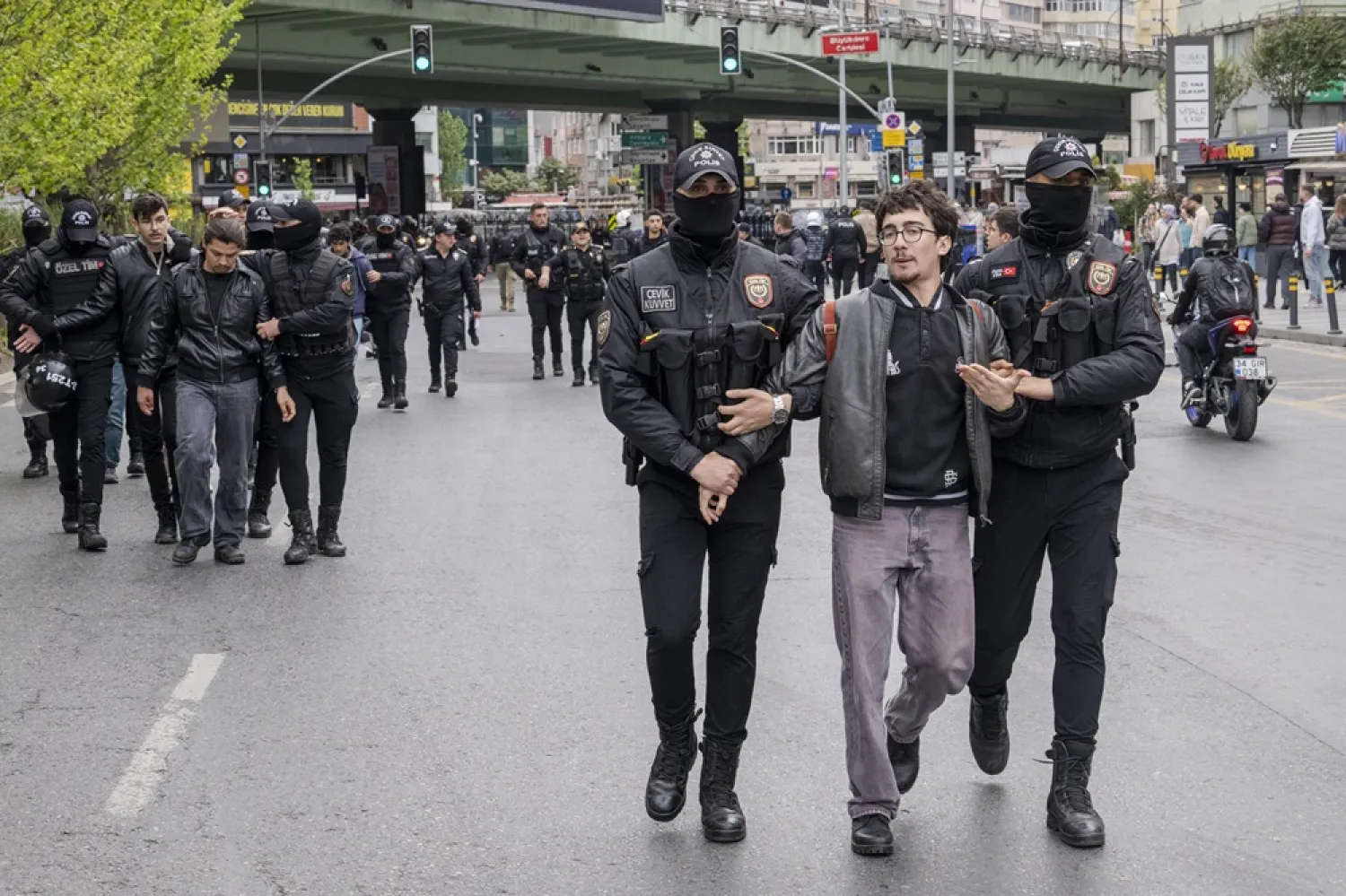
Turkish police officers detain protesters attempting to reach Taksim Square to celebrate International Workers' Day in Istanbul, Türkiye, 01 May 2025. (EPA)
TT

Turkish Police Scuffle with May Day Protesters in Istanbul, Detain Hundreds

Turkish police officers detain protesters attempting to reach Taksim Square to celebrate International Workers' Day in Istanbul, Türkiye, 01 May 2025. (EPA)


Turkish police charged May Day protesters in Istanbul on Thursday, detaining hundreds of people and dragging some away in buses after they tried to defy a ban on public gatherings and march towards Taksim Square.

Unions and NGOs had called for protests and marches across Istanbul, which has seen a wave of mass demonstrations in recent weeks over the detention of its mayor and President Recep Tayyip Erdogan's main political rival, Ekrem Imamoglu.

On Thursday, protesters attempted to march towards the city center's Taksim Square, where all protests have been banned for years, in overcast and rainy weather.

Police blocked them in the central Besiktas and Sisli districts and pushed them back, scuffling with some who attempted to break through barricades.

Footage showed riot police and protesters charging at each other. Protesters held up signs and chanted slogans as police forcefully hauled detainees away to waiting buses.

Interior Minister Ali Yerlikaya said police had detained 409 people in total, including 407 in Istanbul. He said a combined 286,584 people had participated in the protests, which were held in 78 provinces.

Gatherings are held every year in Türkiye for International Labor Day, but police have often intervened in recent years.

Last year, police detained more than 200 people attempting to march to Taksim Square. In 1977, 34 people were killed during May Day demonstrations in the square.

Ozgur Ozel, head of the main opposition Republican People's Party (CHP), to which Imamoglu also belongs, said the ban on demonstrations and marches in Taksim Square showed "the ruling party's insecurity and lack of confidence".

"Imprisoning a square with thousands of police shows those who lead the country have no real authority and have turned the state into a police state," Ozel told reporters.

In Ankara, Erdogan hosted representatives from unions and various professional fields to mark May Day. He said his government had, over the years, lifted some restrictions on laborers and implemented several legal amendments to improve working conditions.

Thousands more rallied in Ankara for largely peaceful marches and demonstrations, while gatherings were held in other cities as well.



UN Warns Hormuz Standstill Will Hit World’s Most Vulnerable

 The Parnassos crude oil tanker sits anchored as the traffic is down in the Strait of Hormuz, amid the US-Israeli conflict with Iran, in Muscat, Oman, March 10, 2026. (Reuters)
The Parnassos crude oil tanker sits anchored as the traffic is down in the Strait of Hormuz, amid the US-Israeli conflict with Iran, in Muscat, Oman, March 10, 2026. (Reuters)
TT

UN Warns Hormuz Standstill Will Hit World’s Most Vulnerable

 The Parnassos crude oil tanker sits anchored as the traffic is down in the Strait of Hormuz, amid the US-Israeli conflict with Iran, in Muscat, Oman, March 10, 2026. (Reuters)
The Parnassos crude oil tanker sits anchored as the traffic is down in the Strait of Hormuz, amid the US-Israeli conflict with Iran, in Muscat, Oman, March 10, 2026. (Reuters)

The standstill in the Strait of Hormuz caused by the Middle East war could hammer some of the world's most vulnerable people, the United Nations warned Tuesday.

The strait is the only sea passage from the Gulf towards the Indian Ocean, through which nearly a quarter of the world's seaborne oil supplies pass, as well as a significant amount of cargo.

Iran has all but blocked the waterway following the launch of the February 28 US-Israeli airstrikes on the country that triggered the war.

"The current shock comes at a time when many developing economies struggle to service their debt, face a tightening of fiscal space and limited capacity to absorb new price shocks," the UN trade and development agency UNCTAD said.

"Higher energy, fertilizer and transport costs -- including freight rates, bunker fuel prices and insurance premiums -- may increase food costs and intensify cost-of-living pressures, particularly for the most vulnerable," it said.

UNCTAD added that, in terms of seaborne trade volume, in the week before the conflict 38 percent of crude oil, 29 percent of liquified petroleum gas, 19 percent of liquified natural gas and 19 percent refined oil products went through the strait.

But while an average of 129 ships transited daily through the passage between February 1 and 27, that number dropped to just three on March 3.

UNCTAD said the disruptions underscored the vulnerability of critical maritime chokepoints and their potential for disruption to them to send shocks across supply chains and commodity markets.

"Rising energy, transport and food costs could strain public finances and increase pressure on household budgets, potentially heightening economic and social pressures... particularly in economies heavily dependent on imported energy, fertilizers and staple foods," it said.

- Food aid hit -

UN rights chief Volker Turk echoed the alarm for the effect the plunge in commercial shipping activity could have, "particularly for the world's most vulnerable".

"The impact of an oil price surge will have a knock-on effect for macro-economic and social stability in many countries, particularly those already experiencing debt distress," he said.

The UN's World Food Program said the costs and time lost to the Strait of Hormuz disruptions were already impacting its humanitarian operations.

"This is nothing less than another seminal moment in global supply chain history," Jean-Martin Bauer, the director of WFP's food and nutrition analysis service, told reporters in Geneva.

Speaking from the WFP's Rome headquarters, he said shipping lines were diverting services and adding surcharges, leading to congestion "in places that are very far from Hormuz".

"We're seeing congestion in Asia. It's quite a severe disruption that's taking place right now," Bauer said.

"We're needing to go the long way around the Cape of Good Hope to reach some of our key geographies."

WFP's biggest operation is in Sudan, but now it is facing approximately 25 days of additional shipping time.

"It's basically 50 percent more than we would usually have. So that's really extending the supply chain and adding to cost," said Bauer.


Israel Says Iran Hacked Security Cameras

People exercise on the beach in Tel Aviv, Israel, 10 March 2026. (EPA)
TT

Israel Says Iran Hacked Security Cameras

People exercise on the beach in Tel Aviv, Israel, 10 March 2026. (EPA)

Israel's cybersecurity directorate said it had identified "dozens of Iranian breaches into security cameras for espionage purposes" since the start of the war in the Middle East, urging the public to be vigilant.

"The directorate is working to alert hundreds of camera owners and calls on the public to change their passwords and update their software to prevent any security risk, whether national or personal," Cyber Israel wrote on X Monday.

Cyberattacks between Iran and Israel have been a frequent occurrence in recent years, as the two foes conducted a shadow war that culminated in open conflict last June and again on February 28.

In December 2025, former Israeli prime minister Naftali Bennett -- who is set to run against incumbent premier Benjamin Netanyahu in a general election this year -- said he had been the victim of a cyberattack targeting his Telegram account, after hackers claimed to have broken into his phone.

Private messages, videos and photographs said to be taken from Bennett's phone were published on a hacker site named after "Handala", a character symbolizing the Palestinian cause, and on an associated X account.

Iran-linked hackers have stepped up their operations in the region since strikes began on the country, an expert told AFP.

Israeli cybersecurity firm Check Point said in a report that since the launch of the US-Israeli offensive on February 28, it has seen hackers accessing surveillance cameras, which are widely used but often poorly secured.

The images were likely used to assess damage caused by the attacks or "to gather the necessary information" on "the habits (of targeted individuals) or locations to hit", Gil Messing, head of cyberintelligence at Check Point, told AFP.

The hackers "are part of (Iran's) army" and "are largely supported by the state", notably by the Revolutionary Guards and the ministry of intelligence and security, he added.

Last week, the Financial Times reported that Israel had hacked nearly all of Tehran's traffic cameras for years in preparation for the operation that killed Iran's supreme leader Ali Khamenei on the first day of the offensive.


Israeli Army Says Half of Iranian Missiles Have Cluster Munitions

An Iranian missile with cluster munitions flies toward Israel, amid the US-Israel conflict with Iran, as seen from Tel Aviv, Israel, March 9, 2026. (Reuters)
TT

Israeli Army Says Half of Iranian Missiles Have Cluster Munitions

An Iranian missile with cluster munitions flies toward Israel, amid the US-Israel conflict with Iran, as seen from Tel Aviv, Israel, March 9, 2026. (Reuters)

Israel's army estimated on Tuesday that around half of the missiles being fired at the country by Iran contained cluster munitions, posing an added danger to people on the ground.

"Approximately 50 percent of Iranian missiles fired toward Israel carry cluster warheads that disperse into smaller bombs in the air, creating additional falling debris hazards," a military official said, in comments shared by the defense ministry.

Cluster munitions explode in mid-air and scatter bomblets. Some of these submunitions do not explode on impact and can cause casualties over time, particularly among children.

"The radius of the impact is about ten kilometers. Although these contain less explosive material than a standard missile, the impact can still be lethal," the official said.

Two construction workers died from shrapnel wounds after missiles were fired at central Israel on Monday, with emergency workers at the site telling AFP the damage appeared to have been caused by a cluster munition.

Iran and Israel are not among the more than 100 countries that are party to the 2008 Convention on Cluster Munitions, which prohibits their use, transfer, production and storage.

Both have reportedly used the munitions in earlier conflicts.

During the 12-day war between Iran and Israel in June 2025, Amnesty International said Tehran used cluster munitions at least three times, based on analysis of photos and videos, as well as media reports.

In 2007, a US government investigation found that Israel had probably violated arms export agreements with Washington when it dropped US-made cluster bombs in Lebanon during its war with Hezbollah the previous year.