

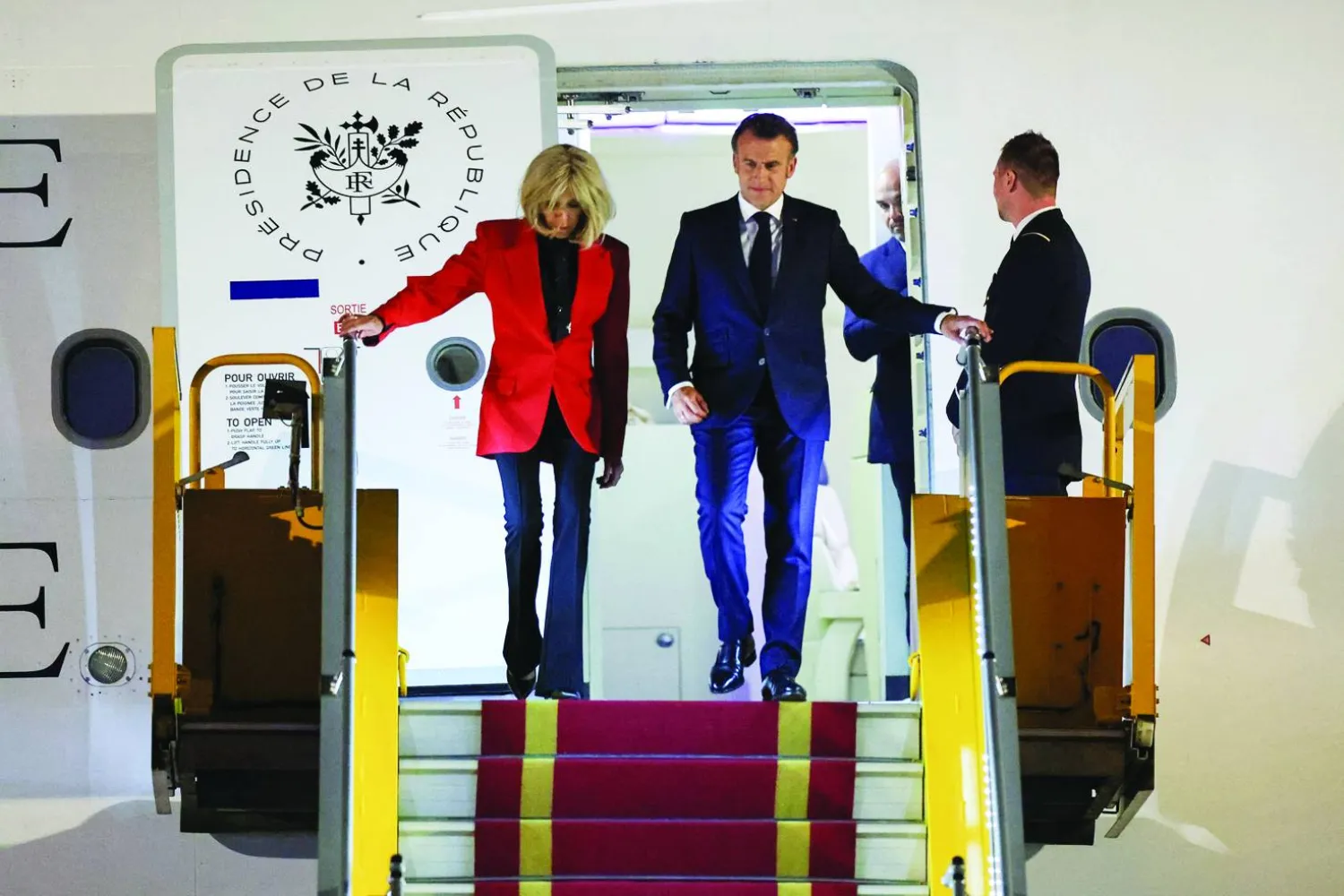

France, Vietnam Sign Airbus, Satellite Deals as Macron Visits Hanoi

France's President Emmanuel Macron and his wife Brigitte Macron arrive at Noi Bai International Airport, marking the first trip to Vietnam by a French president in nearly a decade, in Hanoi, Vietnam, May 25, 2025. REUTERS/Chalinee Thirasupa
TT

France, Vietnam Sign Airbus, Satellite Deals as Macron Visits Hanoi

France's President Emmanuel Macron and his wife Brigitte Macron arrive at Noi Bai International Airport, marking the first trip to Vietnam by a French president in nearly a decade, in Hanoi, Vietnam, May 25, 2025. REUTERS/Chalinee Thirasupa

France and Vietnam signed a deal on Monday for 20 Airbus planes, among other pacts, as President Emmanuel Macron visited Hanoi seeking to boost France's influence in its former colony, grappling with threats of crippling US tariffs.

Macron's first formal visit to Vietnam, the first by a French president in nearly a decade, follows US President Donald Trump's threats on Friday of 50% duties on EU goods from June that sharply fueled tension with the 27-nation bloc.

Export-dependent Vietnam, under pressure from Washington to buy more American goods, has made pledges in trade talks to avert 46% tariffs that could impair its growth, fanning European concerns about deals at the region's expense, said AFP.

Deals signed during Macron's visit covered the plane purchase, cooperation on nuclear energy, railways, Airbus earth-observation satellites and Sanofi vaccines, a list of documents seen by Reuters showed, confirming an earlier report.

In statements to the press with no questions allowed, Macron reiterated France's support of freedom of navigation, an issue dear to Vietnam as it often clashes with Beijing over contested boundaries in the South China Sea.

Macron added the partnership with Vietnam "entails a reinforced defense cooperation", citing the signing of multiple projects on defense and space.

Vietnam's President Luong Cuong said the defense partnership involved "sharing of information on strategic matters" and stronger cooperation in the defense industry, cybersecurity and anti-terrorism.

France ruled the Southeast Asian country for about 70 years until it was forced out in 1954 after a major defeat at Dien Bien Phu in northern Vietnam. Ties have improved in recent decades, being upgraded last year to Vietnam's highest level.

On his trip, the first leg of a Southeast Asian tour that includes Indonesia and Singapore, Macron will visit a university in Hanoi on Tuesday, before flying to Jakarta, the Indonesian capital.

AIRBUS

The deal with European planemaker Airbus for Vietnam's low-cost airline VietJet to buy 20 A330neo wide-body aircraft follows last year's agreement for 20 of the jets.

The signing followed urging by European officials in recent weeks for Vietnam to be careful in concessions made to the White House, two officials based in Vietnam with knowledge of the discussions had told Reuters, referring to concerns on Airbus.

Airbus is the main supplier of jets to Vietnam, contributing 86% of its fleet, data from aviation analytics firm Cirium shows.

A separate agreement with Airbus Defense was also signed during the visit for cooperation with Vietnam on earth-observations satellites.

Airbus has long been in talks with Hanoi for the replacement of Vietnam's earth-observation satellite, built by Airbus' predecessor EADS and launched in 2013.

With an economy heavily dependent on US exports, Vietnam has signaled the possible purchase of at least 250 Boeing planes by flag carrier Vietnam Airlines and rival VietJet.

Officials of both nations have said such deals would help cut its huge trade surplus with the United States and possibly appease Trump.

In talks with the United States, "Vietnam should make sure not to make decisions at the expense of European interests," one of the EU officials said.

Vietnamese leaders have been advised such steps could jeopardize close ties with the EU, which has a free trade deal with Vietnam and is a major buyer of its goods, they added.



Blasts Heard, Sirens in Jerusalem after Iran Missile Alerts

An Israeli Orthodox Jew inspects the site of an Iranian missile strike in Arad on March 22, 2026. (Photo by Ilia YEFIMOVICH / AFP) /
TT

Blasts Heard, Sirens in Jerusalem after Iran Missile Alerts

An Israeli Orthodox Jew inspects the site of an Iranian missile strike in Arad on March 22, 2026. (Photo by Ilia YEFIMOVICH / AFP) /

Blasts were heard and air raid sirens sounded in Jerusalem on Sunday, AFP journalists said, after the Israeli military warned of incoming missile fire from Iran.

The army issued several alerts saying it had identified that "missiles were launched from Iran toward the territory of the State of Israel".

Israel's Magen David Adom emergency medical service said after the first warning that there were no immediate reports of casualties.

Israel's military said personnel were attending "impact sites" in central Israel, with local media showing images of light damage by a road in the city of Holon near Tel Aviv.

The latest alerts come after Iranian missiles struck two towns in southern Israel on Saturday evening.

The Soroka medical center said it had received and treated 175 people, and 10 were in serious condition, including at least one child.

The blasts in the towns of Dimona and Arad tore open residential buildings and gouged craters in the ground.

Iranian state TV said the strike in Dimona, which houses a nuclear facility, was in response to an earlier strike on its own Natanz nuclear site.

The Israeli military said it was investigating how air defense systems had failed to intercept the incoming missiles.


Iran Says Hormuz Open to All But ‘Enemy-linked’ Ships amid US Threat

A cargo ship in the Gulf, near the Strait of Hormuz, as seen from northern Ras al-Khaimah, near the border with Oman’s Musandam governance, amid the US-Israeli conflict with Iran, in United Arab Emirates, March 11, 2026. REUTERS/Stringer
TT

Iran Says Hormuz Open to All But ‘Enemy-linked’ Ships amid US Threat

A cargo ship in the Gulf, near the Strait of Hormuz, as seen from northern Ras al-Khaimah, near the border with Oman’s Musandam governance, amid the US-Israeli conflict with Iran, in United Arab Emirates, March 11, 2026. REUTERS/Stringer

The Strait of Hormuz remains open to all shipping except vessels linked to "Iran's enemies", Iran's representative to the UN maritime agency said on Sunday, after US President Donald Trump threatened to target Iranian power plants if ‌the waterway ‌was not "fully open" within 48 ‌hours.

The ⁠threat of Iranian ⁠attacks during the US-Israeli war on Iran has kept most ships from getting through the narrow strait, the conduit for around a fifth of ⁠global oil and liquefied natural ‌gas supplies, ‌threatening a global energy shock, Reuters said.

Ali Mousavi ‌said Tehran was ready to ‌cooperate with the International Maritime Organization to improve maritime safety and protect seafarers in the Gulf, adding that ‌ships not linked to "Iran's enemies" could pass the strait ⁠by ⁠coordinating security and safety arrangements with Tehran.

"Diplomacy remains Iran's priority. However, a complete cessation of aggression as well as mutual trust and confidence are more important," Mousavi said, adding that Israeli and US attacks against Iran were at the "root of the current situation in the Strait of Hormuz".


Israel Bombs Central Tehran; Trump Gives Iran 48 Hours to Open Strait of Hormuz

People on motorcycles ride past a large billboard with images of Iranian missiles, amid the US-Israeli conflict with Iran, in Tehran, Iran, March 15, 2026. REUTERS/Alaa Al-Marjani
TT

Israel Bombs Central Tehran; Trump Gives Iran 48 Hours to Open Strait of Hormuz

People on motorcycles ride past a large billboard with images of Iranian missiles, amid the US-Israeli conflict with Iran, in Tehran, Iran, March 15, 2026. REUTERS/Alaa Al-Marjani

President Donald Trump warned the US will “obliterate” power plants in Iran if the Iranian Republic doesn’t fully open the Strait of Hormuz within 48 hours, while Iranian missiles struck two communities not far from Israel’s main nuclear research center late Saturday, leaving buildings shattered and dozens injured in the attacks.

The developments signaled the war was moving in a dangerous new direction at the start of its fourth week, The Associated Press said.

Trump, who issued the ultimatum in a social media post while he spent the weekend at his Florida home, said he’s giving Iran 48 hours to open the vital waterway or face a new round of attacks. He said the US would destroy “various POWER PLANTS, STARTING WITH THE BIGGEST ONE FIRST!”

Iran warned early Sunday that any strike on its energy facilities would prompt attacks on US and Israeli energy and infrastructure assets in the region, according to a statement citing an Iranian military spokesperson carried by state media and semiofficial outlets.

The Strait of Hormuz, which connects the Arabian Gulf to the rest of the globe’s oceans, is a critical pathway for the world’s flow of oil. Attacks on commercial ships and threats of further strikes have stopped nearly all tankers from carrying oil, gas and other goods through the passage, leading to cuts in output from some of the world’s largest oil producers, because their crude has nowhere to go.

Iran strikes area near Israeli nuclear site

Israel’s military said it was not able to intercept missiles that hit the southern cities of Dimona and Arad, the largest near the center in Israel’s sparsely populated Negev desert. It was the first time Iranian missiles penetrated Israel’s air defense systems in the area around the nuclear site.

“If the Israeli regime is unable to intercept missiles in the heavily protected Dimona area, it is, operationally, a sign of entering a new phase of the battle,” Iran’s Parliament Speaker Mohammad Bagher Ghalibaf said on X before word of the Arad strike spread.

Rescue workers said the direct hit in Arad caused widespread damage across at least 10 apartment buildings, three of them badly damaged and in danger of collapsing. At least 64 people were taken to hospitals.

Dimona is about 20 kilometers (12 miles) west of the nuclear research center and Arad around 35 kilometers (22 miles) north.

Israel is believed to be the only Middle East nation with nuclear weapons, though its leaders refuse to confirm or deny their existence. The UN nuclear watchdog said on X it had not received reports of damage to the Israeli center or abnormal radiation levels.

The Iranian strikes in Israel came after Tehran’s main nuclear enrichment site at Natanz was hit earlier in the day.

Israel denies responsibility for attack on Natanz

Israel earlier Saturday denied responsibility for the strike on Natanz, nearly 220 kilometers (135 miles) southeast of Tehran. The Iranian judiciary’s official news agency, Mizan, said there was no leakage.

The International Atomic Energy Agency has said the bulk of Iran’s estimated 970 pounds (440 kilograms) of enriched uranium is elsewhere, beneath the rubble at its Isfahan facility. It said on X it was looking into the strike.

The Pentagon declined to comment on the strike on Natanz, which was also hit in the first week of the war and in the 12-day war last June. Russian Foreign Ministry spokesperson Maria Zakharova said such strikes posed a “real risk of catastrophic disaster throughout the Middle East.”

The US and Israel have offered shifting rationales for the war, from hoping to foment an uprising that topples Iran’s leadership to eliminating its nuclear and missile programs and its support for armed proxies. There have been no signs of an uprising, while internet restrictions limit information from Iran.

The war’s effects are felt far beyond the Middle East, raising food and fuel prices.