

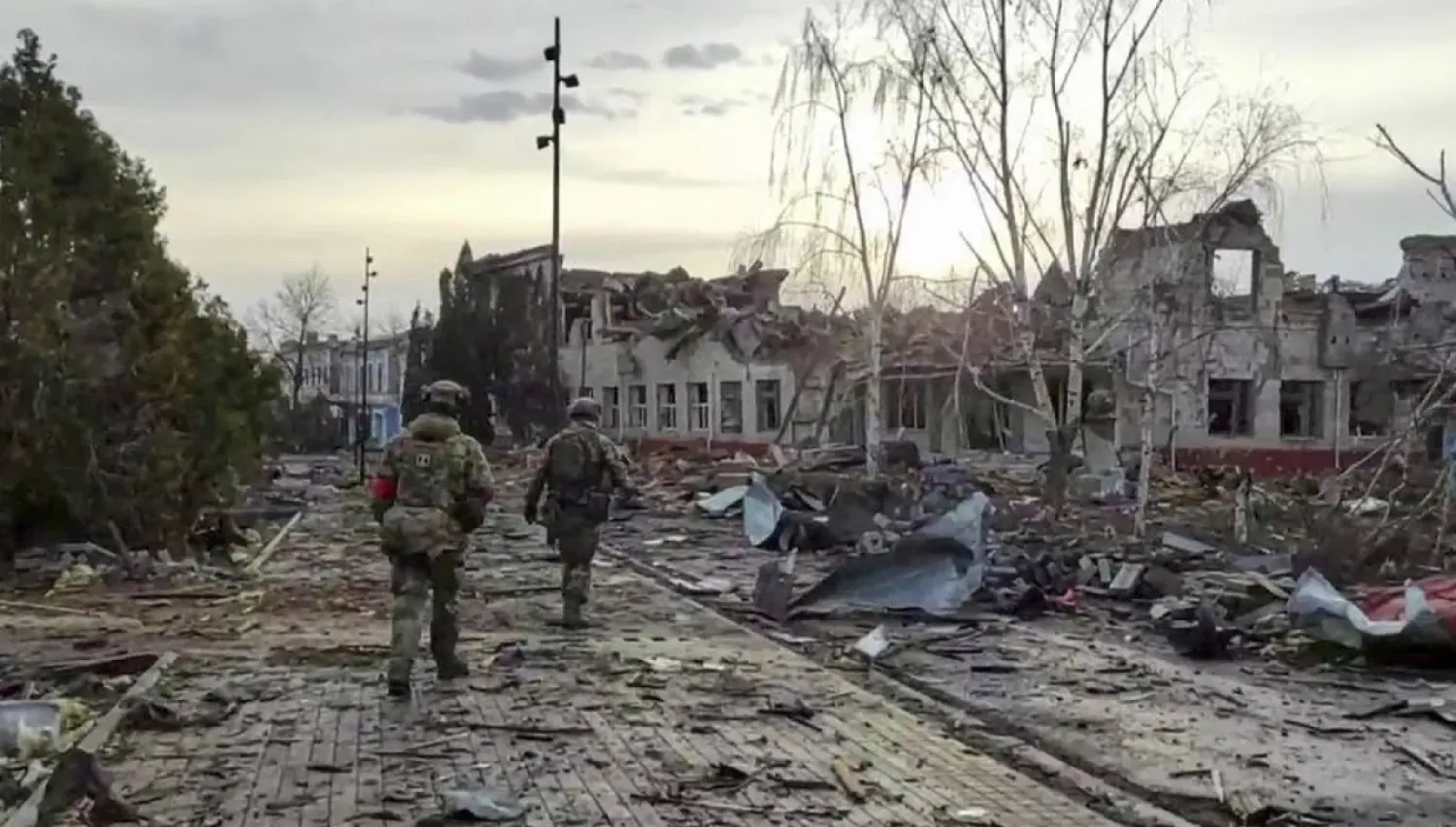

Russia Seizes Ukrainian Border Villages as its Bombing Campaign Slows

In this photo taken from video distributed by the Russian Defense Ministry Press Service on Thursday, March 13, 2025, Russian soldiers patrol an area in Sudzha, in the Kursk region of Russia, after it was taken over by Russian troops. (Russian Defense Ministry Press Service via AP)
TT

Russia Seizes Ukrainian Border Villages as its Bombing Campaign Slows

In this photo taken from video distributed by the Russian Defense Ministry Press Service on Thursday, March 13, 2025, Russian soldiers patrol an area in Sudzha, in the Kursk region of Russia, after it was taken over by Russian troops. (Russian Defense Ministry Press Service via AP)

Russian forces have taken four border villages in Ukraine’s northeastern Sumy region, a local official said Tuesday, days after Russian President Vladimir Putin said he had ordered troops to establish a buffer zone along the border.

Sumy borders Russia’s Kursk region, where a surprise Ukrainian incursion last year captured a pocket of land in the first occupation of Russian territory since World War II. The long border is vulnerable to Ukrainian incursions, Putin said, and creating a buffer zone could help Russia prevent further cross-border attacks there.

Meanwhile, a Russian bombing campaign that had escalated in recent days slowed overnight, with far fewer Russian drones targeting Ukrainian towns and cities, according to Reuters.

Moscow's invasion has shown no signs of stopping despite months of intense US-led efforts to secure a ceasefire and get traction for peace talks. Since Russian and Ukrainian delegations met in Türkiye on May 16 for their first direct talks in three years, a large prisoner exchange has been the only tangible outcome, but negotiations have brought no significant breakthrough.

The US special envoy to Ukraine, Keith Kellogg, said Putin has not yet delivered a promised memorandum that the Russian leader told US President Donald Trump in a phone call on May 19 would outline the framework for a possible peace agreement.

The Kremlin has also ruled out the Vatican as a venue for negotiations, he said. “We would have liked to have it at the Vatican and we were pretty set to do something like that, but the Russians didn’t want to go there ... so I think Geneva may be the next stop,” Kellogg told the Fox News Channel.

Turkish Foreign Minister Hakan Fidan said his country also was ready to host another round of peace talks.

Between Friday and Sunday, Russia launched about 900 drones at Ukraine, officials said, amid a spate of large-scale bombardments. On Sunday night, Russia launched its biggest drone attack of the 3-year-old war, firing 355 drones.

From Monday to Tuesday, Russia fired 60 drones at Ukraine, the Ukrainian air force said. Russia’s Defense Ministry said its defenses downed 99 Ukrainian drones overnight over seven Russian regions.

The weekend surge in Russian bombardments drew a rebuke from Trump, who said Putin had gone “crazy.” That comment brought a sharp Kremlin reaction Monday, with spokesman Dmitry Peskov criticizing ”emotional reactions” to events.

He took a milder tone Tuesday, hailing US peace efforts and saying that “the Americans and President Trump have taken a quite balanced approach.”

In Sumy, Russian forces are trying to advance deeper after capturing villages, said Oleh Hryhorov, head of the Sumy regional military administration.

Ukrainian forces are trying to hold the line, he said, adding that residents of the villages were evacuated earlier, and there is no immediate threat to civilians.

Putin visited the Kursk region last week for the first time since Moscow claimed last month that it drove Ukrainian forces out of the area where they captured land last August. Kyiv officials have denied the claim.

The long border remains vulnerable to Ukrainian incursions, Putin said. He said he told the Russian military to create a “security buffer zone” along the frontier but provided no public details of where the proposed zone would be or how far it would stretch.

Putin said a year ago that a Russian offensive at the time aimed to create a buffer zone in Ukraine’s northeastern Kharkiv region. That could have helped protect Russia’s Belgorod border region, where frequent Ukrainian attacks have embarrassed the Kremlin.



India Rolls Out Red Carpet for Russia's Putin

In this pool photograph distributed by the Russian state agency Sputnik, Russia's President Vladimir Putin and Indian Prime Minister Narendra Modi look out from a car prior to an informal dinner at Modi's residence. Alexander KAZAKOV / POOL/AFP
TT

India Rolls Out Red Carpet for Russia's Putin

In this pool photograph distributed by the Russian state agency Sputnik, Russia's President Vladimir Putin and Indian Prime Minister Narendra Modi look out from a car prior to an informal dinner at Modi's residence. Alexander KAZAKOV / POOL/AFP

India's Prime Minister Narendra Modi hosts Russia's President Vladimir Putin at a summit on Friday, with defense and trade ties taking center stage as New Delhi faces heavy US pressure to stop buying Moscow's oil.

Both leaders will also discuss the geopolitical situation in the wake of the Russian invasion of Ukraine and global trade disruptions triggered by tariffs imposed by US President Donald Trump, said AFP.

Big ticket defense sales and co-production ventures, energy purchases, and wider economic engagement are on the agenda, Putin's first visit to India since the Ukraine war.

Modi welcomed Putin at the airport on Thursday with a warm hug on a red carpet, before the two rode together in the same car to a private dinner -- mirroring a lift that Putin gave Modi when they last met in China in September.

"India-Russia friendship is a time-tested one that has greatly benefitted our people," Modi wrote in a post on social media, accompanying a photograph of them grinning together inside the vehicle.

It was a symbolic show of friendship, after US President Donald Trump imposed 50-percent tariffs on most Indian products in August, citing Delhi's continued purchases of Russian oil -- revenue Washington argues helps fund the war in Ukraine.

In an interview with India Today, Putin said he was "very happy" to be meeting "my friend" Modi.

"The range of our cooperation with India is huge," he said in remarks translated by the broadcaster, citing ship and aircraft manufacturing, nuclear energy and space exploration.

"This visit is part of India's diversification strategy, both in terms of strategic and economic, especially at a time when the US tariffs have hurt India," Ashok Malik of business consultancy The Asia Group told AFP.

On Friday, Putin is due to be given an honor guard welcome at the presidential palace in New Delhi, before meeting with Modi.

'Balancing acts'

India is walking a diplomatic tightrope -- relying on strategic Russian oil imports while trying not to provoke Trump during ongoing tariff negotiations.

"Balancing acts are second nature to Indian foreign policy making", wrote Pankaj Saran, a former Indian envoy to Russia, writing in the Times of India.

The leaders will also address business and industry leaders before Putin attends a state banquet hosted by the Indian President Droupadi Murmu.

India, the world's most populous nation, has become a major buyer of Russian oil, saving itself billions of dollars and providing Moscow with a much-needed export market after it was cut off from traditional buyers in Europe because of the war.

Putin also told India Today that Modi is "not someone who gives in to pressure", when asked about the impact of US tariffs.

The Russian share of India's arms imports fell from 76 percent in 2009-13 to 36 percent in 2019-23, according to the Stockholm International Peace Research Institute.

Besides discussions around cutting-edge defense hardware, which includes air defense systems, fighter jets, and nuclear submarines, New Delhi will push for easier access to the wider Russian market.

Bilateral trade reached $68.7 billion in 2024-25 -- almost six times higher than the pre-pandemic levels -- but Indian exports accounted for only $4.88 billion.

The two countries are expected to announce an agreement on easier mobility of Indian workers into Russia.


Iran Accused of ‘Digital Apartheid’

03 December 2025, Iran, Teheran: View of the smog-ridden metropolis of Tehran. Photo: Aref Taherkenareh/dpa
TT

Iran Accused of ‘Digital Apartheid’

03 December 2025, Iran, Teheran: View of the smog-ridden metropolis of Tehran. Photo: Aref Taherkenareh/dpa

Ordinary Iranians face up to 10 years in prison or even execution if they use X to write anything the government deems critical.

But little did they know that government officials and regime supporters have been using the social media site, which is banned inside Iran, Britain’s The Telegraph reported.

This practice has been revealed after Elon Musk’s X rolled out an update that displays each user’s location.

It has exposed government ministers, state media figures, political officials and pro-regime accounts as having accessed the banned platform from within Iran using special white SIM cards.

The new X location feature was designed to spot fake accounts but instead has lifted the curtain on the divide in Iran, one of the world’s most censored countries, according to the newspaper.

Critics of the regime have termed the online divide a form of “digital apartheid”, with only certain groups able to access the internet freely.

Ordinary Iranians are forced to use VPNs, which conceal their true location, to get around the ban. If they are caught posting on X they are reprimanded by Iranian authorities, and if those posts are anti-Iran or pro-Israel, they face execution or prison sentences.

Meanwhile, state and pro-regime accounts use the white SIM cards in their phones to receive unrestricted access to the internet and bypass their own restrictions.

Ahmad Bakhshayesh Ardestani, an Iranian politician who serves on the national security commission, criticized their use.

Ardestani said: “Many people want filtering to exist because they want to sell VPNs and do business.”

He added that the VPN market, used by ordinary Iranians, has high financial turnover and is controlled by “a mafia”.

If users access X through VPNs, the location shows the country where their server is located rather than their actual location.

Other banned platforms in Iran include Facebook, YouTube and Telegram.

“This is obvious discrimination in public rights and against the explicit text of the constitution,” one Iranian citizen told The Telegraph, referring to Iran’s constitutional guarantee of equality among citizens.

“When you yourself use white SIM cards, how can we expect you to understand the pain of filtering? How can we expect you to fight to remove it?” another Iranian said.

Among those whose locations were displayed were communications minister Sattar Hashemi, former foreign minister Javad Zarif, government spokesman Fatemeh Mohajerani and dozens of journalists working for state-aligned media outlets.

Also exposed were political figures, eulogists who praise the Iranian regime at official events, and accounts that had claimed online to be opposition voices, including some monarchist and separatist pages operating from inside Iran with apparent government approval.

Analysts say it is meant to keep parts of the opposition narrative under the control of the clerical establishment.

The exposure proved particularly embarrassing for officials who had publicly opposed privileged internet access.

Mohajerani had claimed she used VPN software like ordinary citizens, saying: “Class-based internet has neither legal basis nor will it ever be on the government’s agenda.”

Mahdi Tabatabaei, communications deputy, said: “Making society white and black is playing on the enemy’s field.”

He added that from President Masoud Pezeshkian’s view, “all 90 million Iranians are white”.

Journalist Yashar Soltani compared the situation to George Orwell’s Animal Farm. He said: “When freedom is rationed it’s no longer freedom – it’s structural discrimination.”


Aid Workers Stand Trial in Greece on Migrant Smuggling Charges

TOPSHOT - Migrants sit onboard an inflatable boat before attempting to illegally cross the English Channel to reach Britain, off the coast of Sangatte, northern France, on July 18, 2023. (Photo by BERNARD BARRON / AFP)
TT

Aid Workers Stand Trial in Greece on Migrant Smuggling Charges

TOPSHOT - Migrants sit onboard an inflatable boat before attempting to illegally cross the English Channel to reach Britain, off the coast of Sangatte, northern France, on July 18, 2023. (Photo by BERNARD BARRON / AFP)

Two dozen aid workers went on trial in Greece on Thursday on charges including migrant smuggling, in a case that rights groups have dismissed as a baseless attempt to outlaw aid for refugees heading to Europe.

The trial on the island of Lesbos comes as EU countries, including Greece - which saw more than one million people reaching its shores during Europe's refugee crisis in 2015-2016 - are tightening rules on migration as right-wing parties gain ground across the bloc, Reuters said.

The 24 defendants, affiliated with the Emergency Response Center International (ERCI), a nonprofit search-and-rescue group that operated on Lesbos from 2016 to 2018, face multi-year prison sentences. The felony charges include involvement in a criminal group facilitating the illegal entry of migrants and money laundering linked to the group's funding.

Among them is Sarah Mardini, one of two Syrian sisters who saved refugees in 2015 by pulling their sinking dinghy to shore and whose story inspired the popular 2022 Netflix movie The Swimmers, and Sean Binder, a German national who began volunteering for ERCI in 2017. They were arrested in 2018 and spent over 100 days in pre-trial detention before being released pending trial.

"The trial's result will define if humanitarian aid will be judicially protected from absurd charges or whether it will be left to the maelstrom of arbitrary narratives by prosecuting authorities," defense lawyer Zacharias Kesses told Reuters.

Greece has toughened its stance on migrants. Since 2019, the center-right government has reinforced border controls with fences and sea patrols and in July it temporarily suspended processing asylum applications for migrants arriving from North Africa.

Anyone caught helping migrants to shore today may face charges including facilitating illegal entry into Greece or helping a criminal enterprise under a 2021 law passed as part of Europe’s efforts to counter mass migration from the Middle East and Asia. In 2023, a Greek court dropped espionage charges against the defendants.

Rights groups have criticized the case as baseless and lacking in evidence. "The case depends on deeply-flawed logic," Human Rights Watch said in a statement. "Saving lives at sea is mischaracterized as migrant smuggling, so the search-and-rescue group is a criminal organization, and therefore, the group’s legitimate fundraising is money laundering."