


Israel Strikes Iran for Second Night, Trump Says It’s Not Too Late for Deal

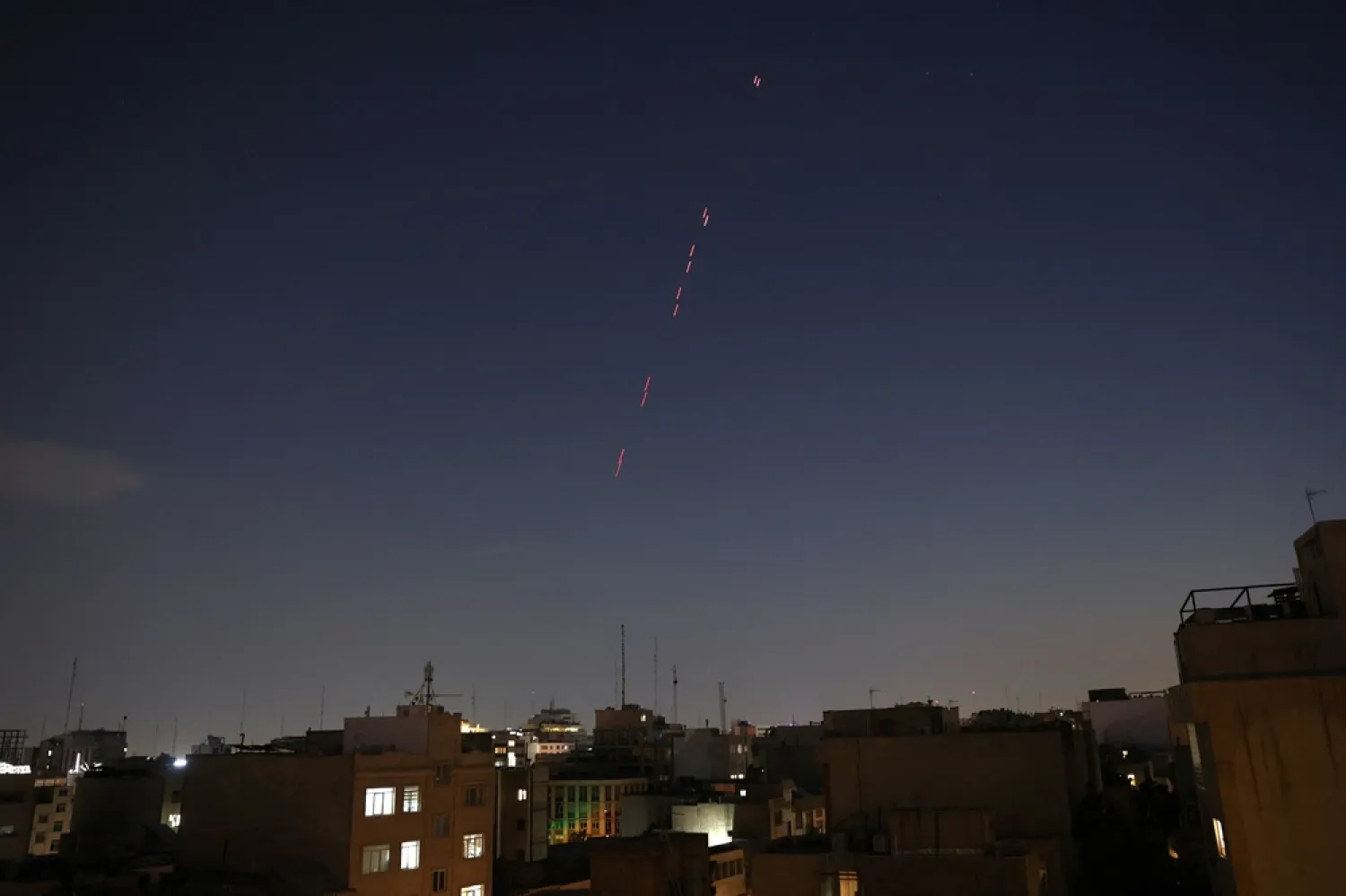
Army air defense firing is seen following the Israeli strike in Tehran, Iran, June 13, 2025. Majid Asgaripour/WANA (West Asia News Agency) via Reuters
TT

Israel Strikes Iran for Second Night, Trump Says It’s Not Too Late for Deal

Army air defense firing is seen following the Israeli strike in Tehran, Iran, June 13, 2025. Majid Asgaripour/WANA (West Asia News Agency) via Reuters

Israel launched renewed attacks on Iran as evening fell on Friday, after its biggest ever attack against its longstanding foe blasted Iran's huge underground nuclear site at Natanz and wiped out its entire top echelon of military commanders. 

Iran said that in retaliation "the gates of hell will open", while Israel said the strikes were only the start of "Operation Rising Lion". US President Donald Trump said it was not too late for Tehran to halt the bombing campaign by reaching a deal on its nuclear program. 

As evening fell on Friday, Iranian media reported explosions on the northern and southern outskirts of Tehran and at Fordow, near the city of Qom, a second nuclear site which had been spared in the first wave of attacks. 

Air defenses were activated across Tehran and explosions could be heard in Isfahan. 

Israel's military said it was striking Iranian missile and drone launching sites, and had struck another nuclear site in Isfahan. 

Israeli Prime Minister Benjamin Netanyahu said the Israeli campaign was aimed at defeating an existential threat from Iran, invoking the failure to halt the Holocaust in World War Two. 

Israel's operation "will continue for as many days as it takes to remove this threat," he said in a TV address. "Generations from now, history will record our generation stood its ground, acted in time and secured our common future." 

Iran's Supreme Leader Ali Khamenei said Israel had "unleashed its wicked and bloody" hand and would suffer "a bitter fate". 

In a phone interview with Reuters, Trump said it was not clear if Iran's nuclear program had survived. He said nuclear talks between Tehran and the United States, scheduled for Sunday, were still on the agenda though he was not sure if they would take place. 

"We knew everything," Trump said of the Israeli attack plans. 

"I tried to save Iran humiliation and death. I tried to save them very hard because I would have loved to have seen a deal worked out," Trump said. "They can still work out a deal, however, it’s not too late." 

Earlier, Trump posted on Truth Social: "Iran must make a deal, before there is nothing left." 

Israel's National Security Adviser Tzachi Hanegbi said military action by itself would not destroy Iran's nuclear program, but could "create the conditions for a long-term deal, led by the United States" to get rid of it. 

DECAPITATION 

Two regional sources said at least 20 Iranian military commanders were killed, a stunning decapitation reminiscent of Israeli attacks that swiftly wiped out the leadership of Lebanon's once-feared Hezbollah group last year. Iran also said six of its top nuclear scientists had been killed. 

Among the generals killed on Friday were the armed forces chief of staff, Major General Mohammad Bagheri, and the Revolutionary Guards chief, Hossein Salami. 

Major General Mohammad Pakpour, swiftly promoted to replace Salami as Guards commander, vowed retaliation in a letter to the Supreme Leader read out on state television: "The gates of hell will open to the child-killing regime." 

Iranians described an atmosphere of fear and anger, with some people rushing to change money and others seeking a way out of the country to safety. 

"People on my street rushed out of their homes in panic, we were all terrified," said Marziyeh, 39, who was awakened by a blast in Natanz. 

While some Iranians quietly hoped the attack would lead to changes in Iran's hardline clerical leadership, others vowed to rally behind the authorities. 

"I will fight and die for our right to a nuclear program. Israel and its ally America cannot take it away from us with these attacks," said Ali, a member of the pro-government Basij militia in Qom. 

Iranian media showed images of destroyed apartment blocks, and said nearly 80 civilians were killed in attacks that targeted nuclear scientists in their beds and wounded more than 300 people. 

Iran's ability to retaliate with weapons fired by its regional proxies has been sharply degraded over the past year, with the downfall of its ally Bashar al-Assad in Syria and the decimation of Hezbollah in Lebanon and Hamas in Gaza. 

Israel said a missile fired from Yemen - whose Houthi militia are one of the last remaining Iranian-aligned groups still able to fire at Israel - had landed in Hebron in the occupied West Bank. The Palestinian Red Crescent said three Palestinian children were wounded by shrapnel there. 

'COWARDLY' 

Israel said that Iran had launched around 100 drones towards Israeli territory on Friday, but Iran denied this and there were no reports of drones reaching Israeli targets. 

The United Nations Security Council was due to meet on Friday at Tehran's request. Iran said in a letter to the Council that it would respond decisively and proportionally to Israel's "unlawful" and "cowardly" acts. 

The price of crude leapt on fears of wider retaliatory attacks across a major oil-producing region, although there were no reports that oil production or storage was damaged. OPEC said the escalation did not justify any immediate changes to oil supply. 

An Israeli security source said Mossad commandos had been operating deep inside the country before the attack, and the Israeli spy agency and military had mounted a series of covert operations against Iran's strategic missile array. 

Israel also established an attack-drone base near Tehran, the source added. The military said it had bombarded Iran's air defenses, destroying "dozens of radars and surface-to-air missile launchers". 

Israeli officials said it may be some time before the extent of damage to the underground nuclear site at Natanz is clear, where Iran has refined uranium to levels Western countries have long said are suitable for a bomb rather than civilian use. 

Iran has long insisted its nuclear program is for civilian purposes only. The UN nuclear watchdog concluded this week that it was in violation of its obligations under the global non-proliferation treaty. 

Tehran had been engaged in talks with the Trump administration on a deal to curb its nuclear program to replace one that Trump abandoned in 2018. Tehran had rejected the last US offer. 


Iran Summons French, German, Italian, UK Envoys Over Support for Protests

 Cars burn in a street during a protest over the collapse of the currency's value, in Tehran, Iran, January 8, 2026. Stringer/WANA (West Asia News Agency) via Reuters
Cars burn in a street during a protest over the collapse of the currency's value, in Tehran, Iran, January 8, 2026. Stringer/WANA (West Asia News Agency) via Reuters
TT

Iran Summons French, German, Italian, UK Envoys Over Support for Protests

 Cars burn in a street during a protest over the collapse of the currency's value, in Tehran, Iran, January 8, 2026. Stringer/WANA (West Asia News Agency) via Reuters
Cars burn in a street during a protest over the collapse of the currency's value, in Tehran, Iran, January 8, 2026. Stringer/WANA (West Asia News Agency) via Reuters

Iran on Monday summoned diplomats in Tehran representing France, Germany, Italy and the UK to object to what it described as support by those countries for the protests that have shaken the country, its foreign ministry said.

The diplomats were shown a video of the damage caused by "rioters" and told their governments should "withdraw official statements supporting the protesters", the ministry said in a statement quoted by state television.

In Paris, the French foreign ministry confirmed that "European ambassadors" had been summoned by Iran.


Iran’s Traders, Frustrated by Economic Losses, Turn Against Clerics

 Cars burn in a street during a protest over the collapse of the currency's value, in Tehran, Iran, January 8, 2026. Stringer/WANA (West Asia News Agency) via Reuters
Cars burn in a street during a protest over the collapse of the currency's value, in Tehran, Iran, January 8, 2026. Stringer/WANA (West Asia News Agency) via Reuters
TT

Iran’s Traders, Frustrated by Economic Losses, Turn Against Clerics

 Cars burn in a street during a protest over the collapse of the currency's value, in Tehran, Iran, January 8, 2026. Stringer/WANA (West Asia News Agency) via Reuters
Cars burn in a street during a protest over the collapse of the currency's value, in Tehran, Iran, January 8, 2026. Stringer/WANA (West Asia News Agency) via Reuters

Iran's bazaar merchants, the trader class who were the financial backbone of the 1979 revolution, have turned against the clerics they helped bring to power, fueling unrest over an economy that has morphed into full-blown anti-government protests.

Frustration among bazaar merchants, from small-scale shopkeepers to large wholesale traders, has grown as their political and economic clout in Iran has diminished over the decades while the elite Revolutionary Guards have tightened their grip on the economy, building sprawling and tightly held networks of power.

"We are struggling. We cannot import goods because of US sanctions and because only the Guards or those linked to them control the economy. They only think about their own benefits," said a trader at Tehran’s centuries-old Grand Bazaar, speaking on condition of anonymity.

The wave of protests that has engulfed the country, posing one of the toughest challenges ever to the clerical leadership, erupted in late December in Tehran's Grand Bazaar, where hundreds of shopkeepers denounced the sharp fall in the rial currency.

The demonstrations quickly swelled and turned political, challenging the Islamic Republic's legitimacy. Protesters burned images of Supreme Leader Ali Khamenei and chanted "Death ‌to the dictator" - ‌undeterred by security forces armed with tear gas, batons, and, in many cases, live ammunition.

Iran’s ‌rulers, ⁠while acknowledging economic difficulties, have ‌blamed their longtime foes the US and Israel for fomenting the unrest. They appear intent on holding onto power at any cost, backed by a security apparatus refined over decades of suppressing ethnic revolts, student movements, and protests over economic hardship and social freedoms.

A combination of international sanctions and the Guards' sprawling economic empire has limited the government's ability to ease the dire economic situation.

Tehran-based analyst Saeed Laylaz said the government has lost control over the situation.

"What is striking is that the unrest began in the bazaar. For merchants, the core issue isn’t inflation - it’s price volatility, which leaves them unable to decide whether to buy or sell," he said.

Economic disparities between ordinary Iranians and the clerical and security elite, along with economic mismanagement and state corruption - ⁠reported even by state media - have fanned discontent at a time when inflation is pushing the price of many goods beyond the means of most people.

Iran's rial currency has lost nearly ‌half its value against the dollar in 2025, with official inflation reaching 42.5% in December.

CONTROL ‍OF SECTORS FROM OIL TO CONSTRUCTION

Created by the republic's ‍late founder Khomeini, the Guards first secured an economic foothold after the Iran-Iraq war in the 1980s, when clerical rulers allowed them ‍to invest in leading Iranian industries.

Their influence expanded exponentially over decades, benefiting from Khamenei's full backing and from opportunities created by Western sanctions, which effectively excluded Iran from the global financial and trading system.

The Guards now control vast sectors of the economy, from oil to transportation, communications, and construction.

Another trader said the crisis was not over, as the Guards have long proved adept at defending their economic interests.

"The government wants to resolve the problem, but it lacks the means and power in this system. The economy is not controlled by the government," said the trader, a 62-year-old carpet seller in Tehran.

All aspects of the country's sanctions-hit oil business have come under the growing influence of the ⁠Guards - from the shadow fleet of tankers that secretly ship sanctioned crude, to logistics and front companies selling the oil, mostly to China.

"No one knows how much of the oil money that the Guards get from selling Iran’s oil returns to the country ... they are too powerful to be questioned about it,” said a senior Iranian official, who asked not to be named.

During his 2013–2021 presidency, pragmatist Hassan Rouhani repeatedly clashed with the Guards, accusing them publicly of resisting budget cuts, while his attempts to curb their commercial networks and assets were largely frustrated.

THE ESTABLISHMENT RELIES ON THE GUARDS TO END UNREST

Even as it has relinquished economic power, the clerical establishment has relied on its loyal forces - the Guards and its affiliated Basij paramilitary - to violently crush ethnic uprisings, student unrest, and protests over economic hardship, preserving the political order.

"Given the sensitive circumstances when the country faces foreign threats, Khamenei cannot upset the Guards by curbing their economic influence. The establishment needs them to quell the protests and confront foreign threats," said an insider, close to Rouhani.

US-based rights group HRANA said it had verified the deaths of 544 people - 496 protesters and 48 security personnel - with 10,681 people arrested since ‌the protests began on December 28 and spread around the country. Reuters was unable to independently verify the tallies.

The authorities have not given numbers of casualties, but officials say many members of the security forces have been killed by "terrorists and rioters" linked to foreign foes, including the US States and Israel.


Greenland Says It Should Be Defended by NATO, Rejects Any US Takeover

 A view of houses in Nuuk, Greenland, June 22, 2025. (AP)
A view of houses in Nuuk, Greenland, June 22, 2025. (AP)
TT

Greenland Says It Should Be Defended by NATO, Rejects Any US Takeover

 A view of houses in Nuuk, Greenland, June 22, 2025. (AP)
A view of houses in Nuuk, Greenland, June 22, 2025. (AP)

Greenland's government said on Monday it will increase efforts to ensure the defense of the Arctic territory takes place under the auspices of NATO and again rejected US President Donald Trump's ambition to take over the island.

Trump has said the United States must own Greenland, an autonomous part of the Kingdom of Denmark, to prevent Russia ‌or China occupying the ‌strategically located and minerals-rich territory ‌in ⁠the future.

"All ‌NATO member states, including the United States, have a common interest in the defense of Greenland," the island's coalition government said in a statement, adding that it can in no way accept a US takeover of Greenland.

"As part of ⁠the Danish commonwealth, Greenland is a member of NATO and ‌the defense of Greenland ‍must therefore be through NATO," ‍the government said.

The European Union Commissioner ‍for Defense and Space Andrius Kubilius said earlier on Monday that any US military takeover of Greenland would be the end of NATO.

Trump first floated the idea of a US takeover of Greenland in 2019 during his first term ⁠in office, although he faces opposition in Washington, including from within his own party.

While Denmark has ruled Greenland for centuries, the territory has gradually been moving towards independence since 1979, a goal shared by all political parties elected to the island's parliament.

"We are a democratic society that makes our own decisions. And our actions are based on international law," Greenland's Prime Minister ‌Jens-Frederik Nielsen wrote on LinkedIn.
