


Israel Warns of ‘Prolonged’ War Against Iran

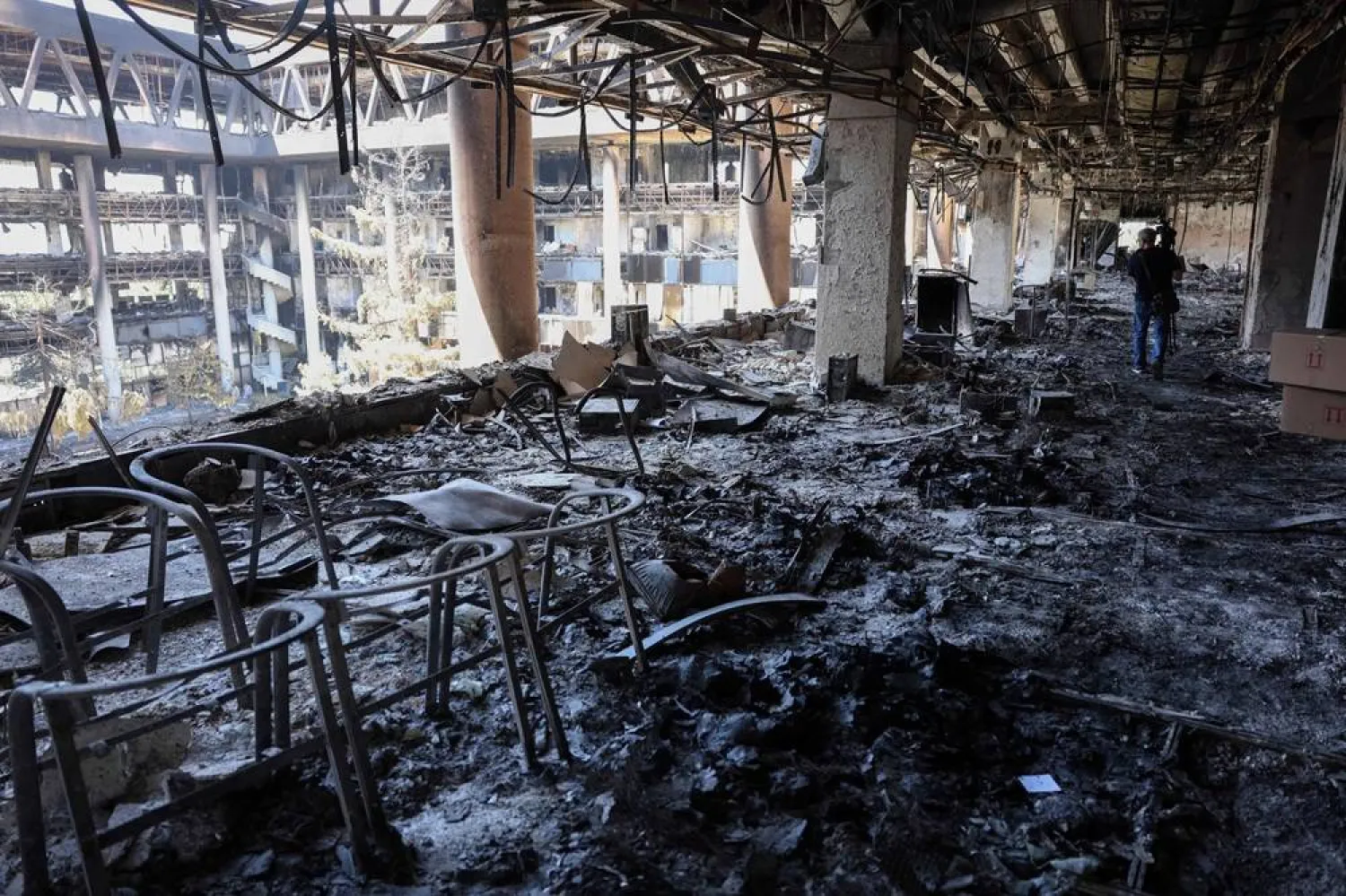
This picture shows the heavily damaged building of the Islamic Republic of Iran Broadcasting (IRIB) after it was hit a few days earlier in an Israeli strike, in Tehran, on June 19, 2025. (AFP)
TT

Israel Warns of ‘Prolonged’ War Against Iran

This picture shows the heavily damaged building of the Islamic Republic of Iran Broadcasting (IRIB) after it was hit a few days earlier in an Israeli strike, in Tehran, on June 19, 2025. (AFP)

Israel's war against Iran, now in its second week, will be "prolonged", military chief Eyal Zamir said Friday as the arch rivals traded fire and European powers held talks with the country.

"We must be ready for a prolonged campaign," Zamir told Israelis in a video statement, eight days after his country launched a massive wave of strikes it said aimed at stopping Iran from developing nuclear weapons -- an ambition Tehran has denied.

"We have embarked on the most complex campaign in our history to remove a threat of such magnitude," said Zamir.

"The campaign is not over. Although we have made significant achievements, difficult days still lie ahead."

Iran has responded with barrages of missiles and drones, which Israeli authorities say have killed at least 25 people.

A hospital in the Israeli port of Haifa reported 19 injured, including one person in serious condition, after the latest Iranian salvo, which President Isaac Herzog said hit a mosque.

Iran said on Sunday that Israeli strikes had killed at least 224 people since June 13, including military commanders, nuclear scientists and civilians.

As US President Donald Trump mulls the prospect of entering the war between the two foes, top diplomats from Britain, France and Germany were meeting with their Iranian counterpart Abbas Araghchi on Friday.

French President Emmanuel Macron said the Europeans were "putting a diplomatic solution on the table".

On the ground, Israel's military said it struck missile launchers in southwestern Iran after overnight air raids on dozens of targets including what it called a "nuclear weapons project" research and development center.

In Israel, sirens sounded in the afternoon after missiles were launched from Iran for the second time on Friday, with a military official saying that "approximately 20 missiles were launched towards Israel".

Iran's Revolutionary Guards said they had targeted military sites and air forces bases.

- 'Betrayal' of diplomacy -

Trump has said he will decide "within the next two weeks" whether to involve the United States in the fighting.

Britain's Foreign Secretary David Lammy said "a window now exists within the next two weeks to achieve a diplomatic solution", while agreeing with US Secretary of State Marco Rubio that "Iran can never develop or acquire a nuclear weapon".

Western governments suspect Iran of seeking a nuclear weapons capability.

The International Atomic Energy Agency said that while Iran is the only country without nuclear weapons to enrich uranium to 60 percent, there was no evidence it had all the components to make a functioning nuclear warhead.

"So, saying how long it would take for them, it would be pure speculation because we do not know whether there was somebody... secretly pursuing these activities," the agency's chief Rafael Grossi told CNN.

"We haven't seen that and we have to say it."

France's foreign ministry spokesperson Christophe Lemoine said that "military solutions are not long-term solutions" to ensure Iran respects its obligations under the nuclear Non-Proliferation Treaty.

Addressing the UN Human Rights Council on Friday, Araghchi said Israel's attacks were a "betrayal" of diplomatic efforts to reach a nuclear deal between Tehran and Washington.

"We were attacked in the midst of an ongoing diplomatic process," he said.

In an interview with German publication Bild, Israel's top diplomat Gideon Saar said he did not "particularly" believe in diplomacy with Iran.

"All diplomatic efforts so far have failed," said Saar, whose country had supported Trump's 2018 decision to abandon a previous nuclear agreement between Iran and world powers.

- 'Madness' -

The UN Security Council convened on Friday for a second session on the conflict, which was requested by Iran with support from Russia, China and Pakistan, a diplomat told AFP on Wednesday.

The escalating confrontation is quickly reaching "the point of no return", Turkish President Recep Tayyip Erdogan warned on Friday, saying "this madness must end as soon as possible".

UN chief Antonio Guterres meanwhile pleaded with all sides to "give peace a chance".

Any US involvement in Israel's campaign would be expected to involve the bombing of an underground uranium enrichment facility in Fordo, using powerful bunker-busting bombs that no other country possesses.

In Iran, people fleeing Israel's attacks described frightening scenes and difficult living conditions, including food shortages.

Government spokeswoman Fatemeh Mohajerani said authorities had restricted internet access to avoid "problems" like cyberattacks.

Iranian authorities have arrested a European "who sought to spy on sensitive areas of the country", Tasnim news agency reported on Friday.

Protests were held in Tehran and other cities after Friday prayers, with demonstrators chanting slogans in support of their leaders, state television showed.

"I will sacrifice my life for my leader," read a protester's banner, a reference to supreme leader Ali Khamenei.

Switzerland announced it was temporarily closing its embassy in Tehran, adding that it would continue to fulfil its role representing US interests in Iran.



Erdogan Warns Black Sea Should Not Be 'Area of Confrontation' after Strikes

Turkish President Recep Erdogan addresses the media after the conclusion on the G20 Summit held at the Nasrec Expo Center in Johannesburg, South Africa, 23 November 2025. EPA/HALDEN KROG
TT

Erdogan Warns Black Sea Should Not Be 'Area of Confrontation' after Strikes

Turkish President Recep Erdogan addresses the media after the conclusion on the G20 Summit held at the Nasrec Expo Center in Johannesburg, South Africa, 23 November 2025. EPA/HALDEN KROG

Turkish President Recep Tayyip Erdogan on Saturday warned that the Black Sea should not turn into an "area of confrontation" between Russia and Ukraine, after several strikes in recent weeks.

"The Black Sea should not be seen as an area of confrontation. This would not benefit Russia or Ukraine. Everyone needs safe navigation in the Black Sea," he was quoted as telling reporters aboard his plane, according to the official Anadolu news agency.


Indonesia Flood Death Toll Passes 1,000

The deadly torrential rains are one of the worst recent disasters to strike Sumatra. (AFP)
TT

Indonesia Flood Death Toll Passes 1,000

The deadly torrential rains are one of the worst recent disasters to strike Sumatra. (AFP)

Devastating floods and landslides have killed 1,003 people in Indonesia, rescuers said Saturday as the Southeast Asian nation grapples with relief efforts.

The disaster, which has hit the northwestern island of Sumatra over the past fortnight, has also injured more than 5,400, the National Disaster Mitigation Agency said in its latest toll.

The deadly torrential rains are one of the worst recent disasters to strike Sumatra, where a tsunami wreaked havoc in 2004 in Aceh province, which lies at the northern tip of the island.

The final toll is expected to rise, with the disaster agency reporting 218 people are still missing.

With vast tracts of territory hit, 1.2 million residents have been forced to take refuge in temporary shelters.

Frustration has grown among flood victims, who have complained about the pace of relief efforts.

President Prabowo Subianto said Saturday the situation has improved, with several areas which had been cut off now accessible.

"Here and there, due to natural and physical conditions, there have been slight delays, but I checked all the evacuation sites: their conditions are good, services for them are adequate, and food supplies are sufficient," Prabowo said after visiting Langkat in North Sumatra province.

Costs to rebuild after the disaster could reach 51.82 trillion rupiah ($3.1 billion) and the Indonesian government has so far shrugged off suggestions that it call for international assistance.


Moscow, Tehran ‘Working Closely’ on Nuclear Program

Russian President Vladimir Putin and Iranian President Masoud Pezeshkian on the sidelines of the Peace Summit in Ashgabat, Turkmenistan, on Friday (Tasnim). 
TT

Moscow, Tehran ‘Working Closely’ on Nuclear Program

Russian President Vladimir Putin and Iranian President Masoud Pezeshkian on the sidelines of the Peace Summit in Ashgabat, Turkmenistan, on Friday (Tasnim). 

Russian President Vladimir Putin said on Friday that relations between Moscow and Tehran are “developing very positively,” stressing that the two countries are working in close coordination at the United Nations on Iran’s nuclear program.

He made the remarks during talks with Iranian President Masoud Pezeshkian on the sidelines of the International Peace and Trust Summit in Ashgabat.

According to Russian media, Putin said Russia is cooperating with Iran at the Bushehr nuclear power plant and on major infrastructure projects, including the North–South Transport Corridor.

He added that the two sides are also exploring cooperation in the gas and electricity sectors.

Pezeshkian, quoted by Iranian and Russian media, reaffirmed Tehran’s commitment to implementing the comprehensive strategic partnership agreement with Moscow.

He said Iran is “determined to activate the agreement” and expects Russia to accelerate implementation of joint understandings, particularly in energy, transport and strategic transit corridors.

The Iranian president said Iran would complete its share of the groundwork for the North–South Corridor by the end of the year, noting growing economic and trade cooperation between the two countries.

He also called for strengthening multilateral partnerships within frameworks such as the Shanghai Cooperation Organization and BRICS to counter what he described as “unilateralism.”

Russia and Iran aim to expand economic ties through projects such as the International North–South Transport Corridor, a multimodal route linking northern and southern Asia via sea, rail and road networks.

The corridor is intended to speed up cargo transport between Russia and India through Iran and other countries while reducing costs compared with traditional routes. The project is seen as part of Moscow’s efforts to deepen trade links with Central Asia and Europe and to lessen reliance on longer maritime routes.

Putin said bilateral trade between Russia and Iran increased by 13 percent last year and by 8 percent in the first nine months of the current year, underscoring continued cooperation in energy and infrastructure. He added that coordination between Moscow and Tehran on international issues remains “close and ongoing.”

On the sidelines of the summit, Pezeshkian also met Pakistani Prime Minister Shehbaz Sharif, with both sides agreeing on the need to accelerate implementation of bilateral agreements and enhance cooperation in transport, transit, energy and border infrastructure, according to Iran’s Mehr News Agency.