NATO Summit Seeks to Keep Trump Happy -- and Alliance United

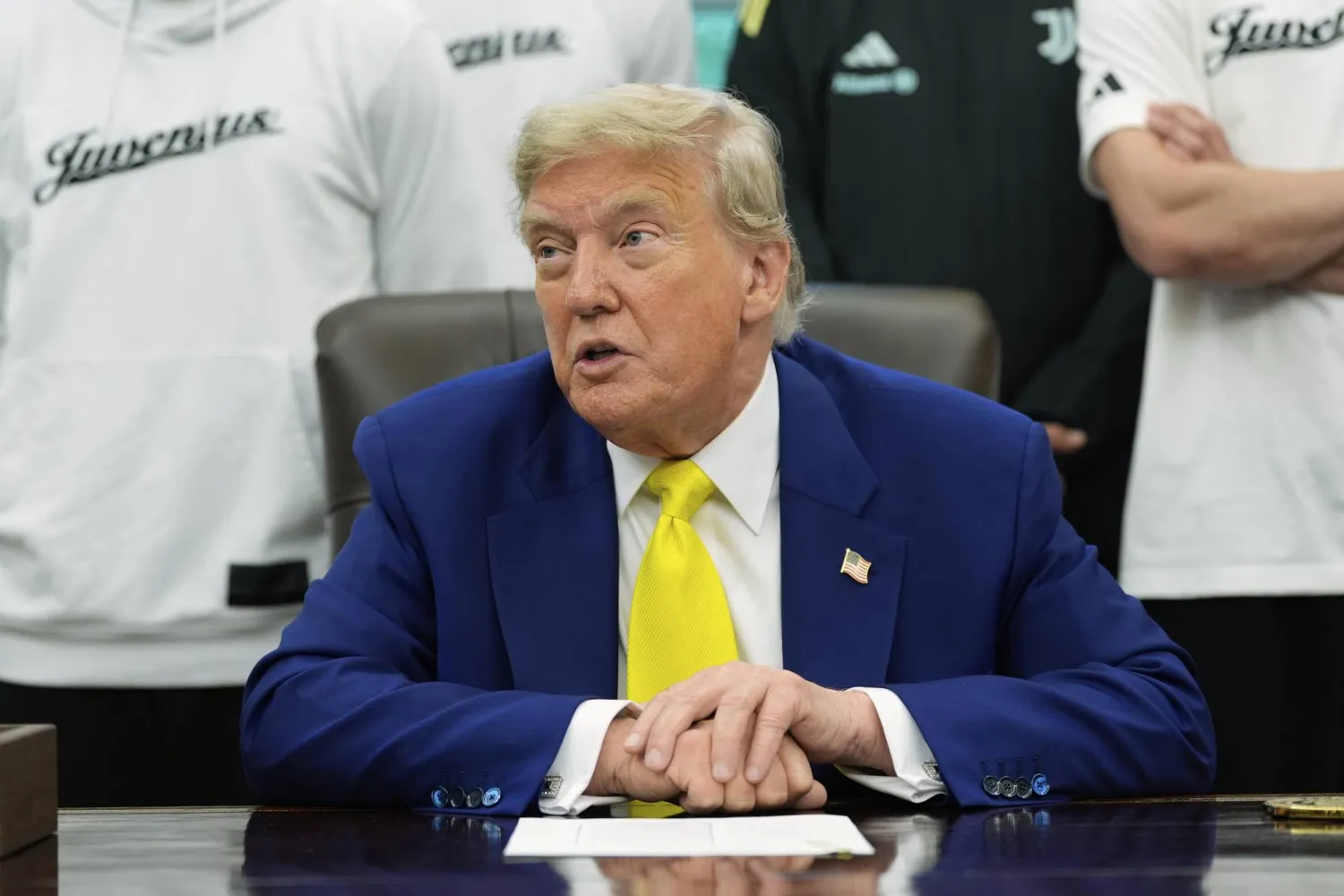
President Donald Trump meets with members of the Juventus soccer club in the Oval Office of the White House, Wednesday, June 18, 2025, in Washington. (AP Photo/Alex Brandon)
TT

NATO Summit Seeks to Keep Trump Happy -- and Alliance United

President Donald Trump meets with members of the Juventus soccer club in the Oval Office of the White House, Wednesday, June 18, 2025, in Washington. (AP Photo/Alex Brandon)

NATO leaders will seek to lock in US President Donald Trump's commitment to their alliance with a summit pledge to boost defense spending, as they gather Tuesday in The Hague with global tensions soaring over Iran.

The overriding focus of the gathering -- which kicks off with dinner hosted by the Dutch king -- has been on keeping Trump happy after his return to power sparked fears he could blow a hole in the seven-decade-old alliance, said AFP.

From meeting his spending demand to limiting the participation of Ukraine's President Volodymyr Zelensky, everything is being done to try to avoid the chances of a damaging confrontation with the volatile leader.

But despite the careful planning the meeting still risks being overshadowed by the fallout from Trump's decision to strike Iran's nuclear facilities.

Central to the effort to keep Trump on board -- given his threat not to protect lower-spending NATO allies -- will be a pledge to satisfy his insistence that members cough up five percent of their GDP on defense.

To give him a headline victory, NATO's 32 countries have thrashed out a compromise deal to dedicate 3.5 percent to core military needs by 2035, and 1.5 percent to broader security-related areas like cybersecurity and infrastructure.

"This is a quantum leap that is ambitious, historic and fundamental to securing our future," said NATO chief Mark Rutte, who warns the alliance must be ready to confront the threat of a Russian attack within five years.

- Deep divisions -

"We must navigate this era of radical uncertainty with agility, speed," British Prime Minister Keir Starmer said Monday in announcing the UK's commitment to meet NATO's spending target.

In a joint Financial Times op-ed on the summit's eve, French President Emmanuel Macron and German Chancellor Friedrich Merz likewise argued that Europe must rearm "not because someone asks us to, but because we are clear-eyed and owe it to our citizens to do so".

In the run-up to the meeting, Spain had sparked fears of undermining the alliance's carefully choreographed unity by refusing to commit to the headline figure of five percent.

But Rutte stressed Spain had not been granted an "opt-out" from the pledge.

"The summit will be historic," US NATO ambassador Matthew Whitaker said.

"This summit is really about NATO's credibility and we are urging all of our allies to step up to the plate and pay their fair share for transatlantic security."

But while the promise of more spending looks like it could win Trump over, deep divisions remain over the approach to Europe's key security issue: Russia's war in Ukraine.

Since storming back to power Trump has upended the West's approach to the three-year conflict by turning his back on Kyiv and opening the door to closer ties with Moscow.

Zelensky downgraded

Zelensky, who had an infamous Oval Office bust-up with Trump, has been downgraded from the central role he played at recent NATO gatherings.

This time he is set to attend the king's dinner, meet EU leaders and attend an industry forum -- but he will not hold formal talks with the alliance's 32 leaders.

Rutte said the summit would still send the message that support for Kyiv was "unwavering and will persist".

The French and German leaders, in a message aimed at Trump, said they would jointly press for a ceasefire in Ukraine and ramped-up pressure on Russia "including through sanctions" while in The Hague.

But despite Rutte's insistence that Ukraine's bid for membership remains "irreversible", the alliance will avoid any mention of Kyiv's push to join after Trump ruled it out.

Allies have also had to push hard just to get Washington to name Moscow as a "threat" in a summit declaration set to be released when NATO leaders hold their main session on Wednesday.

The push to make sure the United States remains on the same page comes as Washington is weighing whether to pull forces from Europe as it focuses more on the threat from China.

The Pentagon is set to announce the results of a review of its global deployments later in the year -- but diplomats at NATO say they don't expect Trump to make any announcements in The Netherlands.


US to Resume Flights After Air Traffic Network Failure Sparks Chaos

 A message board displays flights at Hartsfield-Jackson Atlanta International airport as all flights are canceled or delayed, Friday, Nov. 13, 2026, in Atlanta. (AP)
A message board displays flights at Hartsfield-Jackson Atlanta International airport as all flights are canceled or delayed, Friday, Nov. 13, 2026, in Atlanta. (AP)
TT

US to Resume Flights After Air Traffic Network Failure Sparks Chaos

 A message board displays flights at Hartsfield-Jackson Atlanta International airport as all flights are canceled or delayed, Friday, Nov. 13, 2026, in Atlanta. (AP)
A message board displays flights at Hartsfield-Jackson Atlanta International airport as all flights are canceled or delayed, Friday, Nov. 13, 2026, in Atlanta. (AP)

The FAA lifted a nationwide ground stop on Friday after a communications failure at air traffic control centers caused chaos at US airports and triggered the longest shutdown since the September 11, 2001, attacks.

Transportation Secretary Sean Duffy said US airspace reopened at 8:15 p.m. Eastern Time (0115 GMT), but warned that departures would resume gradually and it would take time for airlines to restore normal operations.

"It's going to be slow," Duffy told reporters at the White House.

More than 6,600 flights were canceled and 8,600 delayed, with another 1,500 already canceled for Sunday, according to FlightRadar24. Aviation analysts said the four-hour nationwide grounding could disrupt airline schedules for days.

Duffy said tens of thousands of passengers were stranded at airports around the country. Duffy said he and Homeland Security Secretary Markwayne Mullin had met with President Donald Trump in the Oval Office to discuss the outage.

The failure is the latest and most dramatic sign of strain on a US air ‌traffic control system ‌beset by aging technology, equipment and communications problems and a shortage of several thousand controllers.

Duffy said ‌the ⁠trouble began at ⁠3:36 p.m., when air traffic control centers experienced instability in radar and communications systems.

"Our switches, our routers actually got overloaded with data and they started to give us inconsistencies in the data from those routers and because of that we shut the system down," Duffy said, adding that at no stage did they completely lose radar or communications and they were able to safely land thousands of planes.

Duffy said the immediate problem had been fixed and that flying was safe, but warned that a broader overhaul of the aging air traffic control system was needed to prevent similar failures.

$50 BILLION AVIATION OVERHAUL

Duffy blamed Congress for failing to fund a new system that he said could prevent such outages, ⁠and called for $50 billion to modernize it.

Earlier on Friday, before the outage, the White House ‌and Department of Transportation had urged Congress to approve $30.1 billion to upgrade the nation's ‌aging airports and air traffic control infrastructure.

"What we have is an incredibly old air traffic control system," Duffy said.

"Give us the money to fix ‌it."

Homeland Security Secretary Mullin said there was "zero evidence" so far that the outage resulted from a cyberattack or a rogue AI ‌system, though investigators had not ruled out either possibility.

"It appears this was mechanically driven, however, we're still looking," Mullin said.

The National Security Agency was working with the Department of Homeland Security on the investigation, he added.

The outage appeared to be affecting a telecommunications network overseen by L3Harris Technologies, according to two airline officials. The network handles critical radio frequencies used by air traffic controllers to communicate with pilots. L3Harris did not respond to a request ‌for comment.

PAIN NOT OVER FOR PASSENGERS

Though the ground stop was lifted, the disruption for passengers was far from over. From Boston to Seattle and New York to Los Angeles, passengers ⁠crowded departure halls and airline desks ⁠as delays and cancellations mounted and aircraft remained parked at gates.

Thousands of passengers faced being stranded overnight. Edward Kargbo, 50, from West Chester, Pennsylvania, had been scheduled to take a 9 p.m. Ethiopian Airlines flight to Lomé, Togo. Instead, he planned to spend the night at the airport before a rescheduled flight at 6 a.m. on Saturday.

“I have to squat the night here,” he said. “I’m stranded.”

Louise Maher, 47, was also caught up in the disruption at Newark after her British Airways flight to London was caught up in the aviation meltdown.

“I might cry at some point but not yet,” she said.

US airlines will not be required to provide compensation to stranded passengers because the carriers were not responsible for the FAA system failures.

The only other nationwide ground stop since the September 11 attacks came in January 2023, when the FAA halted domestic departures for about 90 minutes.

Investors were already pricing in a financial hit to airlines. Shares of American Airlines, United Airlines and Delta Air Lines fell between 1% and 2% in after-hours trading, while JetBlue Airways dropped about 3%.

American Airlines said it was prioritizing flights to smaller cities outside its major hubs and international destinations to position aircraft and crews for a faster recovery.


US Treasury Chief Blames Commerce Dept for Failure in Nvidia Scandal

 US Treasury Secretary Scott Bessent speaks during the National Committee on US-China Relations 60th Anniversary Gala Dinner in New York City, US, November 10, 2026. (Reuters)
US Treasury Secretary Scott Bessent speaks during the National Committee on US-China Relations 60th Anniversary Gala Dinner in New York City, US, November 10, 2026. (Reuters)
TT

US Treasury Chief Blames Commerce Dept for Failure in Nvidia Scandal

 US Treasury Secretary Scott Bessent speaks during the National Committee on US-China Relations 60th Anniversary Gala Dinner in New York City, US, November 10, 2026. (Reuters)
US Treasury Secretary Scott Bessent speaks during the National Committee on US-China Relations 60th Anniversary Gala Dinner in New York City, US, November 10, 2026. (Reuters)

US Treasury Secretary Scott Bessent on Friday blamed the Commerce Department for failing to blacklist Megaspeed, the Singapore company at the center of a scandal that prompted Nvidia chief executive Jensen Huang to resign.

Speaking on CNBC, Bessent said Treasury, the Defense Department, the US Trade Representative's office and the State Department had backed adding Megaspeed to the Washington's trade blacklist, "for months."

"But Commerce has the pen," Bessent said. "You will have to ask them about their internal processes."

He said he was "frustrated" because President Donald Trump "made it very clear that China should not receive any Nvidia chips above H100s."

"Any leakage is very frustrating because it hurts our great companies, and in the AI race gives the Chinese an advantage," he said.

The remarks are a rare public rebuke of one cabinet department by another. Commerce is led by Secretary Howard Lutnick.

Megaspeed is suspected of helping Chinese firms get around US export controls by buying Nvidia chips for its data centers in Southeast Asia and routing them to China.

The company reportedly traded more than $4 billion worth of Nvidia chips over two years.

Its former director Alice Huang was this week identified in US media as an alleged Chinese intelligence asset who had a relationship with Jensen Huang. The two are not related. Beijing has denied the spying allegations.

Jensen Huang acknowledged an extramarital affair in a November 8 letter to Nvidia employees that did not name the woman involved and resigned his position on Thursday.

Nvidia's board has said it will investigate, and three US Congress committee chairs have asked him to attend a closed-door briefing on November 18.

Bessent said coverage of the affair had focused too much on Huang's private life.

"The story thus far has been on Jensen Huang's personal foibles," he said. "The real story here should be: Did Nvidia know their client, and was there a robust effort at Nvidia to make sure that there was no leakage."

He questioned whether Nvidia had been selling to "what were obviously pass-through shell companies."

"I think it's important that anyone at the company there be held accountable for that," Bessent said.

He said there was "a lot of leakage in the system" and that the administration was "constantly working to close that down."


UN Chief Urges Drastic Emissions Cuts as COP31 Wrestles with Fossil Fuels

UN Secretary-General Antonio Guterres speaks at a press conference on the fifth day of the COP31 annual UN climate conference in Antalya, Türkiye, 13 November 2026. (EPA)
TT

UN Chief Urges Drastic Emissions Cuts as COP31 Wrestles with Fossil Fuels

UN Secretary-General Antonio Guterres speaks at a press conference on the fifth day of the COP31 annual UN climate conference in Antalya, Türkiye, 13 November 2026. (EPA)

UN Secretary-General Antonio Guterres on Friday called for an "immediate and drastic reduction" in greenhouse gas emissions, as divisions over fossil fuels dominated the first week of COP31 climate talks in Türkiye.

Big fossil fuel producers and consumers at the talks are resisting any deal that would specify firm new targets or a shift away from oil, gas and coal, observers said as the first week of talks drew to a close.

That poses a challenge for summit host Türkiye and lead negotiator Australia, which have another week to land the kind of ambitious agreement climate advocates such as Guterres say is needed.

"The central question is in the hands of member states, particularly the big emitters. They must recognize the need for an immediate and drastic reduction in emissions to keep the 1.5 goal still possible by the end of the century," he said, referring to the warming limit countries had agreed to ‌pursue under the 2015 ‌Paris Agreement.

A UN report last month found the world is on course to exceed ‌the 1.5 ⁠degrees Celsius (2.7 ⁠degrees Fahrenheit) warming threshold, a limit scientists say should prevent the worst effects of climate change.

As temperatures have risen, this year has been marked by extreme heatwaves across Western Europe and a glacier collapse in Nepal that triggered a flood that killed more than 1,450 people. Thousands more are still missing.

'DISPROPORTIONATE INFLUENCE'

Major oil producers have traditionally resisted language constraining fossil fuels, while large developing economies such as India have opposed measures they say could limit their development and energy choices, a dynamic that has compromised the outcomes of past deals.

The world’s biggest oil consumer, the United States, meanwhile, has skipped the talks for the second year ⁠in a row under President Donald Trump, who has called global warming a hoax and promoted ‌continued use of fossil fuels.

"We must confront the disproportionate influence of the fossil ‌fuel lobby. The future of our planet cannot be negotiated on the terms of those profiting from its destruction," said Guterres, who is leaving ‌his job at the end of December after two five-year terms.

"But I remain hopeful. I've also seen something extraordinary over ‌these 10 years. Renewable energy has moved from the margins to the mainstream. The economics have changed. The technology has advanced. A cleaner, safer, and more secure energy future is in our hands. The question is whether we have the courage and speed to reach for it."

ELECTRIFICATION AND NO FIRM TARGETS

COP31 host Türkiye is striving to place a proposal to expand global electrification at the center of an eventual deal, saying the ‌plan will lead to emissions cuts by speeding the shift away from fossil fuel-powered cars, boilers and other equipment.

The proposal does not require the increased electricity use to come ⁠from renewable sources, although some ⁠countries, including last year’s COP host Brazil, are advocating for progress on a plan to require countries to more clearly map out their transition away from fossil fuels.

Katrine Petersen, an observer for the non-governmental organization E3G, said whether those measures survive the talks depends on conversations in the days to come.

"We've also heard quite clearly from countries like India, the G77, that they don't want any firm targets. They don't want any kind of technology or fuel-specific language," she said. "(These are) the kind of consistent and ongoing divides that we've seen from those different parties before."

Diana Acconcia, head of the EU delegation, said Europe backed the electrification goal.

"Electrification is, in a way, an inclusive agenda because it is non-prescriptive in a way on how the electrification is achieved," she said. "Of course, for the European Union electrification is to be achieved by clean sources of energy."

The Australian team, which is leading negotiations under a split presidency arrangement, spent the first few days of the summit gathering views on what should be included in a political text agreed by consensus that will be followed by all the negotiated technical points.

Australia is taking further submissions from countries until Saturday night, with a view to formulating a draft text early next week.