

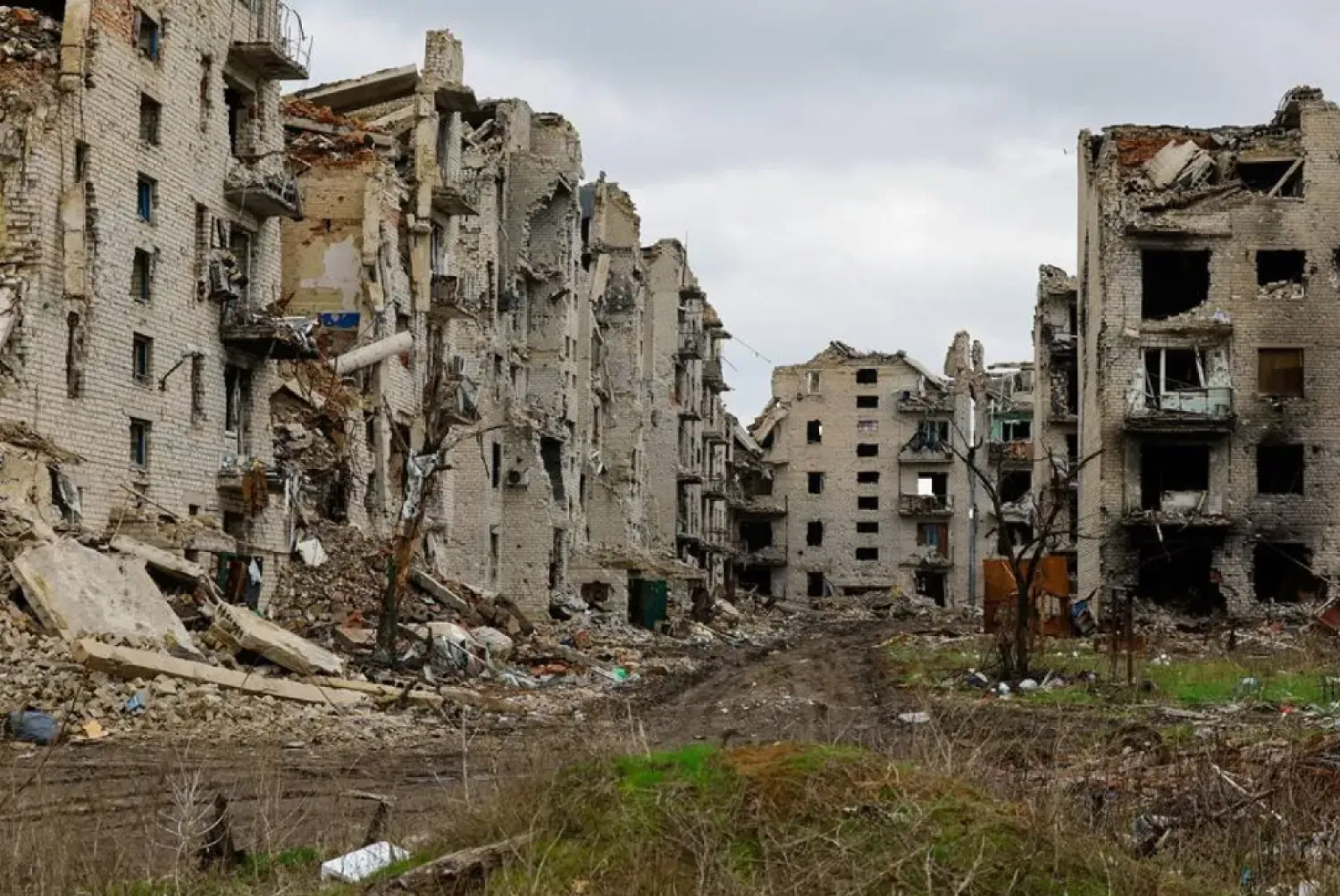

Russia Focusing Airstrikes on Ukraine Draft Offices to Derail Recruitment, Kyiv Says

A view shows ruins of buildings in the abandoned town of Marinka (Maryinka), which was destroyed in the course of Russia-Ukraine conflict in the Donetsk region, a Russian-controlled area of Ukraine, April 1, 2025. (Reuters)
TT

Russia Focusing Airstrikes on Ukraine Draft Offices to Derail Recruitment, Kyiv Says

A view shows ruins of buildings in the abandoned town of Marinka (Maryinka), which was destroyed in the course of Russia-Ukraine conflict in the Donetsk region, a Russian-controlled area of Ukraine, April 1, 2025. (Reuters)

Russia killed two people in an airstrike on the central Ukrainian city of Poltava on Thursday and damaged a military draft office there in what Kyiv said was a concerted campaign to disrupt recruitment for its war effort.

The strike on Poltava, which also injured 47 people and caused a fire at the city's main draft office, followed a drone attack on Monday near a recruitment center in Kryvyi Rih. Both cities are regional capitals.

"We understand that their (Russian) goal is to disrupt the mobilisation process," Vitaliy Sarantsev, a spokesperson for Ukraine's ground forces, told Ukraine's public broadcaster, Reuters reported.

"But I want to say that...it is too early (for Russia) to uncork the champagne because the process is impossible to stop."

Ukraine has struggled to fend off a bigger and better-equipped Russian army, and its call-up process has been marred by reports of draft-office corruption, poor training and weak battlefield command.

Well into the fourth year of its full-scale invasion, Russia has gained ground in eastern Ukraine and repeatedly hit cities far behind the front lines with drones and missiles, while also waging a sabotage campaign there, Kyiv's domestic security agency says.

In a statement to Reuters last month, the Security Service of Ukraine said it had arrested more than 700 people since 2024 for alleged crimes that included arson attacks on troop vehicles and bombings at draft offices.

A Ukrainian security official, who requested anonymity to discuss sensitive matters, said Russia was aiming to derail Kyiv's military call-up effort also by spreading disinformation and hacking recruitment office computers.

"The disruption of mobilisation is closely linked to the spread of panic and intimidation of the population," the source said, adding that bombings were part of the general strategy.

INTENSIFYING STRIKES

Russian forces have also stepped up strikes on military training grounds in recent weeks, prompting Kyiv's top general to order a strengthening of security measures at bases.

A missile attack on southeastern Ukraine this week killed a brigade commander. Ukrainian forces have also staged longer-range attacks on Russian bases in occupied territory as well as deep inside Russia.

Thursday's strike on Poltava came after the US said it had paused some weapons shipments to Ukraine, which drew warnings in Kyiv that the move would harm Ukraine's defence against intensifying Russian air strikes and battlefield gains.

Separately on Thursday, two people were killed in a ballistic missile strike on port infrastructure in the southern Ukrainian city of Odesa, said regional governor Oleh Kiper.

Dozens of people have been killed in recent drone and missile salvoes at Ukrainian cities, including the capital Kyiv.



NYT: US Says Iran Campaign Cost $11 Billion in Six Days

FILE PHOTO: A map showing the Strait of Hormuz and Iran is seen in this illustration taken June 22, 2025. REUTERS/Dado Ruvic/Illustration/File Photo
TT

NYT: US Says Iran Campaign Cost $11 Billion in Six Days

FILE PHOTO: A map showing the Strait of Hormuz and Iran is seen in this illustration taken June 22, 2025. REUTERS/Dado Ruvic/Illustration/File Photo

The opening week of the war against Iran cost the United States more than $11.3 billion, lawmakers were told in a Pentagon briefing, according to a New York Times report underscoring the pace at which the conflict is consuming weapons and resources.

The Times, citing unnamed sources familiar with Tuesday's closed-door briefing, said members of Congress were told that the figure excludes many costs connected with the buildup to the strikes -- suggesting the final tally for the first week could rise substantially.

Defense officials had previously told Congress that roughly $5.6 billion worth of munitions were expended in just the first two days of fighting, according to US media -- a burn rate far higher than earlier public estimates.

The Center for Strategic and International Studies (CSIS) independent think tank in Washington estimated that the first 100 hours of Operation Epic Fury cost $3.7 billion -- or more than $891 million per day.

Most of these costs, $3.5 billion, had not already been budgeted, the CSIS said.

The Iran War Cost Tracker website, which estimates the cost of the conflict in real time, showed a figure of more than $17 billion on its counter at around 08:00 GMT on Thursday.

According to the site, the United States is spending $1 billion per day on the war.

However, it points out the true cost of the war is likely higher, as the figures do not take into account long-term expenses such as veteran healthcare.


Iran-US-Israel Conflict Enters Phase of Prolonged Attrition

Smoke rises from a building in Kuwait following Iranian attacks (AFP). 
TT

Iran-US-Israel Conflict Enters Phase of Prolonged Attrition

Smoke rises from a building in Kuwait following Iranian attacks (AFP). 

The confrontation between Iran on one side and the United States and Israel on the other has entered a phase of mutual attrition, shifting from temporary military escalation to a sustained pattern of operations, deterrence and endurance.

According to a report released Wednesday by the Gulf Research Center, based in Jeddah, the United States is building a long-term campaign aimed at degrading Iran’s missile capabilities and restoring confidence in maritime shipping routes.

Iran, meanwhile, is relying on its geography, security infrastructure and the strategic leverage of the Strait of Hormuz to prevent its adversaries from turning operational superiority into lasting strategic stability.

Rear Admiral Abdullah Al-Zaidi, senior adviser for security and defense studies at the center and author of the report, said the crisis has entered a stage of extended confrontation.

In this phase, the US effort has shifted from merely containing the Iranian threat to reducing Tehran’s capacity to regenerate and sustain its military capabilities by targeting missiles, drones and the military-industrial infrastructure that supports them.

A War of Attrition

The report said one of the most notable developments is the expansion of the US campaign from exhausting Iranian operational capabilities to striking the broader military-industrial base.

The chairman of the US Joint Chiefs of Staff has indicated that the campaign now focuses on destroying Iran’s missile and drone capabilities and degrading its naval forces in order to safeguard freedom of navigation through the Strait of Hormuz.

The report also noted that after national energy authorities in Qatar, Kuwait and Bahrain declared force majeure, the conflict could no longer be viewed as purely military. Its repercussions have now extended into the global energy sector.

Strait of Hormuz Pressure

Developments in the Strait of Hormuz, the report argued, show that Iran remains capable of generating significant strategic impact without formally closing the waterway. By reducing shipping traffic, raising operational risks and undermining confidence in maritime routes, Tehran can disrupt the flow of commerce without declaring a blockade.

The report added that from a Gulf perspective, the crisis is no longer simply an external escalation affecting global markets, but rather a direct challenge to national and energy securities and freedom of navigation.

Military Campaign Expands

Militarily, the report stated that the US campaign has shifted from reducing the tempo of Iranian attacks to systematically targeting the sources of Iranian military power. This includes destroying missile stockpiles and launch platforms, weakening Iran’s naval capabilities and expanding strikes to facilities involved in drone production.

Iran’s Strategic Depth

According to the report, Iran’s geography provides Tehran with natural strategic depth and a layered defensive capability. The country relies on rugged terrain, underground fortifications, tunnel networks and buried facilities to protect critical military assets.

Israeli estimates cited in the report suggest that more than 60 percent of Iran’s ballistic missile launchers have been disabled, with operational launch platforms declining from roughly 400 to about 150.

Nevertheless, current indicators suggest Tehran is pursuing a strategy of prolonged attrition based on absorbing strikes while extending the duration of the confrontation.

Disruption Without Closure

More than 20 million barrels of oil per day pass through the Strait of Hormuz, along with roughly one-fifth of global liquefied natural gas trade. Yet the report stressed that disrupting shipping does not require a full closure of the waterway.

Recent developments have shown that traffic can be significantly impeded without a formal blockade, it says.

The report also warned of rising risks in the strait, including the possibility that naval mines could be deployed as a direct tool of pressure.

Restoring Shipping Confidence

The contest over Hormuz is no longer solely military but also economic. The report said the central challenge now lies in persuading shipping companies and insurers to resume normal operations in the corridor.

Key Risks

Among the main risks identified are the possibility that the Strait of Hormuz crisis could evolve from a price shock into a supply crisis.

Other risks include potential direct confrontations during naval escort operations, the normalization of shipping disruption without a declared blockade, and the introduction of naval mines into the strategic equation.

The report also highlighted the continued external supply of Iranian missile capabilities, along with expanding international intelligence activity and growing cyber threats.

Outlook

The Gulf Research Center report concluded that the most likely short-term scenario is the continued disruption of traffic in the Strait of Hormuz without a full closure, a strategy that raises operational costs while avoiding the political consequences of an openly declared blockade.

It also expected Iran’s missile-based attrition strategy to continue without a rapid collapse, given the country’s geographic advantages and defensive infrastructure, which could prolong the confrontation.


Pezeshkian Puts Conditions to End the War as Trump Insists Iran is ‘at the End of the Line’

This satellite image taken and released on March 11, 2026 courtesy of Vantor shows a view of damaged buildings after airstrikes at Hakimabad garrison, some 30 kms (20 miles) south of Tehran, Iran. MANDATORY CREDIT "AFP PHOTO / Satellite image 2026 Vantor
TT

Pezeshkian Puts Conditions to End the War as Trump Insists Iran is ‘at the End of the Line’

This satellite image taken and released on March 11, 2026 courtesy of Vantor shows a view of damaged buildings after airstrikes at Hakimabad garrison, some 30 kms (20 miles) south of Tehran, Iran. MANDATORY CREDIT "AFP PHOTO / Satellite image 2026 Vantor

American and Israeli strikes on Thursday pounded Iran with no sign of an end to the war in sight as unrelenting Iranian attacks on shipping traffic and energy infrastructure pushed oil above $100 a barrel.

Iranian Supreme Leader Mojtaba Khamenei hasn't yet made a statement or been seen since being chosen to succeed his father Ali Khamenei, who was killed in the opening day of the conflict.

But Iranian President Masoud Pezeshkian has suggested that Tehran sought the world to recognize Iran’s “legitimate rights, payment of reparations” and international guarantees against future attacks to see an end of the war.

His comment came as US President Donald Trump reiterated his insistence that US-Israeli strikes had already practically defeated Iran.

"They are pretty much at the end of the line," he told reporters, after delivering a speech to supporters in which he declared: "We've won... we won -- in the first hour it was over."

Trump suggested that Iran’s halting of attacks was not imminent, however, promising to “finish the job” even though he claimed Iran is “virtually destroyed.”

“We don’t want to leave early do we? We’ve got to finish the job," he said at an event Wednesday in Kentucky.

In addition to attacking energy infrastructure around the region, Iran has a stranglehold on the Strait of Hormuz, the waterway leading from the Arabian Gulf toward the Indian Ocean through which a fifth of the world's oil is transported.

With traffic in the strait effectively stopped, the price of Brent crude oil, the international standard, rose another 9% to more than $100 a barrel, up some 38% over what it cost when the war started.