


Japan PM Vows to Stay on after Bruising Election Defeat

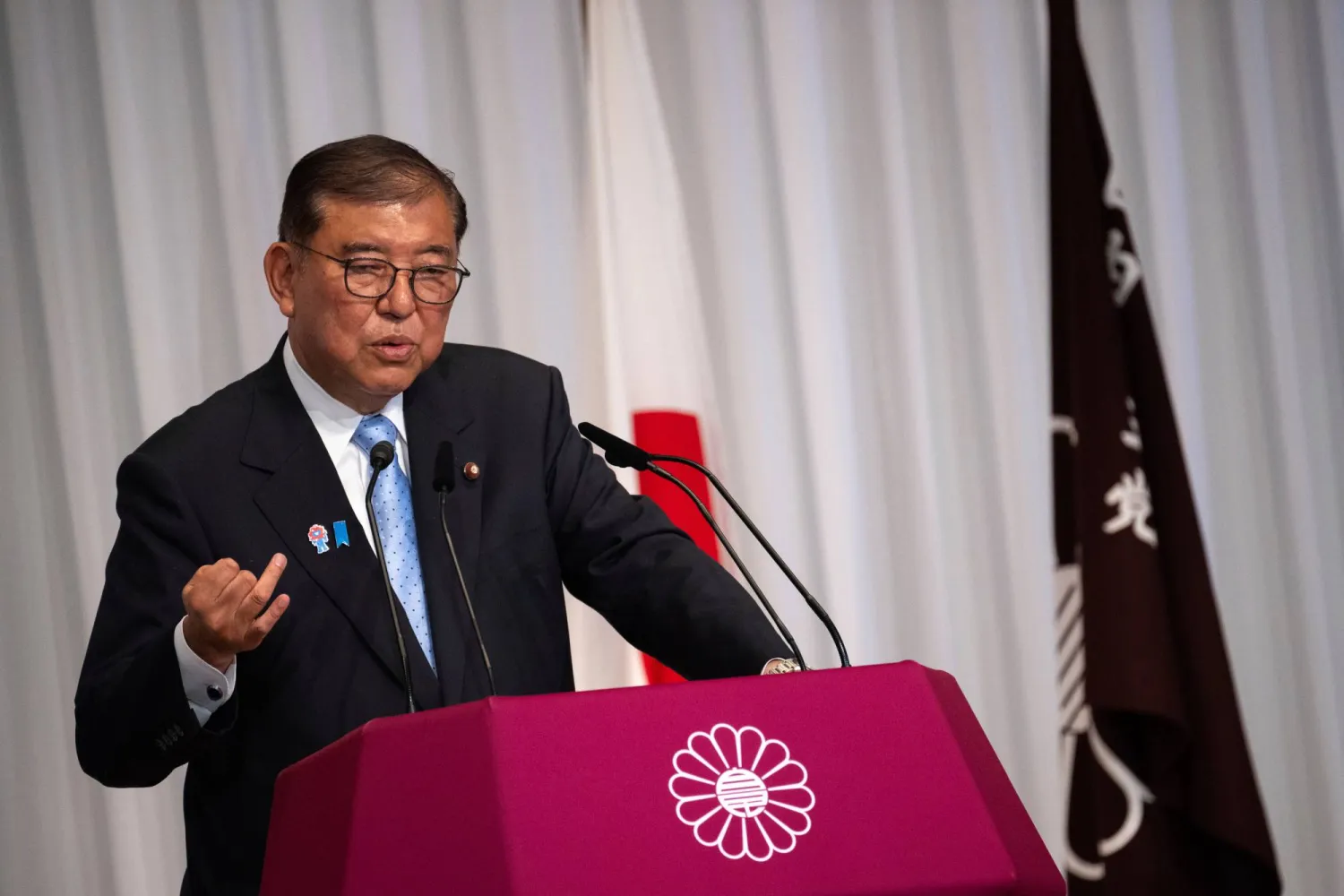
Japan's Prime Minister Shigeru Ishiba attends a press conference at the headquarters of the Liberal Democratic Party (LDP) in Tokyo Monday, July 21, 2025 after the prime minister's ruling coalition failed to secure a majority in the upper house in a parliamentary election. (Philip Fong/Pool Photo via AP)
TT

Japan PM Vows to Stay on after Bruising Election Defeat

Japan's Prime Minister Shigeru Ishiba attends a press conference at the headquarters of the Liberal Democratic Party (LDP) in Tokyo Monday, July 21, 2025 after the prime minister's ruling coalition failed to secure a majority in the upper house in a parliamentary election. (Philip Fong/Pool Photo via AP)

Japanese Prime Minister Shigeru Ishiba vowed to remain in office on Monday after his ruling coalition suffered a bruising defeat in upper house elections, prompting some of his own party to deliberate his future as the opposition weighed a no-confidence motion.

The embattled premier told a news conference he would remain in office to oversee tariff talks with the United States and other pressing matters such as rising consumer prices that are straining the world's fourth largest economy. According to Reuters, analysts say his days may be numbered, having also lost control of the more powerful lower house in elections last year and shedding votes on Sunday to opposition parties pledging to cut taxes and tighten immigration policies.

"The political situation has become fluid and could lead to a leadership change or the reshuffling of the coalition in coming months, but Prime Minister Shigeru Ishiba will likely stay to complete the tariff negotiations with the US for now," said Oxford Economics' lead Japan economist Norihiro Yamaguchi.

Facing a voter backlash over rising consumer prices, investors fear his administration will now be more beholden to opposition parties advocating for tax cuts and welfare spending that the world's most indebted country can ill afford. Markets in Japan were closed for a holiday on Monday, although the yen strengthened and Nikkei futures rose slightly, as the election results appeared to be priced in.

Yields on Japanese government bonds sold off sharply ahead of the ballot as polls showed the ruling coalition - which had been calling for fiscal restraint - was likely to lose its majority in the upper house.

Adding to the economic anxiety, Ishiba's lack of progress in averting tariffs set to be imposed by its biggest trading partner, the United States, on August 1 appears to have frustrated some voters. "Had the ruling party resolved even one of these issues, it (its approval rate) would have gone up, but we didn’t feel anything and it seems like the US would continue to push us around," Hideaki Matsuda, a 60-year-old company manager, said outside Tokyo's bustling Shinjuku station on Monday morning.

Japan's chief tariff negotiator Ryosei Akazawa departed for trade talks in Washington on Monday morning, his eighth visit in three months.

POPULIST POLITICS

Ishiba's Liberal Democratic Party (LDP), which has ruled Japan for most of its post-war history, and coalition partner Komeito returned 47 seats, short of the 50 seats it needed to ensure a majority in the 248-seat upper chamber in an election where half the seats were up for grabs.

The leader of the main opposition Constitutional Democratic Party (CDPJ), Yoshihiko Noda, said on Sunday he is considering submitting a vote of non-confidence in the Ishiba administration as the result showed it did not have voters' trust.

The CDPJ returned 22 seats in the ballot, finishing second.

Some senior LDP lawmakers were also quietly voicing doubts over whether Ishiba should stay, according to local media reports on Monday.

Among them was former prime minister Taro Aso, leader of a powerful faction within the ruling party, who said he "couldn't accept" Ishiba staying on, Japan's TV Asahi reported. Senior party members including Aso met on Sunday evening to discuss whether Ishiba should resign, Sankei newspaper reported. The far-right Sanseito party clocked the biggest gains of the night, adding 14 seats to one elected previously.

Launched on YouTube during the pandemic by spreading conspiracy theories about vaccinations and a cabal of global elites, the party found wider appeal with its 'Japanese First' campaign and warnings about a "silent invasion" of foreigners. Dragging once-fringe rhetoric into the mainstream, its success could mark the arrival of populist politics in Japan, which until now has failed to take root as it has in the United States and western Europe.

Sanseito's party leader Sohei Kamiya, a former supermarket manager and English teacher, has previously pointed to Germany's AfD and Reform UK as a possible blueprint for future success.



Zelensky Says Meeting with Trump in Davos was 'Very Good'

Ukrainian President Volodymyr Zelenskyy speaks to wounded Ukrainian soldiers during a visit at Staten Island University Hospital, in New York, Monday, Sept. 18, 2023. (AP)
TT

Zelensky Says Meeting with Trump in Davos was 'Very Good'

Ukrainian President Volodymyr Zelenskyy speaks to wounded Ukrainian soldiers during a visit at Staten Island University Hospital, in New York, Monday, Sept. 18, 2023. (AP)

Ukrainian President Volodymyr Zelensky said he had a "very good" meeting with US President Donald Trump in Davos on Thursday.

"We spoke about documents and about air defense," Zelensky told reporters briefly without elaborating before addressing the World Economic Forum in the Swiss ski resort.

Zelenskiy also said he ​discussed progress on peace talks.

"We discussed the work of our teams, and practically every there are meetings ⁠or communication," Zelenskiy ‌wrote on X, adding ‍that ‍the documents ‍being negotiated by Kyiv and Washington were "now even better prepared".

"Our ​previous meeting with President Trump helped ⁠strengthen the protection of our skies, and I hope that this time we will reinforce it further as well."


France Says Won't Join Peace Board for Now, Partly Contrary to UN Charter

France's President Emmanuel Macron speaks during a ministerial meeting on the implementation of the Middle East peace plan at the Quai d'Orsay, in Paris, France October 9, 2025. Thomas Samson/Pool via REUTERS
TT

France Says Won't Join Peace Board for Now, Partly Contrary to UN Charter

France's President Emmanuel Macron speaks during a ministerial meeting on the implementation of the Middle East peace plan at the Quai d'Orsay, in Paris, France October 9, 2025. Thomas Samson/Pool via REUTERS

France will not join US President ​Donald Trump's Board of Peace for now because its charter does not correspond with ‌a UN ‌resolution ‌to ⁠resolve the ​war ‌in Gaza, and some of the charter's elements were contrary to the UN charter, ⁠its foreign ministry ‌spokesman said on ‍Thursday, Reuters reported.

"It ‍was not corresponding ‍on the one hand with the pure Gaza mandate, which ​is not even mentioned, and ⁠on the other hand, there are elements of this charter which are contrary to the United Nations charter," Pascal Confavreux told reporters.

According to The AP news, the new peace board was initially envisioned as a small group of world leaders overseeing the ceasefire, but it has morphed into something far more ambitious — and skepticism about its membership and mandate has led some countries usually closest to Washington to take a pass.


UK's Starmer Welcomes Trump Move to Drop Greenland Tariff Threat

Britain's Prime Minister Keir Starmer speaks as he hosts a reception to celebrate Hanukkah at Downing Street in London, Britain December 16, 2025. Alastair Grant/Pool via REUTERS
TT

UK's Starmer Welcomes Trump Move to Drop Greenland Tariff Threat

Britain's Prime Minister Keir Starmer speaks as he hosts a reception to celebrate Hanukkah at Downing Street in London, Britain December 16, 2025. Alastair Grant/Pool via REUTERS

British Prime Minister Keir Starmer told his ​Danish counterpart on Thursday that US President Donald Trump's decision not to pursue tariffs on European countries who opposed his plans to take control of Greenland was a pragmatic and common sense step.

Trump abruptly stepped back on ‌Wednesday from ‌threats to impose tariffs ‌as ⁠leverage ​to ‌seize Greenland, ruled out the use of force and suggested a deal was in sight to end a dispute over the Danish territory.

"In terms of recent developments and the withdrawal of the threat of ⁠tariffs, I see that as a reflection of ‌pragmatism, common sense and sticking ‍to our values ‍and our principles," Starmer told Mette ‍Frederiksen.

Frederiksen said Britain was one of Denmark's oldest and most important allies and partners and thanked Starmer for his support.

"I like the ​British way of doing things... You have a cup of tea and ⁠then you think a bit about everything, you get the facts on the table, and then you find a way forward, and that's exactly what we're doing now," she told Starmer at the start of their meeting at Chequers, the British prime minister's country residence.

"I think we've got to get by with ‌a little help from our friends."