


Russia Tries to Make Sudden Advance in Ukraine Before Trump-Putin Summit, Maps Show

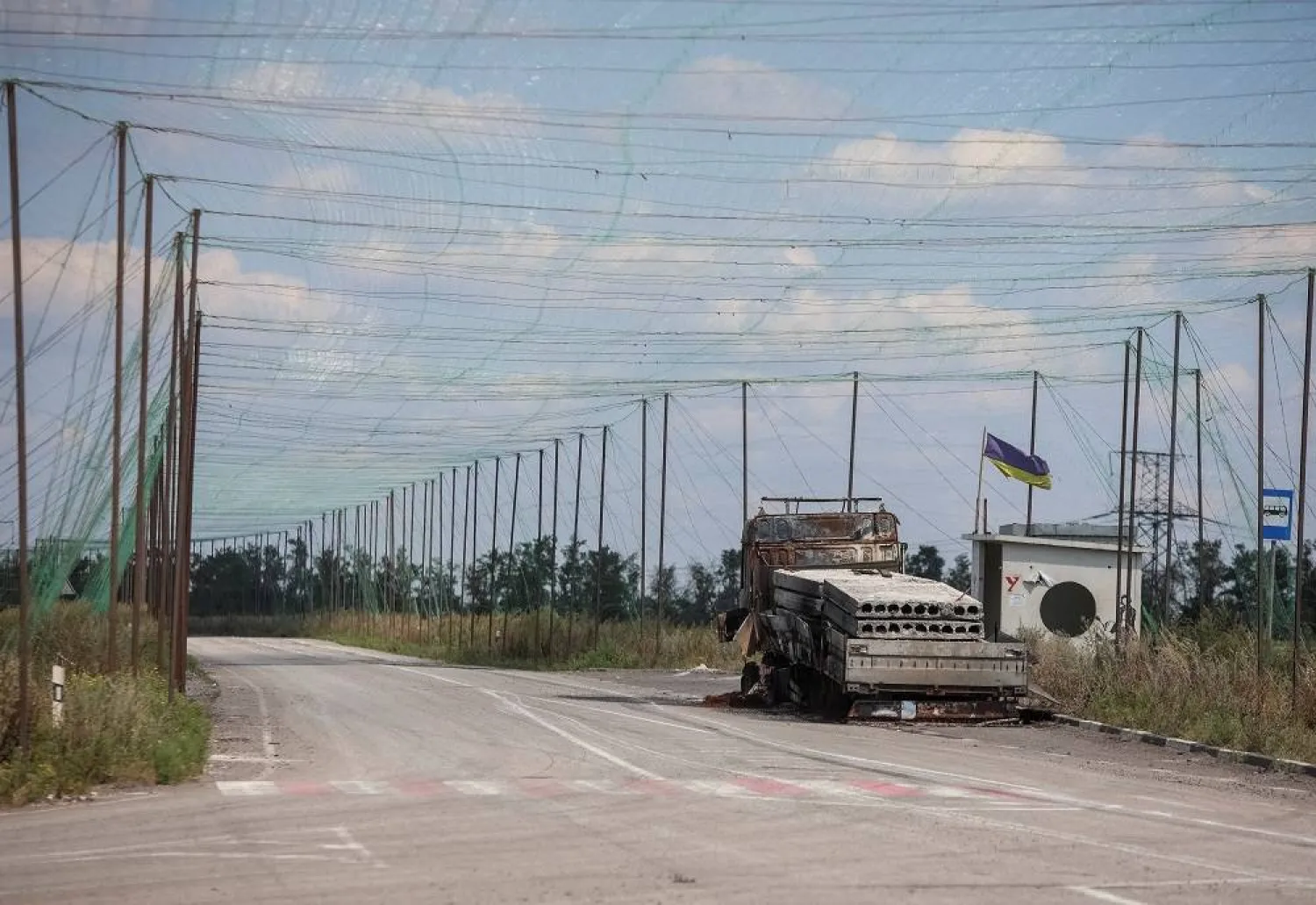
A view shows a burned vehicle and anti-drone nets installed over a road near the frontline town of Dobropillia, amid Russia's attack on Ukraine, in Donetsk region, Ukraine August 10, 2025. (Reuters)
TT

Russia Tries to Make Sudden Advance in Ukraine Before Trump-Putin Summit, Maps Show

A view shows a burned vehicle and anti-drone nets installed over a road near the frontline town of Dobropillia, amid Russia's attack on Ukraine, in Donetsk region, Ukraine August 10, 2025. (Reuters)

Russian forces have made a sudden thrust into eastern Ukraine near the coal mining town of Dobropillia, a move that may be an attempt to increase the pressure on Kyiv to give up land as the US and Russian presidents prepare to meet. 

Ukraine's authoritative DeepState war map showed on Tuesday that Russian forces had advanced by at least 10 km (six miles) north in two prongs in recent days, part of their drive to take full control of Ukraine's Donetsk region. 

The advance is one of the most dramatic in the last year, although military analysts said the Russians were using small groups of soldiers to try to establish footholds and that it was uncertain if they could maintain their positions in the face of a Ukrainian push back. 

DeepState said the Russians had surged forward near three villages on a section of the frontline associated with the Ukrainian towns of Kostyantynivka and Pokrovsk, which Moscow is trying to encircle by exploiting Kyiv's lack of manpower. 

"The situation is quite chaotic, as the enemy, having found gaps in the defense, is infiltrating deeper, trying to quickly consolidate and accumulate forces for further advancement," DeepState said on its Telegram channel.  

US President Donald Trump and Russian President Vladimir Putin are expected to discuss a possible deal to end the war in Ukraine when they meet in Alaska on Friday. Unconfirmed media reports say Putin has told Trump he wants Ukraine to hand over the part of the Donetsk region that Russia does not control. 

The Russian Defense Ministry said units of its army grouping "Center" had improved their positions on the edge of the frontline. Ukraine's military said it was engaged in "difficult" combat near the cities of Pokrovsk and Dobropillia and had sent in reserves to block advances by small groups of Russian troops. 

It said some of the groups attempting to bypass Ukraine's defensive lines in the area had already been destroyed, and that others were being engaged by Ukrainian forces. 

Pasi Paroinen, a military analyst with the Finland-based Black Bird Group, said the situation had escalated rapidly, with Russian forces infiltrating past Ukrainian lines to a depth of roughly 17 km (10 miles) in the past three days. 

"Forwardmost Russian units have reportedly reached the Dobropillia – Kramatorsk road T0514 and Russian infiltration groups have also been reported near Dobropillia proper," he wrote on X. 

Pro-Ukrainian open source military analysts were divided on how significant the development was, with some saying that Russia's tactic of sending small groups to quickly seize but not necessarily hold territory for long had made mapping the war much harder. 

Konrad Muzyka, director of Rochan Consulting, said the Russian thrust, although it appeared sudden, was the culmination of more than a week of infiltration and positional gains. 

RUSSIA MAY GAIN LEVERAGE FOR TRUMP TALKS 

Tatarigami_UA, a former Ukrainian army officer whose Frontelligence Insight analysis tracks the conflict, posted: "In both 2014 and 2015, Russia launched major offensives ahead of negotiations to gain leverage. The current situation is serious, but far from the collapse some suggest." 

Sergei Markov, a former Kremlin adviser, said the Russians had been able to advance amid "a partial collapse in the front" due to Ukraine's shortage of soldiers. 

"This breakthrough is like a gift to Putin and Trump during the negotiations," Markov said, suggesting that, if sustained, it could increase pressure on Kyiv to cede some land to prevent the Russian army eventually taking the rest of Donetsk by force. 

To do that, though, Russian forces would first need to take control of Sloviansk, Kramatorsk, Druzhkivka and Kostyantynivka - which Russian military analysts call "fortress cities". 

Ukrainian President Volodymyr Zelenskiy has publicly pushed back against the idea of ceding territory to Russia, saying any peace deal must be a just one. 

Bohdan Krotevych, former chief of staff of Ukraine's Azov brigade and a National Guard lieutenant colonel, took to X late on Monday to warn Zelenskiy of the threat, saying the frontline in the area was "a complete mess". 

"The line of combat engagement as a fixed line does not actually exist," he said. 


Russia Hits Energy System in Several Regions of Ukraine, Kyiv Says

Local residents gather around a bonfire during an outdoor party to keep warm as many apartments remain without heating in Kyiv on January 18, 2026, amid the Russian invasion of Ukraine. (AFP)
TT

Russia Hits Energy System in Several Regions of Ukraine, Kyiv Says

Local residents gather around a bonfire during an outdoor party to keep warm as many apartments remain without heating in Kyiv on January 18, 2026, amid the Russian invasion of Ukraine. (AFP)

Russia launched a barrage of drone strikes on Ukraine's energy infrastructure overnight on Monday, cutting off power in five regions ​across the country amid freezing temperatures and high demand, Ukrainian officials said.

The Ukrainian air force said that Russian troops had launched 145 drones. Air defense units shot down 126 of them, it said.

"As of this morning, consumers in Sumy, Odesa, Dnipropetrovsk, Kharkiv, and Chernihiv regions are without power," the energy ministry said in a statement. "Emergency repair ‌work is ‌underway if the security situation ‌allows."

In ⁠the ​southern ‌Odesa region, energy and gas infrastructure was damaged, the regional governor said, adding that one person was hurt in the attack.

DTEK, Ukraine's largest private energy company, said its energy facility in Odesa was "substantially" damaged, knocking out power for 30,800 households.

A local power grid company in northern Chernihiv region said that ⁠five important energy facilities were damaged, leaving tens of thousands of consumers ‌without power.

Russia also hit Ukraine's second-largest ‍city of Kharkiv with missiles ‍on Monday morning, significantly damaging a critical infrastructure facility, ‍Mayor Ihor Terekhov said.

Moscow has stepped up a winter campaign of strikes on the Ukrainian energy system, including generation, electricity transmission and gas production facilities, amid freezing temperatures that complicate repair works.

The ​attacks have caused long blackouts.

"Being without electricity for more than 16 hours is awful," Serhii Kovalenko, ⁠CEO of energy distribution company Yasno, said on Facebook late on Sunday. "And it's not because of the energy companies, but because of cynical attacks by the enemy, who is trying to create a humanitarian disaster."

Ukraine declared an energy emergency last week as its grid crumbled due to accumulated wartime damage and a new targeted wave of Russian bombardments.

Energy Minister Denys Shmyhal said on Monday the government would implement projects to improve electricity transmission from the western part ‌of the country to its power-hungry east.


‘Not Right’ for Iran to Attend Davos Summit After Deadly Protests, Say Organizers

Iranian Foreign Minister Abbas Araghchi speaks in a joint press briefing with his Iraqi counterpart Fuad Hussein in Tehran, Iran, Sunday, Jan. 18, 2026. (AP)
TT

‘Not Right’ for Iran to Attend Davos Summit After Deadly Protests, Say Organizers

Iranian Foreign Minister Abbas Araghchi speaks in a joint press briefing with his Iraqi counterpart Fuad Hussein in Tehran, Iran, Sunday, Jan. 18, 2026. (AP)

Iran's foreign minister will not be attending the Davos summit in Switzerland this week, the organizers said Monday, stressing it would not be "right" after the recent deadly crackdown on protesters in Iran.

Abbas Araghchi had been scheduled to speak on Tuesday during the annual gathering of the global elite at the upscale Swiss ski resort town.

But activists have been calling on the World Economic Forum organizers to disinvite him amid what rights groups have called a "massacre" in his country.

"The Iranian Foreign Minister will not be attending Davos," the World Economic Forum said on X.

"Although he was invited last fall, the tragic loss of lives of civilians in Iran over the past few weeks means that it is not right for the Iranian government to be represented at Davos this year," it added.

Demonstrations sparked by anger over economic hardship exploded into protests late December in what has been widely seen as the biggest challenge to the Iranian leadership in recent years.

The rallies subsided after a government crackdown under the cover of a communications blackout that started on January 8.

Norway-based Iran Human Rights says it has verified the deaths of 3,428 protesters killed by security forces, confirming cases through sources within the country's health and medical system, witnesses and independent sources.

The NGO warned that the true toll is likely to be far higher. Media cannot independently confirm the figure and Iranian officials have not given an exact death toll.


Iran to Consider Lifting Internet Ban; State TV Hacked

People walk past a burnt-out building destroyed during public protests in the Iranian capital Tehran on January 19, 26. (AFP)
TT

Iran to Consider Lifting Internet Ban; State TV Hacked

People walk past a burnt-out building destroyed during public protests in the Iranian capital Tehran on January 19, 26. (AFP)

Iran may lift its internet blackout in a few days, a senior parliament member said on Monday, after authorities shut communications while they used massive force to crush protests in the worst domestic unrest since ​the 1979 revolution.

In the latest sign of weakness in the authorities' control, state television appeared to be hacked late on Sunday, briefly showing speeches by US President Donald Trump and the exiled son of Iran's last shah calling on the public to revolt.

Iran's streets have largely been quiet for a week since anti-government protests that began in late December were put down in three days of mass violence.

An ‌Iranian official ‌told Reuters on condition of anonymity that the ‌confirmed ⁠death ​toll ‌was more than 5,000, including 500 members of the security forces, with some of the worst unrest taking place in ethnic Kurdish areas in the northwest. Western-based Iranian rights groups also say thousands were killed.

Opponents accuse the authorities of opening fire on peaceful demonstrators to crush dissent. Iran's clerical rulers say armed crowds egged on by foreign enemies attacked hospitals and mosques.

The death tolls dwarf ⁠those of previous bouts of anti-government unrest put down by the authorities in 2022 and 2009. ‌The violence drew repeated threats from Trump ‍to intervene militarily, although he has backed ‍off since the large-scale killing stopped.

INTERNET TO RETURN WHEN 'CONDITIONS ARE APPROPRIATE'

Ebrahim ‍Azizi, the head of parliament's National Security and Foreign Policy Committee, said top security bodies would decide on restoring internet in the coming days, with service resuming "as soon as security conditions are appropriate".

Another parliament member, hardliner Hamid Rasaei, said authorities should ​have listened to earlier complaints by Supreme Leader Ali Khamenei about "lax cyberspace".

Iranian communications including internet and international phone lines were ⁠largely stopped in the days leading up to the worst unrest. The blackout has since partially eased, allowing accounts of widespread attacks on protesters to emerge.

During Sunday's apparent hack into state television, screens broadcast a segment lasting several minutes with the on-screen headline "the real news of the Iranian national revolution".

It included messages from Reza Pahlavi, the US-based son of Iran's last shah, calling for a revolt to overthrow rule by the clerics who have run the country since the 1979 revolution that toppled his father.

Pahlavi has emerged as a prominent opposition voice and has said he plans ‌to return to Iran, although it is difficult to assess independently how strong support for him is inside Iran.
