


Russian Oil Refineries, Terminals Burn as Ukraine Hits Putin's War Economy

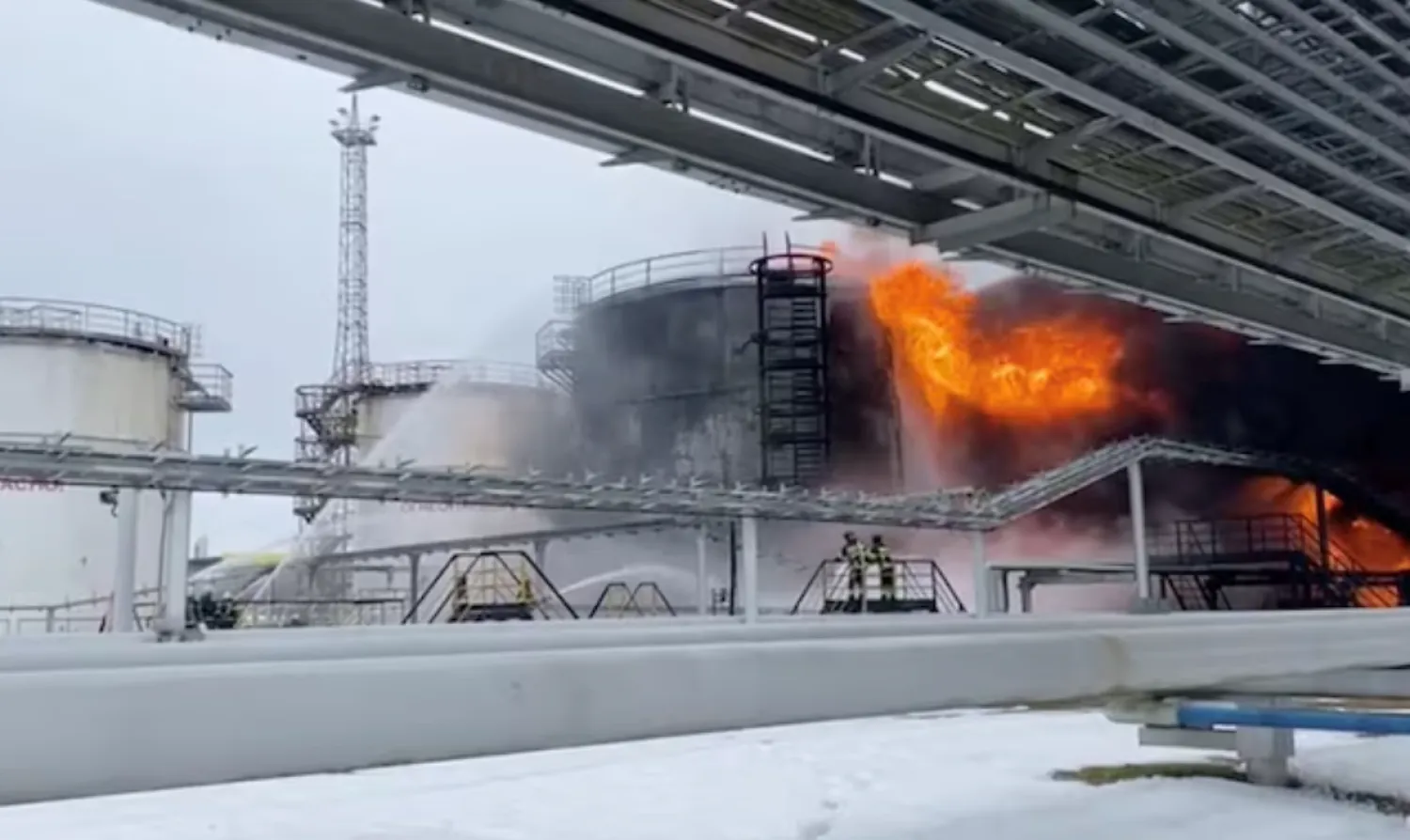
Firefighters extinguish oil tanks at a storage facility that local authorities say caught fire after the military brought down a Ukrainian drone, in the town of Klintsy in the Bryansk Region, Russia January 19, 2024, in this still image taken from video. Russian Emergencies Ministry/Handout via REUTERS/File Photo
TT

Russian Oil Refineries, Terminals Burn as Ukraine Hits Putin's War Economy

Firefighters extinguish oil tanks at a storage facility that local authorities say caught fire after the military brought down a Ukrainian drone, in the town of Klintsy in the Bryansk Region, Russia January 19, 2024, in this still image taken from video. Russian Emergencies Ministry/Handout via REUTERS/File Photo

Ukraine has stepped up drone attacks on Russian oil refineries and exporting infrastructure, striking the most important sector of President Vladimir Putin's economy to show it can fight back as the United States seeks to broker a peace deal.

The attacks disrupted Moscow's oil processing and exports, created gasoline shortages in some parts of Russia and came in response to Moscow's advances on the front lines and its pounding of Ukraine’s gas and power facilities.

Kyiv's move is an attempt to raise the stakes in possible peace talks and challenge the idea that Ukraine has already lost the war after US President Donald Trump and Putin met in Alaska this month, analysts have said.

Ukrainian attacks on 10 plants disrupted at least 17% of Russia's refinery capacity, or 1.1 million barrels per day, according to Reuters calculations.

The drone war has pushed more crude towards exports from the world's No.2 oil exporter at a time Washington is pressing China and India to reduce purchases of Russian oil.

The refinery hits come as Russia's seasonal demand for gasoline from tourists and farmers peaks.

Russia had tightened its gasoline export ban in July to deal with a spike in domestic demand even before the attacks.

There were shortages of gasoline in some areas of Russian-controlled Ukraine, southern Russia and even the Far East, forcing motorists to switch to more expensive petrol due to shortages of the regular A-95 grade.

"We will endure, but this is a big hit to our family budget, a big hit. It's really noticeable," said Svetlana Bazhanova, a resident of Sevastopol, the largest city in Crimea which Russia annexed in 2014.

TOURISM DEMAND

Russia's far eastern port of Vladivostok saw long car queues at gasoline stations, according to a Reuters reporter. The shortages are due to a seasonal influx of tourists, local authorities said.

The affected refineries have lost only part of their capacity but this could still create problems with domestic fuel supplies, said Sergei Vakulenko, a senior fellow at the Carnegie Russia Eurasia Center, who previously worked at Russian oil major Gazprom Neft.

Russia relies on oil and gas exports for a quarter of its budget revenues, which are funding a 25% rise in defence spending this year to the highest levels since the Cold War.

Western sanctions have forced Moscow to sell oil at discounts and stop gas sales in most of Europe. This has not deterred Moscow from producing record numbers of artillery and weapons, according to US military generals.

The war in Ukraine has become a battle of attrition with both Russia and Ukraine using drones and missiles to strike far behind the front lines to damage each other's economies.

So far, Russia's economy has coped with the sanctions but growth has slowed raising concern in the Kremlin.

In the past month, Ukraine has attacked Lukoil's Volgograd, Rosneft's Ryazan and a host of other plants in the Rostov, Samara, Saratov and Krasnodar regions.

A fire at Russia's Novoshakhtinsk refinery was still burning on Monday after a Ukrainian drone strike.

Ukrainian drones also attacked the Druzhba pipeline and Novatek's Ust-Luga export terminal and fuel processing complex on the Baltic.



Iran to Consider Lifting Internet Ban; State TV Hacked

People walk past a burnt-out building destroyed during public protests in the Iranian capital Tehran on January 19, 26. (AFP)
TT

Iran to Consider Lifting Internet Ban; State TV Hacked

People walk past a burnt-out building destroyed during public protests in the Iranian capital Tehran on January 19, 26. (AFP)

Iran may lift its internet blackout in a few days, a senior parliament member said on Monday, after authorities shut communications while they used massive force to crush protests in the worst domestic unrest since ​the 1979 revolution.

In the latest sign of weakness in the authorities' control, state television appeared to be hacked late on Sunday, briefly showing speeches by US President Donald Trump and the exiled son of Iran's last shah calling on the public to revolt.

Iran's streets have largely been quiet for a week since anti-government protests that began in late December were put down in three days of mass violence.

An ‌Iranian official ‌told Reuters on condition of anonymity that the ‌confirmed ⁠death ​toll ‌was more than 5,000, including 500 members of the security forces, with some of the worst unrest taking place in ethnic Kurdish areas in the northwest. Western-based Iranian rights groups also say thousands were killed.

Opponents accuse the authorities of opening fire on peaceful demonstrators to crush dissent. Iran's clerical rulers say armed crowds egged on by foreign enemies attacked hospitals and mosques.

The death tolls dwarf ⁠those of previous bouts of anti-government unrest put down by the authorities in 2022 and 2009. ‌The violence drew repeated threats from Trump ‍to intervene militarily, although he has backed ‍off since the large-scale killing stopped.

INTERNET TO RETURN WHEN 'CONDITIONS ARE APPROPRIATE'

Ebrahim ‍Azizi, the head of parliament's National Security and Foreign Policy Committee, said top security bodies would decide on restoring internet in the coming days, with service resuming "as soon as security conditions are appropriate".

Another parliament member, hardliner Hamid Rasaei, said authorities should ​have listened to earlier complaints by Supreme Leader Ali Khamenei about "lax cyberspace".

Iranian communications including internet and international phone lines were ⁠largely stopped in the days leading up to the worst unrest. The blackout has since partially eased, allowing accounts of widespread attacks on protesters to emerge.

During Sunday's apparent hack into state television, screens broadcast a segment lasting several minutes with the on-screen headline "the real news of the Iranian national revolution".

It included messages from Reza Pahlavi, the US-based son of Iran's last shah, calling for a revolt to overthrow rule by the clerics who have run the country since the 1979 revolution that toppled his father.

Pahlavi has emerged as a prominent opposition voice and has said he plans ‌to return to Iran, although it is difficult to assess independently how strong support for him is inside Iran.


12 Schoolchildren Killed in South Africa Crash

File photo: A general view of the scene of a bus accident in Ekurhuleni on March 11, 2025. (AFP)
TT

12 Schoolchildren Killed in South Africa Crash

File photo: A general view of the scene of a bus accident in Ekurhuleni on March 11, 2025. (AFP)

A minibus carrying school students collided with a truck south of Johannesburg on Monday, killing 12 pupils, police said.

It was the latest in a string of deadly crashes in a country whose modern road network is undermined by rampant speeding, reckless driving and poorly maintained vehicles.

The crash happened near the industrial city of Vanderbijlpark, about 60 kilometers (40 miles) south of Johannesburg.

Police said the driver of the minibus appeared to have lost control while attempting to overtake other vehicles.

Eleven students died at the scene and another in hospital, provincial education minister Matome Chiloane told reporters at the scene.

He did not know the ages of the children involved but said they were from primary schools, where pupils are aged from six years, and also high schools.

Images on social media showed the crushed minibus on the roadside with distraught parents gathered behind the police tape. Some broke down in wails when they were allowed to see the bodies.

"It is a terrible scene," Gauteng premier Panyaza Lesufi said.

More than 11,400 lives were lost on South African roads in 2025, according to the latest data from the transport ministry.

Many South African parents have to rely on private minibuses to get their children to school.

In October, 18 children were badly hurt when their minibus lost control and overturned on a highway in KwaZulu-Natal.

At least five students were killed and eight others injured in September when a school minibus ploughed into a creche in a KwaZulu-Natal township.


Glitch Delays Restart of World's Biggest Nuclear Plant in Japan

Local Japanese authorities have approved the restart of the world's biggest nuclear power facility, the Kashiwazaki-Kariwa Nuclear Power Plant, for the first time since the 2011 Fukushima disaster. STR / JIJI Press/AFP
TT

Glitch Delays Restart of World's Biggest Nuclear Plant in Japan

Local Japanese authorities have approved the restart of the world's biggest nuclear power facility, the Kashiwazaki-Kariwa Nuclear Power Plant, for the first time since the 2011 Fukushima disaster. STR / JIJI Press/AFP

A technical glitch pushed back the restart of the world's biggest nuclear reactor in Japan, its operator said on Monday, a day before local media reported it would go online.

Tokyo Electric Power Company (TEPCO) said it would need another day of two to check the equipment at the Kashiwazaki-Kariwa plant, which media reports said was set to restart on Tuesday.

The plant was taken offline when Japan pulled the plug on nuclear power after a colossal earthquake and tsunami sent three reactors at the Fukushima plant into meltdown in 2011.

The Kashiwazaki-Kariwa facility would be the first nuclear plant that Fukushima operator TEPCO restarts since the disaster.

The company has never publicly announced a date to switch on the plant.

TEPCO has decided to run more checks after detecting a technical issue on Saturday related to an alarm linked to one of the reactors at Kashiwazaki-Kariwa, company spokesman Isao Ito told AFP.

The alarm issue had been fixed by Sunday, he added.

After the final checks, the utility will explain to nuclear authorities what had happened and proceed to restart the plant, the spokesman said, without providing an exact timeline.

More than a decade since the Fukushima accident, Japan now wants to revive atomic energy to reduce its dependence on fossil fuels, achieve carbon neutrality by 2050 and meet growing energy needs from artificial intelligence.

But it is a divisive issue, with many residents worried about nuclear safety.

About 50 people gathered Monday outside TEPCO's headquarters in the capital Tokyo, chanting "No to the restart of Kashiwazaki-Kariwa!"

"TEPCO only mentions a possible delay. But that's not enough," said Takeshi Sakagami, president of the Citizens' Nuclear Regulatory Watchdog Group.

"A full investigation is needed, and if a major flaw is confirmed, the reactor should be permanently shut down," he said at the rally.

The reactor has cleared the nation's nuclear safety standard.

Prime Minister Sanae Takaichi has voiced her support for the use of nuclear power.

Japan is the world's fifth-largest single-country emitter of carbon dioxide, and is heavily dependent on imported fossil fuels.