


Spy Agency: Iran Link to Australian Synagogue Attack Uncovered Via Funding Trail

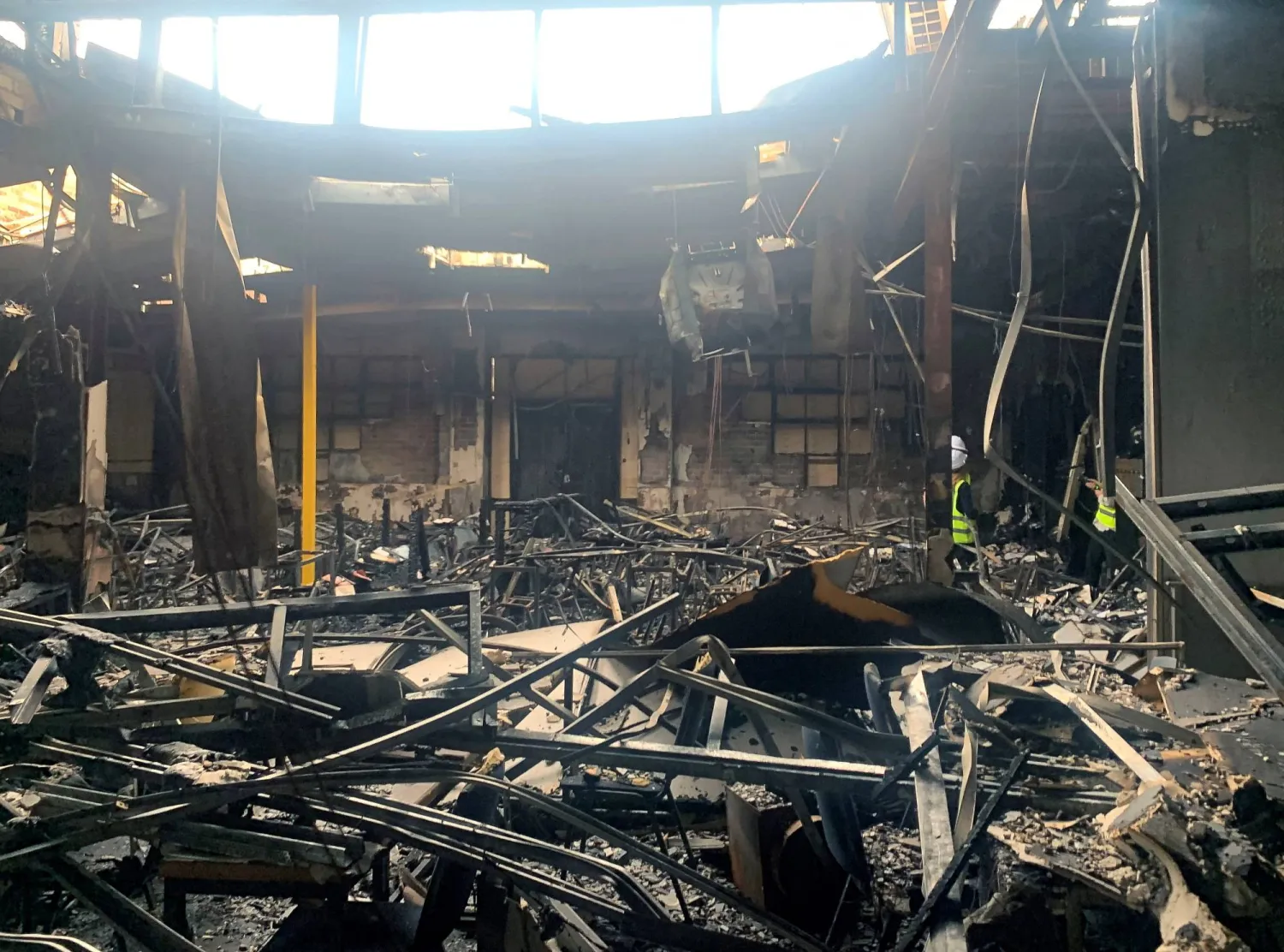
Debris from damage following an attack at the Adass Israel Synagogue in Melbourne, Australia, December 9, 2024. AAP/Yumi Rosenbaum via REUTERS
TT

Spy Agency: Iran Link to Australian Synagogue Attack Uncovered Via Funding Trail

Debris from damage following an attack at the Adass Israel Synagogue in Melbourne, Australia, December 9, 2024. AAP/Yumi Rosenbaum via REUTERS

Australia's intelligence agency traced the funding of hooded criminals who allegedly set fire to a Melbourne synagogue, linking the antisemitic attack to Iran, officials said, even as those charged with the crime were likely unaware Tehran was their puppet master.

A 20-year-old local man, Younes Ali Younes, appeared in Melbourne's Magistrates Court on Wednesday charged with the December 6 arson attack on the Adass Israel synagogue and theft of a car. He did not enter a plea and did not seek bail. His lawyer declined to comment to Reuters.

A day earlier Prime Minister Anthony Albanese said Australia's intelligence agencies had shown the attack, and another in Sydney last year, were directed by the Iranian government, and expelled Tehran's ambassador, becoming the latest Western government to accuse Iran of carrying out hostile covert activities on its soil.

Security services in Britain and Sweden warned last year that Tehran was using criminal proxies to carry out its violent attacks in those countries, with London saying it had disrupted 20 Iran-linked plots since 2022. A dozen other countries have condemned what they called a surge in assassination, kidnapping, and harassment plots by Iranian intelligence services.

Australia's spy chief Mike Burgess said a series of "cut outs", an intelligence term for intermediaries, were used to conceal Iran's involvement in the attacks, and warned that it may have orchestrated others.

Security forces "have done rather extraordinary work to trace the source of the funding of these criminal elements who've been used as tools of the Iranian regime," Albanese told the Australian Broadcasting Corporation on Tuesday.

The investigation worked backwards through payments made onshore and offshore to "petty and sometimes not so petty criminals", he said in parliament on Wednesday.

Albanese was briefed by the Australian Security Intelligence Organization on Monday on evidence of a "supply chain" that he said linked the attacks to offshore individuals and Tehran's Revolutionary Guard Corps.

Australia's diplomats in Iran were discreetly told to leave, making it out of Iranian airspace just after midnight, he said.

A public announcement, with Albanese flanked by his spy chief and foreign and home affairs ministers, came on Tuesday, prompting accolades from Israel. Iran's Foreign Ministry said it "absolutely rejected" Australia's accusation.

The turning point in the investigation came weeks earlier, as Australian Federal Police and the Australian Security Intelligence Organization (ASIO) seized mobile phones and digital devices from suspects arrested in Victoria state over the synagogue attack - and highlighted a stolen blue Volkswagen Golf sedan used in unrelated attacks.

CCTV footage of the night of December 6 released by police shows three hooded figures unloading red jerry cans of fuel from the boot of the car, one of whom was wielding an axe, at the entrance of the synagogue and setting it alight before speeding away.

Victoria's Joint Counter Terrorism Team alleged Younes, 20, stole the car to carry out the attack and recklessly endangered lives by setting fire to the A$20 million synagogue when people were inside, a charge sheet shows. No one was wounded in the attack.

A co-accused, Giovanni Laulu, 21, appeared in court last month on the same charges.

Police have referred to the sedan as a "communal crime car" linked to other attacks that were not politically motivated.

In a press conference on July 30 to announce seven search warrants had been executed and a man arrested over the synagogue attack, the Australian Federal Police's then deputy commissioner Krissy Barrett said it was politically motivated and involved offshore criminals.

"We suspect these criminals worked with criminal associates in Victoria to carry out the arson attack," she said, also confirming a major Australian crime figure deported to Iraq in 2023 was "one of our ongoing lines of inquiry."

Police were working with the Five Eyes intelligence network that also includes Britain, the United States, Canada and New Zealand, she said.

Home Affairs Minister Tony Burke told ABC Radio on Wednesday that those involved locally would not have necessarily known "who had started it".

"You have a series of intermediaries so that people performing different actions don't in fact know who is directing them or don't necessarily know who is directing them," he said.



Ukraine’s New Defense Minister Reveals Scale of Desertions as Millions Avoid the Draft

Ukraine's newly appointed Defense Minister Mykhailo Fedorov attends a parliamentary session in Kyiv, Ukraine, 14 January 2026. (EPA)
TT

Ukraine’s New Defense Minister Reveals Scale of Desertions as Millions Avoid the Draft

Ukraine's newly appointed Defense Minister Mykhailo Fedorov attends a parliamentary session in Kyiv, Ukraine, 14 January 2026. (EPA)

Wide-scale desertions and 2 million draft-dodgers are among a raft of challenges facing Ukraine's military as Russia presses on with its invasion of its neighbor after almost four years of fighting, the new defense minister said Wednesday.

Mykhailo Fedorov told Ukraine's parliament that other problems facing Ukraine’s armed forces include excessive bureaucracy, a Soviet-style approach to management, and disruptions in the supply of equipment to troops along the about 1,000-kilometer (600-mile) front line.

“We cannot fight a war with new technologies but an old organizational structure,” Fedorov said.

He said the military had faced some 200,000 troop desertions and draft-dodging by around 2 million people.

President Volodymyr Zelenskyy appointed 34-year-old Fedorov at the start of the year. The former head of Ukraine’s digital transformation policies is credited with spearheading the army's drone technology and introducing several successful e-government platforms.

His appointment was part of a broad government reshuffle that the Ukrainian leader said aimed to sharpen the focus on security, defense development and diplomacy amid a new US-led push to find a peace settlement.

Fedorov said the defense ministry is facing a shortfall of 300 billion hryvnia ($6.9 billion) in funding needs.

The European Union will dedicate most of a massive new loan program to help fund Ukraine’s military and economy over the next two years, European Commission President Ursula von der Leyen said Wednesday.

Fedorov said Ukraine’s defense sector has expanded significantly since Russia’s full-scale invasion in February 2022. At the start of the war, he said, the country had seven private drone companies and two firms developing electronic warfare systems. Today, he said, there are nearly 500 drone manufacturers and about 200 electronic warfare companies in Ukraine.

He added that some sectors have emerged from scratch, including private missile producers, which now number about 20, and more than 100 companies manufacturing ground-based robotic systems.


France Explores Sending Eutelsat Terminals to Iran Amid Internet Blackout

 Protesters hold up placards with pictures of victims as they demonstrate in support of anti-government protests in Iran, outside Downing Street, in London, Wednesday, Jan. 14, 2026. (AP)
Protesters hold up placards with pictures of victims as they demonstrate in support of anti-government protests in Iran, outside Downing Street, in London, Wednesday, Jan. 14, 2026. (AP)
TT

France Explores Sending Eutelsat Terminals to Iran Amid Internet Blackout

 Protesters hold up placards with pictures of victims as they demonstrate in support of anti-government protests in Iran, outside Downing Street, in London, Wednesday, Jan. 14, 2026. (AP)
Protesters hold up placards with pictures of victims as they demonstrate in support of anti-government protests in Iran, outside Downing Street, in London, Wednesday, Jan. 14, 2026. (AP)

France is looking into sending Eutelsat satellite terminals to Iran to help citizens after Iranian authorities imposed a blackout of internet services in a bid to quell the country's most violent domestic unrest in decades.

"We are exploring all options, and the one you have mentioned is among them," French Foreign Minister Jean-Noel Barrot said on Wednesday in ‌the lower house ‌after a lawmaker asked whether France ‌would ⁠send Eutelsat ‌gear to Iran.

Backed by the French and British governments, Eutelsat owns OneWeb, the only low Earth orbit constellation, or group of satellites, besides Elon Musk's Starlink.

The satellites are used to beam internet service from space, providing broadband connectivity to businesses, governments and consumers in underserved areas.

Iranian authorities in recent days have ⁠launched a deadly crackdown that has reportedly killed thousands during protests against clerical rule, ‌and imposed a near-complete shutdown of internet ‍service.

Still, some Iranians have ‍managed to connect to Starlink satellite internet service, three people ‍inside the country said.

Even Starlink service appears to be reduced, Alp Toker, founder of internet monitoring group NetBlocks said earlier this week.

Eutelsat declined to comment when asked by Reuters about Barrot's remarks and its activities in Iran.

Starlink’s more than 9,000 satellites allow higher speeds than Eutelsat's fleet of over 600, ⁠and its terminals connecting users to the network are cheaper and easier to install.

Eutelsat also provides internet access to Ukraine's military, which has relied on Starlink to maintain battlefield connectivity throughout the war with Russia.

Independent satellite communications adviser Carlos Placido said OneWeb terminals are bulkier than Starlink’s and easier to jam.

"The sheer scale of the Starlink constellation makes jamming more challenging, though certainly not impossible," Placido said. "With OneWeb it is much easier to predict which satellite will become online over a given ‌location at a given time."


China Says It Opposes Outside Interference in Iran’s Internal Affairs

Iranians walk next to a billboard reading "Iran is our Homeland" at Enqelab Square in Tehran, Iran, 13 January 2026. (EPA)
TT

China Says It Opposes Outside Interference in Iran’s Internal Affairs

Iranians walk next to a billboard reading "Iran is our Homeland" at Enqelab Square in Tehran, Iran, 13 January 2026. (EPA)

China opposes any outside interference in Iran's ​internal affairs, the Chinese foreign ministry said on Wednesday, after US President Donald Trump warned that Washington ‌would take "very ‌strong action" ‌against Tehran.

China ⁠does ​not ‌condone the use or the threat of force in international relations, Mao Ning, spokesperson at ⁠the Chinese foreign ministry, said ‌at a ‍regular ‍news conference when ‍asked about China's position following Trump's comments.

Trump told CBS News in ​an interview that the United States would take "very ⁠strong action" if Iran starts hanging protesters.

Trump also urged protesters to keep protesting and said that help was on the way.