


NATO Scrambles Jets to Shoot Down Russian Drones in Poland, Raising Fears of War Spillover

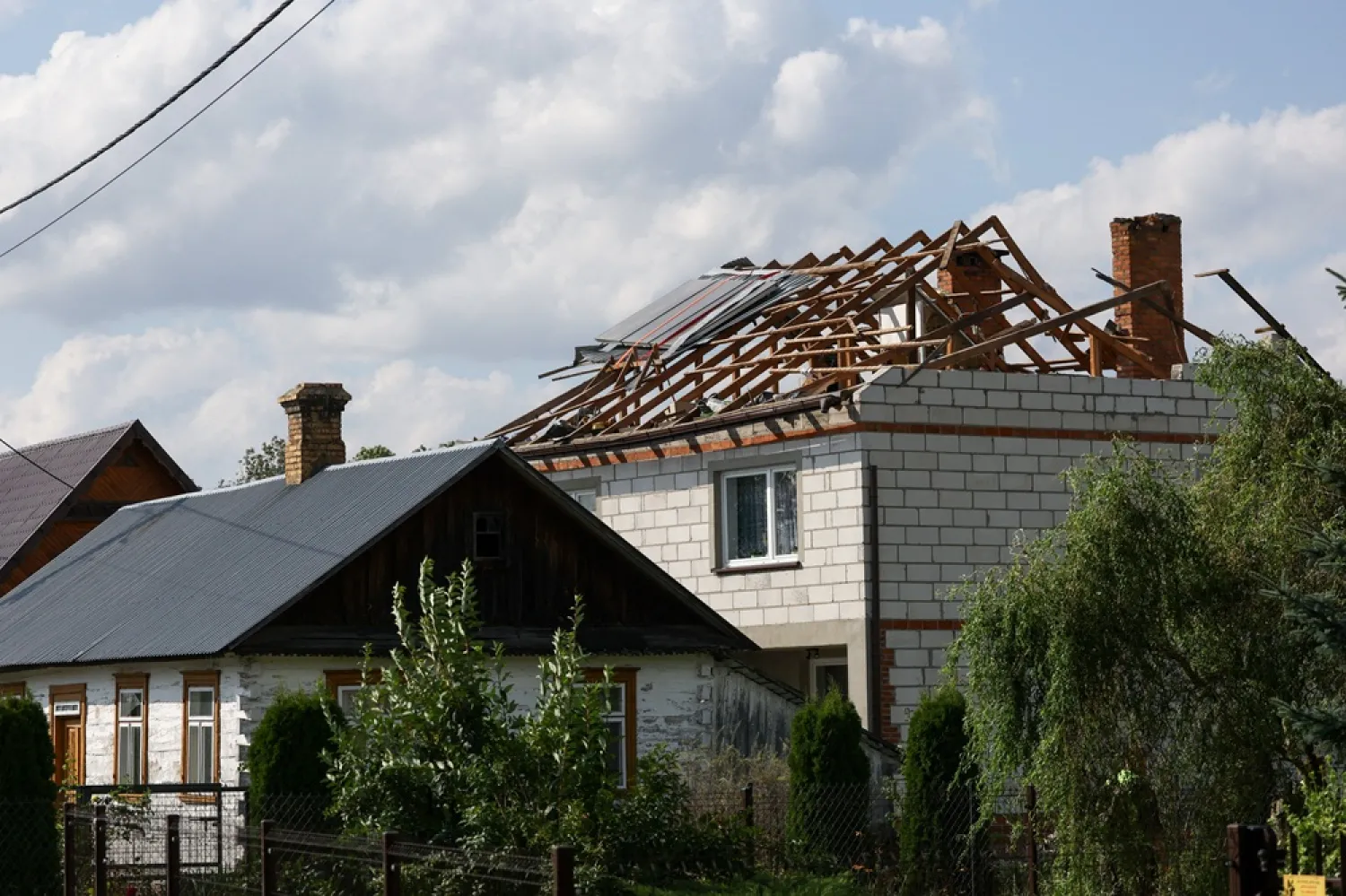
A destroyed roof of a house, after Russian drones violated Polish airspace during an attack on Ukraine, with some being shot down by Poland with the backing from its NATO allies, in Wyryki, Lublin Voivodeship, Poland, September 10, 2025. (Reuters)
TT

NATO Scrambles Jets to Shoot Down Russian Drones in Poland, Raising Fears of War Spillover

A destroyed roof of a house, after Russian drones violated Polish airspace during an attack on Ukraine, with some being shot down by Poland with the backing from its NATO allies, in Wyryki, Lublin Voivodeship, Poland, September 10, 2025. (Reuters)

Multiple Russian drones crossed into Poland in what European officials described Wednesday as a deliberate provocation, causing NATO to send fighter jets to shoot them down. A NATO spokesman said it was the first time the alliance confronted a potential threat in its airspace. 

The incursion, which occurred during a wave of strikes by the Kremlin on Ukraine, and the NATO response swiftly raised fears that the war could spill over — a fear that has been growing in Europe as Russia steps up its attacks and peace efforts go nowhere. 

Russia's Defense Ministry said it did not target Poland, while Belarus, a close ally of Moscow, said it tracked some drones that “lost their course” because they were jammed. 

However, several European leaders said they believed the incursion amounted to an intentional expansion of Russia's assault against Ukraine. 

“Russia’s war is escalating, not ending,” European Union foreign policy chief Kaja Kallas told reporters in Brussels. “What (Russian President Vladimir) Putin wants to do is to test us. What happened in Poland is a game changer,” and it should result in stronger sanctions. 

Polish airspace has been violated many times since Russia’s full-scale invasion of Ukraine in 2022, but never on this scale in Poland or anywhere else in NATO territory. 

Poland said some of the drones came from Belarus, where Russian and Belarusian troops have begun gathering for war games scheduled to start Friday. 

It was not immediately clear how many drones were involved. Polish Prime Minister Donald Tusk told parliament 19 violations were recorded over seven hours, but he said information was still being gathered. Polish authorities said nine crash sites were found, with some of them hundreds of kilometers from the border. 

“There are definitely no grounds to suspect that this was a course correction mistake or the like,” German Defense Minister Boris Pistorius told parliament. “These drones were very clearly put on this course deliberately.” 

Dutch fighter jets came to Poland’s aid and intercepted some drones. Polish Foreign Minister Radek Sikorski later thanked the Dutch government “for the magnificent performance of Dutch pilots in neutralizing" the drones. 

NATO met to discuss the incident, which came three days after Russia’s largest aerial attack on Ukraine since the war began. 

Poland says some drones came from Belarus  

Tusk told parliament that the first violation came at approximately 11:30 p.m. Tuesday and the last around 6:30 a.m. Wednesday. Earlier, Defense Minister Władysław Kosiniak-Kamysz wrote on X that more than 10 objects crossed into Polish airspace. 

“What is new, in the worst sense of the word, is the direction from which the drones came. This is the first time in this war that they did not come from Ukraine as a result of errors or minor Russian provocations. For the first time, a significant portion of the drones came directly from Belarus,” Tusk said in parliament. 

The Russian Defense Ministry said its overnight strikes targeted Ukraine’s military-industrial complex in the western regions of the country, which border Poland, with no planned targets on Polish territory. 

In an unusual message of outreach, the ministry said it was ready to hold consultations with Poland's Defense Ministry. 

Belarusian Maj. Gen. Pavel Muraveiko, the chief of the country's general staff and first deputy defense minister, appeared to try to put some distance between his country and the incursion. 

In an online statement, he said that as Russia and Ukraine traded drone strikes overnight, Belarusian air defense forces tracked “drones that lost their course” after they were jammed, adding that Belarusian forces warned their Polish and Lithuanian counterparts about “unidentified aircraft” approaching their territory. 

Drones or parts of drones were found in eight locations in Poland, according to Polish officials. At a ninth site, objects of unknown origin were found. 

A house was hit in the village of Wyryki in the Lublin region near the Ukrainian border, Mayor Bernard Blaszczuk told the TVP Info television news channel. The roof was severely damaged, but no one was hurt. 

Rattled NATO members vow support  

NATO air defenses supported Poland in what spokesman Col. Martin O’Donnell called “the first time NATO planes have engaged potential threats in Allied airspace.” That included the Dutch F-35 fighter jets that intercepted drones, according to Defense Minister Ruben Brekelmans. 

The alliance “is committed to defending every kilometer of NATO territory, including our airspace,” O’Donnell said. 

Tusk told parliament consultations took place under Article 4 of the NATO treaty — a clause that allows countries to call for urgent discussions with their allies. The consultations happened Wednesday at a previously planned meeting. They do not automatically lead to any action under Article 5, which is NATO’s collective security guarantee. 

Mark Lyall Grant, UK national security adviser from 2015 to 2017, said the incursion was obviously an escalation of Russia’s war in Ukraine, but there was not yet enough evidence to say it was an attack on a NATO member. 

But many European leaders expressed deep concern, including those in the Baltic states of Lithuania, Latvia and Estonia that are the NATO members most nervous about Russian aggression. 

Ukrainian President Volodymyr Zelenskyy called it an “extremely dangerous precedent for Europe” and called for Russia to “feel the consequences.” 

“Moscow always tests the limits of what is possible and, if it does not encounter a strong response, remains at a new level of escalation," he said. “Not just one Shahed (drone), which could be dismissed as an accident, but at least eight attack drones that were aimed in the direction of Poland.” 

By midday in Washington, US President Donald Trump's only public comments about the incursion was a short post on social media: “What’s with Russia violating Poland’s airspace with drones? Here we go!” 

Trump was set to speak later Wednesday to Polish President Karol Nawrocki, according to a White House official who was not authorized to speak publicly and spoke on condition of anonymity. 

Phillips O’Brien, professor of strategic studies at the University of St. Andrews in Scotland, said the incident underscored the failure of NATO member states to accurately assess the threat posed by Russia and properly prepare for war. 

“NATO states, even front line ones, have clearly not prepared for war of the type that is happening now,” he said in his Substack newsletter. 

Poland has complained about Russian objects entering its airspace during attacks on Ukraine before. 

In August, Poland’s defense minister said that a flying object that crashed and exploded in a cornfield in eastern Poland was identified as a Russian drone, and called it a provocation. 

In March, Poland scrambled jets after a Russian missile briefly passed through Polish airspace on its way to a target in western Ukraine. And in 2022, a missile that was likely fired by Ukraine to intercept a Russian attack landed in Poland, killing two people. 

Meanwhile, the Ukrainian air force said Russia fired 415 strike and decoy drones, as well as 42 cruise missiles and one ballistic missile overnight. 

Ukrainian air defenses intercepted or jammed 386 drones and 27 cruise missiles, according to the report. 

One person was killed and at least five wounded, while several homes and businesses were damaged, according to local officials. 

The Russian Defense Ministry said in its morning report Wednesday that it had destroyed 122 Ukrainian drones over various Russian regions overnight, including over the illegally annexed Crimea and areas of the Black Sea. 


Back From Iran, Pakistani Students Say They Heard Gunshots While Confined to Campus

 A Pakistani medical student Arslan Haider waits at the airport after arriving from Tehran on a commercial flight amid the ongoing nationwide protests in Iran, in Islamabad, Pakistan, January 15, 2026. (Reuters)
A Pakistani medical student Arslan Haider waits at the airport after arriving from Tehran on a commercial flight amid the ongoing nationwide protests in Iran, in Islamabad, Pakistan, January 15, 2026. (Reuters)
TT

Back From Iran, Pakistani Students Say They Heard Gunshots While Confined to Campus

 A Pakistani medical student Arslan Haider waits at the airport after arriving from Tehran on a commercial flight amid the ongoing nationwide protests in Iran, in Islamabad, Pakistan, January 15, 2026. (Reuters)
A Pakistani medical student Arslan Haider waits at the airport after arriving from Tehran on a commercial flight amid the ongoing nationwide protests in Iran, in Islamabad, Pakistan, January 15, 2026. (Reuters)

Pakistani students returning from Iran on Thursday said they heard gunshots and stories of rioting and violence while being confined to campus and not allowed out of their dormitories in the evening.

Iran's leadership is trying to quell the worst domestic unrest since its 1979 revolution, with a rights group putting the death toll over 2,600.

As the protests swell, Tehran is seeking to deter US President Donald Trump's repeated threats to intervene on behalf of anti-government protesters.

"During ‌nighttime, we would ‌sit inside and we would hear gunshots," Shahanshah ‌Abbas, ⁠a fourth-year ‌student at Isfahan University of Medical Sciences, said at the Islamabad airport.

"The situation down there is that riots have been happening everywhere. People are dying. Force is being used."

Abbas said students at the university were not allowed to leave campus and told to stay in their dormitories after 4 p.m.

"There was nothing happening on campus," Abbas said, but in his interactions with Iranians, he ⁠heard stories of violence and chaos.

"The surrounding areas, like banks, mosques, they were damaged, set on fire ... ‌so things were really bad."

Trump has repeatedly ‍threatened to intervene in support of protesters ‍in Iran but adopted a wait-and-see posture on Thursday after protests appeared ‍to have abated. Information flows have been hampered by an internet blackout for a week.

"We were not allowed to go out of the university," said Arslan Haider, a student in his final year. "The riots would mostly start later in the day."

Haider said he was unable to contact his family due to the blackout but "now that they opened international calls, the students are ⁠getting back because their parents were concerned".

A Pakistani diplomat in Tehran said the embassy was getting calls from many of the 3,500 students in Iran to send messages to their families back home.

"Since they don't have internet connections to make WhatsApp and other social network calls, what they do is they contact the embassy from local phone numbers and tell us to inform their families."

Rimsha Akbar, who was in the middle of her final year exams at Isfahan, said international students were kept safe.

"Iranians would tell us if we are talking on Snapchat or if we were riding in a cab ... ‌that shelling had happened, tear gas had happened, and that a lot of people were killed."


Bomb Hoax Forces Turkish Airlines to Make Emergency Landing in Barcelona

A Turkish Airlines aircraft after landing at El Prat airport, in Barcelona, northeastern Spain, 15 January 2026, after Spanish security forces where alerted due to a bomb threat on board the aircraft. (EPA)
TT

Bomb Hoax Forces Turkish Airlines to Make Emergency Landing in Barcelona

A Turkish Airlines aircraft after landing at El Prat airport, in Barcelona, northeastern Spain, 15 January 2026, after Spanish security forces where alerted due to a bomb threat on board the aircraft. (EPA)

A false bomb threat delivered via an onboard mobile connection caused a Turkish Airlines flight from Istanbul to make an emergency landing at Barcelona's El Prat Airport on Thursday, Spanish police and the airline ‌said.

A Turkish ‌Airlines spokesperson ‌said ⁠earlier that ‌the plane had landed after crew detected that a passenger had created an in-flight internet hotspot which was named to include a bomb threat as the aircraft approached ⁠Barcelona.

Spain's Guardia Civil police force said ‌in a statement ‍that following a ‍thorough inspection of the aircraft ‍after its passengers had disembarked, the alert had been deactivated and no explosives had been found. Spanish airport operator AENA said El Prat was operating normally.

Police have launched ⁠an investigation to determine who was behind the hoax, the statement added.

Türkiye's flag carrier has faced previous incidents of hoax threats, usually made via written messages, that led to emergency landings over the years.


US Sanctions Iranian Officials Over Protest Crackdown

 Treasury Secretary Scott Bessent watches as President Donald Trump speaks to reporters on the South Lawn at the White House, Tuesday, Jan. 13, 2026, in Washington. (AP)
Treasury Secretary Scott Bessent watches as President Donald Trump speaks to reporters on the South Lawn at the White House, Tuesday, Jan. 13, 2026, in Washington. (AP)
TT

US Sanctions Iranian Officials Over Protest Crackdown

 Treasury Secretary Scott Bessent watches as President Donald Trump speaks to reporters on the South Lawn at the White House, Tuesday, Jan. 13, 2026, in Washington. (AP)
Treasury Secretary Scott Bessent watches as President Donald Trump speaks to reporters on the South Lawn at the White House, Tuesday, Jan. 13, 2026, in Washington. (AP)

The United States imposed sanctions Thursday on Iranian security officials and financial networks, accusing them of orchestrating a violent crackdown on peaceful protests and laundering billions in oil revenues.

Treasury Secretary Scott Bessent announced the measures in the wake of the biggest anti-government protests in the history of the republic, although the demonstrations appear to have diminished over the last few days in the face of repression and an almost week-long internet blackout.

"The United States stands firmly behind the Iranian people in their call for freedom and justice," Bessent said in a statement, adding that the action was taken at President Donald Trump's direction.

Among those sanctioned is Ali Larijani, secretary of Iran's Supreme Council for National Security, whom Washington accused of coordinating the crackdown and calling for force against protesters.

Four regional commanders of Iran's Law Enforcement Forces and Revolutionary Guard were also sanctioned for their roles in the crackdown in Lorestan and Fars provinces.

Security forces in Fars "have killed countless peaceful demonstrators" with hospitals "so inundated with gunshot wound patients that no other types of patients can be admitted," the Treasury said.

The Treasury additionally designated 18 individuals and entities accused of operating "shadow banking" networks that launder proceeds from Iranian oil sales through front companies in the UAE, Singapore and Britain.

These networks funnel billions of dollars annually using cover companies and exchange houses, as Iranian citizens face economic hardship, according to the Treasury.

The sanctions freeze any US assets of those designated and prohibit Americans from doing business with them. Foreign financial institutions risk secondary sanctions for transactions with the designated entities.

The action builds on the Trump administration's "maximum pressure" campaign against Iran. In 2025, the Treasury sanctioned more than 875 persons, vessels and aircraft as part of this effort, it said.
