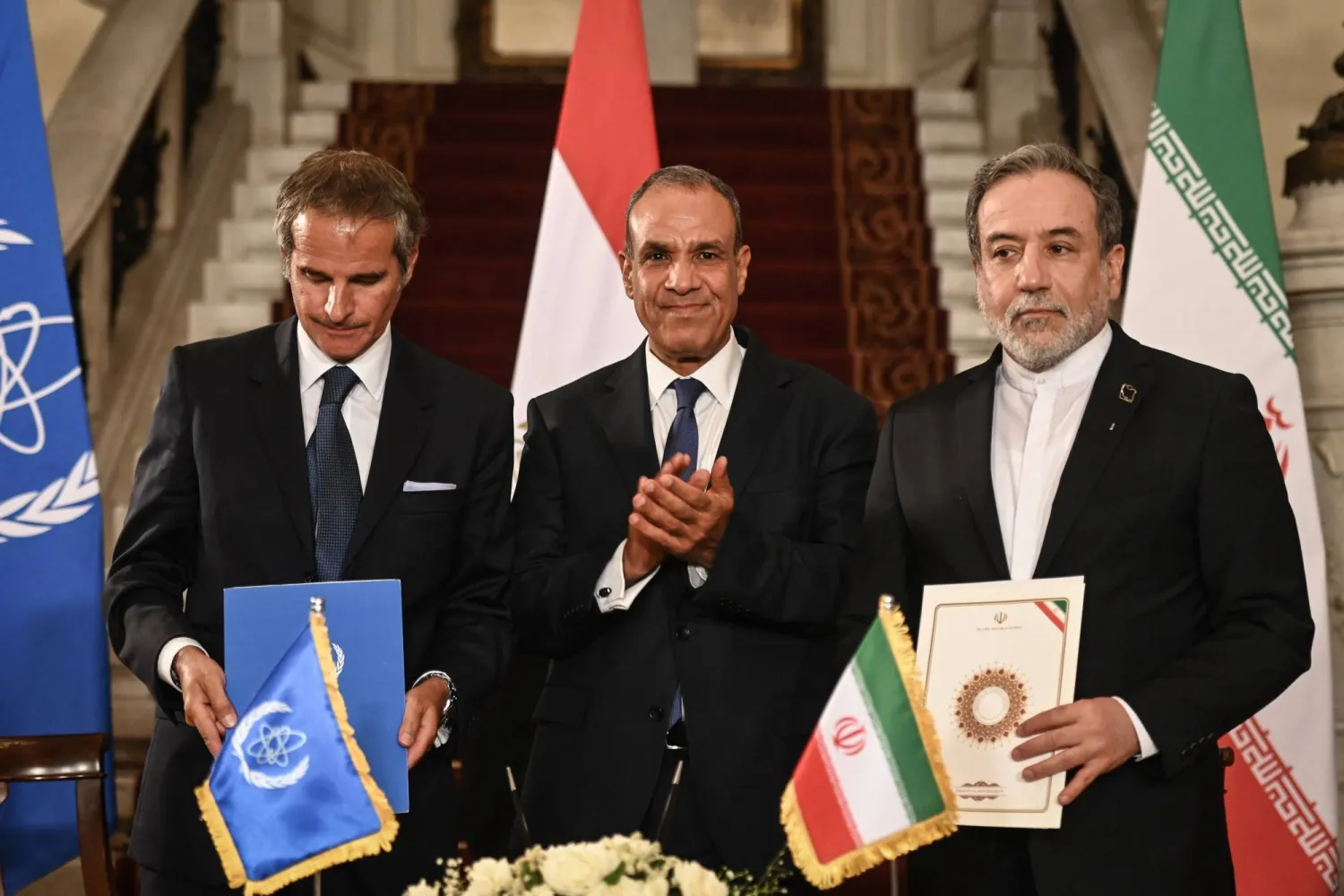

Egyptian Foreign Minister Badr Abdelatty announced on Tuesday that the International Atomic Energy Agency and Iran agreed on a new cooperation framework, after Tehran suspended cooperation with the agency following the 12-day war with Israel, which saw Israeli and US strikes on Iranian nuclear facilities.
“In Cairo today, I agreed with Iran’s Foreign Minister (Abbas) Araghchi on practical modalities to resume inspection activities in Iran. This is an important step in the right direction,” Grossi said on X.
For the past three months, Egypt has been mediating between Iran and the UN nuclear watchdog to resolve their dispute after Tehran suspended cooperation with the IAEA.
Foreign Ministry spokesman Tamim Khallaf said Abdelatty received Araghchi on Tuesday and the two men addressed ways to strengthen bilateral relations, regional developments, and cooperation between Iran and IAEA.
Khallaf told Asharq Al-Awsat that Cairo has facilitated cooperation between Iran and the agency during the past period and “will continue its tireless diplomatic efforts towards reaching satisfactory agreements on the Iranian nuclear file and achieving the interests of all parties and restoring trust.”
Abdelatty met with his Iranian counterpart in Cairo on Tuesday to discuss developing bilateral relations and the latest developments in the Iranian nuclear file. Later, Grossi joined the two ministers.
Following the meeting, Egypt’s FM stressed the importance of continuing efforts to create conditions for a “satisfactory and sustainable” settlement between Iran and the IAEA that considers the interests of all parties and contributes to de-escalation, restoring trust, and creating a supportive climate for regional security and stability.
Tuesday’s talks came as the IAEA Board of Governors kicked off their meetings in Vienna early this week.
On Monday, Grossi said talks between Iran and the IAEA do not alter Iran's duty to allow verification measures such as inspections as a party to the nuclear Non-Proliferation Treaty.
“There is still time, but not much. Always enough when there is good faith and a clear sense of responsibility,” Grossi said in a statement to a quarterly meeting of the IAEA's 35-nation Board of Governors.
But Araghchi affirmed during his meeting with Abdelatty that Iran and the IAEA have agreed to enhance their cooperation in a way that respects Iranian sovereignty and protects the security of the Iranian people, noting that his country will not compromise its nuclear policy or rights again.
Mohammed Abbas Naji, the Iranian expert at the Al-Ahram Center for Political and Strategic Studies, told Asharq Al-Awsat that through its efforts, Egypt is seeking to prevent a new war between Tehran and Israel.
“The visit of Grossi and Araghchi to Cairo suggests a progress between both sides for reaching a satisfactory deal, especially after Iran affirmed that a cooperation framework could be announced in Cairo soon,” Naji said.
Meanwhile, Egyptian expert on Iranian affairs, Ali Atef said Egypt’s efforts to facilitate cooperation between Iran and the IAEA aim to strengthen regional stability and prevent a nuclear arms race.
Egypt has used its diplomatic weight and its geopolitical position to reach a nuclear deal between Iran and the West, he noted.
Tuesday’s agreement comes against the backdrop of an ongoing threat by European powers to re-impose wide-ranging sanctions against Iran that were lifted under a 2015 nuclear deal between Iran and major powers.
Those European powers - France, Britain and Germany, known as the E3 – have initiated the so-called “snapback” process that is due to run until late this month. They have said they will only hold off on completing it if Iran allows inspections to resume, accounts for its highly enriched uranium stockpile and holds nuclear talks with the United States.
Iran’s Foreign Ministry spokesman Esmail Baghaei said on Tuesday that the main purpose of the meeting between Araghchi and Grossi is to “finalize negotiations on new protocols for Iran-IAEA cooperation in implementing safeguards obligations.”
The protocols have been developed taking into account recent attacks on Iranian nuclear sites, parliamentary legislation, and considerations from Iran’s Supreme National Security Council, Baghaei said.
He added that the framework is now in its final stages.
Last June, soon after the US and Israeli attacks, Iran's parliament passed a law suspending cooperation with the IAEA and stipulating that any inspections must be approved by Iran's Supreme National Security Council.