
EU Commission Chief Says she Will Propose New Measures Targeting Israel

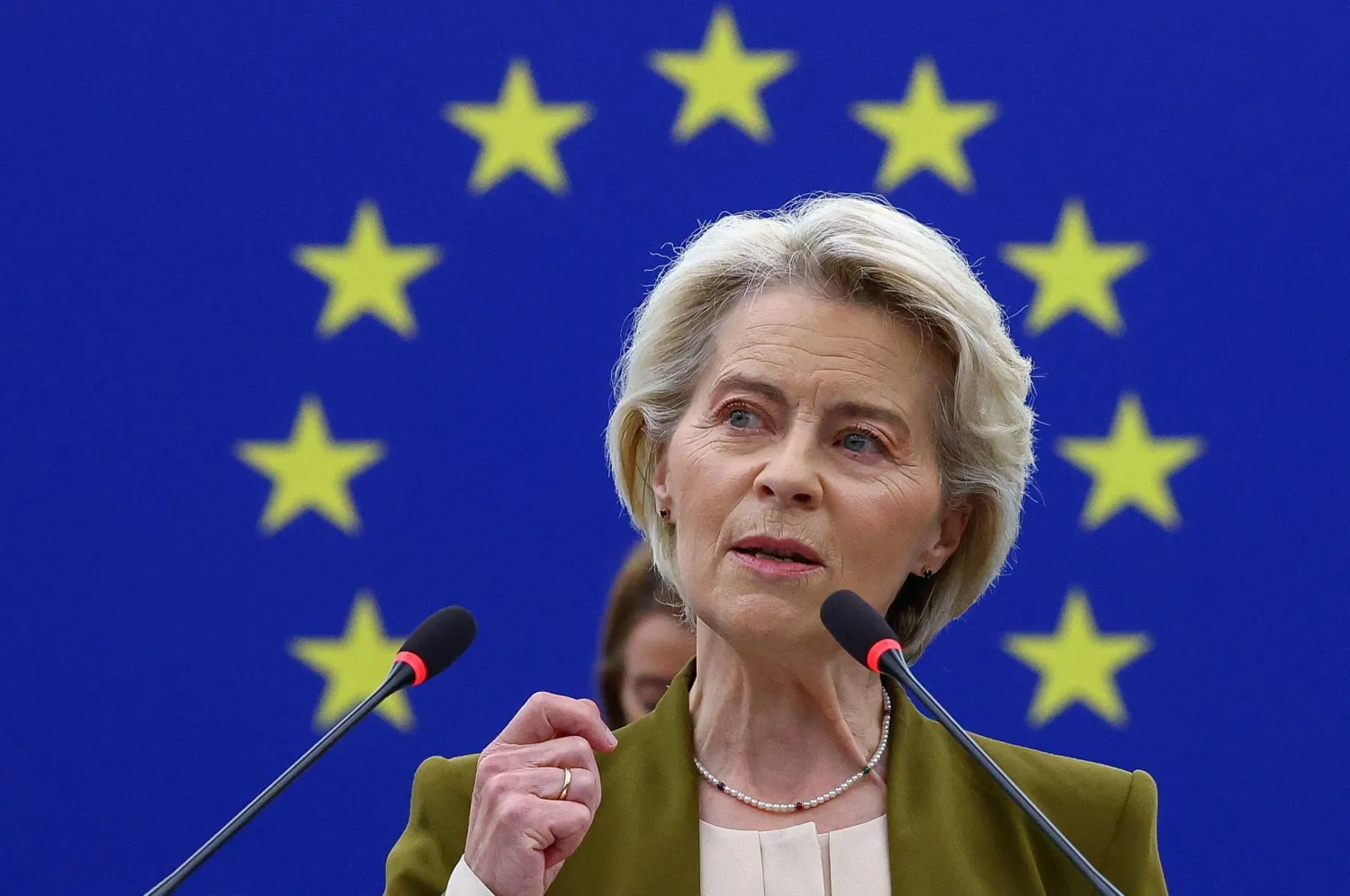
European Commission President Ursula von der Leyen delivers the State of the European Union address to the European Parliament, in Strasbourg, France, September 10, 2025. REUTERS/Yves Herman
TT

EU Commission Chief Says she Will Propose New Measures Targeting Israel

European Commission President Ursula von der Leyen delivers the State of the European Union address to the European Parliament, in Strasbourg, France, September 10, 2025. REUTERS/Yves Herman

The European Commission will propose sanctioning extremist Israeli ministers and the suspension of trade-related measures in a European Union agreement with Israel, European Commission President Ursula von der Leyen said on Wednesday. 

The proposals, announced by von der Leyen in a speech to the European Parliament in Strasbourg, reflect growing EU criticism of Israel's conduct of the war in Gaza and increased pressure on the bloc's executive body to take action. 

The proposals would need broad or unanimous support among the EU's member states, which is likely to be hard to achieve as the bloc is deeply divided on the Middle East. But von der Leyen made clear the proposal was also meant to be a political signal. 

"What is happening in Gaza has shaken the conscience of the world," von der Leyen said in her State of the Union speech, an annual address setting out her priorities for the year ahead. 

Von der Leyen acknowledged the divisions within Europe on Gaza but pledged the Commission would do what it can on its own. 

"We will propose sanctions on the extremist ministers and on violent settlers. And we will also propose a partial suspension of the Association Agreement on trade-related matters," she said. 

She did not name the ministers or outline which "trade-related matters" the Commission would propose to suspend. 

Israeli Foreign Minister Gideon Saar said on Wednesday that von der Leyen's comments were "regrettable", adding that the president is aware of Israel's efforts to assist humanitarian aid and that suffering in Gaza is due to Hamas. 

The European Union is Israel's biggest trading partner, with trade in goods between the two amounting to 42.6 billion euros ($49.9 billion) last year, according to the EU. 

According to a July options paper prepared by the EU's diplomatic service, a suspension of the entire trade chapter of the Association Agreement governing relations with Israel would withdraw trade preferences for Israeli products entering the EU. 

It would require a qualified majority vote among EU governments - the support of 15 out of 27 EU members representing 65% of the EU population. 

DIVISIONS ON ISRAEL POLICY 

EU members including Ireland, Spain, Denmark, Sweden and the Netherlands have called for the suspension of an EU free trade pact with Israel. But others such as Germany, Hungary and the Czech Republic have opposed such steps. 

EU sanctions on individuals require unanimous backing from member states. Hungary has blocked an existing proposal to sanction violent settlers. 

"I am aware it will be difficult to find majorities. And I know that any action will be too much for one, and too little for others. But we must all take our own responsibility," von der Leyen said. 

Von der Leyen also said that the Commission will put its bilateral support for Israel on hold, without affecting work with Israeli civil society and Yad Vashem, Israel's main Holocaust memorial center. 

A Commission spokesperson said future allocations of an average of 6 million euros that Israel is set to receive annually from an EU instrument will be suspended, and that the bloc will also put on hold approximately 14 million euros intended for ongoing projects. 

The Commission had previously proposed curbing Israeli access to its flagship research funding program but failed to garner sufficient support from EU member countries for the move. 

The Commission chief said the body will set up a Palestine Donor Group next month, including an instrument for Gaza reconstruction, without giving details. 


Iran: Divisions Deepen as Bazaar Protests Expand

 A protester in the city of Abdanan, which saw the largest demonstrations on Tuesday (Telegram)
A protester in the city of Abdanan, which saw the largest demonstrations on Tuesday (Telegram)
TT

Iran: Divisions Deepen as Bazaar Protests Expand

 A protester in the city of Abdanan, which saw the largest demonstrations on Tuesday (Telegram)
A protester in the city of Abdanan, which saw the largest demonstrations on Tuesday (Telegram)

Iranian authorities are showing clear internal divisions as protests widen across the country, with strikes spreading through Tehran’s historic Grand Bazaar and demonstrations flaring in dozens of cities.

President Masoud Pezeshkian has instructed officials to avoid a heavy-handed security response to protesters, stressing that confrontational tactics could undermine national security.

His position contrasts sharply with the escalating rhetoric of Judiciary Chief Gholam-Hossein Mohseni-Ejei, who has warned against any tolerance toward what he calls “rioters” and those “assisting the enemy,” accusing the United States and Israel of seeking to destabilize Iran.

In Tehran, protests intensified in and around the Grand Bazaar as merchants continued a strike for a second consecutive day. In a notable move, Tehran Metro announced that the capital’s main subway line would remain closed “until further notice” at the 15 Khordad station near the bazaar, a decision widely interpreted as an attempt to curb the flow of people into the area.

Reports also described scattered gatherings and sporadic clashes in central and southern parts of the capital.

Beyond Tehran, the protest movement has expanded to include market strikes and intermittent nighttime demonstrations in multiple cities. On Tuesday night, protests were reported in several provinces.

In Ilam, demonstrators took to the streets in different neighborhoods chanting anti-government slogans. In Torbat-e Heydarieh, solidarity gatherings were held alongside a heavy deployment of special security units. Videos circulated from Alvand, in Qazvin province, showing crowds amid the sound of gunfire, while security forces fired tear gas at protesters in Neyriz, in Fars province.

As strikes spread through commercial centers, currency markets hit record levels. The US dollar approached 1.48 million rials on Tehran’s informal market, while exchange shops quoted selling prices around 1.47 million rials. Analysts said the surge reflected the sharp decline in the rial’s value and the erosion of purchasing power, factors widely seen as key drivers of the unrest.

Official Divide

Vice President for Executive Affairs Mohammad-Jafar Qaempanah said Pezeshkian emphasized during a cabinet meeting the need to avoid a security-first approach to protests “so as not to harm national security,” while distinguishing peaceful demonstrations from acts of violence.

“Anyone carrying a weapon or knife and attacking police or military centers is a rioter and must be separated from protesters,” he said, according to a state news agency.

Government spokeswoman Fatemeh Mohajerani also quoted the president as saying that dialogue with citizens and protesters would not allow “other parties to hijack the people’s protests.”

Former reformist lawmaker Mahmoud Sadeghi criticized the judiciary chief’s threats, saying they played into the hands of hardliners, and urged security forces to respect protesters and show greater tolerance, even toward harsh slogans or angry behavior.

By contrast, Mohseni-Ejei struck a far tougher tone, labeling demonstrators as troublemakers and arguing that those taking to the streets were serving the objectives of Iran’s enemies. He said there would be no room for leniency and promised that prosecutions and punishments would be “swift,” while remaining “precise and in accordance with legal standards.”

Speaking to a group of traders and business owners, he added that “bazaar protests do not mean confronting the system.”

Casualties, Arrests, and Hospitals

Human rights organizations reported dozens of deaths and thousands of arrests in the early days of the unrest.

The Kurdish rights group Hengaw said at least 27 people were killed and more than 1,500 arrested over a 10-day period.

The Human Rights Activists News Agency (HRANA) put the death toll at no fewer than 36, with at least 2,076 arrests.

The Oslo-based Iran Human Rights organization said detainees exceeded 1,000, as protests spread to 28 of Iran’s 31 provinces and around 80 cities.

Tehran Governor Mohammad Sadegh Motamedian said no deaths had been recorded in Tehran province, adding that when events turn into vandalism and clashes, “they are no longer protests.”

Authorities confirmed that at least two members of the security forces were killed and more than 10 wounded, without releasing figures for protester fatalities.

Amid allegations that security forces entered hospitals in Tehran and Ilam, Health Minister Mohammad-Reza Zafarghandi denied that injured protesters had been removed from medical facilities. He said no tear gas had been fired inside Sina Hospital, while noting that investigations were ongoing.

International Pressure

Iran is also facing mounting international pressure. US President Donald Trump warned he would intervene to “save protesters” if security forces opened fire, months after Israeli and US strikes on Iranian nuclear sites during a 12-day conflict.

Iran’s Supreme Leader Ali Khamenei responded by vowing not to “bow to the enemy.”

Foreign Minister Abbas Araghchi said Iran’s internal affairs “have nothing to do with any foreign country,” describing Trump’s comments as “interference,” while expressing hope that tensions between the government and protesting citizens could be resolved through dialogue.

The Foreign Ministry reaffirmed Iran’s recognition of the right to peaceful protest, while condemning what it called “interventionist and misleading” US statements.

In an effort to contain public anger, the government has begun distributing monthly cash assistance of about $7 per citizen to help cover basic food costs.

A Persian-language account run by the US State Department described the payment of one million tomans per person as “humiliating,” contrasting it with Iran’s financial support for regional allies.


2 Killed in Shooting in Mormon Church Parking Lot in Salt Lake City

Police respond to a fatal shooting in a parking lot of The Church of Jesus Christ of Latter-day Saints in Salt Lake City on Wednesday, Jan. 7, 2025. (AP Photo/Hannah Schoenbaum)
TT

2 Killed in Shooting in Mormon Church Parking Lot in Salt Lake City

Police respond to a fatal shooting in a parking lot of The Church of Jesus Christ of Latter-day Saints in Salt Lake City on Wednesday, Jan. 7, 2025. (AP Photo/Hannah Schoenbaum)

A shooting outside a church building in Salt Lake City killed two people and injured six others Wednesday, police said.

The shooting took place in the parking lot of a meetinghouse of The Church of Jesus Christ of Latter-day Saints, widely known as the Mormon church.

Dozens of people were attending a funeral inside at the time. All the victims were adults, The Associated Press reported.

Police said they do not believe the shooter had any animus toward a particular faith.

“We don’t believe this was a targeted attack against a religion or anything like that,” Salt Lake City Police Chief Brian Redd said.

Police also do not believe the shooting was random. Authorities said no suspect was in custody.

Brennan McIntire said he and his wife, Kenna, heard the gunshots from their apartment next to the parking lot while watching TV. He jumped off the couch and ran outside to check on things.

“As soon as I came over, I see someone on the ground,” McIntire said. “People are attending to him and crying and arguing.”

About 100 law enforcement vehicles were at the scene in the aftermath, and helicopters flew overhead.

“This should never have happened outside a place of worship. This should never have happened outside a celebration of life,” Mayor Erin Mendenhall said.

The church was cooperating with law enforcement and was grateful for efforts first responders' efforts, a spokesperson said.

“We extend prayers for all who have been impacted by this tragedy and express deep concern that any sacred space intended for worship should be subjected to violence of any kind,” Sam Penrod said in a statement.

The church is headquartered in Salt Lake City, and about half of Utah’s 3.5 million residents are members of the faith. Churches like the one where the shooting occurred can be found in towns throughout the city and state.

The faith has been on heightened alert since four people were killed when a former Marine opened fire in a Michigan church last month and set it ablaze.

The FBI found that he was motivated by “anti-religious beliefs” against the church.


China Reportedly Hacked Email Systems of US Congressional Committee Staffers

FILED - 04 March 2017, United Kingdom, London: A woman's hand presses a key of a laptop keyboard. Photo: Dominic Lipinski/PA Wire/dpa
TT

China Reportedly Hacked Email Systems of US Congressional Committee Staffers

FILED - 04 March 2017, United Kingdom, London: A woman's hand presses a key of a laptop keyboard. Photo: Dominic Lipinski/PA Wire/dpa

A Chinese hacking group has compromised emails used by staff members of powerful committees in the US House of Representatives, the Financial Times reported on Wednesday, citing people familiar with the matter.

The group, nicknamed Salt Typhoon, accessed email systems used by some staffers on the House China committee as well as aides on panels covering foreign affairs, intelligence and the armed services, the report said. It did not identify which specific staffers were targeted.

Reuters could not immediately verify the report. Chinese Embassy spokesman ⁠Liu Pengyu condemned what he called "unfounded speculation and accusations," while the Federal Bureau of Investigation declined to comment.

The White House and the offices of the four committees reportedly targeted in the surveillance sweep did not immediately respond to requests for comment.

The FT cited a person familiar with the campaign as saying it was unclear whether the attackers ⁠had accessed lawmakers' emails in the intrusions, which were detected in December.

US lawmakers and their aides, especially those that oversee America's sprawling military and intelligence agencies, have long been top targets for cyberespionage and reports of hacks or attempted hacks have surfaced periodically.

In November, the Senate Sergeant at Arms notified multiple congressional offices of a "cyber incident," where hackers may have accessed communications between the nonpartisan Congressional Budget Office, which provides key financial research data to lawmakers, and some Senate offices.

In 2023, the Washington Post reported that two senior ⁠US lawmakers were among the targets of a Vietnam-linked hacking operation.

The Salt Typhoon hackers, in particular, have long rattled the US intelligence community. The spies - alleged to be working for Chinese intelligence - stand accused of gathering data on wide swathes of Americans' telephone communications and intercepted conversations, including those between prominent US politicians and government officials.

Beijing has repeatedly denied being behind the spying.

Early last year, the US imposed sanctions on alleged hacker Yin Kecheng and cybersecurity company Sichuan Juxinhe Network Technology, accusing both of being involved in Salt Typhoon.