

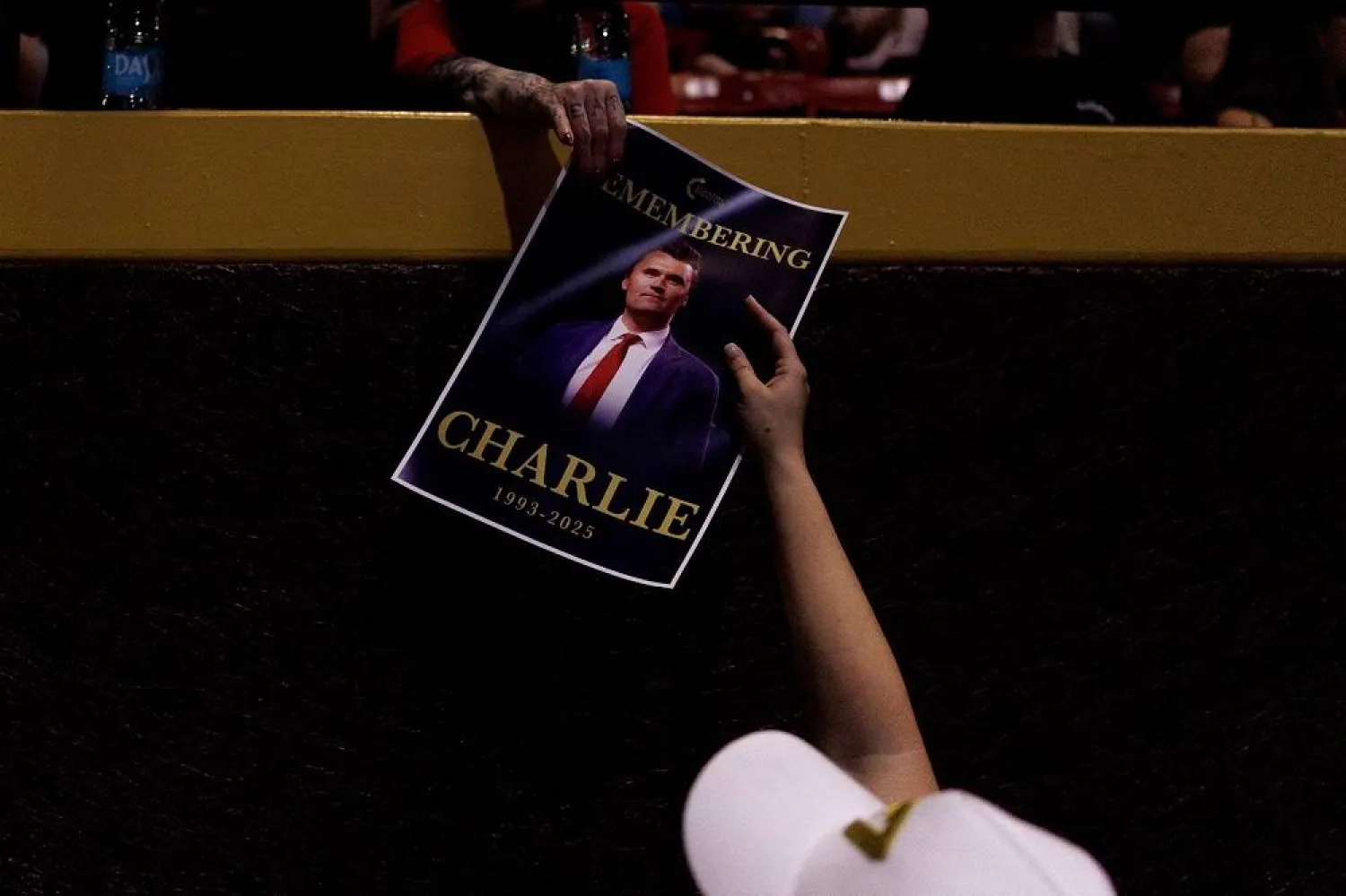

Pentagon Cracks Down on Troops’ Social Media Posts About Charlie Kirk 

People attend a vigil for Charlie Kirk at Arizona State University on September 15, 2025 in Tempe, Arizona. (Getty Images/AFP) 
TT

Pentagon Cracks Down on Troops’ Social Media Posts About Charlie Kirk 

People attend a vigil for Charlie Kirk at Arizona State University on September 15, 2025 in Tempe, Arizona. (Getty Images/AFP) 

The US military is taking swift disciplinary action against US troops over social media posts linked to the assassination of conservative activist Charlie Kirk, carrying out a "zero-tolerance" policy toward those it sees as cheering his death, US officials said.

The Pentagon has not publicly said how many service members have been disciplined so far but one US official told Reuters it was likely in the dozens, as US military leadership pursues a crackdown ordered by Defense Secretary Pete Hegseth, who knew Kirk personally.

Kirk, a 31-year-old conservative media celebrity known for his hard-right rhetoric, was killed by a single rifle shot during an outdoor event last week at Utah Valley University.

The staunch ally of President Donald Trump was not in the US military's chain of command and had no official role in the US government.

But legal experts and US officials say US troops do not have the same free speech rights as private citizens and can be punished for public-facing comments if commanders determine they violate Uniform Code of Military Justice provisions related to "good order and discipline."

"We WILL NOT tolerate those who celebrate or mock the assassination of a fellow American at the Department of War," Sean Parnell, the top Pentagon spokesperson, wrote on X, in comments reposted by Hegseth.

"It's a violation of the oath, it's conduct unbecoming, it's a betrayal of the Americans they've sworn to protect & dangerously incompatible with military service."

Trump has ordered the Department of Defense to rename itself the Department of War, a change that will require action by Congress.

The Army, Marine Corps and Navy did not immediately respond when asked by Reuters whether they had disciplined US troops over such social media posts.

An Air Force spokesperson said: "As commanders verify inappropriate actions, they are taking the necessary administrative and disciplinary actions to hold service members accountable."

CHILLING EFFECT

Three US officials, speaking on condition of anonymity, said disciplinary actions so far have included relieving service members from their positions and other admonishment. While there were no known cases of people being separated from military service entirely, officials did not rule out that it might happen.

"The problem is they have very little protection," said Rachel VanLandingham, a former Air Force lawyer now at Southwestern Law School.

One US official referred to Article 88 of the Uniform Code of Military Justice, which he said clearly prohibited "contemptuous words" against any sitting US president, the defense secretary, Congress and other senior officials.

Matthew Lohmeier, an undersecretary of the Air Force, announced over the weekend his intention to prosecute and remove from service an Air Force senior master sergeant in Florida who made comments about Kirk as well as about Trump. He said the airman's entire chain of command should be investigated.

"Men and women who are guilty of this kind of behavior will not serve in uniform," Lohmeier wrote on X.

While the Pentagon may find clear cases of violations of military law during the crackdown, legal experts caution that it is also creating a chilling effect on what would otherwise be permissible speech by US troops, who are increasingly fearful of being seen as opposing the Trump administration.

VanLandingham said she had spoken to an active duty service member who had just combed through 20 years of social media posts, deleting those that have views not currently supported by Trump and his allies.

"The Department of Defense, from the very top, is telling individuals they cannot have certain thoughts," she said, adding that others will likely be "suppressed by threat of punishment."

One US official, speaking on condition of anonymity, acknowledged a chilling effect on what troops were sharing online. But the official also said troops should watch what they do, particularly on public-facing social media - given the current heated political climate.

"Sharing any kind of hot take when publicly identifiable as part of DoD (is) also dumb," the official added.



Türkiye Preparing Law to Let PKK Fighters Return under Peace Plan

(FILES) Supporters display a poster depicting jailed leader of the Kurdistan Workers' Party (PKK) Abdullah Ocalan, after he called on the Kurdistan Workers' Party (PKK) to disarm and dissolve itself in Diyarbakir, southeastern Türkiye, on February 27, 2025.(Photo by Yasin AKGUL / AFP)
TT

Türkiye Preparing Law to Let PKK Fighters Return under Peace Plan

(FILES) Supporters display a poster depicting jailed leader of the Kurdistan Workers' Party (PKK) Abdullah Ocalan, after he called on the Kurdistan Workers' Party (PKK) to disarm and dissolve itself in Diyarbakir, southeastern Türkiye, on February 27, 2025.(Photo by Yasin AKGUL / AFP)

Türkiye is preparing a law to let thousands of Kurdistan Workers Party (PKK) fighters and civilians return home from hideouts in northern Iraq under negotiations to end generations of war.

A senior Middle East official and a Kurdish political party source in Türkiye said the proposed law would protect those returning home but stop short of offering a general amnesty for crimes committed by former militants. Some militant leaders could be sent to third countries under the plans.

Bringing PKK guerrillas and their families home from their bases in mountainous northern Iraq is seen as one of the final hurdles in a peace process launched a year ago to end a war that has killed 40,000 people.

While officials have spoken publicly about reconciliation efforts in general terms, the sources disclosed details that have not previously been reported, including proposals for returns to take place in separate waves of civilians and fighters, and for commanders to be sent to third countries.

The Middle East official, describing the sensitive negotiations on condition of anonymity, said legislation to allow the returns could come before the Turkish parliament as soon as this month.

PLAN COULD INCLUDE SEPARATE WAVES OF RETURNS

Türkiye‘s intelligence agency MIT, which has led talks with the PKK, did not immediately comment on the proposal. The PKK did not immediately comment.

Since Kurdish militants launched their insurgency in 1984 - originally with the aim of creating an independent Kurdish state - the conflict has exerted a huge economic and social burden on Türkiye and neighboring countries.

Ending it would boost NATO member Türkiye’s political and economic stability, and ease tensions in Iraq where the PKK is based, and Syria where Kurdish fighters have been allied with US forces.

In a major breakthrough, the PKK announced a decision in May to disarm and disband after a call to end its armed struggle from its jailed leader Abdullah Ocalan.

In July the group symbolically burned weapons, and last month it announced it was withdrawing fighters from Türkiye as part of the disarmament process. It called on Ankara to take steps to let its members participate in "democratic politics".

But the terms of reconciliation have been sensitive, with Türkiye wary of offering a wide amnesty for what it considers past crimes of a terrorist organization.

Numan Kurtulmus, who heads a reconciliation commission set up by Türkiye in August, said last week that any legal steps would come only after Türkiye verifies that the PKK has completed its dissolution process.

"Once Türkiye’s security and intelligence units have verified and confirmed that the organiئation has truly laid down its arms and completed its dissolution process, the country will enter a new phase of legal regulations aimed at building a terror-free Türkiye," he said.

According to the senior Middle East official, the proposal now being discussed would see roughly 1,000 civilians and non-combatants return first, followed by about 8,000 fighters after individual screening.

Beyond that, the official said Türkiye had so far rejected taking back around 1,000 senior and mid-level PKK figures, and wants them relocated to a third country, possibly in Europe.

Talks were ongoing on that issue, with some parties involved in the negotiations concerned that excluding PKK top brass from repatriation could eventually fuel a renewed insurgency, the official said.

Legislation to enable returns could come before the Turkish parliament as early as the end of November, the official added.

Tayip Temel, deputy co-chair of the pro-Kurdish DEM Party - which though an opposition party has worked closely with the government on the peace process - said the ongoing negotiations focused on a formula personally emphasiئed by Ocalan.

"Work is underway on a special law for the PKK to enable the democratic and social reintegration of its members," Temel told Reuters.

"The law will cover everyone returning from the PKK, whether civilian or militant. There is no plan for a phased return. The formula being worked on is comprehensive and applies to all."

He confirmed that Türkiye had raised the idea of some PKK figures being sent to third countries, but said this would have to be discussed with the potential hosts.

DIFFERENT PROCEDURES FOR DIFFERENT GROUPS

Another source at DEM, parliament's third-biggest party, said the commission drafting the proposal was working on a single, PKK-specific law that would avoid the language of a general amnesty.

"Different procedures will apply to different groups of returnees," the source said, adding that some returning PKK members will likely face investigations and trials. "Otherwise it will be hard to reach common ground among parties in the commission."

Once the parliamentary commission completes its work, it is expected to recommend the special PKK law to parliament, paving the way for potential legislation.

Human Rights Watch urged lawmakers to use the peace process to reform laws that have long been used to charge and incarcerate non-violent Kurdish activists.

The commission "has a unique opportunity to help shape a post-conflict society and should make bold recommendations to repeal abusive laws used to silence and marginalize people," said Hugh Williamson, Europe and Central Asia director at HRW.


Russia Urges Trump Administration to Clarify 'Contradictory' Signals on Nuclear Testing

Representation photo: This photograph shows a general view of Kurskaya nuclear power plant taken outside the town of Kurchatov on August 27, 2024. (Photo by TATYANA MAKEYEVA / AFP)
TT

Russia Urges Trump Administration to Clarify 'Contradictory' Signals on Nuclear Testing

Representation photo: This photograph shows a general view of Kurskaya nuclear power plant taken outside the town of Kurchatov on August 27, 2024. (Photo by TATYANA MAKEYEVA / AFP)

Russia urged the United States on Friday to clarify what it called contradictory signals about a resumption of nuclear testing, saying such a step would trigger responses from Russia and other countries.

President Donald Trump last week ordered the US military to immediately restart the process for testing nuclear weapons. But he did not make clear if he meant flight-testing of nuclear-capable missiles or a resumption of tests involving nuclear explosions - something neither the US nor Russia has done for more than three decades.

"If it is the latter, then this will create negative dynamics and trigger steps from other states, including Russia, in response," Russian Foreign Ministry spokeswoman Maria Zakharova told reporters.

"For now, we note that the signals emanating from Washington, which are causing justified concern in all corners of the world, remain contradictory, and, of course, the real state of affairs must be clarified."

Citing the lack of clarity around US plans, President Vladimir Putin on Wednesday instructed top officials to prepare proposals for Russia to carry out its own potential nuclear test in response to any US test.

Security analysts say a resumption of testing by any of the world's nuclear powers would be a destabilizing step at a time of acute geopolitical tension, notably over the war in Ukraine, and would likely prompt other countries to follow suit.

Russia and the US possess the world's largest nuclear arsenals.

The last remaining treaty between them that limits the number of strategic nuclear warheads on both sides is due to expire in three months, potentially fueling an arms race that is already in progress.

Putin has proposed that both sides continue to observe the treaty limits for another year, but Trump has yet to respond formally to the idea.


Russia Says It’s Ready to Respond to Venezuela’s Appeal for Help 

Russian President Vladimir Putin shakes hands with his Venezuelan counterpart Nicolas Maduro during a meeting at the Kremlin in Moscow, Russia, May 7, 2025. (Alexander Zemlianichenko/Pool via Reuters)
TT

Russia Says It’s Ready to Respond to Venezuela’s Appeal for Help 

Russian President Vladimir Putin shakes hands with his Venezuelan counterpart Nicolas Maduro during a meeting at the Kremlin in Moscow, Russia, May 7, 2025. (Alexander Zemlianichenko/Pool via Reuters)

Russia is prepared to respond to Venezuela's requests for assistance, while urging against any escalation of tension in the region, Foreign Ministry spokeswoman Maria Zakharova said on Friday.

Venezuelan President Nicolas Maduro has appealed to Moscow for military support, including repairs to Russian-made Sukhoi fighter jets, upgrades to radar systems, and the delivery of missile systems.

The request was made in response to what Caracas views as growing threats from Washington, which has built up a large military presence in the Caribbean in recent months.