

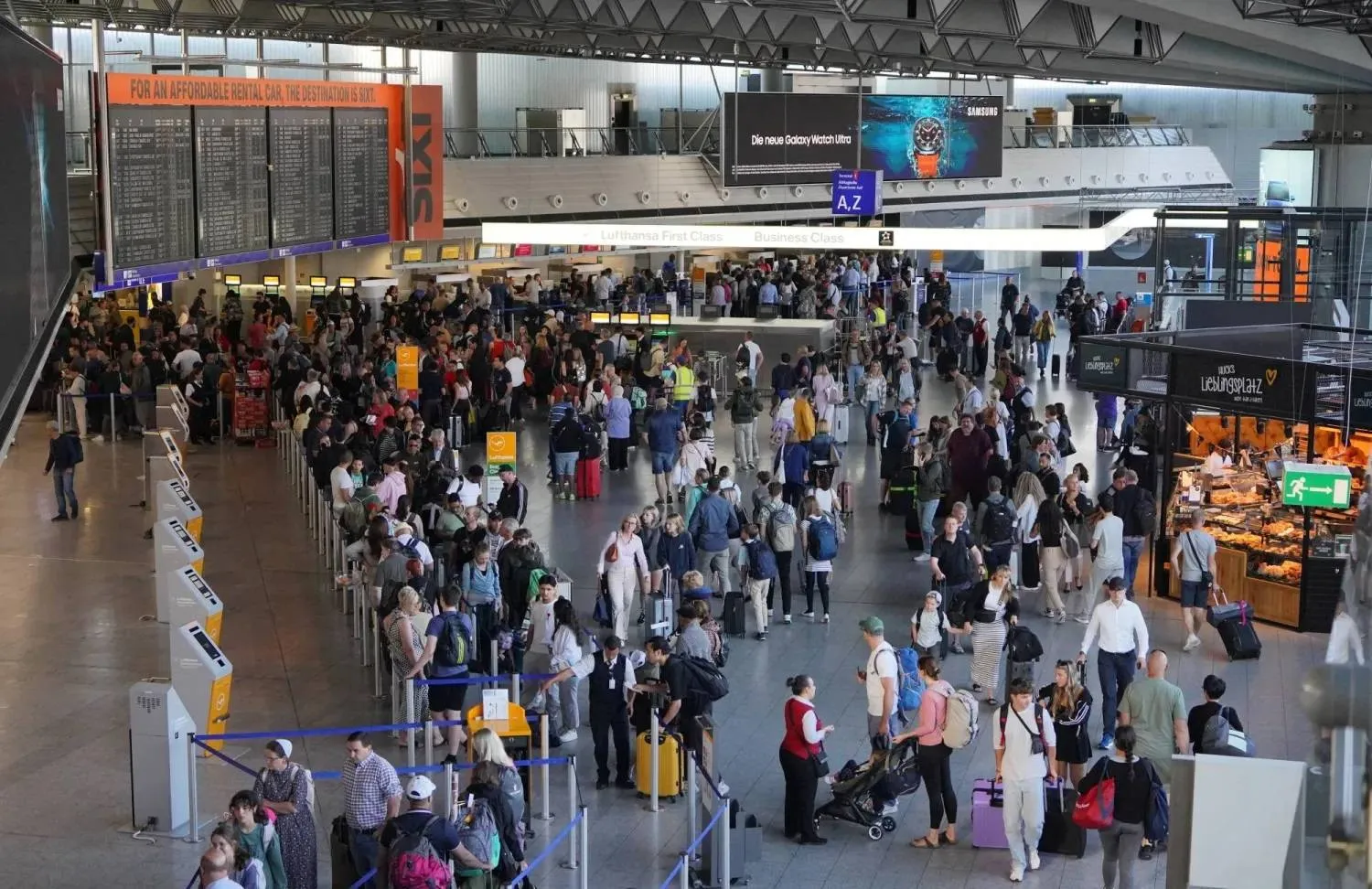

Cyberattack Disrupts Check-in Systems at Major European Airports

A cyberattack causes flight delays at the German capital's airport (File photo - Reuters)
TT

Cyberattack Disrupts Check-in Systems at Major European Airports

A cyberattack causes flight delays at the German capital's airport (File photo - Reuters)

 A cyberattack targeting check-in and boarding systems has disrupted air traffic and caused delays at several of Europe’s major airports, officials said Saturday. 

Brussels airport reported that the attack means that only manual check-in and boarding was possible there, and the incident was having a “large impact” on flight schedules, reported The Associated Press.

“There was a cyberattack on Friday night 19 September against the service provider for the check-in and boarding systems affecting several European airports including Brussels Airport,” it said in a statement. 

Authorities at Berlin’s Brandenburg Airport said a service provider for passenger handling systems was attacked on Friday evening, prompting airport operators to cut off connections to the systems. 

London Heathrow Airport, Europe’s busiest, said “a technical issue” affected a service provider for check-in and boarding systems. 

“Collins Aerospace, which provides check-in and boarding systems for several airlines across multiple airports globally, is experiencing a technical issue that may cause delays for departing passengers,” Heathrow said in a statement. 

The airports advised travelers to check their flight status and apologized for any inconvenience. 

Formed in 2018, Collins is a US aviation and defense technology company and a subsidiary of RTX Corp., which was formerly Raytheon Technologies. 

Collins provides the technology that allows passengers to check themselves in, print boarding passes and bag tags, and dispatch their own luggage, all from a kiosk. 

Collins said it was “aware of a cyber-related disruption” to its MUSE (Multi-User System Environment) software at “select airports” but that manual check-in operations could still be used. 

“We are actively working to resolve the issue and restore full functionality to our customers as quickly as possible,” it said in a statement. “The impact is limited to electronic customer check-in and baggage drop and can be mitigated with manual check-in operations.” 

The impact was felt only at some airports: the Roissy, Orly and Le Bourget airports in the Paris area reported no disruptions. 


Iran Says France's Move to Expel Two Iranian Diplomats 'Illegal'

Iranian Foreign Ministry spokesperson Esmaeil Baqaei (Archive photo – MEHR)
TT

Iran Says France's Move to Expel Two Iranian Diplomats 'Illegal'

Iranian Foreign Ministry spokesperson Esmaeil Baqaei (Archive photo – MEHR)

Iran's foreign ministry said on Monday that France's decision to expel two Iranian diplomats in response to Tehran's ban on two French diplomats was "illegal".

"The action that France took is an illegal action in response to Iran's legal action, and is in no way helpful to bilateral relations," ministry spokesman Esmaeil Baqaei said at a weekly press conference.

Last week, Baqaei said two French diplomats who were briefly arrested in Iran in July over "interference" in Iran's internal affairs "would not be permitted to return".

French Foreign Minister Jean-Noel Barrot responded by saying that two Iranian diplomats in France would be expelled "in the coming days".

Barrot said the French move was a consequence of "intolerable" treatment of the French diplomats, who were briefly detained last month in Tehran.

He said the pair had been targeted by Iranian officials "in flagrant violation of diplomatic immunity".

They had also suffered "an extremely serious act of intimidation" at the hands of Iran's security service, he added.

Baqaei had previously said Paris should apologize for the actions of the French diplomats, which he said had violated the Vienna Convention.


Iran’s Currency Hits New Record Low as US Prepares to Announce More Sanctions

People walk in the Grand Bazaar in Tehran, Iran, August 23, 2026. Majid Asgaripour/WANA (West Asia News Agency) via Reuters
TT

Iran’s Currency Hits New Record Low as US Prepares to Announce More Sanctions

People walk in the Grand Bazaar in Tehran, Iran, August 23, 2026. Majid Asgaripour/WANA (West Asia News Agency) via Reuters

Iran’s currency hit a new record low Monday as Washington prepared to announce new sanctions it said would be an “economic D-Day” and would add further pressure on an economy already battered by previous sanctions and a US naval blockade.

The rial dropped to 2.02 million to the US dollar as trading opened on informal currency markets. Iran’s official Central Bank rate stood at around 1.5 million rial to the dollar, but the informal rate is what most Iranians pay.

The currency had already been under pressure before the US and Israel attacked Iran on Feb. 28, with double-digit inflation and negative growth, but has been hitting new record lows as nearly six months of war have taken an even greater toll.

Still, US President Donald Trump has been unable to win concessions from Iran, which continues to keep a firm grip on shipping through the Strait of Hormuz, the key waterway through which a fifth of the world’s traded oil transited freely before the war began.

Iranian attacks and threats have severely hampered that traffic during the war.


Iran Dismisses US Threat of 'Economic D-day'

FILE - Iran's Ambassador to the International Atomic Energy Agency, IAEA, Kazem Gharibabadi, waits for the start of the IAEA board of governors meeting at the International Center in Vienna, Austria, Nov. 21, 2019. (AP Photo/Ronald Zak, file)
TT

Iran Dismisses US Threat of 'Economic D-day'

FILE - Iran's Ambassador to the International Atomic Energy Agency, IAEA, Kazem Gharibabadi, waits for the start of the IAEA board of governors meeting at the International Center in Vienna, Austria, Nov. 21, 2019. (AP Photo/Ronald Zak, file)

Iran on Monday dismissed Washington's declaration of a massive economic pressure campaign, saying it disproved US claims to have dismantled Tehran's military and nuclear capabilities.

"Your narrative doesn't add up: you say that Iran's military power has been 'dismantled', 100% of its military factories 'destroyed' and its nuclear program 'buried'," Kazem Gharibabadi, deputy foreign minister, said in a post on X.

Yet, he added, "there is a need for 'the largest financial invasion in history' and the mobilization of 'all institutions and powers' of the United States! Is this a victory or an admission of America's defeat?"

Earlier, US Treasury Secretary Scott Bessent wrote in the Financial Times that Washington was launching the "single greatest financial offensive marshalled against an adversary" -- calling it an "economic D-Day".

Bessent posted on X that the measure came after the United States "dismantled Iran's military capabilities, destroyed nearly 100 percent of its military factories, and buried its nuclear program."

He is scheduled to explain the new US sanctions on Iran on Monday.

Meanwhile, Iran's foreign ministry warned countries against joining the US economic campaign. Spokesman Esmaeil Baqaei said taking part would "definitely have its own consequences".

The United States and Israel triggered the Middle East war with a massive wave of strikes against Iran on February 28, triggering Iranian retaliation across the region.

An April 8 ceasefire ended nearly 40 days of intense bombardment, but control over the Strait of Hormuz soon emerged as a key flashpoint in the conflict.

Iran has controlled the vital energy conduit since the war began. Reopening the strait, vital for global oil and gas supplies, has become a US priority, but Tehran insists the waterway will remain closed until Washington lifts its naval blockade on Iranian ports, removes oil sanctions and unfreezes Iranian assets abroad.

Last week, US President Donald Trump announced that Washington would ramp up economic pressure on Iran "on an unprecedented scale."

Washington has urged other governments, including Beijing, to join efforts to further isolate Iran's economy.

In an article published on Monday in Iran's Ettela'at newspaper, Tehran's Foreign Minister Abbas Araghchi said relations with China "have taken on deeper, more structural, and more comprehensive dimensions."

Iran has faced US and international sanctions since the 1979 Iranian revolution.

Trump has repeatedly pursued a "maximum pressure" policy of economic sanctions against Iran, reinstating the approach after returning to office in January 2025 following a similar campaign during his first term.

Iran has repeatedly dismissed the sanctions policy as a failure, insisting that economic pressure and threats will not force it to change course.
