


As the World Convulses in War and Contentiousness, Its Leaders Convene at the UN to Figure it Out

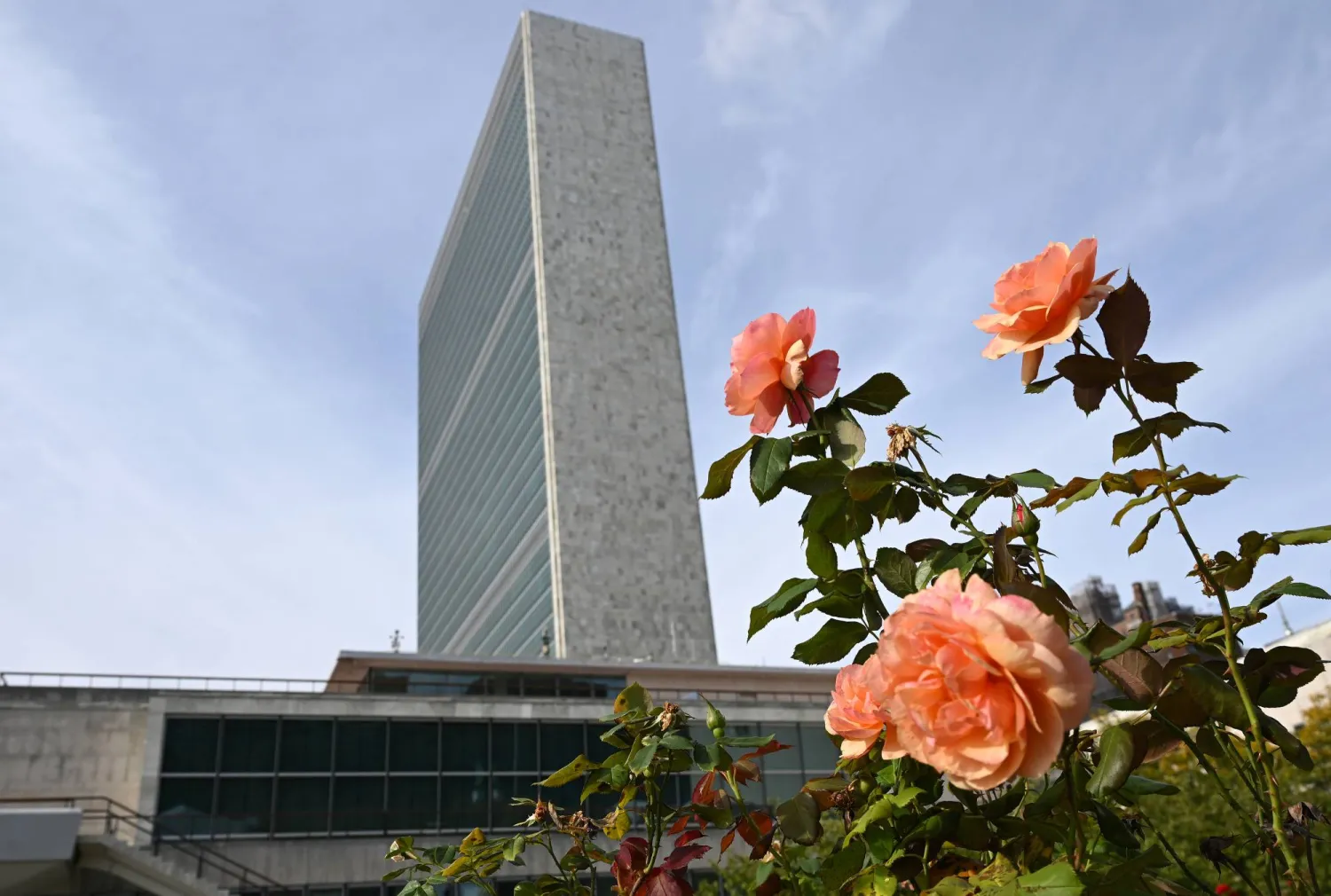
The United Nations (UN) headquarters, as seen from the Rose Garden, in New York, USA, 21 September 2025. EPA/LUKAS COCH AUSTRALIA AND NEW ZEALAND OUT
TT

As the World Convulses in War and Contentiousness, Its Leaders Convene at the UN to Figure it Out

The United Nations (UN) headquarters, as seen from the Rose Garden, in New York, USA, 21 September 2025. EPA/LUKAS COCH AUSTRALIA AND NEW ZEALAND OUT

World leaders begin convening Monday at one of the most volatile moments in the United Nations' 80-year history, and the challenges they face are as dire as ever if not more so: unyielding wars in Gaza and Ukraine, escalating changes in the US approach to the world, hungry people everywhere and technologies that are advancing faster than the understanding of how to manage them.

The United Nations itself, which emerged from World War II's rubble on the premise that nations would work together to tackle political, social and financial issues, is in crisis itself. As Secretary-General Antonio Guterres said last week: "International cooperation is straining under pressures unseen in our lifetimes.”

Yet the annual high-level gathering at the UN General Assembly will bring presidents, prime ministers and monarchs from about 150 of the 193 UN member nations to UN headquarters. The secretary-general says it is an opportunity that can’t be missed — even in the most challenging of moments.

“We are gathering in turbulent — even uncharted — waters,” Guterres said. He pointed to, among other specters, "our planet overheating, new technologies racing ahead without guardrails, inequalities widening by the hour.”

They gather for a better world, but can they build it? Guterres said he will use the more than 150 one-on-one meetings he has with leaders and ministers to urge that they speak to each other, bridge divides, reduce risks and find solutions — to conflicts, to keep the planet from increased warming, to put guardrails on fast-expanding artificial intelligence, and to find funding for lagging UN goals for 2030 including ending poverty in all countries and ensuring quality education for every child.

He said leaders must make progress, not merely engage in “posturing and promises."

But UN watchers say that in a deeply polarized world, with no prospects of ceasefires in Gaza, Ukraine and Sudan, whether the high-level meeting makes any progress remains a big question mark.

Richard Gowan, UN director for the International Crisis Group, said he is confident three topics will dominate high-level week – US President Donald Trump’s first appearance in his second term, the horrific situation in Gaza, and what’s next for the United Nations as it grapples with major funding and staff cuts, mainly due to the cutoff in US payments to its regular and peacekeeping budgets.

Gowan said he expects the nearly two-year war in Gaza to be the central issue, as Israel launches a major offensive in Gaza City forcing thousands to flee and following a report by independent experts commissioned by the UN Human Rights Council that accused Israel of committing genocide in Gaza. Israel rejected the allegation, calling the report “distorted and false.”

Riyad Mansour, the Palestinian ambassador to the United Nations, has stressed that “Palestine is going to be the huge elephant in this session of the General Assembly.”

It will be front and center on Monday at a high-level meeting co-chaired by France and Saudi Arabia on implementing a two-state solution to the nearly eight-decade Israeli-Palestinian conflict. And the spotlight will be even brighter because the Trump administration refused to give a US visa to Palestinian President Mahmoud Abbas to speak at that meeting and the General Assembly.

On Friday, the General Assembly overwhelmingly adopted a resolution enabling Abbas to speak by video — as it did in 2022 for Ukrainian President Volodymyr Zelenskyy following Russia's invasion. This year Zelenskyy will be attending in person, and the Security Council is expected to meet on Ukraine on Tuesday.

The assembly voted overwhelmingly earlier this month to support a two-state solution and urge Israel to commit to a Palestinian state. Hours before that vote, Israeli Prime Minister Benjamin Netanyahu said that “there will be no Palestinian state.”

More than 145 countries already recognize Palestine as a state, and Mansour told The Associated Press on Sunday that “it's going to be 10 more” announcing their recognition at Monday afternoon’s meeting. High-level week is also expected to see a Security Council meeting on Gaza, possibly Tuesday afternoon.

Lots of thorny issues are on the docket

The high-level meeting starts Tuesday morning in the vast General Assembly chamber. Trump will speak that day shortly after Guterres' opening “state of the world” speech.

Gowan said there is “hope” that Trump will come in a positive mood, touting the international accomplishments that the president says merit the Nobel Peace Prize. Also on the docket: Trump's financial approach to the larger world. “Obviously, most leaders are going to be focusing on what he has to say about tariffs,” Gowan said, but also about Russia and China.

Other speakers to watch are interim Syrian President Ahmad al-Sharaa, making his debut on the international stage following the ouster of former strongman Bashar Assad in December, and Iranian President Masoud Pezeshkian.

The Iranian leader will be in New York days after the Security Council decided not to permanently lift UN sanctions on his country over its escalating nuclear program, but it gave Tehran and key European powers France, Germany and the United Kingdom until midnight Sept. 27 to agree to a delay. That’s when the sanctions will automatically “snapback” unless a deal is reached.

High-level week will also see numerous meetings on tackling climate change; on the more than two-year war in Sudan started by rival military and paramilitary generals that has sparked the world’s worst displacement crisis; on Somalia, which is home to the extremist group Al-Shabab; and on Haiti, where gangs control over 90% of the capital and have expanded into the countryside .

An event on Monday will commemorate the 30th anniversary of the Beijing women’s conference, which adopted a platform to achieve gender equality. The United Nations says that goal is growing more distant and Guterres has said it is 300 years away on the current track.

One of Guterres’ major aims this year: to generate support for his plans to reform the United Nations and make it more responsive to the world as it is in 2025. Because of funding cuts by the US and others, the UN announced last week that its regular operating budget for 2026 needs to be cut by 15% to $3,2 billion along with a 19% cut in that budget's staff positions. — 2,681 posts.

Gowan said he doesn’t see the United States or other countries running away from the United Nations. But he stressed that it is going through “an extraordinarily difficult period” and will have to shrink and change.

“The UN’s resonance on peace and security issues is unquestionably not what it was," he said, “but I think that the organization will continue to muddle through.”



Strikes Near Iran, Israel Nuclear Sites Risk ‘Unmitigated Catastrophe’, Says UN

 A drone view shows a damage in a residential neighborhood, following a night of Iranian missile strikes which injured dozens of Israelis, amid the US-Israel conflict with Iran, in Dimona, southern Israel March 22, 2026. (Reuters)
A drone view shows a damage in a residential neighborhood, following a night of Iranian missile strikes which injured dozens of Israelis, amid the US-Israel conflict with Iran, in Dimona, southern Israel March 22, 2026. (Reuters)
TT

Strikes Near Iran, Israel Nuclear Sites Risk ‘Unmitigated Catastrophe’, Says UN

 A drone view shows a damage in a residential neighborhood, following a night of Iranian missile strikes which injured dozens of Israelis, amid the US-Israel conflict with Iran, in Dimona, southern Israel March 22, 2026. (Reuters)
A drone view shows a damage in a residential neighborhood, following a night of Iranian missile strikes which injured dozens of Israelis, amid the US-Israel conflict with Iran, in Dimona, southern Israel March 22, 2026. (Reuters)

Strikes around Iran and Israel's nuclear sites risk unleashing an "unmitigated catastrophe", the United Nations rights chief said Wednesday, warning that the Middle East war had created an "extremely dangerous" situation.

Speaking before the UN Human Rights Council, where countries were holding an urgent debate on Tehran's attacks across the Gulf, Volker Turk warned that many of the strikes in the weeks-long war "raise serious concerns under international law".

In particular, Turk cautioned that "recent missile strikes near nuclear sites in both Israel and Iran underscore the immense danger of further escalation".

"States are flirting with unmitigated catastrophe."

His comments came after the UN nuclear watchdog said Iran had informed it that "another projectile hit the premises" of the Bushehr nuclear power plant on Tuesday, without damaging it.

Over the weekend, an Iranian strike hit the southern Israeli town of Dimona, home to a nuclear facility, in what Tehran said was in response to an earlier attack on its nuclear site at Natanz.

"The situation is extremely dangerous and unpredictable, and has created chaos across the region," Turk said, insisting that "we cannot go back to war as a tool of international relations".

The UN rights chief also warned that "this conflict has an unprecedented power to ensnare countries across borders and around the world".

"The complex dynamics could ignite further national, regional or global crises at any moment, with an appalling impact on civilians and people everywhere."


Hungary Says Will Phase Out Gas Deliveries to Ukraine

Hungarian Prime Minister Viktor Orban speaks during an assembly of European far-right parties with Orban’s Patriots for Europe group, in Budapest, Hungary, Monday, March 23, 2026. (AP)
TT

Hungary Says Will Phase Out Gas Deliveries to Ukraine

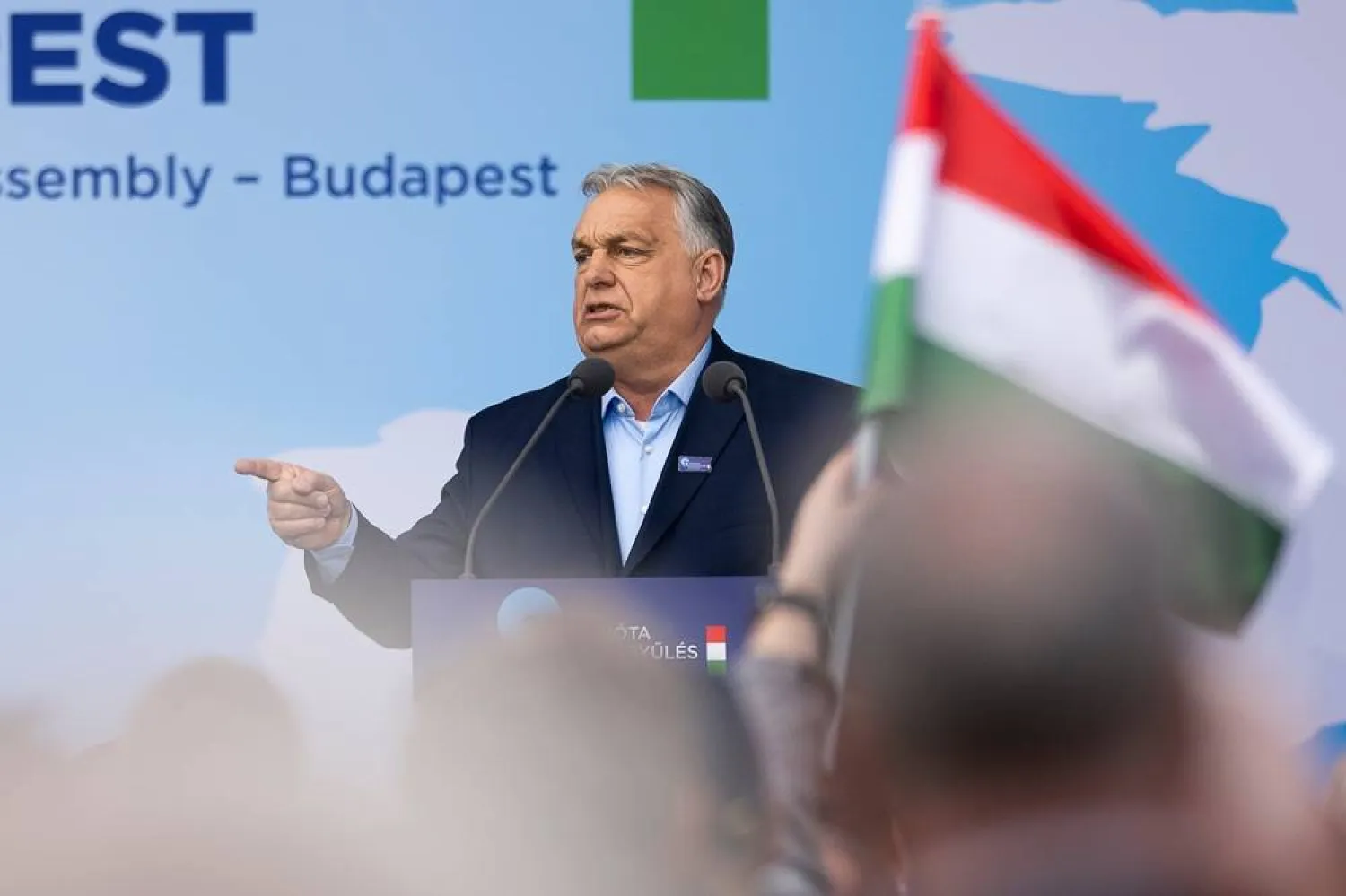
Hungarian Prime Minister Viktor Orban speaks during an assembly of European far-right parties with Orban’s Patriots for Europe group, in Budapest, Hungary, Monday, March 23, 2026. (AP)

Hungary's prime minister said on Wednesday that Budapest would phase out gas deliveries to Ukraine, the latest salvo in a bitter feud between the two countries over a damaged pipeline transporting Russian oil. 

Hungarian Prime Minister Viktor Orban, whose country is a major gas supplier to Ukraine, has accused Kyiv of delaying repairs on the pipeline, effectively stopping the flow of Russian oil to Hungary and its neighbor Slovakia. 

"To break the oil blockade and guarantee the security of Hungary's energy supply, new measures are now necessary," Orban said in a video posted on Facebook. 

"We are gradually halting gas shipments from Hungary to Ukraine and storing the gas that remains here domestically. Until Ukraine supplies oil, it will receive no gas from Hungary," he added. 

Ukrainian authorities have said that the Druzhba (Friendship) pipeline, which crosses its territory, was damaged by Russian airstrikes on January 27. 

Hungary and Slovakia, which have obtained exemptions from the European Union to continue purchasing Russian oil, accuse Kyiv of dragging their feet to repair it. 

In retaliation, Orban -- who is facing crucial parliamentary elections next month -- is blocking a European loan of 90 billion euros ($104 billion) to Ukraine. 

Last week, European Commission President Ursula von der Leyen announced that the EU would help reopen the Druzhba pipeline. 

Budapest and Bratislava are also blocking the official adoption of new economic sanctions against Russia, endorsed by other EU countries. 

According to analysts at the pro-government Hungarian Economic Research Foundation (Oeconomus), Hungary has become one of Ukraine's main gas suppliers. 

Ukraine imported 2.94 billion cubic meters of gas from Hungary in 2025, the top source for Ukrainian imports, accounting for 45.5 percent of all Ukrainian imports, Ukrainian consultancy ExPro said in a report. 

ExPro said separately that Ukraine's imports from Hungary were already slightly dropping as a share in 2026, down to 34 percent of Ukraine's import mix in March 2026. 

Ukraine's total gas consumption in 2025 was 21 billion cubic meters, the Dixi group consultancy said in a report in March, meaning Hungary accounted for 14 percent of Ukraine's total gas use in 2025. 


Iran Speaker Warns US Not to Test 'Resolve to Defend Our Land'

FILED - 12 October 2024, Lebanon, Beirut: Iranian Parliament speaker Mohammad Bagher Ghalibaf speaks during a press conference in Beirut. Photo: Hassan Ibrahim/Lebanese Parliament/dpa
TT

Iran Speaker Warns US Not to Test 'Resolve to Defend Our Land'

FILED - 12 October 2024, Lebanon, Beirut: Iranian Parliament speaker Mohammad Bagher Ghalibaf speaks during a press conference in Beirut. Photo: Hassan Ibrahim/Lebanese Parliament/dpa

Iran's parliament speaker on Wednesday warned Washington not to test Tehran’s determination to defend its territory after the United States was reported to be sending more troops to the Middle East.

"We are closely monitoring all US movements in the region, especially troop deployments.

What the generals have broke, the soldiers can't fix; instead, they will fall victim to (Israeli Prime Minister Benjamin) Netanyahu's delusions," said Mohammad Bagher Ghalibaf in an X post in English.

"Do not test our resolve to defend our land."

At least 1,000 troops from the 82nd Airborne Division will be sent to the Mideast in the coming days, three people with knowledge of the plans told The Associated Press. They spoke on condition of anonymity to discuss sensitive military plans.

The Pentagon is also in the process of deploying two Marine units that will add about 5,000 Marines and thousands of sailors to the region.