

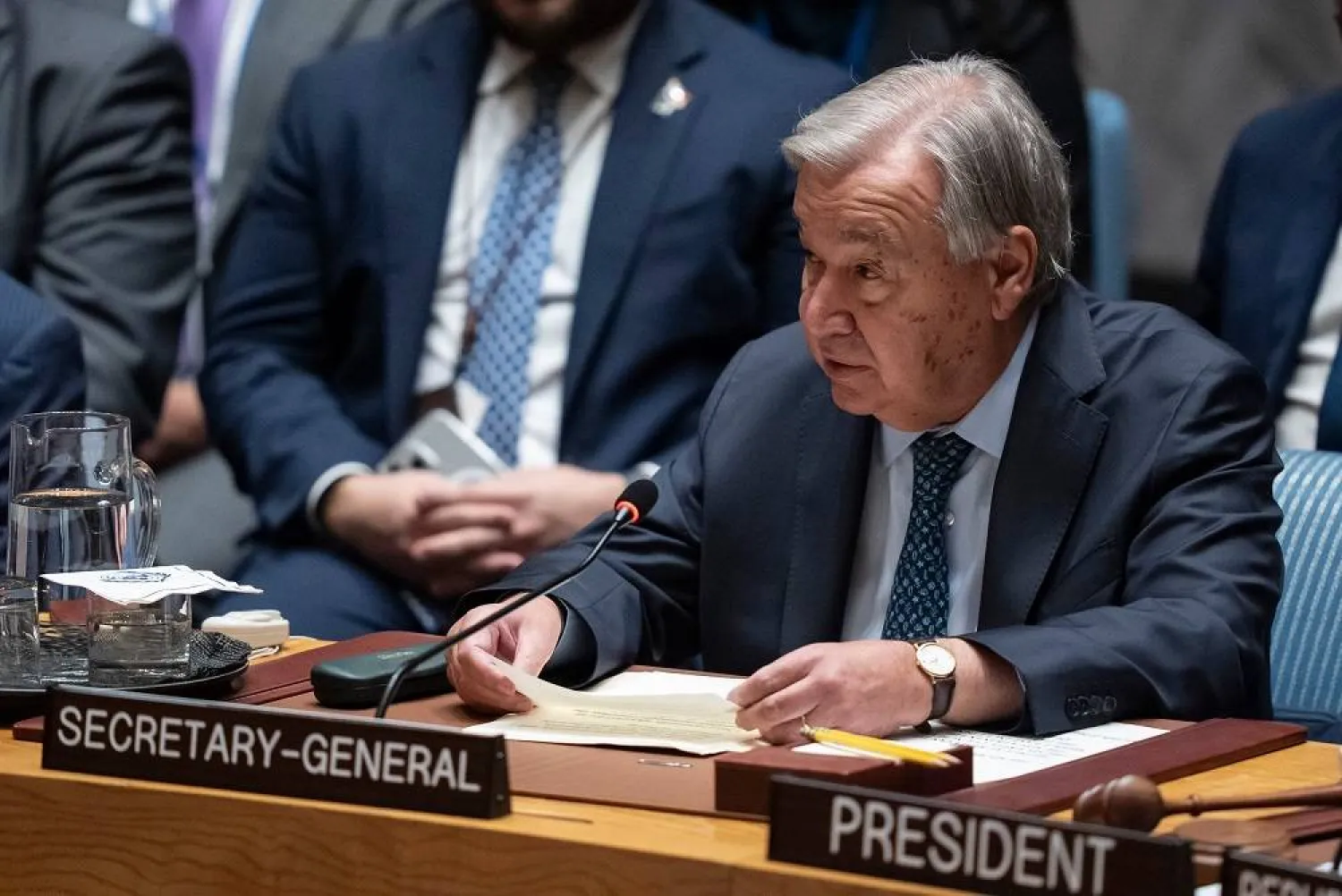

UN Chief Warns World Leaders of ‘An Age of Reckless Disruption and Relentless Human Suffering’ 

United Nations Secretary-General Antonio Guterres speaks during a Security Council meeting at the United Nations headquarters, Tuesday, Sept. 23, 2025, at UN headquarters. (AP)
TT

UN Chief Warns World Leaders of ‘An Age of Reckless Disruption and Relentless Human Suffering’ 

United Nations Secretary-General Antonio Guterres speaks during a Security Council meeting at the United Nations headquarters, Tuesday, Sept. 23, 2025, at UN headquarters. (AP)

With global peace and progress under siege, the United Nations chief challenged world leaders Tuesday to choose a future where the rule of law triumphs over raw power and where nations come together rather than scramble for self-interests.

Secretary-General Antonio Guterres said the UN’s founders faced the same questions 80 years ago, but he told today’s world leaders at the opening of their annual gathering at the General Assembly that the choice of peace or war, law or lawlessness, cooperation or conflict, is "more urgent, more intertwined, more unforgiving."

"We have entered an age of reckless disruption and relentless human suffering," he said in his annual "State of the World" speech. "The pillars of peace and progress are buckling under the weight of impunity, inequality and indifference."

But despite all the internal and external challenges facing the UN, he and General Assembly President Annalena Baerbock pleaded with its members not to give up. "If we stop doing the right things, evil will prevail," Baerbock said in her opening remarks.

Looking broadly at the changing world, Guterres said it is becoming increasingly multipolar – certainly a nod to rising economic powers China and India but a slap to the US insistence on superpower status. The UN chief said a world of many powers can be more diverse and dynamic but warned that without international cooperation and effective global institutions there can be "chaos."

President Donald Trump insisted in a nearly hour-long speech that the United States has the strongest borders, military, friendships "and the strongest spirit of any nation on the face of the earth." And he boasted, "This is indeed the golden age of America."

As for the United Nations, he told the packed assembly chamber that the 193-member world body failed to help him end and alleviate conflicts which he said many believe merit the Nobel Peace Prize.

"All they seem to do is write a really strongly worded letter," and not follow up, he said as he portrayed the UN as an ineffectual institution, from its policies to even its escalators. One of them had stopped unexpectedly as he and first lady Melania Trump were riding it toward the Assembly hall, and his teleprompter also wasn’t working.

A UN official said the United Nations understands that someone from the president’s party who ran ahead of him inadvertently triggered the stop mechanism on the escalator. The official, speaking on condition of anonymity because of the sensitivity of the issue, said the White House was operating the teleprompter for the president.

Trump reiterated that the UN has "tremendous, tremendous potential" but now delivers "empty words – and empty words don’t solve war."

But his tone shifted at a meeting with Guterres soon after. "Our country is behind the United Nations 100%," Trump told the UN chief. "I may disagree with it sometimes, but I am so behind it because the potential for peace at this institution is great."

Guterres told the General Assembly that the first obligation of world leaders is to choose peace, and without naming any countries, he urged all parties to stop supporting Sudan’s warring parties.

He also didn’t name Israel but used his strongest words against its actions in Gaza, saying the scale of death and destruction are the worst in his nearly nine years as secretary-general, and that "nothing can justify the collective punishment of the Palestinian people."

While Guterres has repeatedly said only a court can determine whether Israel has committed genocide in Gaza, he referred to the case South Africa brought to the UN’s highest court under the genocide convention by name and stressed its legally binding provisional measures, first and foremost to protect Palestinian civilians.

Since the International Court of Justice issued that ruling in January 2024, Guterres said, killings have intensified, and famine has been declared in parts of Gaza. He said the court’s measures "must be implemented fully and immediately."

The UN also is facing financial cuts as the US and some other nations pulled back funding or have yet to pay their dues. Guterres said aid cuts are "wreaking havoc," calling them "a death sentence for many."

Israeli-Palestinian conflict takes center stage

With global support for a Palestinian state growing, Israel’s devastating war in Gaza is taking center stage. But humanity’s myriad conflicts, rising poverty and heating planet will also be in the spotlight.

Türkiye's President Recep Tayyip Erdoğan began his speech voicing regret at the absence of Palestinian President Mahmoud Abbas, who was denied a visa by the United States.

He said he was standing at the assembly podium "for our Palestinian brothers and sisters whose voices are being silenced" while recognition of the state of Palestine is increasing is increasing. He thanked all countries that have done so and called on those that haven’t to do so "as soon as possible."

Indonesia’s President Prabowo Subianto also gave strong support to the Palestinians and warned the assembly that "human folly, fueled by fear, racism, hatred, oppression and apartheid threatens our common future."

"Every day we witness suffering, genocide and a blatant disregard for international law and human decency," the head of the world’s most populous Muslim nation said. "In the face of these challenges, we must not give up. ... We must draw closer, not drift further apart."

The General Assembly ’s big week of meetings began Monday with events including a conference on the Israeli-Palestinian conflict.

Tuesday's speakers also included Brazilian President Luiz Inacio Lula da Silva, Jordan’s King Abdullah II, French President Emmanuel Macron, South Korea’s President Lee Jae Myung and South African President Cyril Ramaphosa.

Da Silva — speaking first, under a longtime tradition dating to when Brazil was the only nation that volunteered to lead off — worried aloud that the UN’s authority was waning.

"We are witnessing the consolidation of an international order blocked by repeated concessions to power play," he said.

Geopolitical problems keep getting more complex

While the debate’s theme is "Better Together," observers can expect a rundown of ways in which the world is falling apart.

Gaza already has seized attention at the General Assembly. Monday’s conference, co-chaired by Saudi Arabia and France, focused on garnering support for the longstanding idea of a two-state solution to the Israeli-Palestinian conflict.

Almost all UN member nations have signed up to take their turn during the Assembly’s six-day-long speech-fest. The speakers’ list so far includes 89 heads of state, 43 heads of government, 10 vice presidents or deputy prime ministers, and 45 foreign ministers and other ministerial-level officials.



US Judge Blocks Deportation of Columbia University Palestinian Activist

Mohsen Mahdawi at a press conference in Vermont last year - Photo by Alex Driehaus/AP
TT

US Judge Blocks Deportation of Columbia University Palestinian Activist

Mohsen Mahdawi at a press conference in Vermont last year - Photo by Alex Driehaus/AP

A US immigration judge has blocked the deportation of a Palestinian graduate student who helped organize protests at Columbia University against Israel's war in Gaza, according to US media reports.

Mohsen Mahdawi was arrested by immigration agents last year as he was attending an interview to become a US citizen.

Mahdawi had been involved in a wave of demonstrations that gripped several major US university campuses since Israel began a massive military campaign in the Gaza Strip.

A Palestinian born in the occupied West Bank, Mahdawi has been a legal US permanent resident since 2015 and graduated from the prestigious New York university in May. He has been free from federal custody since April.

In an order made public on Tuesday, Judge Nina Froes said that President Donald Trump's administration did not provide sufficient evidence that Mahdawi could be legally removed from the United States, multiple media outlets reported.

Froes reportedly questioned the authenticity of a copy of a document purportedly signed by Secretary of State Marco Rubio that said Mahdawi's activism "could undermine the Middle East peace process by reinforcing antisemitic sentiment," according to the New York Times.

Rubio has argued that federal law grants him the authority to summarily revoke visas and deport migrants who pose threats to US foreign policy.

The Trump administration can still appeal the decision, which marked a setback in the Republican president's efforts to crack down on pro-Palestinian campus activists.

The administration has also attempted to deport Mahmoud Khalil, another student activist who co-founded a Palestinian student group at Columbia, alongside Mahdawi.

"I am grateful to the court for honoring the rule of law and holding the line against the government's attempts to trample on due process," Mahdawi said in a statement released by his attorneys and published Tuesday by several media outlets.

"This decision is an important step towards upholding what fear tried to destroy: the right to speak for peace and justice."


Fire Breaks out Near Iran's Capital Tehran, State Media Says

Smoke rises from a fire caused by an explosion in Tehran (File photo - Reuters)
TT

Fire Breaks out Near Iran's Capital Tehran, State Media Says

Smoke rises from a fire caused by an explosion in Tehran (File photo - Reuters)

A fire broke out in Iran's Parand near the capital city Tehran, state media reported on Wednesday, publishing videos of smoke rising over the area which is close to several military and strategic sites in the country's Tehran province, Reuters reported.

"The black smoke seen near the city of Parand is the result of a fire in the reeds around the Parand river bank... fire fighters are on site and the fire extinguishing operation is underway", state media cited the Parand fire department as saying.


Pakistan PM Sharif to Seek Clarity on Troops for Gaza in US Visit

US President Donald Trump looks at Pakistan's Prime Minister Shehbaz Sharif speaking following the official signing of the first phase of the Gaza ceasefire agreement between Israel and Hamas, during a world leaders' summit on ending the Gaza war, in Sharm El-Sheikh, Egypt, October 13, 2025. REUTERS/Evelyn Hockstein/File Photo
TT

Pakistan PM Sharif to Seek Clarity on Troops for Gaza in US Visit

US President Donald Trump looks at Pakistan's Prime Minister Shehbaz Sharif speaking following the official signing of the first phase of the Gaza ceasefire agreement between Israel and Hamas, during a world leaders' summit on ending the Gaza war, in Sharm El-Sheikh, Egypt, October 13, 2025. REUTERS/Evelyn Hockstein/File Photo

Before Pakistan commits to sending troops to Gaza as part of the International Stabilization Force it wants assurances from the United States that it will be a peacekeeping mission rather than tasked with disarming Hamas, three sources told Reuters.

Pakistan's Prime Minister Shehbaz Sharif is set to attend the first formal meeting of President Donald Trump's Board of Peace in Washington on Thursday, alongside delegations from at least 20 countries.

Trump, who will chair the meeting, is expected to announce a multi-billion dollar reconstruction plan for Gaza and detail plans for a UN-authorized stabilization force for the Palestinian enclave.

Three government sources said during the Washington visit Sharif wanted to better understand the goal of the ISF, what authority they were operating under and what the chain of command was before making a decision on deploying troops.

"We are ready to send troops. Let me make it clear that our troops could only be part of a peace mission in Gaza," said one of the sources, a close aide of Sharif.

"We will not be part of any other role, such as disarming Hamas. It is out of the question," he said.

Analysts say Pakistan would be an asset to the multinational force, with its experienced military that has gone to war with arch-rival India and tackled insurgencies.

"We can send initially a couple of thousand troops anytime, but we need to know what role they are going to play," the source added.

Two of the sources said it was likely Sharif, who has met Trump earlier this year in Davos and late last year at the White House, would either have an audience with him on the sidelines of the meeting or the following day at the White House.

Initially designed to cement Gaza's ceasefire, Trump sees the Board of Peace, launched in late January, taking a wider role in resolving global conflicts. Some countries have reacted cautiously, fearing it could become a rival to the United Nations.

While Pakistan has supported the establishment of the board, it has voiced concerns against the mission to demilitarize Gaza's militant group Hamas.