


Iran Weighs Confrontation or Diplomacy After UN Sanctions Reimposed over Its Nuclear Program

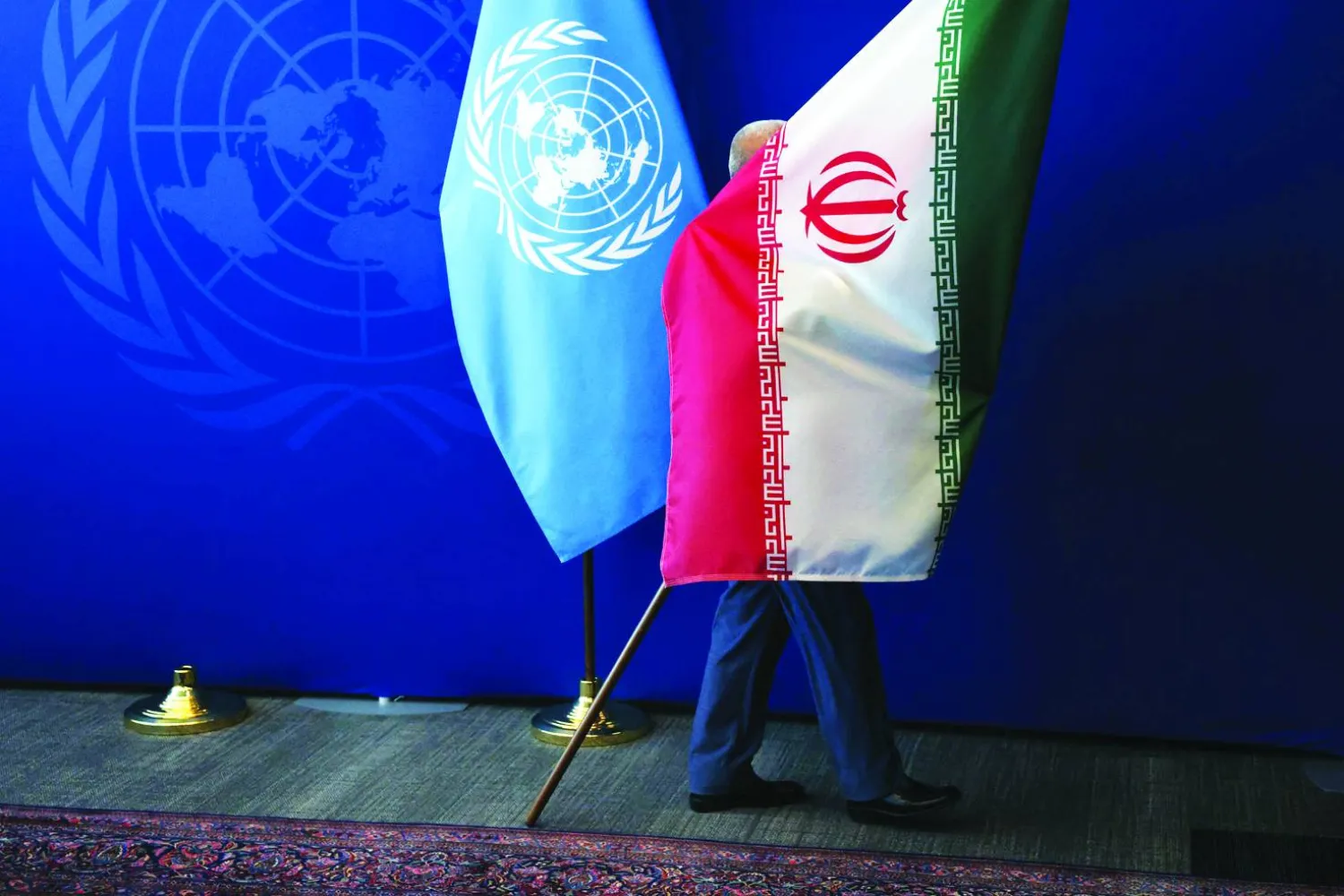
NEW YORK - SEPTEMBER 25: The Iranian flag is taken out of the room after Iranian President Masoud Pezeshkian met with the United Nations (UN) Secretary General Antonio Guterres during the UN's General Assembly on September 25, 2025, in New York City. Spencer Platt/Getty Images/AFP
TT

Iran Weighs Confrontation or Diplomacy After UN Sanctions Reimposed over Its Nuclear Program

NEW YORK - SEPTEMBER 25: The Iranian flag is taken out of the room after Iranian President Masoud Pezeshkian met with the United Nations (UN) Secretary General Antonio Guterres during the UN's General Assembly on September 25, 2025, in New York City. Spencer Platt/Getty Images/AFP

Iran's theocracy prepared Sunday for a possible confrontation with the West after the United Nations reimposed sanctions over its nuclear program, even as some pushed for continued negotiations to ease the economic pain squeezing the country. 

The sanctions imposed before dawn Sunday again freeze Iranian assets abroad, halt arms deals with Tehran and penalize any development of Iran’s ballistic missile program, among other measures. It came via a mechanism known as "snapback," included in Iran’s 2015 nuclear deal with world powers. 

Iran's Parliament briefly denounced the sanctions before going into a closed-door session likely to discuss the country's response, which could include abandoning the Nuclear Nonproliferation Treaty and rushing for the bomb. People worry about a new round of fighting between Iran and Israel, as well as potentially the United States, as missile sites struck during the 12-day war in June now appear to be being rebuilt. 

Meanwhile, Iran's rial currency fell to a new record low of 1.1 million to $1, sending food prices even higher and making daily life that much more challenging. 

"The government must negotiate. This is a world of business," said Mohsen Rahaei, a 49-year-old Tehran resident. "One must get along with everyone, with all countries. Until when we want to fight? We won’t gain anything." 

Iran considers withdrawing from treaty Iran tried a last-ditch diplomatic push at the UN General Assembly in New York this week, but efforts by its officials, as well as China and Russia, failed to stop the sanctions. 

Speaking to the Young Journalists Club, which is affiliated with Iranian state television, lawmaker Ismail Kowsari said Parliament would discuss withdrawing from the nuclear treaty. Nonproliferation experts fear such a move could see Iran follow a path first laid down by North Korea, which said it abandoned the treaty before obtaining nuclear weapons. 

Kowsari however said it wouldn't mean Iran would go for the bomb. Such a move would need the approval of Iran's 86-year-old Supreme Leader Ali Khamenei. Iranian diplomats have long pointed to Khamenei’s preachings as a binding fatwa, or religious edict, that Iran won’t build an atomic bomb. 

Parliament Speaker Mohammad Bagher Qalibaf issued his own warning to those who would honor the UN sanctions as the chamber began meeting Sunday. 

"We announce that if any country wants to take action against Iran based on these illegal resolutions, it will face serious reciprocal action from Iran, and the three European countries that are the initiators of this illegal action will also face our reaction," Qalibaf said without elaborating, according to a report by the state-run IRNA news agency. 

Parliament soon after entered a closed session, without any formal announcement on what, if anything, was decided. 

Iran warns against any military attack  

Leaders in both Iran's regular military and its paramilitary Revolutionary Guard both issued statements Sunday, warning that their forces were ready for any possible attack. Concerns have grown among the public that Israel could launch a new attack in the wake of the sanctions. 

Israel's Foreign Ministry applauded the sanctions being reimposed. 

"The goal is clear: prevent a nuclear-armed Iran," the ministry said. "The world must use every tool to achieve this goal." 

France, Germany and the United Kingdom triggered "snapback" over Iran 30 days ago, citing Tehran's restrictions of monitoring its nuclear program and the deadlock over its negotiations with the US. 

Iran further withdrew from the International Atomic Energy Agency monitoring after Israel’s war in June, which also saw the US strike nuclear sites in the Islamic Republic. 

Meanwhile, Iran still maintains a stockpile of uranium enriched up to 60% purity — a short, technical step away from weapons-grade levels of 90% — that is largely enough to make several atomic bombs, should Tehran choose to rush toward weaponization. 

Iran has long insisted its nuclear program is peaceful, though the West and IAEA say Tehran had an organized weapons program up until 2003. 

The three European nations on Sunday said they "continuously made every effort to avoid triggering snapback." But Iran "has not authorized IAEA inspectors to regain access to Iran’s nuclear sites, nor has it produced and transmitted to the IAEA a report accounting for its stockpile of high-enriched uranium." 

The nations also noted Iran enriches uranium at a level that no other peaceful program does. 

US Secretary of State Marco Rubio praised the three European nations for "an act of decisive global leadership" for imposing the sanctions on Iran and said "diplomacy is still an option." 

"For that to happen, Iran must accept direct talks," Rubio said. 

Tehran maintains ‘snapback’ shouldn't have happened  

Tehran has argued the three European nations shouldn’t be allowed to implement snapback, pointing in part to America’s unilateral withdrawal from the accord in 2018, during the first term of President Donald Trump’s administration. 

Iranian Foreign Minister Abbas Araghchi, speaking to Iranian state TV before the sanctions were imposed, sought to downplay the effect UN sanctions would have on the country. 

"It will have some damages, some losses for us," Araghchi said Saturday night. "However, they have presented it in their own media as something far greater and much bigger than it actually is, and they have tried to create a monster to frighten the Iranian people and then force our government and our foreign policy to give concessions and pay tribute in this regard." 

However, the Iranian public already say they feel the pinch of sanctions with the rial's fall and other economic pressures. One Tehran resident, who gave only his first name Najjari for fear of reprisal, warned against abandoning negotiations. 

"If we continue to get into a fight with the outside world and become isolated like North Korea, good things won’t happen at all," he said. "We’re already seeing the impact of this, the dollar rate is going up." 


Iran Warns US Troops, Israel Will Be Targets if America Strikes

FILE PHOTO: Protesters gather as vehicles burn, amid evolving anti-government unrest, in Tehran, Iran, in this screen grab obtained from a social media video released on January 9, 2026. Social Media/via REUTERS/File Photo
TT

Iran Warns US Troops, Israel Will Be Targets if America Strikes

FILE PHOTO: Protesters gather as vehicles burn, amid evolving anti-government unrest, in Tehran, Iran, in this screen grab obtained from a social media video released on January 9, 2026. Social Media/via REUTERS/File Photo

Nationwide protests challenging Iran’s regime saw protesters flood the streets in the country’s capital and its second-largest city into Sunday, crossing the two-week mark as violence surrounding the demonstrations has killed at least 116 people, activists said.

With the internet down in Iran and phone lines cut off, gauging the demonstrations from abroad has grown more difficult. But the death toll in the protests has grown, while 2,600 others have been detained, according to the US-based Human Rights Activists News Agency.

Meanwhile, Iran's parliament speaker warned the US military and Israel would be “legitimate targets” if America strikes Iran, as threatened by President Donald Trump.

Trump offered support for the protesters, saying on social media that “Iran is looking at FREEDOM, perhaps like never before. The USA stands ready to help!!!”

The New York Times and Wall Street Journal, citing anonymous US officials, said on Saturday night that Trump had been given military options for a strike on Iran, but hadn’t made a final decision.

The State Department separately warned: “Do not play games with President Trump. When he says he’ll do something, he means it.”

Iranian state television broadcast the parliament session live. Qalibaf gave a speech applauding police and Iran's Revolutionary Guard, particularly its all-volunteer Basij, for having “stood firm” during the protests.

“The people of Iran should know that we will deal with them in the most severe way and punish those who are arrested,” Qalibaf said.

He went on to directly threaten Israel, “the occupied territory” as he referred to it, and the US military, possibly with a preemptive strike.

“In the event of an attack on Iran, both the occupied territory and all American military centers, bases and ships in the region will be our legitimate targets,” Qalibaf said. “We do not consider ourselves limited to reacting after the action and will act based on any objective signs of a threat.”


Sources: Israel on High Alert for Possibility of US Intervention in Iran

In this frame grab from video taken by an individual not employed by The Associated Press and obtained by the AP outside Iran shows people during a protest in Tehran, Iran, Friday, Jan. 9, 2026. (UGC via AP)
TT

Sources: Israel on High Alert for Possibility of US Intervention in Iran

In this frame grab from video taken by an individual not employed by The Associated Press and obtained by the AP outside Iran shows people during a protest in Tehran, Iran, Friday, Jan. 9, 2026. (UGC via AP)

Israel is on high alert for the possibility of any US intervention in Iran as authorities there confront the biggest anti-government protests in years, according to three Israeli sources with knowledge of the matter.

President Donald Trump has repeatedly threatened to intervene ⁠in recent days and warned Iran’s rulers against using force against demonstrators. On Saturday, Trump said the US stands “ready to help”.

The sources, who were present ⁠for Israeli security consultations over the weekend, did not elaborate on what Israel’s high-alert footing meant in practice, Reuters reported. Israel and Iran fought a 12-day war in June.

In a phone call on Saturday, Israeli Prime Minister Benjamin Netanyahu and US Secretary ⁠of State Marco Rubio discussed the possibility of US intervention in Iran, according to an Israeli source who was present for the conversation. A US official confirmed the two men spoke but did not say what topics they discussed.


NKorea Says Another SKorean Drone Entered its Airspace

These images taken on January 4, 2026 and released as a combo image by North Korea's official Korean Central News Agency (KCNA) via KNS on January 10, 2026 shows an aerial view of Kaesong city, which North Korea claims is footage taken retrieved from a drone from South Korea that violated North Korean airspace and brought down by specialized electronic warfare assets. (Photo by KCNA VIA KNS / AFP)
TT

NKorea Says Another SKorean Drone Entered its Airspace

These images taken on January 4, 2026 and released as a combo image by North Korea's official Korean Central News Agency (KCNA) via KNS on January 10, 2026 shows an aerial view of Kaesong city, which North Korea claims is footage taken retrieved from a drone from South Korea that violated North Korean airspace and brought down by specialized electronic warfare assets. (Photo by KCNA VIA KNS / AFP)

North Korea said on Saturday that South Korea flew another drone into its airspace on January 4, infringing on its sovereignty, according to state media KCNA.

The announcement, which comes before North Korea holds a key party congress that will lay out policies for the next five years, sets the stage for cementing leader Kim Jong Un's rhetoric that South Korea is a foreign and hostile nation, an analyst said.

The drone, which originated from an island in the South Korean city of Incheon, flew 8 km (5 miles) before it was shot down inside North Korean airspace, KCNA said, citing a spokesperson for the North Korean military.

The drone was equipped with surveillance cameras to record "major" North Korean facilities, ⁠Reuters quoted KCNA as saying. Photos on KCNA showed a drone salvaged in pieces, electronic parts and aerial photos of buildings that KCNA said the drone had taken.

KCNA said the incident follows a September incursion by another South Korean drone that was shot over Kaesong.

"Even after the change of a regime... (South Korea) has continued to commit such acts of provocation by drones near the border," KCNA said, calling South Korea its "enemy most hostile".

Since South Korean President Lee Jae Myung took office in June, North Korea has rebuffed conciliatory gestures from Lee's administration. Lee had ⁠pledged to re-engage with Pyongyang to defuse tensions on the Korean Peninsula.

South Korea's military said on Saturday it does not operate the drone model in question, it did not operate drones on the date North Korea is claiming, and it will conduct a thorough investigation of a civilian possibly having operated the drone.

"We have no intention of provoking North Korea, and we will continue to take practical measures and efforts to ease... tensions and build trust," South Korea's military said in a statement.

The drone and electronics parts shown by North Korean state media are low-cost consumer products, and the captured video it revealed is of areas that do not have particular information value or military targets, said North Korean expert Hong Min at the Korea Institute for National Unification.

"The South Korean military already has a ⁠number of high-value assets that can clearly monitor the area near the armistice line," Hong said, making it unlikely that it was the South Korean military.

The timing of North Korea's mention of the drones is notable, as it comes just before North Korea's 9th Party Congress expected to be held soon.

Kim Jong Un's rhetoric of deeming the relationship between the two Koreas as two hostile countries, first introduced in 2024, is expected to be cemented further at the congress and may be put into North Korea's constitution this year, Hong said.

North Korea previously accused South Korea of sending a drone over Pyongyang in October 2024.

South Korea's former President Yoon Suk Yeol was accused by Seoul's special prosecutor late last year of ordering the Pyongyang drone operation to use military tensions between Pyongyang and Seoul as a justification for declaring emergency martial law.

Yoon has denied the charge, with his legal counsel saying the performance of the president's duties cannot be framed as a crime after the fact.
