


Swedes Stock Up on Food as Fears of War Deepen

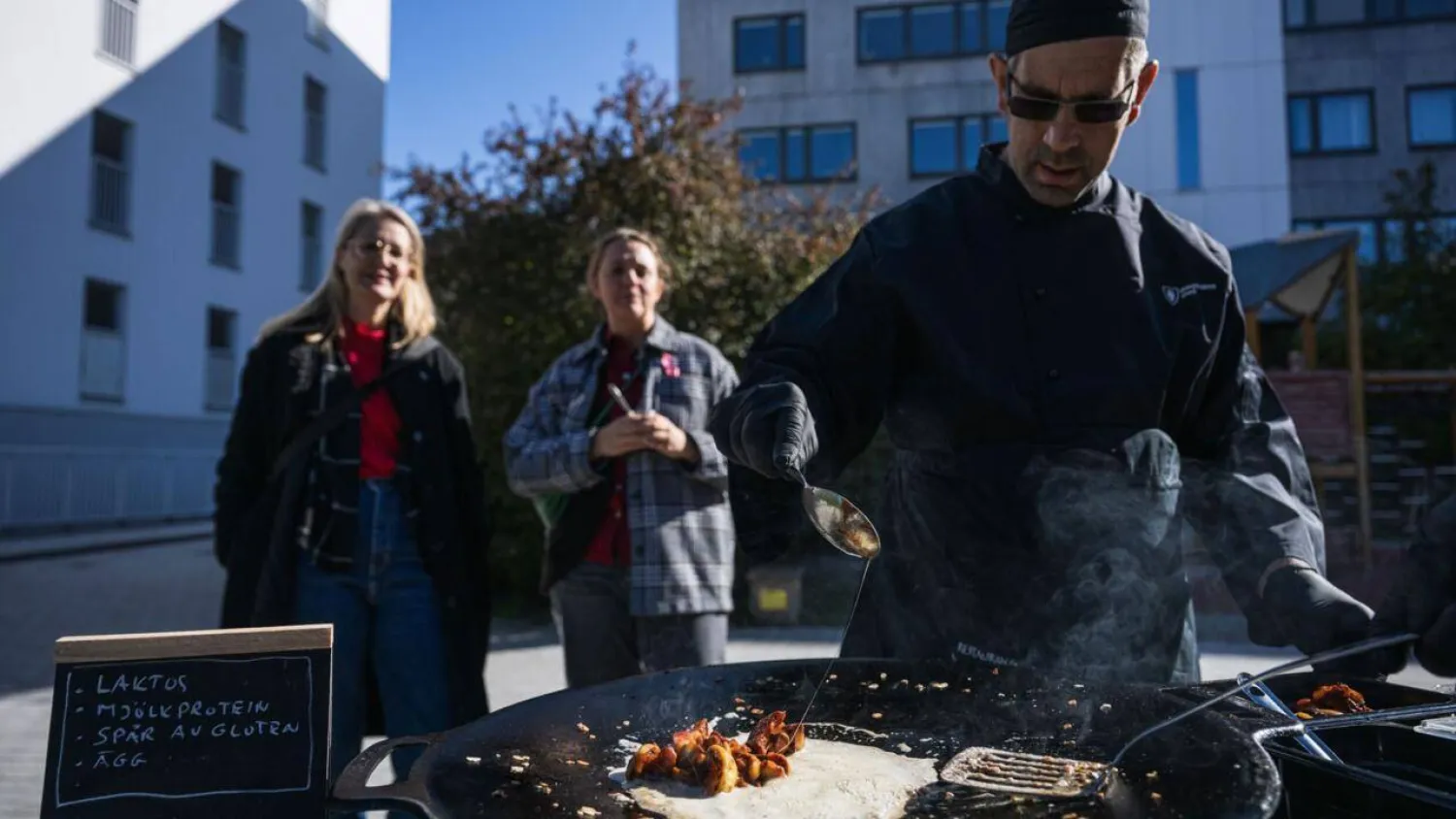
Onlookers watch as workers prepare a dish that can be made under emergency conditions. Jonathan NACKSTRAND / AFP
TT

Swedes Stock Up on Food as Fears of War Deepen

Onlookers watch as workers prepare a dish that can be made under emergency conditions. Jonathan NACKSTRAND / AFP

Swedes are stocking up on food items in case of war, as more conflict in Europe no longer feels like a distant possibility and authorities encourage measures to boost readiness.

At a civil preparedness fair in southwest Stockholm, 71-year-old Sirkka Petrykowska told AFP that she is taking the prospect of hostilities seriously and preparing as much as she can.

"I have bought a camping stove. I have taken a course on preservation in an old-fashioned way, where you can preserve vegetables, meat, and fruit that lasts for 30 years without a refrigerator," Petrykowska said.

"I've set aside blankets for warmth, I bought a gas burner for heating. I've also stocked up at my countryside home," she continued.

In late September, Sweden held its annual Preparedness Week, where authorities seek to raise awareness as part of the country's "total defense" strategy.

The country revived the strategy in 2015 following Russia's annexation of Crimea, and more measures were introduced -- including the appointment of a Minister for Civil Defense -- after Moscow's full-scale invasion of Ukraine in 2022.

The idea is to mobilize all of society, from authorities to citizens and businesses, to collectively resist armed aggression while maintaining essential functions.

Pesto, powdered milk and dried meat

The focus, as it often is in Sweden, is on individual responsibility.

Everyone is encouraged to stockpile enough food to live independently for at least seven days without external aid in the event of a crisis.

That means "resources can initially be directed for instance to elderly and sick people", the Swedish Food Agency writes on its website.

"Meanwhile, society has time re-adjust so that everyone can get help," it continues.

The Swedish Civil Contingencies Agency (MSB) has published a list of recommended foods that are high in fat and protein, and easy to store.

It includes pesto, dried meat or fish, jam, chocolate, mashed potatoes, powdered milk and biscuits.

"In a war scenario, people will be more physically active than under normal circumstances," Oskar Qvarfort, emergency planning officer at the Swedish Food Agency, told AFP, adding that on average the increased need will be about 100 calories.

Martin Svennberg, a business developer from Stockholm, has taken the advice to heart and stockpiled ample food reserves in his basement for his family.

Stacked in boxes in a cramped storage unit are 100 kilograms of flour, dozens of cans of various foods, and an array of freeze-dried meals, enough to last them three months.

For him, the food is not just for sustenance but also for moral support, which is essential in such situations, he stressed to AFP.

"Stocking up on food that you like and that you eat in normal life, I think that is really important," he said.

"I mean when you go to your mum's place or dad's place and you get the food that they made for you as a kid, you get that sense of relief and nostalgia. The same thing goes for food in a crisis," Svennberg said.

'Real challenge'

According to an MSB survey of 2,000 people, 86 percent of Swedes believe the country is worth defending in the event of a military attack, and 76 percent would be willing to defend it as part of Swedish civil defense.

The agency has twice sent out a brochure to all Swedish households informing them of how to act in a crisis, once in 2018 and then in 2024.

The survey, published in March, showed that 39 percent of people felt "worried" when receiving the 2024 edition, compared to 24 percent in 2018.

Sweden also faces logistical challenges owing to its large size, with many areas sparsely populated.

"A large part of food production is concentrated in the south ... and the majority of imports also primarily arrive in these regions," Qvarfort said.

Food transportation would therefore be "a real challenge" in the event of an armed conflict, he said, adding that Ukraine is currently facing the same issue.



Russia's Lavrov Says Work Under Way on Putin's Order on Possible Russian Nuclear Test

Russian Foreign Minister Sergei Lavrov - Reuters
TT

Russia's Lavrov Says Work Under Way on Putin's Order on Possible Russian Nuclear Test

Russian Foreign Minister Sergei Lavrov - Reuters

Russian Foreign Minister Sergei Lavrov said on Saturday that work is under way on President Vladimir Putin's order to prepare proposals for a possible Russian nuclear test, state news agency TASS reported.

According to TASS, Lavrov said: "Regarding President Vladimir Putin's instruction at the Security Council meeting on November 5, it has been accepted for implementation and is being worked on. The public will be informed of the results."

The order was in response to President Donald Trump's surprise announcement last week that the US would resume testing.

TASS also cited Lavrov as saying that Russia had received no clarification from the US regarding Trump's order, Reuters reported.

Russia-US relations have deteriorated sharply in the past few weeks as Trump, frustrated with a lack of progress towards ending the war in Ukraine, has cancelled a planned summit with Putin and imposed sanctions on Russia for the first time since returning to the White House in January.


Tornado in Southern Brazil Kills Six, Injures Hundreds

This handout photo released by the Parana State Government shows the destruction after a tornado with winds of up to 250 kilometers per hour hit the city of Rio Bonito do Iguacu, in Brazil's Parana State on November 7, 2025. A tornado killed at least five people and injured around 130 when it swept through parts of a town in southern Brazil on November 7, authorities said. (Photo by Handout / Parana State Government / AFP) /
TT

Tornado in Southern Brazil Kills Six, Injures Hundreds

This handout photo released by the Parana State Government shows the destruction after a tornado with winds of up to 250 kilometers per hour hit the city of Rio Bonito do Iguacu, in Brazil's Parana State on November 7, 2025. A tornado killed at least five people and injured around 130 when it swept through parts of a town in southern Brazil on November 7, authorities said. (Photo by Handout / Parana State Government / AFP) /

A tornado accompanied by strong winds and heavy rain struck the southern Brazilian state of Parana, killing six people, the state government said on Saturday.

The town of Rio Bonito do Iguacu was hit hardest late Friday, with the state's civil defense agency reporting that over half of the urban area suffered roof collapses, along with multiple structural failures.

Roads were blocked and power lines damaged, Reuters reported.

Authorities said 437 people were treated for injuries and about 1,000 were displaced. The nearby city of Guarapuava was also affected.

According to the Parana Meteorology and Environmental Monitoring System, the tornado's winds reached speeds between 180 kph (111 mph) and 250 kph (155 mph).

Institutional Relations Minister Gleisi Hoffmann said she would travel to the area on Saturday with acting Health Minister Adriano Massuda and other federal officials to support relief efforts and reconstruction.

"We will continue to assist the people of Parana and provide all the help needed," President Luiz Inacio Lula da Silva wrote on X, expressing condolences to the victims' families.


Russia Hits Several Key Ukraine Energy Facilities, Kills 3 People

In this handout photograph taken and released by the Dnipropetrovsk Regional Military Administration on November 8, 2025, Ukrainian rescuers work at the site of a heavily damaged residential building following an air attack in Dnipro, amid the Russian invasion of Ukraine. (Photo by Handout / Dnipropetrovsk Regional Military Administration / AFP)
TT

Russia Hits Several Key Ukraine Energy Facilities, Kills 3 People

In this handout photograph taken and released by the Dnipropetrovsk Regional Military Administration on November 8, 2025, Ukrainian rescuers work at the site of a heavily damaged residential building following an air attack in Dnipro, amid the Russian invasion of Ukraine. (Photo by Handout / Dnipropetrovsk Regional Military Administration / AFP)

Russia launched a barrage of drones and missiles in overnight attacks on Ukraine on Saturday, killing at least three people and damaging large energy infrastructure facilities in three regions, Ukrainian officials said.

President Volodymyr Zelenskiy said Russia had launched more than 450 drones and 45 missiles.

Two people were killed and 12 wounded in the city of Dnipro when a drone hit an apartment building. One person was killed in the Kharkiv region, regional officials said. Energy facilities in the Kyiv, Poltava and Kharkiv regions were damaged, Prime Minister Yulia Svyrydenko said.

Zelenskiy said the strikes showed that sanctions pressure should be intensified. "... for every Moscow strike on energy infrastructure – aimed at harming ordinary people before winter – there must be a sanctions response targeting all Russian energy, with no exceptions," he said on the Telegram app.

Since the start of its full-scale assault on Ukraine almost four years ago, Russia has made a point of attacking the power sector as the need for heating grows.

This autumn it has attacked gas facilities nine times in the space of two months, according to the state energy firm Naftogaz.

Moscow's Defense Ministry said it had launched "a massive strike with high-precision long-range air, ground and sea-based weapons" on weapon production and energy facilities in response to Kyiv's strikes on Russia.

Russia also said its forces continued to advance in grinding battles around the key towns of Pokrovsk and Kupiansk, and had captured a tiny village in eastern Ukraine. Ukraine regularly sends its drones to strike oil facilities inside Russia.

As diplomatic efforts to stop the war have faltered, Kyiv is trying to reduce Moscow's ability to finance its war.

The Ukrainian air force said 406 Russian drones and nine missiles had been shot down, and 26 Russian missiles and 52 drones had hit 25 sites. Svyrydenko said the government and energy companies were working to restore damaged electricity, water and heating provision.

In the central Poltava region, two cities - Kremenchuk with a population of about 200,000 people and Horishni Plavni with some 50,000 residents - lost most of their electricity and were using generators to provide water, city officials said.