
2 Powerful Quakes Strike Off Southern Philippines, at Least 7 Dead

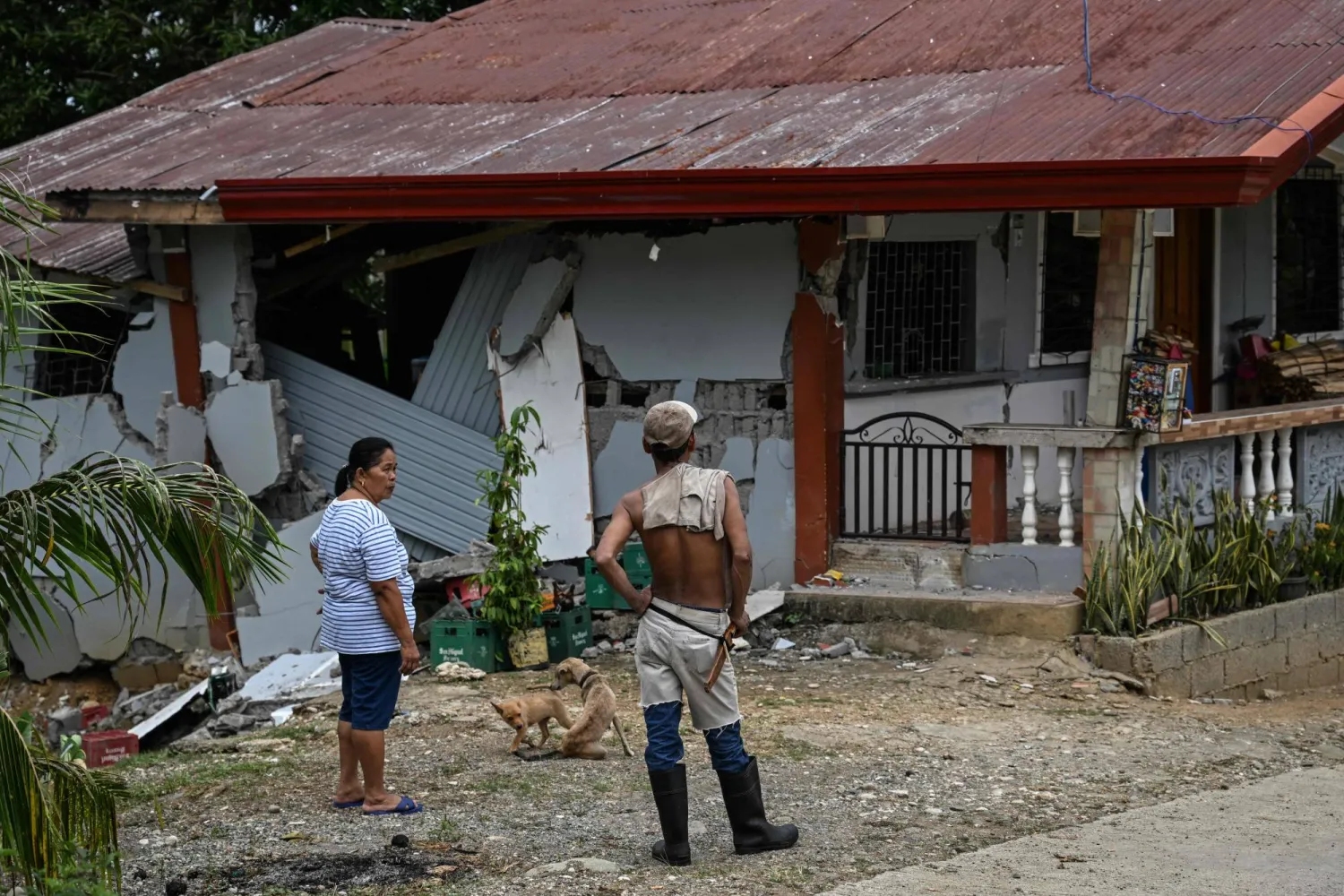
People look at a damaged house in Manay, in the province of Davao Oriental on October 11, 2025. (Photo by Jam STA ROSA / AFP)
TT

2 Powerful Quakes Strike Off Southern Philippines, at Least 7 Dead

People look at a damaged house in Manay, in the province of Davao Oriental on October 11, 2025. (Photo by Jam STA ROSA / AFP)

Two powerful offshore earthquakes struck the same region in the southern Philippines hours apart on Friday with the first 7.4 magnitude temblor killing at least seven people, setting off landslides and prompting evacuations of coastal areas nearby because of a brief tsunami scare.

The second one had a preliminary 6.8 magnitude and also sparked a local tsunami warning by authorities. It was caused by movement in the same fault line, the Philippine Trench, at a depth of 37 kilometers (23 miles) off Manay town in Davao Oriental province, Philippine Institute of Seismology and Volcanology chief Teresito Bacolcol said.

“The second one is a separate earthquake, which we call a doublet quake,” Bacolcol told The Associated Press. “Both happened in the same area but have different strengths and epicenters.”

Bacolcol and other authorities expressed fears that the second nighttime earthquake could further weaken or collapse structures already undermined by the first one.

President Ferdinand Marcos Jr., facing his latest natural disaster after a recent deadly quake and back-to-back storms, said the potential damage was being assessed and rescue teams and relief operations were being prepared and would be deployed when it was safe to do so.

Quake toll The first quake was centered at sea about 43 kilometers (27 miles) east of Manay town and was caused by movement in the Philippine Trench at a depth of 23 kilometers (14 miles), government seismologists said.

At least seven people were killed, including two patients who died of heart attacks at a hospital during the first earthquake and a resident who was hit by debris in Mati city in Davao Oriental, Ednar Dayanghirang, regional director of the government's Office of Civil Defense, told The AP.

Three villagers died and several others were rescued with injuries by army troops and civilian volunteers in a landslide set off by the first quake in a remote gold-mining village in Pantukan town in Davao de Oro province near Davao Oriental, Dayanghirang said.

Another resident died because of the first quake in the port city of Davao, disaster mitigation officials said without providing other details. They added that a few hundred residents were injured in the city.

Damage assessment Office of Civil Defense deputy administrator Bernardo Rafaelito Alejandro IV said that several buildings sustained cracks in their walls, including an international airport in Davao city, but it remained operational without any flights being canceled.

“I was driving my car when it suddenly swayed and I saw power lines swaying wildly. People darted out of houses and buildings as the ground shook and electricity came off,” Jun Saavedra, a disaster-mitigation officer of Governor Generoso town in Davao Oriental, told The AP.

Schools evacuated “We've had earthquakes in the past, but this was the strongest,” Saavedra said, adding that the intense ground swaying caused cracks in several buildings, including a high school, where about 50 students were brought to a hospital by ambulance after sustaining bruises, fainting or becoming dizzy because of the first quake.

Governor Generoso is a town about 100 kilometers (60 miles) south of Manay, where school classes in all levels were also suspended.

Children evacuated schools in Davao city, which has about 5.4 million people and is the biggest city near the epicenter, about 250 kilometers (155 miles) west of Davao Oriental province.

Tsunami fears The Pacific Tsunami Warning Center in Honolulu said that small waves were detected on the coasts of the Philippines and Indonesia before the threat passed about two hours after the first quake. It said that small sea fluctuations may continue.

A tsunami warning that set off evacuations in six coastal provinces near Davao Oriental was later lifted without any major waves being detected, Bacolcol said.

Indonesia’s Meteorology, Climatology and Geophysics Agency said that small tsunami waves were detected in North Sulawesi province with heights ranging from 3.5 to 17 centimeters (1.3 to 6.7 inches) in Melonguane, Beo, Essang and Ganalo in Talaud Islands districts.

History of quakes and storms The Philippines is still recovering from a Sept. 30 earthquake with a 6.9 magnitude that left at least 74 people dead and displaced thousands of people in the central province of Cebu, particularly in Bogo city and outlying towns.

The archipelago also is lashed by about 20 typhoons and storms each year, making disaster response a major task of the government and volunteer groups.

Also Friday, an earthquake with a preliminary magnitude of 6.0 struck Friday off the coast of Papua New Guinea. The US Geological Survey said that it was centered in the Bismarck Sea 414 kilometers (257 miles) northeast of Lae, the South Pacific island nation’s second-most populous city.

Lae police official Mary Jane Huafilong said that no damage was reported.


Türkiye Preparing Law to Let PKK Fighters Return under Peace Plan

(FILES) Supporters display a poster depicting jailed leader of the Kurdistan Workers' Party (PKK) Abdullah Ocalan, after he called on the Kurdistan Workers' Party (PKK) to disarm and dissolve itself in Diyarbakir, southeastern Türkiye, on February 27, 2025.(Photo by Yasin AKGUL / AFP)
TT

Türkiye Preparing Law to Let PKK Fighters Return under Peace Plan

(FILES) Supporters display a poster depicting jailed leader of the Kurdistan Workers' Party (PKK) Abdullah Ocalan, after he called on the Kurdistan Workers' Party (PKK) to disarm and dissolve itself in Diyarbakir, southeastern Türkiye, on February 27, 2025.(Photo by Yasin AKGUL / AFP)

Türkiye is preparing a law to let thousands of Kurdistan Workers Party (PKK) fighters and civilians return home from hideouts in northern Iraq under negotiations to end generations of war.

A senior Middle East official and a Kurdish political party source in Türkiye said the proposed law would protect those returning home but stop short of offering a general amnesty for crimes committed by former militants. Some militant leaders could be sent to third countries under the plans.

Bringing PKK guerrillas and their families home from their bases in mountainous northern Iraq is seen as one of the final hurdles in a peace process launched a year ago to end a war that has killed 40,000 people.

While officials have spoken publicly about reconciliation efforts in general terms, the sources disclosed details that have not previously been reported, including proposals for returns to take place in separate waves of civilians and fighters, and for commanders to be sent to third countries.

The Middle East official, describing the sensitive negotiations on condition of anonymity, said legislation to allow the returns could come before the Turkish parliament as soon as this month.

PLAN COULD INCLUDE SEPARATE WAVES OF RETURNS

Türkiye‘s intelligence agency MIT, which has led talks with the PKK, did not immediately comment on the proposal. The PKK did not immediately comment.

Since Kurdish militants launched their insurgency in 1984 - originally with the aim of creating an independent Kurdish state - the conflict has exerted a huge economic and social burden on Türkiye and neighboring countries.

Ending it would boost NATO member Türkiye’s political and economic stability, and ease tensions in Iraq where the PKK is based, and Syria where Kurdish fighters have been allied with US forces.

In a major breakthrough, the PKK announced a decision in May to disarm and disband after a call to end its armed struggle from its jailed leader Abdullah Ocalan.

In July the group symbolically burned weapons, and last month it announced it was withdrawing fighters from Türkiye as part of the disarmament process. It called on Ankara to take steps to let its members participate in "democratic politics".

But the terms of reconciliation have been sensitive, with Türkiye wary of offering a wide amnesty for what it considers past crimes of a terrorist organization.

Numan Kurtulmus, who heads a reconciliation commission set up by Türkiye in August, said last week that any legal steps would come only after Türkiye verifies that the PKK has completed its dissolution process.

"Once Türkiye’s security and intelligence units have verified and confirmed that the organiئation has truly laid down its arms and completed its dissolution process, the country will enter a new phase of legal regulations aimed at building a terror-free Türkiye," he said.

According to the senior Middle East official, the proposal now being discussed would see roughly 1,000 civilians and non-combatants return first, followed by about 8,000 fighters after individual screening.

Beyond that, the official said Türkiye had so far rejected taking back around 1,000 senior and mid-level PKK figures, and wants them relocated to a third country, possibly in Europe.

Talks were ongoing on that issue, with some parties involved in the negotiations concerned that excluding PKK top brass from repatriation could eventually fuel a renewed insurgency, the official said.

Legislation to enable returns could come before the Turkish parliament as early as the end of November, the official added.

Tayip Temel, deputy co-chair of the pro-Kurdish DEM Party - which though an opposition party has worked closely with the government on the peace process - said the ongoing negotiations focused on a formula personally emphasiئed by Ocalan.

"Work is underway on a special law for the PKK to enable the democratic and social reintegration of its members," Temel told Reuters.

"The law will cover everyone returning from the PKK, whether civilian or militant. There is no plan for a phased return. The formula being worked on is comprehensive and applies to all."

He confirmed that Türkiye had raised the idea of some PKK figures being sent to third countries, but said this would have to be discussed with the potential hosts.

DIFFERENT PROCEDURES FOR DIFFERENT GROUPS

Another source at DEM, parliament's third-biggest party, said the commission drafting the proposal was working on a single, PKK-specific law that would avoid the language of a general amnesty.

"Different procedures will apply to different groups of returnees," the source said, adding that some returning PKK members will likely face investigations and trials. "Otherwise it will be hard to reach common ground among parties in the commission."

Once the parliamentary commission completes its work, it is expected to recommend the special PKK law to parliament, paving the way for potential legislation.

Human Rights Watch urged lawmakers to use the peace process to reform laws that have long been used to charge and incarcerate non-violent Kurdish activists.

The commission "has a unique opportunity to help shape a post-conflict society and should make bold recommendations to repeal abusive laws used to silence and marginalize people," said Hugh Williamson, Europe and Central Asia director at HRW.


Russia Urges Trump Administration to Clarify 'Contradictory' Signals on Nuclear Testing

Representation photo: This photograph shows a general view of Kurskaya nuclear power plant taken outside the town of Kurchatov on August 27, 2024. (Photo by TATYANA MAKEYEVA / AFP)
TT

Russia Urges Trump Administration to Clarify 'Contradictory' Signals on Nuclear Testing

Representation photo: This photograph shows a general view of Kurskaya nuclear power plant taken outside the town of Kurchatov on August 27, 2024. (Photo by TATYANA MAKEYEVA / AFP)

Russia urged the United States on Friday to clarify what it called contradictory signals about a resumption of nuclear testing, saying such a step would trigger responses from Russia and other countries.

President Donald Trump last week ordered the US military to immediately restart the process for testing nuclear weapons. But he did not make clear if he meant flight-testing of nuclear-capable missiles or a resumption of tests involving nuclear explosions - something neither the US nor Russia has done for more than three decades.

"If it is the latter, then this will create negative dynamics and trigger steps from other states, including Russia, in response," Russian Foreign Ministry spokeswoman Maria Zakharova told reporters.

"For now, we note that the signals emanating from Washington, which are causing justified concern in all corners of the world, remain contradictory, and, of course, the real state of affairs must be clarified."

Citing the lack of clarity around US plans, President Vladimir Putin on Wednesday instructed top officials to prepare proposals for Russia to carry out its own potential nuclear test in response to any US test.

Security analysts say a resumption of testing by any of the world's nuclear powers would be a destabilizing step at a time of acute geopolitical tension, notably over the war in Ukraine, and would likely prompt other countries to follow suit.

Russia and the US possess the world's largest nuclear arsenals.

The last remaining treaty between them that limits the number of strategic nuclear warheads on both sides is due to expire in three months, potentially fueling an arms race that is already in progress.

Putin has proposed that both sides continue to observe the treaty limits for another year, but Trump has yet to respond formally to the idea.


Russia Says It’s Ready to Respond to Venezuela’s Appeal for Help 

Russian President Vladimir Putin shakes hands with his Venezuelan counterpart Nicolas Maduro during a meeting at the Kremlin in Moscow, Russia, May 7, 2025. (Alexander Zemlianichenko/Pool via Reuters)
TT

Russia Says It’s Ready to Respond to Venezuela’s Appeal for Help 

Russian President Vladimir Putin shakes hands with his Venezuelan counterpart Nicolas Maduro during a meeting at the Kremlin in Moscow, Russia, May 7, 2025. (Alexander Zemlianichenko/Pool via Reuters)

Russia is prepared to respond to Venezuela's requests for assistance, while urging against any escalation of tension in the region, Foreign Ministry spokeswoman Maria Zakharova said on Friday.

Venezuelan President Nicolas Maduro has appealed to Moscow for military support, including repairs to Russian-made Sukhoi fighter jets, upgrades to radar systems, and the delivery of missile systems.

The request was made in response to what Caracas views as growing threats from Washington, which has built up a large military presence in the Caribbean in recent months.