
Iran ‘Closer to Paralysis’ After Year of War, Sanctions

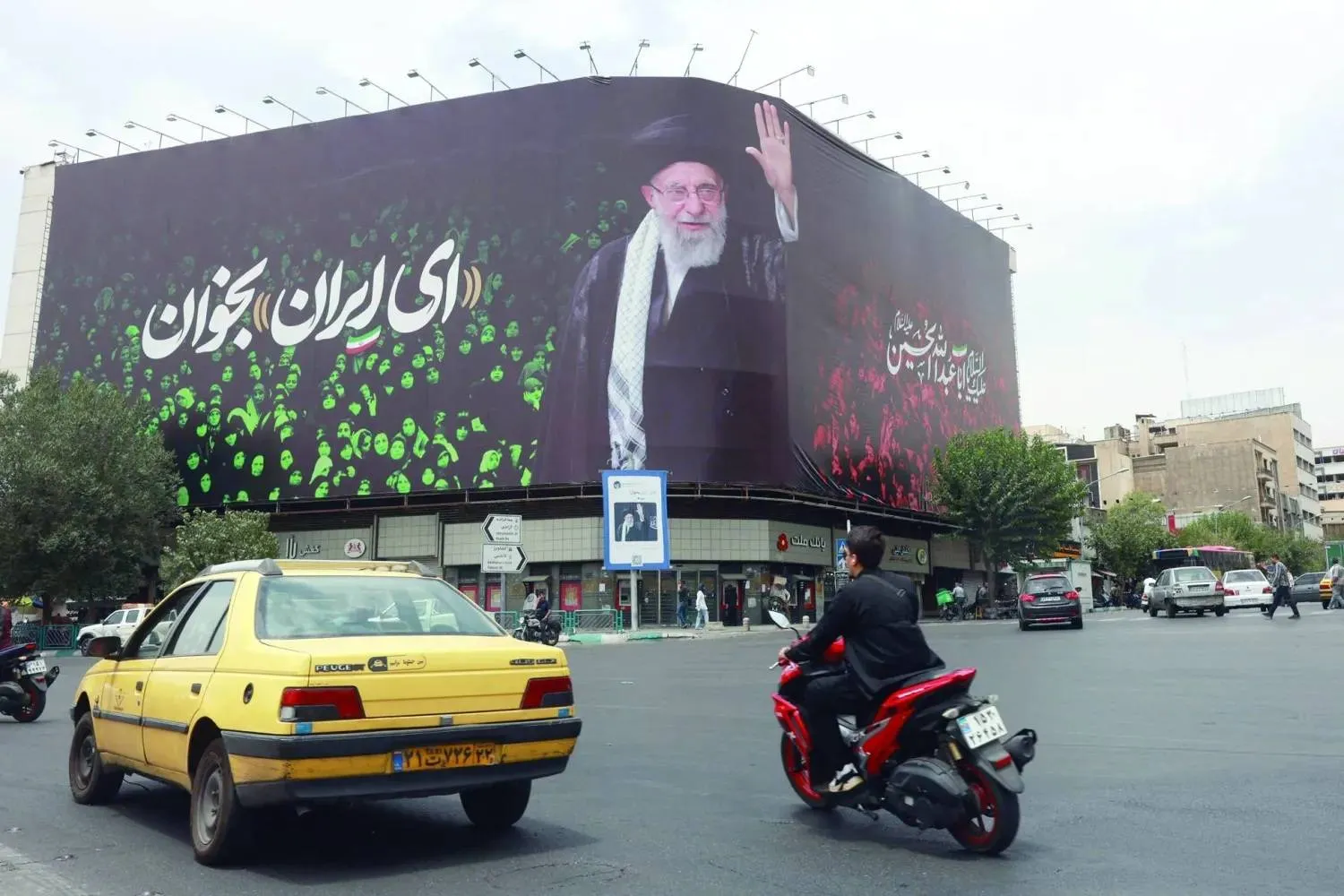
Cars pass a billboard of Khamenei reading “O Iran” at Enghelab (Revolution) Square in central Tehran (AFP)
TT

Iran ‘Closer to Paralysis’ After Year of War, Sanctions

Cars pass a billboard of Khamenei reading “O Iran” at Enghelab (Revolution) Square in central Tehran (AFP)

Iran has come under bombardment, faced the reinstatement of United Nations sanctions, and seen its economy sink deeper into crisis this year.

An analysis published by the AP points to Iran still not taking any major action to halt the slide, restart crucial nuclear negotiations with the West nor fully prepare for possible further hostilities with Israel and the US.

In the past, Iran’s 86-year-old Supreme Leader Ali Khamenei heralded the benefit of Tehran’s “strategic patience” in confronting its enemies.

According to The AP, concern is growing that patience has slipped into paralysis as Iran’s partners in its self-described “Axis of Resistance” have been devastated and there’s no overt sign of materiel support from either China or Russia.

“One of the harms and dangers facing the country is precisely this state of neither war nor peace, which isn’t good,” Khamenei himself warned in September.

But there’s been no move to change that calculus, as Iranians themselves remain fearful of war resuming. Each fire or industrial accident becomes grist for new worry as they watch their life savings further dwindle as Iran’s rial currency falls to historic lows against the US dollar.

“Even if we accept that the possibility of a second war exists, the right approach to governing the country is not to keep public opinion in constant anxiety through recurring alerts every few days,” said Ali Abdullah Khani, an analyst with Iran’s Presidential Strategic Affairs Office, in an interview published in October by the website NourNews.

“Such a policy places the nation in a permanent state of crisis, a condition in which it always seems that war could break out at any moment, and as a result, all managerial and political capacities are consumed by confronting a presumed and hypothetical conflict.”

Iran Tries to Talk Sanctions Away

The United Nations reimposed sanctions on Iran last month, but Tehran has sought to downplay their effect or even insist they don’t exist. The sanctions date from Tehran’s 2015 nuclear deal and were reimposed by a mechanism known to diplomats as “snapback.”

China, Iran and Russia issued a tripartite statement over the weekend, decrying them as “legally and procedurally flawed.”

But while China and Russia have signaled they won’t enforce the sanctions, the US, European nations and others are.

Some of the measures are pretty out of date, for instance, sanctions on Iranian Revolutionary Guard Gen. Qassem Soleimani, who was killed in a US drone strike in Baghdad during President Donald Trump’s first term in 2020.

But the main ones squeeze Iran’s Central Bank and its oil exports, one of the few sources of hard currency for the government. That could allow for the seizure of Iranian crude oil shipments on the seas, something that in the past has sparked confrontations with Tehran.

Iranian Gov’t at Odds

The June war saw Israel kill top leadership in Iran’s regular military and its paramilitary Revolutionary Guard, a force answerable only to Khamenei that controls its own arsenal of ballistic missiles. In the time since, Iran has held no major military parades and conducted only limited drills at sea, likely out of the concern of providing Israel with any tempting targets.

Criticism is slowly rising to the surface of Iran’s theocracy, which under Khamenei has grown into various competing camps and agencies often tasked with the same missions.

Ali Shamkhani, a top adviser to Khamenei who survived an Israeli attack targeting him during the war, said in an online video that Iran’s earlier attacks against Israel in 2024 “did not achieve the outcomes” sought by Tehran, a rare acknowledgment by a senior official of the low accuracy plaguing the theocracy’s vaunted missile arsenal.

He also even went as far as to openly muse about Iran pursuing a nuclear weapon — something Tehran long has insisted it doesn’t want to do despite the West and the International Atomic Energy Agency saying the Islamic Republic had an organized weapons program up until 2003.

“Now that it has become clear, Iran should have developed this capability for itself,” Shamkhani said.

Khamenei Halts Talks with West

Then there is Khamenei himself, with no clear front-runner to succeed him. His profile has dropped since the war, with more delays surrounding the release of his remarks — likely again a security measure against possibly being targeted by Israel.

Yet at a moment when talks with the US and the Europeans represent one path out of Iran’s issues, he’s been adamant that negotiations can’t be held. He gave a speech as both Iranian President Masoud Pezeshkian and Foreign Minister Abbas Araghchi went to New York for the UN General Assembly, which had the effect of stopping them from having direct negotiations.

“Once a decision is made, everyone must follow it, whether they support it or not,” Araghchi told the state-run IRNA news agency in August, before the summit.

Speaking to athletes on Monday, Khamenei kept up his criticism of the US president and insisted Iran “will not submit to coercion.”

Trump “prides himself on ‘bombing and destroying Iran’s nuclear industry,’” Khamenei said. “Fine, keep living that fantasy.”

But for now, it doesn’t appear time is on Iran’s side.


Iranians Chant Slogans Against Supreme Leader at Memorials for Slain Protesters

An Iranian man holds the Iranian national flag during a memorial ceremony for those killed in anti-government protests earlier last month, at the Mosalla mosque in Tehran, Iran, 17 February 2026. (EPA)
TT

Iranians Chant Slogans Against Supreme Leader at Memorials for Slain Protesters

An Iranian man holds the Iranian national flag during a memorial ceremony for those killed in anti-government protests earlier last month, at the Mosalla mosque in Tehran, Iran, 17 February 2026. (EPA)

Iranians shouted slogans against Supreme Leader Ali Khamenei on Tuesday as they gathered to commemorate protesters killed in a crackdown on nationwide demonstrations that rights groups said left thousands dead, according to videos verified by AFP.

The country's clerical authorities also staged a commemoration in the capital Tehran to mark the 40th day since the deaths at the peak of the protests on January 8 and 9.

Officials acknowledge more than 3,000 people died during the unrest, but attribute the violence to "terrorist acts", while rights groups say many more thousands of people were killed, shot dead by security forces in a violent crackdown.

The protests, sparked by anger over the rising cost of living before exploding in size and anti-government fervor, subsided after the crackdown, but in recent days Iranians have chanted slogans from the relative safety of homes and rooftops at night.

On Tuesday, videos verified by AFP showed crowds gathering at memorials for some of those killed again shouting slogans against the theocratic government in place since the 1979 revolution.

In videos geolocated by AFP shared on social media, a crowd in Abadan in western Iran holds up flowers and commemorative photos of a young man as they shout "death to Khamenei" and "long live the shah", in support of the ousted monarchy.

Another video from the same city shows people running in panic from the sounds of shots, though it wasn't immediately clear if they were from live fire.

In the northeastern city of Mashhad a crowd in the street chanted, "One person killed, thousands have his back", another verified video showed.

Gatherings also took place in other parts of the country, according to videos shared by rights groups.

- Official commemorations -

At the government-organized memorial in Tehran crowds carried Iranian flags and portraits of those killed as nationalist songs played and chants of "Death to America" and "Death to Israel" echoed through the Khomeini Grand Mosalla mosque.

Iranian President Masoud Pezeshkian attended a similar event at the Imam Reza shrine in Mashhad.

Authorities have accused sworn enemies the United States and Israel of fueling "foreign-instigated riots", saying they hijacked peaceful protests with killings and vandalism.

Senior officials, including First Vice President Mohammad Reza Aref and Revolutionary Guards commander Esmail Qaani, attended the ceremony.

"Those who supported rioters and terrorists are criminals and will face the consequences," Qaani said, according to Tasnim news agency.

International organizations have said evidence shows Iranian security forces targeted protesters with live fire under the cover of an internet blackout.

The US-based Human Rights Activists News Agency (HRANA) has recorded more than 7,000 killings in the crackdown, the vast majority protesters, though rights groups warn the toll is likely far higher.

More than 53,500 people have been arrested in the ongoing crackdown, HRANA added, with rights groups warning protesters could face execution.

Tuesday's gatherings coincided with a second round of nuclear negotiations between Iran and the United States in Geneva, amid heightened tensions after Washington deployed an aircraft carrier group to the Middle East following Iran's crackdown on the protests.


Independent UN Body Condemns ‘Vicious Attacks’ on UN Expert on Palestinian Rights

United Nations (UN) Special Rapporteur on the occupied Palestinian territories Francesca Albanese looks on at the end of a press conference on the human rights situation in Gaza in Geneva on September 15, 2025. (AFP)
TT

Independent UN Body Condemns ‘Vicious Attacks’ on UN Expert on Palestinian Rights

United Nations (UN) Special Rapporteur on the occupied Palestinian territories Francesca Albanese looks on at the end of a press conference on the human rights situation in Gaza in Geneva on September 15, 2025. (AFP)

An ‌independent United Nations body on Tuesday condemned what it described as vicious attacks based on disinformation by several European ministers against the organization's special rapporteur for Palestine, Francesca Albanese.

In the past week several European countries, including Germany, France and Italy, called for Albanese’s resignation over her alleged criticism of Israel. Albanese, an Italian lawyer, denies making the remarks.

On Friday, the Czech Republic's Foreign Minister Petr Macinka quoted Albanese on X as having called Israel a "common enemy of humanity", and he ‌also called for ‌her resignation.

A transcript of Albanese's remarks ‌made ⁠in Doha on ⁠February 7 seen by Reuters did not characterize Israel in this way, although she has consistently criticized the country in the past over the Gaza conflict.

The UN Coordination Committee - a body of six independent experts which coordinates and facilitates the work of Special Rapporteurs - accused European ministers of relying on "manufactured ⁠facts".

"Instead of demanding Ms. Albanese's resignation ‌for performing her mandate...these government representatives ‌should join forces to hold accountable, including before the International Criminal Court, ‌leaders and officials accused of committing war crimes and ‌crimes against humanity in Gaza," the Committee said.

It said the pressure exerted on Albanese was part of an increasing trend of politically motivated and malicious attacks against independent human rights experts, UN officials ‌and judges of international courts.

US President Donald Trump's administration imposed sanctions on Albanese after she wrote ⁠letters ⁠to US companies accusing them of contributing to gross human rights violations by Israel in Gaza and the West Bank.

UN experts are commissioned by the Geneva-based Human Rights Council to monitor and document specific human rights crises but are independent of the organization itself.

There is no precedent for removing a special rapporteur during their term, although diplomats said that states on the 47-member council could in theory propose a motion to do so.

However, they said strong support for Palestinian rights within the body means that such a motion was unlikely to pass.


US Plans to Deploy More Missile Launchers to the Philippines Despite China’s Alarm 

A US M142 High Mobility Artillery Rocket System (HIMARS) fires a missile during a Combined Joint Littoral Live Fire Exercise at the joint military exercise called "Balikatan", Tagalog for shoulder-to-shoulder in a Naval station in Zambales province, northern Philippines on Wednesday, April 26, 2023. (AP)
TT

US Plans to Deploy More Missile Launchers to the Philippines Despite China’s Alarm 

A US M142 High Mobility Artillery Rocket System (HIMARS) fires a missile during a Combined Joint Littoral Live Fire Exercise at the joint military exercise called "Balikatan", Tagalog for shoulder-to-shoulder in a Naval station in Zambales province, northern Philippines on Wednesday, April 26, 2023. (AP)

The United States plans to deploy more high-tech missile systems to the Philippines to help deter aggression in the South China Sea, where the treaty allies on Tuesday condemned what they called China’s "illegal, coercive, aggressive, and deceptive activities."

Beijing has repeatedly expressed alarm over the installation in the northern Philippines of a US mid-range missile system called the Typhon in 2024 and of an anti-ship missile launcher last year. It said the US weapons were aimed at containing China’s rise and warned that these were a threat to regional stability.

China has asked the Philippines to withdraw the missile launchers from its territory, but officials led by President Ferdinand Marcos Jr. have rejected the demand.

US and Philippine officials held annual talks Monday in Manila on broadening security, political and economic engagements and boosting collaboration with regional security allies.

The US and the Philippines outlined in a joint statement Tuesday specific defense and security plans for this year, including joint military exercises, Washington's support to help modernize the Philippine military and efforts "to increase deployments of US cutting-edge missile and unmanned systems to the Philippines."

The longtime allies "underscored their support for preserving freedom of navigation and overflight, unimpeded lawful commerce and other lawful uses of the sea for all nations," the statement said.

"Both sides condemned China’s illegal, coercive, aggressive and deceptive activities in the South China Sea, recognizing their adverse effects on regional peace and stability and the economies of the Indo-Pacific and beyond," it added.

Confrontations between Chinese and Philippine coast guard forces have spiked in the disputed waters in recent years. Vietnam, Malaysia, Brunei and Taiwan are also involved in the territorial standoffs.

Neither side elaborated on the planned missile deployments but Philippine ambassador to Washington, Jose Manuel Romualdez, who took part in Monday’s talks, said US and Filipino defense officials discussed the possible deployment this year of "upgraded" types of US missile launchers that the Philippines may eventually decide to purchase.

"It’s a kind of system that’s really very sophisticated and will be deployed here in the hope that, down the road, we will be able to get our own," Romualdez told The Associated Press.

The Typhon missile system that the US Army deployed to the main northern Philippine region of Luzon in April 2024 and an anti-missile launcher called the Navy Marine Expeditionary Ship Interdiction System that was deployed in April last year also to Luzon have remained in the Philippines, Romualdez said.

During joint drills, US forces have exhibited the missile systems to batches of Filipino forces to familiarize them with the weapons’ capabilities and usage, military officials said.

Romualdez said the US missile deployments to the Philippines did not aim to antagonize any country.

"It’s purely for deterrence," he said. "Every time the Chinese show any kind of aggression, it only strengthens our resolve to have these types."

The Typhon missile launchers, a land-based weapon, can fire the Standard Missile-6 and the Tomahawk Land Attack Missile. Tomahawk missiles can travel over 1,000 miles (1,600 kilometers), which places China within their target range, from the northern Philippine region of Luzon.

Last year, the US Marines deployed the anti-ship missile launcher, the Navy Marine Expeditionary Ship Interdiction System, to Batan island in the northernmost Philippine province of Batanes, which faces the Bashi Channel just south of Taiwan.

The sea passage is a critical trade and military route that the US and Chinese militaries have tried to gain strategic control of.